
AI Is Shopping for Your Customers Now — Can It Find Your Products?
A learn article on how conversational AI search moves product discovery from search boxes to chat, outlining four practices for sellers: structured product data, real-time inventory and price updates, natural-language descriptions, and machine-readable reviews.
A while back, I was looking to buy a coffee machine online.
The old me would have opened a search box, typed in a few keywords, scrolled through a couple pages of results, and compared options one by one. This time I took the lazy route and just asked an AI: family of three, two cups a day, a budget of 1,500 — and please, nothing that leaves me scrubbing cups every single day.
In a few seconds, it gave me three recommendations — with the reasoning written out for me, no less.
Wow. And then it hit me: I wasn't browsing a store. I was asking for directions. The one doing the shopping for me stopped being my eyes a long time ago. It's the algorithm.
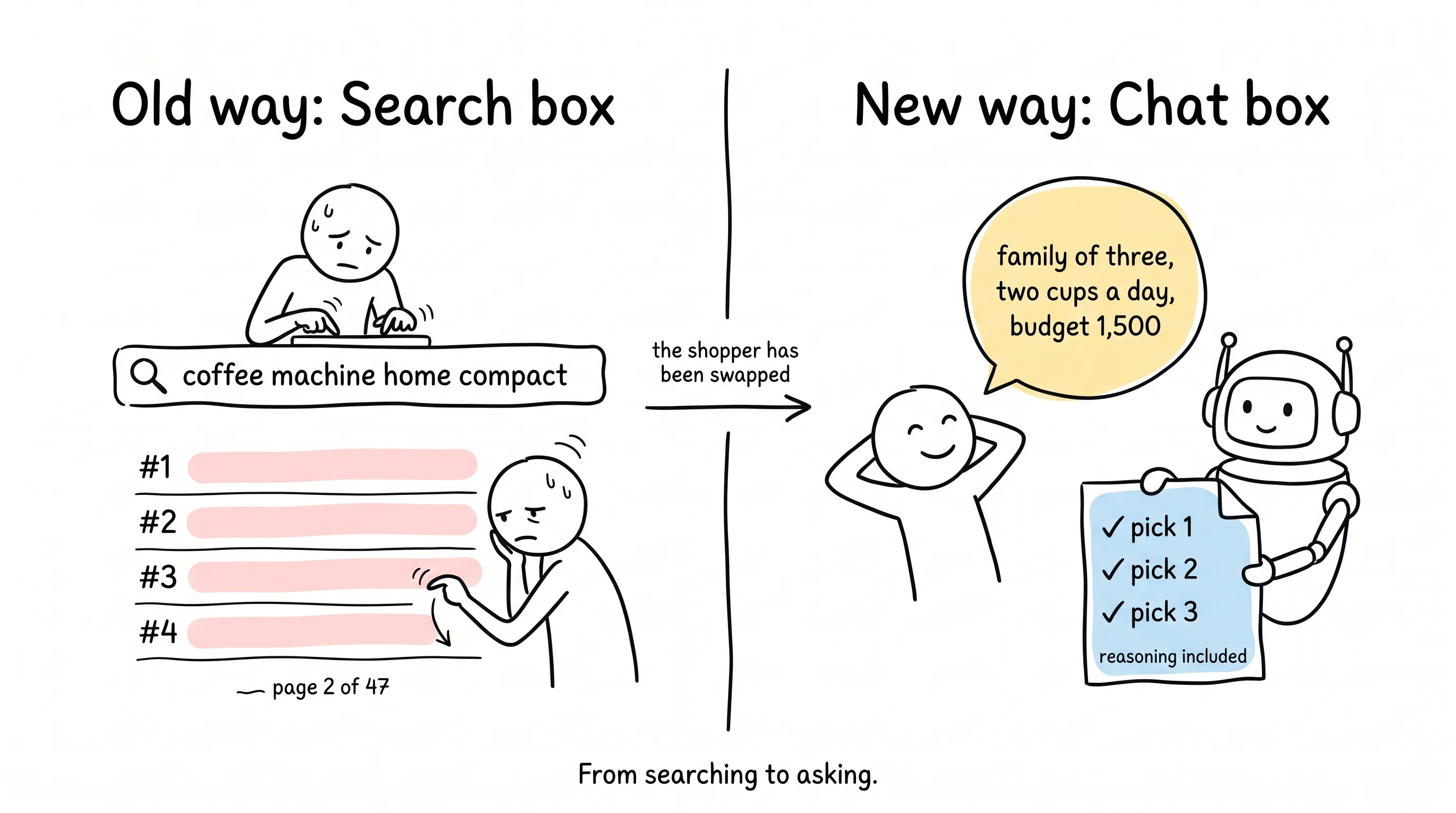
I immediately thought of my friends who sell online. What do they obsess over, day in and day out? Where to bury keywords, how to lay out the product page, where to trade backlinks. But today, the customer's first stop is moving from the search box to the chat box.
This one deserves a real conversation.
The store is still the store. The shopper has been swapped out.
So what is conversational search?
Simple: you stop "searching" and start "asking." The AI goes out and reads the open web, reads your product pages, reads what buyers said about you — then rolls it all into one answer and dishes it up, right in front of the customer.
The search optimization we all practiced breaks down into three things: keywords, page layout, backlinks. And all three, at the end of the day, were done for human eyes. Humans needed pages to flip through and clicks to land somewhere.
But the one now choosing products for the customer is an algorithm.
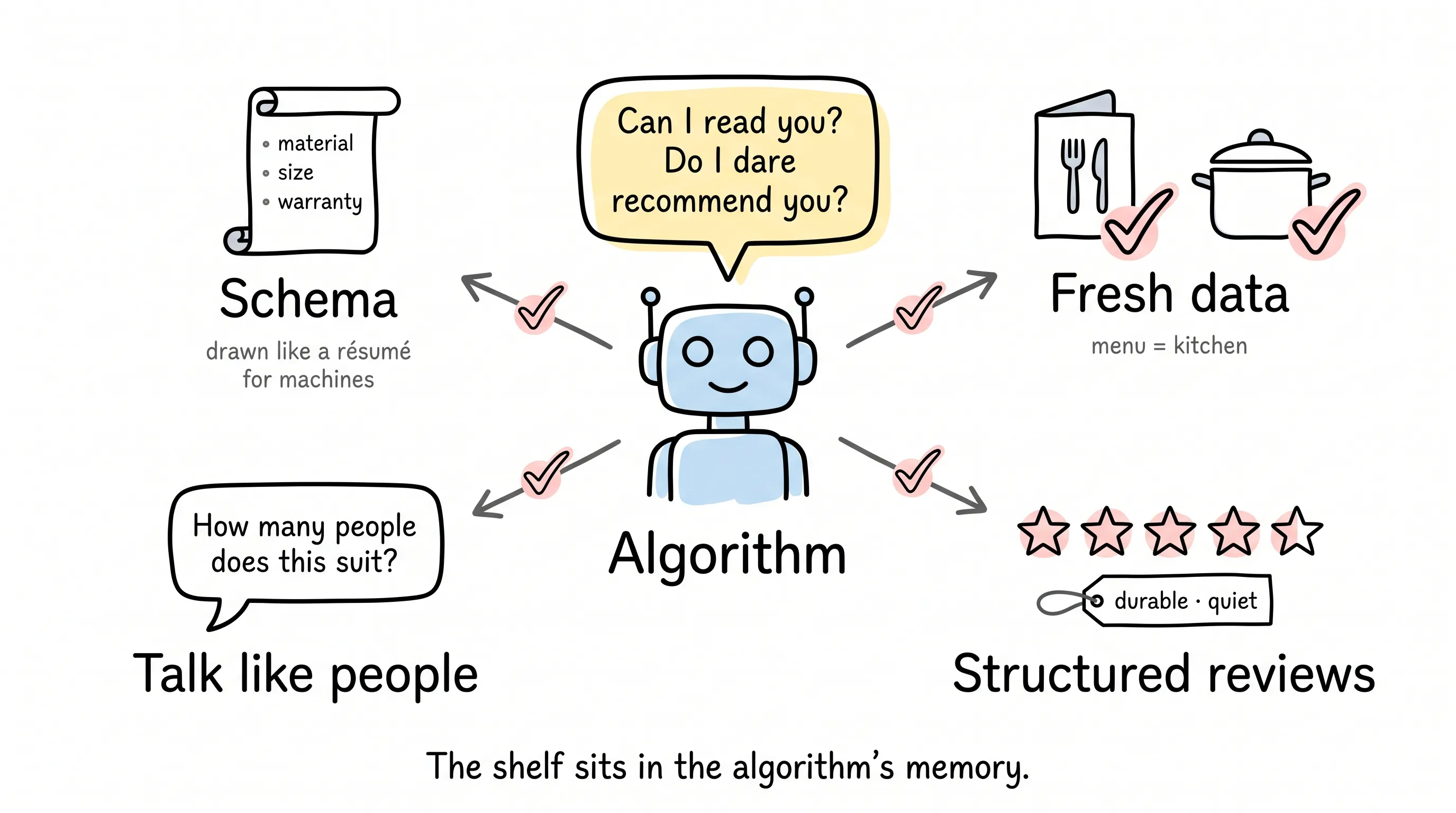
It doesn't care how pretty your page looks. It asks exactly one question: Can I read your product data? And once I've read it — do I dare recommend you?
In new retail, the shelf doesn't sit in a shopping district. It sits in the algorithm's memory.
So how do you make the algorithm understand you — and dare to recommend you? Four things.
First: write your product data as a résumé the machine can read
What does it mean to structure your product data?
Plainly put: keep the instruction sheet written for humans, and add a résumé written for machines.
The product page you have now — images, copy, mood — is written for shoppers. But the algorithm is strictly literal-minded. It only reads fields: what material, what size, how many years of warranty, where it's made.
Write all of that out clearly, embed it in the page in a format machines can parse (the industry calls it schema, structured markup), and the algorithm can verify on the spot: the customer wants machine-washable — this one, yes. A two-year warranty — this one, yes too.
Only when the answers match do you make the shortlist.
Customer questions are getting more specific, too. "Will a 1.8-meter-tall person find this heavy to carry?" "Will it go moldy in the humid rainy season down South?" No keyword buried in a title will catch questions like those. What catches them are the small, precise fields in your product data.
The finer you write it, the more questions you can catch.
Second: data must be fresh. Not even one day stale.
Let me walk you through the math.
Say the algorithm takes a liking to your product and recommends it. The customer excitedly places an order — and it turns out you sold out long ago. That sale just died.
Who does the customer blame? They have no idea the data was stale. All they remember is: this store can't be trusted.
The algorithm keeps score, too. Next time it considers recommending you, it has to weigh one thing: is this store's data accurate?
For many teams, product information gets refreshed only when a platform's crawler drops by every so often. Every so often means delay. Delay means the file the algorithm holds on you might be yesterday's — even last week's. It's running your business on last week's inventory.
The fix? Push stock levels, prices, and promo changes to these platforms in real time. It's like a restaurant where the front of house and the kitchen move together: the moment a dish sells out, it comes off the menu.
What the menu says is available, the kitchen actually has. That's the bottom line before a machine dares speak for you.
Third: write descriptions the way people talk, not like a billboard
The old keyword playbook was to cram something like "coffee machine home compact fully automatic" into the title.
To an AI, that reads as fake instantly. Because it reads language for context, not for keyword density.
What it wants to see is you answering, head-on, the questions customers actually ask: How many people does this suit? How loud is it? First-time buyer — is it a hassle to operate? How small a countertop does it fit on?
Write those answers into the product description in natural sentences, and the algorithm can match them against customer questions. When they match, you get recommended.
Think about it: a sales clerk who answers every question by repeating "fully automatic, compact, for home use" — would you buy from them?
Machines are no different. Except this one is asking on the customer's behalf.
Fourth: organize your reviews so machines can read them
When the algorithm decides whom to recommend, a major reference is what others say about you.
But customer reviews are, by nature, scattered prose. How many stars, what they bought, what's good about it — the machine has to guess its way through, paragraph by paragraph.
Your job is to give reviews structure too: star rating, whether it's a verified purchase, the review content — all in machine-readable form. Then, in a single crawl, the algorithm can summarize cleanly: this product, praise clusters around "durable" and "quiet," complaints cluster around "slow delivery."
That's what lets it slot you into comparison lists — and include you with confidence.
Your reputation shouldn't be buried in prose. It should be lying in structure.
At the end of the day, this is a move
Now that all four are on the table — notice anything? They all point at the same move:
Taking your online store from a place built for people to browse, and turning it into a data warehouse built for the algorithm to read.
The storefront is the face; the data is the foundation. The face can be renovated slowly. If the foundation is shaky, the whole thing sways at the first gust of wind.
So this is much bigger than picking up one more traffic tactic. It's swapping out the very ground your business stands on.
That day, I ended up buying the second coffee machine the AI recommended. I've been drinking from it ever since — it's been great.
Later, I thought of an old friend who sells online too. His products honestly aren't bad. But my guess is his name most likely wasn't on that list that day.
No other reason than this: his product data most likely reads as too much effort for a machine.
Here's wishing that, in the algorithm's eyes, every word of your product data is legible — and every claim is one it dares to recommend.
Continue reading
Related articles

Cross-Border Business: Time to Upgrade Your AI Toolbox
A learn article explaining how AI tools help cross-border e-commerce sellers clear five hurdles: language, regulation, logistics, payments, and fraud. It outlines a five-compartment toolbox, a five-step adoption path, and metrics such as conversion rate and CLV, while cautioning against over-reliance on AI.

AI Is Taking Over the Dirty Work of Social Media Marketing, One Task at a Time
This learn article outlines four social media marketing tasks AI can handle — audience analytics, content drafting and design, ad targeting and creative testing, and spam moderation — and cautions that taste, judgment, and data security remain human responsibilities.

AI Is Already This Good — Why Is Your Social Media Marketing Still Pure Manpower?
An overview of 18 AI tools for social media marketing, organized into six categories covering audience research, content creation, scheduling, comment and DM handling, ad management, and visual production, plus notes on personalization, prediction, and emerging trends.