
AI Is Moving Four Mountains for Cross-Border E-Commerce
A learn article describing how AI is applied across four friction points in cross-border e-commerce: language localization, logistics, compliance and fraud, and customer trust, with adoption guidance on readiness checks, tool selection, and keeping humans in the loop.
A while back, I had dinner with a friend who runs a cross-border e-commerce business.
He sells home goods to Europe, the US, and Southeast Asia — no small operation. But the moment we sat down, the complaints started pouring out: paid traffic keeps getting more expensive, returns keep piling up, customs clearance times swing wildly from one shipment to the next. He had hired a whole team of customer service reps for less-common languages, and the negative reviews kept coming anyway.
I told him: you might be fighting the wrong competitor.
You think you're competing with rivals for traffic. Actually, you're fighting "distance."
Selling one product to someone on the other side of the planet — a person who has never seen you — means four mountains stand in between: the mountain of language, the mountain of logistics, the mountain of rules, and the mountain of trust.
How well your cross-border business does comes down, in essence, to how fast you can move those four mountains.
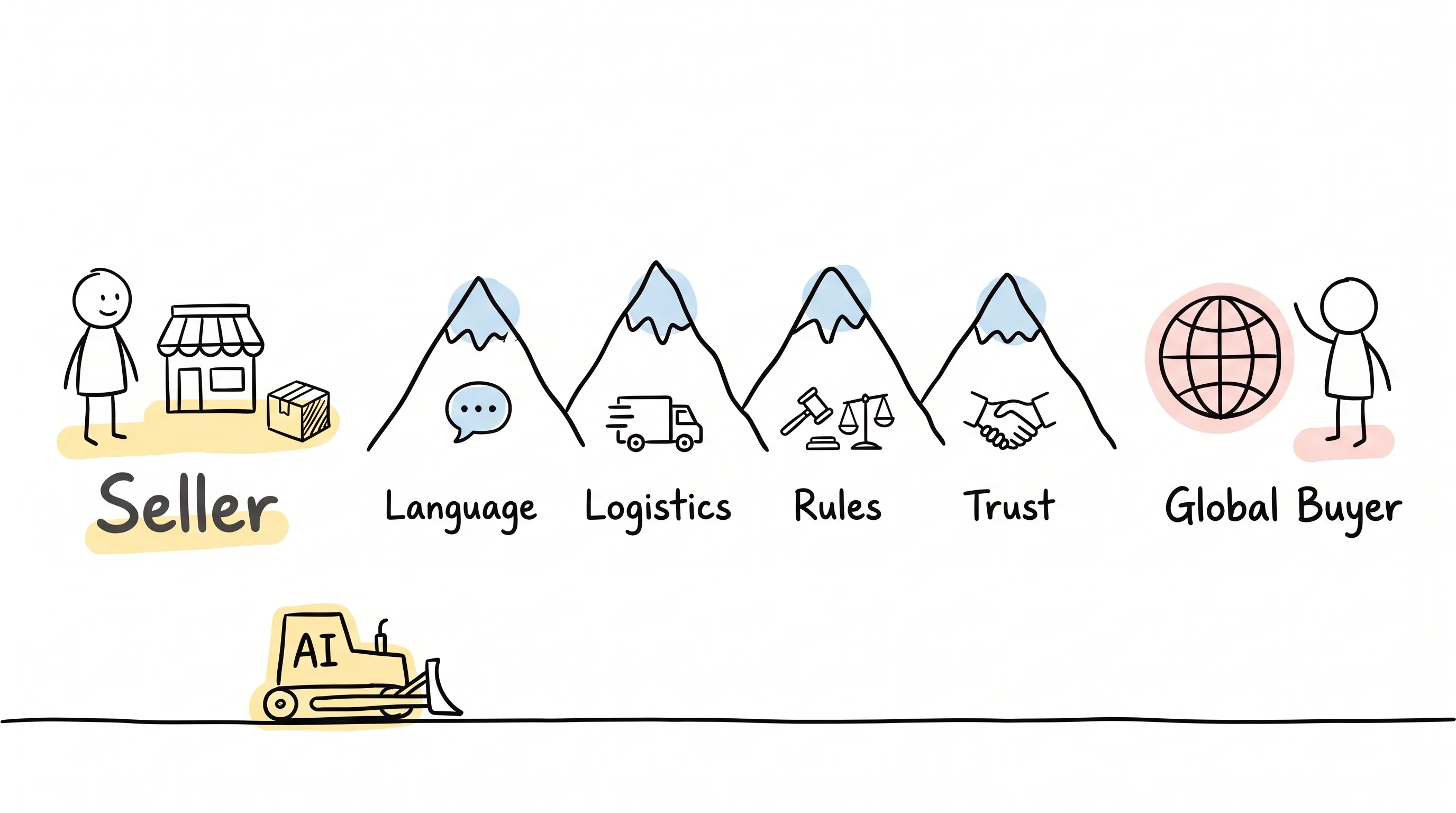
Moving mountains used to mean piling up people, money, and time.
Now there's something else: AI.
And it's moving those mountains for sellers, one at a time.
Let's take them one at a time.
Mountain One: Language. Translation Is Just the Entry Ticket
You'd think translation software solved the language problem ages ago, right?
Quite the opposite.
My friend told me about one example. The copy for one of their products was machine-translated into German, and one of the words meant something entirely different in local slang. The day the ads went live, consumers were screenshotting and mocking them.
Every word was right. The meaning was all wrong.
Translation solves for "readable." Localization is what solves for "ready to buy."
Images should be local. Colors should match local aesthetics. Promotions should follow the local holiday calendar. There's a word for this: glocalization — a global brand with a local soul.
So what can AI do here?
Today's multilingual AI customer service has long moved past just getting sentences right. It recognizes cultural differences: the same greeting can be direct and to-the-point in the US, while in Japan it needs to circle around first; the same joke lands as funny in one country and offensive in another.
Run the numbers. Sellers who use AI for localization and multilingual service typically see conversion rates rise 15% to 30%, cart abandonment drop 17%, and customer satisfaction climb above 85%. Non-English markets they couldn't serve at all before are now real, tangible incremental revenue.
Honestly — that's like picking up an entire market for free.
Mountain Two: Logistics. The Profit Shredder
For many sellers, cross-border logistics is a profit shredder.
Freight is expensive. Delivery is slow. Customs clearance is like opening a mystery box. International returns are a disaster of their own: sending goods back can cost more than the goods are worth.
What AI does in logistics is unglamorous, but it works.
Route optimization watches traffic and weather, working out which route saves the most fuel and time today.
Predictive maintenance flags anomalies in vehicle sensor data the moment they appear, so you fix the truck before it conks out halfway there.
Inventory forecasting calculates what to sell, how much to sell, and how much stock to hold, based on sales trends and big data — never too much, never too little. Stockouts and overstock both burn money; it saves you on both ends.
Put all that together — how big is the payoff?
I've seen one set of data: logistics companies using AI can cut operating costs by up to half. And one forecast goes even bolder: by 2035, productivity across the logistics industry could rise 40% because of it.
Now that's firepower.
Mountain Three: Rules. One Misstep and You're Fined
What is the mountain of rules?
Every country runs its own import-export game, each with its own rulebook: how tariffs are calculated, how data is protected, how consumer rights are safeguarded. Miss one step and, at best, your goods get held; at worst, you face fines and lawsuits.
Then there's fraud. Cross-border transactions happen across screens, time zones, and legal jurisdictions. It's exactly the environment fraudsters love.
On both fronts, AI works like a tireless co-pilot.
On compliance, it fills out customs declarations automatically and calculates taxes in real time, taking over the most error-prone, most tedious steps.
On fraud, it learns from massive volumes of transaction data, and before long it can recognize a suspicious order within milliseconds. Merchants using AI fraud detection see fraud losses fall by an average of 25%.
Even better is another number: the false positive rate is down 50%.
What does that mean? Risk controls used to be so strict that legitimate customers kept getting flagged by mistake. Orders were blocked, customers stood there bewildered, and turned around and left. Now, the bad actors get stopped and the good ones get through.
Mountain Four: Trust. Invisible, But the Most Expensive
The first three mountains are tangible. The fourth can't be seen or touched — and it costs the most.
Trust.
When a foreign buyer places an order in your store, they're placing a bet: will what shows up look nothing like the photos? Will the package sink without a trace? If something goes wrong, who do they even turn to?
Think about it — when you shop online, don't you also pick your stores, check ratings, and steer clear of shops piled with negative reviews? In cross-border shopping, that sense of uncertainty is magnified tenfold. Taxes and shipping fees that suddenly pop up at checkout have scared off a full 60% of shopping carts.
What AI can do is make every single interaction live up to that trust.
Chatbots speak the buyer's native language, stay online 24/7, and can shoulder about 70% of common inquiries. Personalized recommendations know what they like, when they browse, and what price they'll accept. Dynamic pricing watches competitors and market conditions, offering a fair price at any moment.
Sellers using these tools have boosted sales by as much as 67%.
But there's a trap here I have to warn you about: don't overdo it.
You looked at one product yesterday; today it fills your whole screen, and even the ad you scroll past at midnight seems to know exactly who you are. That sense of being watched makes users' skin crawl, and they turn and walk.
The endpoint of personalization is trust, not intrusion.
Here's the Sharper Part: AI Doesn't Just Move Mountains — It Reads the Road Ahead
Everything above is about solving problems that have already happened.
Where AI is truly formidable is looking ahead.
What is demand forecasting?
It's AI crunching sales data, social media buzz, local news, even weather changes to work out ahead of time: which market is about to take off next month, which category is about to run dry, which demand is cooling off.
This decides two things.
The first is inventory. Stock too much and your cash is tied up; stock too little and you lose customers. Get the forecast right and cash flow keeps moving.
The other is direction. The current landscape is fascinating: e-commerce growth in mature Western markets is slowing, and everyone has started competing on retention and cost; emerging markets are racing ahead — mobile-first, fragmented channels, opportunity everywhere — but the playbook is completely different.
Whoever spots the turning point in the data gets in first. By the time you can see it, it's no longer an opportunity — it's a red ocean.
Three Stories
Let me share three examples that left a deep impression on me.
The first: a cosmetics brand entering the EU. In the past, listing a product meant going through compliance review, then translating product information — easily weeks at a time. After AI took over, new products could go live within days. In the beauty industry, a few days' head start is money in the bank.
The second: Xiaohongshu (RED). They launched a "Global E-commerce Pioneer Program," using AI translation to sharply lower the barrier to cross-border selling, and their international e-commerce user base saw a huge wave of growth. The platform lowers barriers, merchants cut costs, buyers get more choices — all three sides benefit.
The third happened at Alibaba.com's CoCreate event. SMB owners on stage shared how it used to be: finding overseas suppliers and vetting them relied entirely on experience and connections; now, AI lays supplier screening, risk analysis, and real-time market data out in front of you. Small companies have intelligence muscle that, for the first time, rivals the big corporations'.
Three stories, different protagonists, but only one thing in common: AI has moved mountains that in the past only the giants could budge, and brought them within reach of smaller players.
The data speaks too. Early-adopting merchants have seen lead generation rise by up to 50%, conversion rates run 47% higher, revenue growth generally land at 13% to 15%, and sales ROI improve by 10% to 20%. Nearly two-thirds of decision-makers saw positive returns within a year.
Staggering.
Ready to Start? Look in the Mirror First, Then Pick Your Tools
If you've read this far, you might be running hot, ready to blanket your entire workflow with AI by tomorrow.
Hold on.
First thing: look in the mirror. Ask yourself four questions: Do my cross-border goals match AI's capabilities? Are my data and systems rich enough for AI to feed on? Can my team actually use it? And the boss and key people — do they genuinely support this, or are they just watching the show?
If you can't answer two of the four questions, do your homework first. However good the tools, without a stable foundation it's all wasted effort.
Second thing: pick your tools. Don't just look at the feature list — run through these questions: How much return will it bring? Does it connect with my existing platforms? Can my data actually feed it? How much work will integration take? How fast will results show? What's the total cost (not the sticker price — the whole lifecycle bill)? Is the data secure?
Third thing: start small and move fast. Pick one or two of your most painful scenarios first — customer service, say, or inventory — test them with real data, set clear metrics, and work out your first ROI. If it's worth it, double down; if not, switch. You'll usually know where you stand within a few months, and most teams finish their first round of validation within a year, then roll it out to more processes and more markets.
Finally — and most important: keep humans in the loop.
On critical decisions, AI gives the advice, humans make the call. However fast it computes, someone still has to answer for the results.
Back to That Dinner
Toward the end of that meal, I asked him: so do you think cross-border is still worth doing?
He thought for a moment and said: yes, it's doable. But you have to change how you play. It used to be a contest of who could endure longer; now it's a contest of who uses AI first to drive friction costs down.
Exactly.
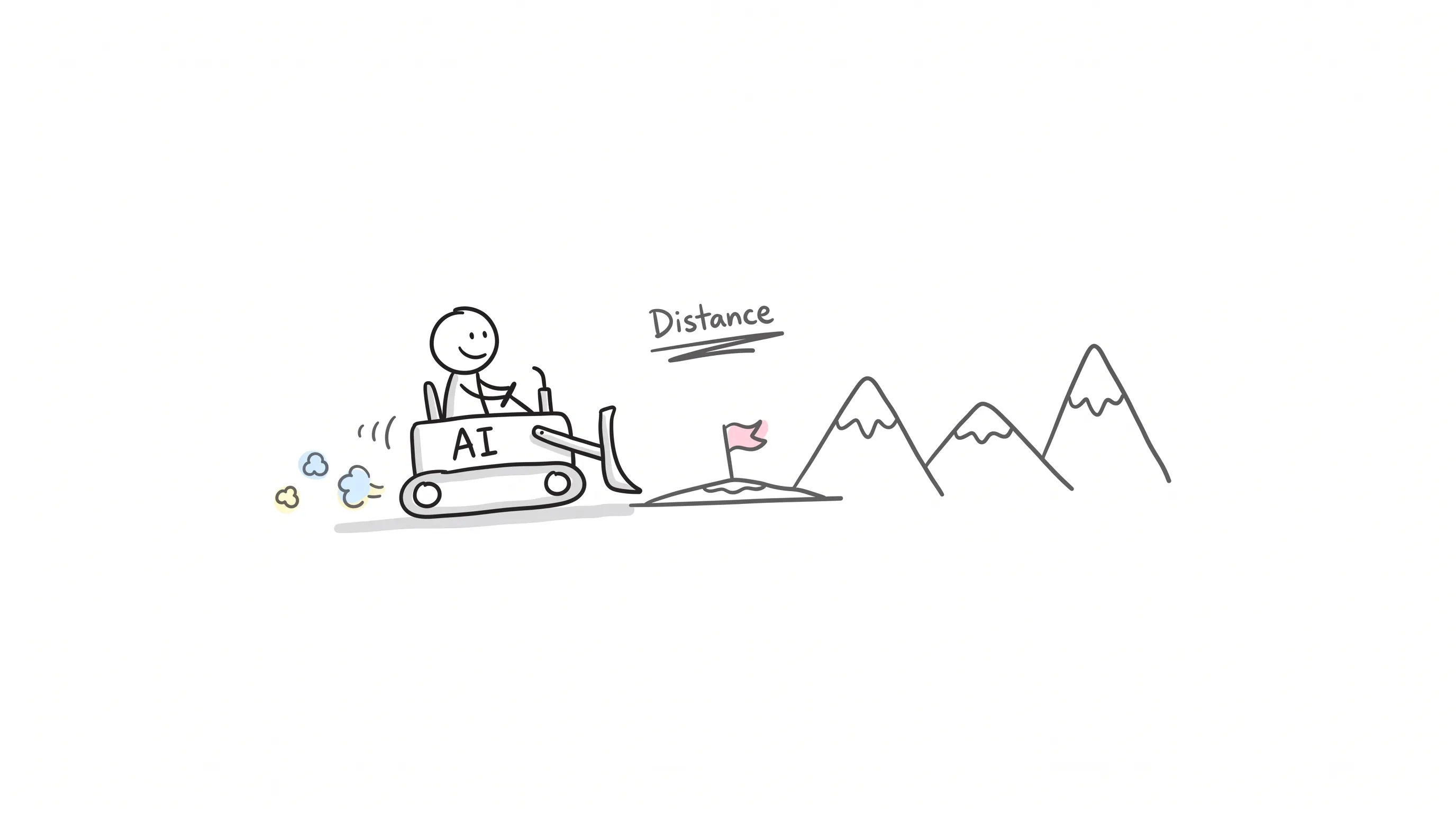
AI can't erase distance, but it can take apart the friction that distance creates, piece by piece.
The mountains are still the same four mountains. The difference is that today, you have a bulldozer in your hands.
Here's wishing your cross-border business flattens those mountains soon — and your goods flow to every corner of the globe.
Continue reading
Related articles

Cross-Border Business: Time to Upgrade Your AI Toolbox
A learn article explaining how AI tools help cross-border e-commerce sellers clear five hurdles: language, regulation, logistics, payments, and fraud. It outlines a five-compartment toolbox, a five-step adoption path, and metrics such as conversion rate and CLV, while cautioning against over-reliance on AI.

AI Is Taking Over the Dirty Work of Social Media Marketing, One Task at a Time
This learn article outlines four social media marketing tasks AI can handle — audience analytics, content drafting and design, ad targeting and creative testing, and spam moderation — and cautions that taste, judgment, and data security remain human responsibilities.

AI Is Already This Good — Why Is Your Social Media Marketing Still Pure Manpower?
An overview of 18 AI tools for social media marketing, organized into six categories covering audience research, content creation, scheduling, comment and DM handling, ad management, and visual production, plus notes on personalization, prediction, and emerging trends.