
AI Is Making Decisions for Your Customers. But Does It Know You?
A learn article on GEO (Generative Engine Optimization): how AI answer engines pick and cite sources, and nine practical moves — crawler access, SEO foundations, consistent brand descriptions, quotable content, experiments, and PR — plus ongoing tracking with AI search analytics tools.
A few days ago, a friend who runs a B2B software business invited me out for tea.
He said his website's Google rankings had been rock solid, but over the past six months, inbound inquiries had quietly shrunk.
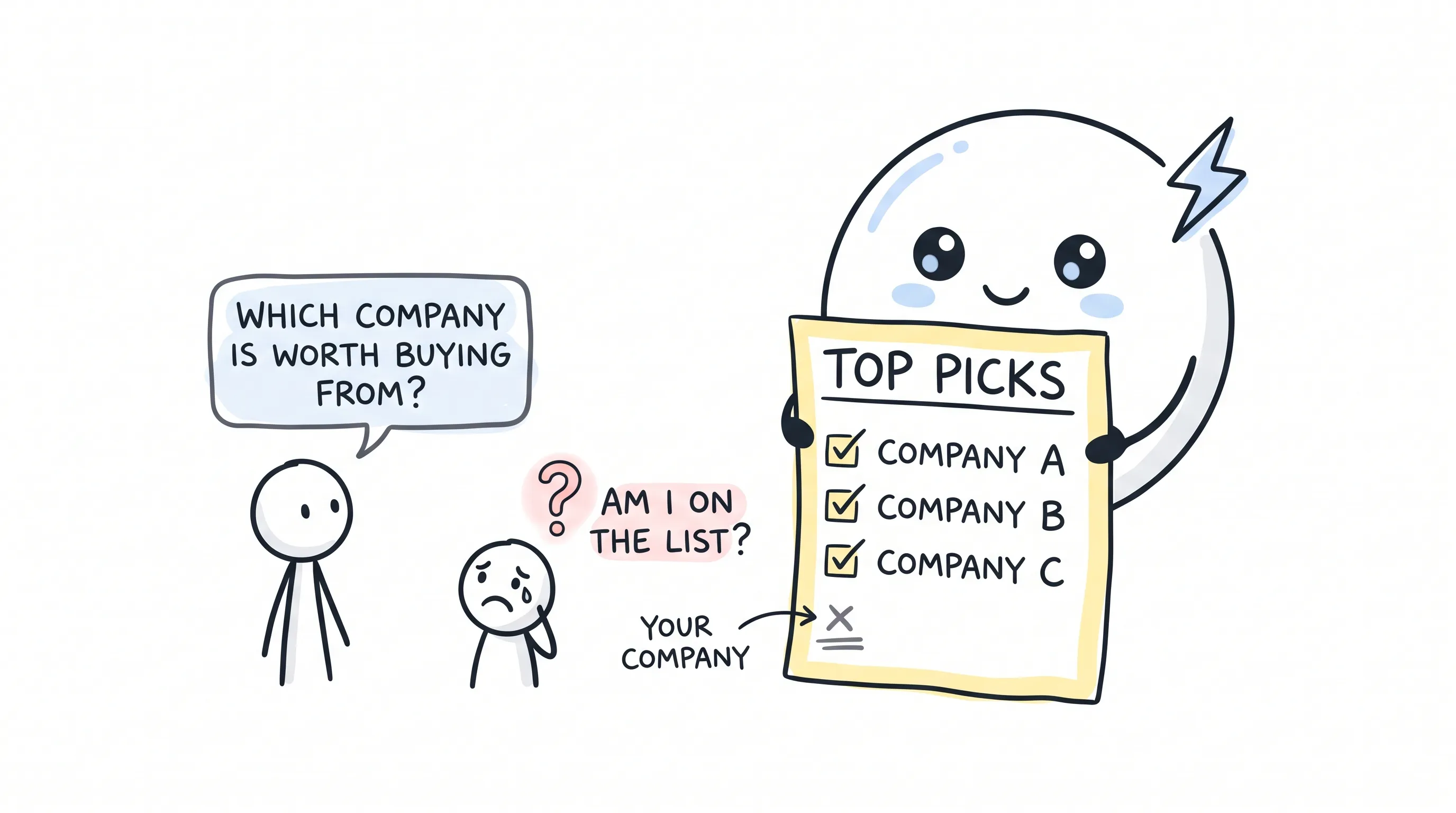
I asked him: have you ever tried asking ChatGPT, "In this category, which company is worth buying from?"
He froze, pulled out his phone, and tried it on the spot.
The AI gave him a list. He wasn't on it.
I still remember the look on his face. His business wasn't failing — he simply had no idea that an exam had started long ago, and he hadn't even found the exam room.
This exam has a name: GEO — Generative Engine Optimization.
Today, let me walk you through exactly how this exam works and how to score well on it.
1. AI Is a Star Student Who Has Never Left Home
Start with a question: what makes an AI answer engine recommend one company and not another?
Think about it. However smart a large model may be, there is one thing it can't do: first-hand experience.
It has never used your product, never toured your factory, never been moved by your after-sales service. It's a brilliant student who has never left home — full of book knowledge, but no first-hand experience.
And first-hand experience is exactly what users want most.
So when a large model has to answer "which one is reliable?", it has to go out and find answers written by people with real experience — and cite them.
That's the opportunity: Whatever AI lacks, you supply.
So where do you start? First, we need a clear view of the battlefield.
2. Two Paths: One You Can't Touch, One You Sprint Down
There are two paths to influencing AI's answers.
The first path is influencing model training. The trouble? Once a model is trained, it's frozen. Like a graduation photo — once taken, you can't print a second version. If you want to squeeze in, you wait for the next enrollment.
This path also hides a risk. Imagine: this year you buy a smart fridge, and its brain runs a model trained last year. If that training was fed some preference — say, a bias toward a particular cola brand — that preference will shape what you buy, every single day, for years.
For most companies, this path is simply out of reach.
The second path is where ordinary companies fight.
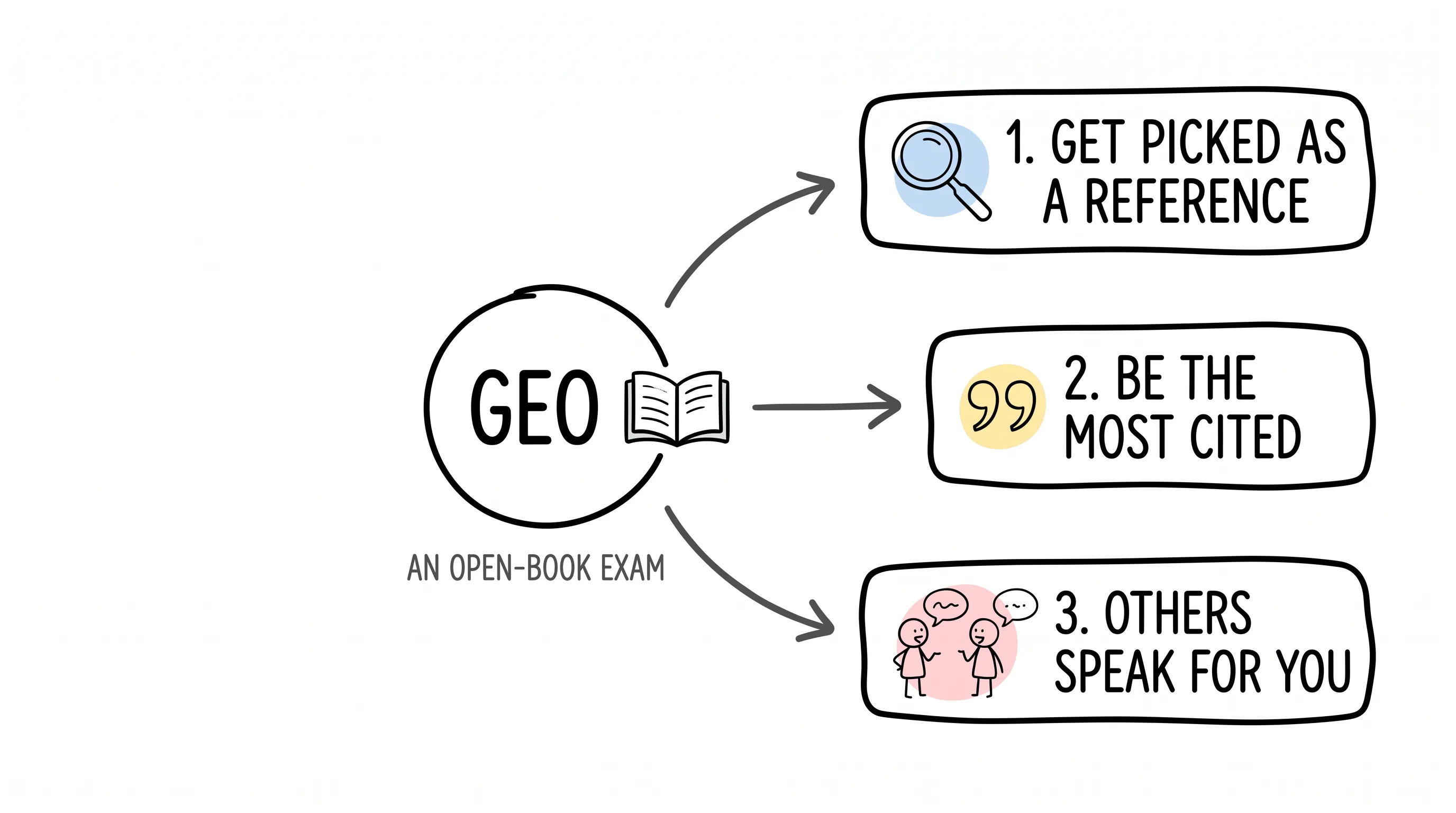
What is retrieval-augmented generation? In plain terms: an open-book exam.
When a large model hits a question it can't answer confidently, it doesn't make things up. It goes online first, looks up the material, then answers. Every AI search you've seen, every web-connected ChatGPT answer — they all work this way.
An open-book exam means the reference materials can be influenced.
GEO comes down to three things: first, when AI looks things up, it picks your content as a reference; second, among the selected materials, you're the most cited; third, the other selected materials speak for you too.
So where do you start? I'll break it into nine moves.
3. Nine Moves to Turn AI Into Your Referrer
Move 1: Let AI reach your front door.
Crawlers from OpenAI, Anthropic, and other companies must be able to enter your website. Many sites run anti-bot and anti-attack policies that treat these crawlers as intruders and block them at the gate. Go have your IT colleagues check right away — especially if you're on a CDN like Cloudflare or Fastly, where a default setting may be blocking them by mistake. Also, most LLM crawlers don't execute JavaScript. If you hide your core content in JS, it's like stocking the warehouse full while keeping the shop door locked.
Move 2: Don't abandon the old craft.
Traditional SEO isn't obsolete — it's the foundation of GEO. Google rankings feed Gemini and AI Overviews; Bing feeds ChatGPT and Copilot; Brave connects to Claude; Baidu connects to DeepSeek. The better you rank on these search engines, the more likely AI picks you up.
Move 3: Ride the fan-out.
What is query fan-out? When you ask the AI a question, it doesn't search just once. It splits out a whole string of search queries on its own and searches everywhere.
Here's an example. Someone asks "what Google patent is the SEO world discussing lately?" The AI may fire off two or three variant searches at once, tacking on "forum" and the current year. One earlier observation: ask what people are discussing, it loves adding "forum"; ask about a specific person, it loves adding "interview."
These derived search queries are the fan-out. Watch them, and go rank for them one by one.
A word of caution: fan-out patterns differ from model to model, and they change. What works this year may stop working next year.
Move 4: One story everywhere.
However you describe yourself on X, that's how you must describe yourself on LinkedIn, on GitHub, on your own site. Don't be a "GEO consultant for SMBs" in one place and an "AI search optimization expert" in another. Mixed signals confuse the AI.
Here's the interesting part: this works fast. Someone simply changed their self-description across the web into one consistent phrasing — and within days, how ChatGPT and AI Overviews presented them changed.
Move 5: Get familiar in communities AI trusts.
Large models rely heavily on UGC platforms like Reddit and Wikipedia. Why? These are vetted layer by layer by their communities; spam and filler have long been filtered out, so their average credibility far exceeds the open web. Same for Quora and Stack Overflow.
I'm not telling you to spam posts — that's a death wish. But if you get a chance to influence how your brand is discussed on these platforms, take it.
Move 6: Write sentences AI wants to quote.
Nobody has scored full marks on this yet, but a few practices are already proven.
Write declarative, factual statements, not vague ones. Don't write "our shoes are praised by customers." Write "96% of buyers report being satisfied."
Add Schema markup. Fabrice Canel, Bing's product lead, confirmed firsthand that Schema helps large models understand your content.
Want to squeeze into an existing AI summary? Look at how long the current summary for that keyword is, and write something of similar length. Don't copy it — be similar to it.
Pair jargon with a plain-language explanation. Put a summary before long paragraphs. Turn content into lists and tables. The easier a sentence is to lift whole, the more likely it gets cited.
Move 7: When in doubt, run experiments.
Academia has studied this question, and the findings are fascinating. Adding unique terms, presenting both sides, collecting user reviews, citing experts, giving data with sources, writing simply, keeping a positive tone, using more lists — all of these help. But only for certain topics and certain models. Change the combination, and the same tactic can backfire.
Until widely accepted best practices emerge, I have only two pieces of advice: do things that benefit users, and then run lots of experiments.
Move 8: Don't invent facts.
For over a decade, algorithms have been breaking text into triples — subject, predicate, object — and feeding them into knowledge graphs. One sentence that conflicts with established facts tells the AI you're not trustworthy.
The ideal state: stand with the consensus, then add the unique facts nobody else has.
Move 9: Invest in data-driven PR.
Everything above holds not only for your own website, but for content across the entire web. The more the media covers you, and the more positively, the more likely the AI retells those stories to users. I've even seen paid placements get cited by AI as sources.
4. Turn the Occasional Into the Routine
Nine moves — if you track them by hand, you can't keep up. This needs to be tool-driven.
Take an AI search analytics tool like Peec AI as an example. In daily operations, watch three things.
First, find the hidden competitors. What happens in traditional SEO happens here too: in the auto-identified competitor list, there are always a few names that surprise you. Go investigate: in which questions are they mentioned, and through what sources did they get in?
Find that they owe their spot to a profile page on a review platform, where you have zero reviews? Ask your customers to write reviews, quickly. Find that their CEO appeared on an interview show? Go on one too, or just shoot your own video on the same keywords. Find that they're always top five on a ranking list you can't get into? Talk to the publisher about a revenue-share deal. Next content update, you'll likely be the new number one.
Second, decode the sources. Pull out a large batch of questions relevant to you, ignore your own website first, and see who the AI keeps citing.
A community like Reddit? Go into the community and discuss. X? Move fast — volume on X directly influences Grok. Influencer territory like YouTube and TikTok? Hire influencers, and remember to tell them to aim at the right keywords. Affiliate ranking sites? Raise the commission. News media? Knock with PR — and when necessary, go straight to their branded content team.
Third, backfill the fan-out. Take the derived search queries you've observed, turn each one into content, publish on your own site, publish on Medium and LinkedIn, publish press releases. As long as it can rank in search engines, the AI has a chance to cite it.
5. Finally, Let's Do the Math
Is GEO worth it? Two numbers for you.
There's a company called Peec AI that specializes in AI search analytics. The LLM traffic they see across their customers roughly doubles every two to three months. And that traffic converts at up to twenty times the rate of traditional SEO traffic.
Twenty times. Sit with that.
For people in the traffic business, this is almost a newly dug canal — and right now, there are barely any boats on it.
Remember the friend from the tea scene at the beginning? After he went back, he did what he could do himself first: unified the story across the web, added Schema, moved the core content out of JavaScript. A month later he told me ChatGPT had started recommending them.
He said something I still remember to this day: "Before, we studied how to let customers find us. Now we study how to let AI find customers for us."
The AI your users will trust tomorrow is reading what you write today.
What it reads decides who it recommends tomorrow.
May you soon become the name on AI's list.
Continue reading
Related articles

Cross-Border Business: Time to Upgrade Your AI Toolbox
A learn article explaining how AI tools help cross-border e-commerce sellers clear five hurdles: language, regulation, logistics, payments, and fraud. It outlines a five-compartment toolbox, a five-step adoption path, and metrics such as conversion rate and CLV, while cautioning against over-reliance on AI.

AI Is Taking Over the Dirty Work of Social Media Marketing, One Task at a Time
This learn article outlines four social media marketing tasks AI can handle — audience analytics, content drafting and design, ad targeting and creative testing, and spam moderation — and cautions that taste, judgment, and data security remain human responsibilities.

AI Is Already This Good — Why Is Your Social Media Marketing Still Pure Manpower?
An overview of 18 AI tools for social media marketing, organized into six categories covering audience research, content creation, scheduling, comment and DM handling, ad management, and visual production, plus notes on personalization, prediction, and emerging trends.