
AI Is Buying Ads for You: Closer Than You Think, and Messier Too
Analysis of an IAB Europe survey on AI agents buying ads: most surveyed European ad executives expect agent-driven buying to go live within a year, with adoption gaps by company size, early buyer- and sell-side agent pilots, and safety, privacy, and standards concerns.
Recently, I came across a survey by IAB Europe.
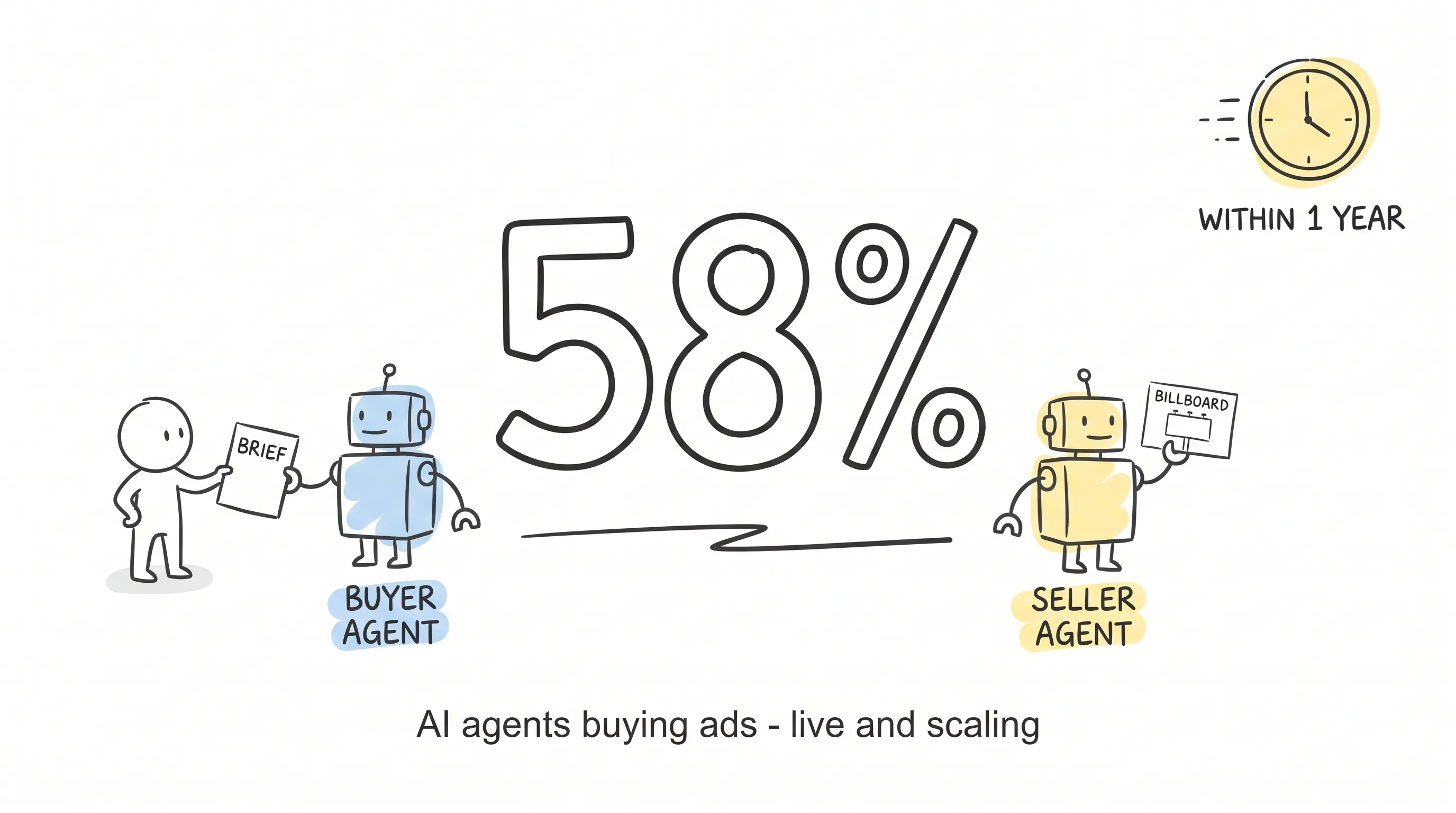
Earlier this year, in spring and summer, they asked 50 European advertising executives across 44 markets one core question: when will AI agents actually start buying ads on our behalf?
58% answered: within a year, it will be in live operation — even scaling.
Seeing that number took me back to how people talked about "programmatic buying" a few years ago. Back then, plenty of folks said they didn't believe it either. And then? Belief didn't matter — whether the numbers added up did.
First, let's be clear about what agents buying ads actually means.
Put simply, it's the difference between browsing an e-commerce site yourself — comparing prices, placing the order, chasing after-sales — and hiring a procurement officer who never sleeps to watch prices, negotiate terms, place orders, and run the post-mortems for you.
Buying ads used to mean humans in meetings and humans adjusting bids in spreadsheets. With agents buying ads, it's machines negotiating with machines. The buyer sends an agent, the seller sends an agent, and the two of them talk it out.
That's what's called agent-to-agent trading.
Everyone says the same words, but they're not talking about the same thing.
"Scale within a year" sounds tidy, but there's more beneath the surface.
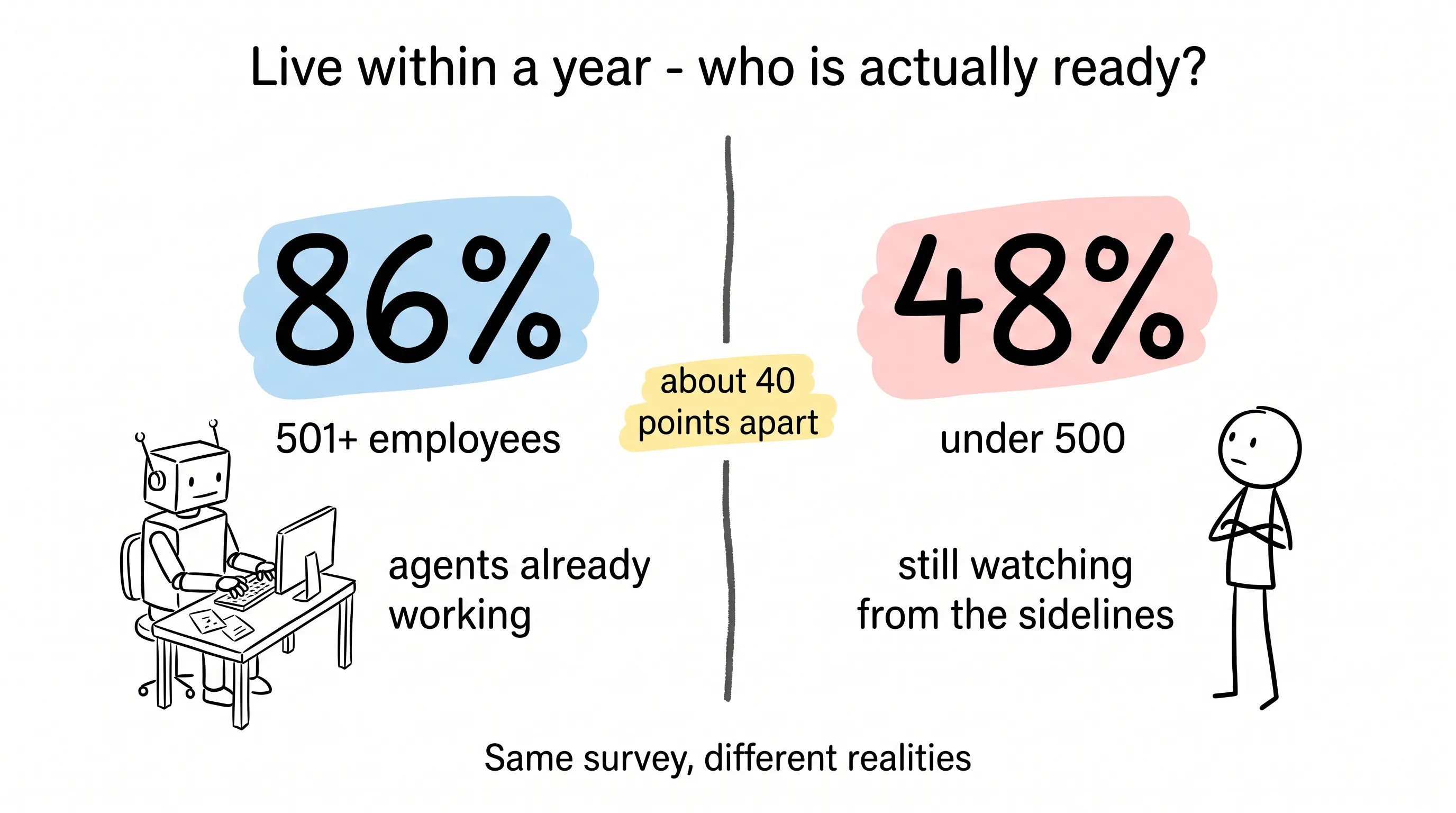
Among companies with 501 or more employees, 86% have already put agents to work planning, dividing tasks, and executing alongside humans. Among companies under 500? Less than half — 48%.
Think about it: on one side, already up and running; on the other, still watching from the sidelines. Nearly 40 percentage points between them. When people in those two camps say "live within a year," can that mean the same thing?
Their forecasts are split too. Three in ten believe AI agents will become the mainstream way of buying and selling ads in some markets; just over a quarter believe agents will be used routinely, but never get to that level.
Still, whichever tier you stand in, the direction is clear: this reaches every company eventually — just earlier for some than others.
By the way, of these 50 surveyed companies, 47 are already using AI internally, and 43 use it specifically in marketing.
The big players are already moving.
WPP is testing its own buyer agent. So is Omnicom. On the sell side, CNN and News U.K. are building sell-side agents to take orders coming in from machines. And on the advertiser side — Georgia-Pacific, for instance — hasn't said it won't, but wants proof the industry is ready before spending.
Buyers, sellers, intermediaries — all crowding in the same direction.
But here's where it gets interesting.
What these people worry about is not at all "whether to use AI."
Of the 47 companies using AI, 36 said: we either have no agent systems running day to day, or our systems still have humans in the driver's seat, with people steering and doing much of the work.
Why? Standards haven't caught up, processes are a shambles, and handing that much authority to a machine makes everyone uneasy. The survey's number-one concern is safety; number two is privacy.
You'd trial an intern for three months before handing over the keys to the company budget. Would you hand it to an agent when no industry standard even exists?
So look at what agents are actually doing inside ad companies right now: the least "risky" jobs. Of 29 surveyed companies, 22 list reporting, analysis, and dashboards as their most common AI workflow; next comes programmatic optimization at 59%.
These jobs share one trait: judged on output only, no accountability.
How they measure AI echoes this. 68% of respondents rate how well AI performs by "efficiency."
But money will change all of it.
The savings from efficiency get reinvested, training agents to be faster, better, cheaper. Once that flywheel starts spinning, it doesn't stop. In fact they're already doing it: 2026 AI spending is higher than 2025's, and 59% of companies say explicitly they will increase investment in AI marketing technology.
Omnicom's CFO Phil Angelastro said something at Goldman Sachs's Communacopia conference earlier this month that stuck with me. In essence: advertisers will spend more willingly, because AI keeps making marketing effectiveness easier to measure — we can prove to clients the return on investment we deliver.
In plain English: the ad budget used to be a number nobody could account for; agents can account for it. Once the books balance, the money comes in.
That logic sounds like a tidy closed loop, doesn't it?
But someone always pours cold water on it.
Converge Digital's CEO Ian Maxwell is the one pouring. His question cuts deep: what value does agents buying ads actually create? One small stretch of a giant process gets automated, and humans still have to babysit it. If you train it on past campaign data, all it learns is to repeat the past — the results won't meaningfully improve.
And he twisted the knife: suppose an ad goes from build to launch in seconds — but the creative arrives four days late. Compared with today, what exactly is different?
Good question.
My take: agents are gnawing at the softest spots along the whole chain. Launch, reporting, optimization — clear rules, quantifiable outcomes, a good fit for machines. The real bottlenecks are in creativity, in decisions, in the messy, hard-to-specify collaboration between people.
Those places, agents can't chew through yet.
Back to the survey we started with.
58% — I believe half of it. On the big-company side, it will genuinely be running within a year. On the small-company side, wait and see how the show plays out.
That doesn't matter.
What matters is the math: as soon as AI saves the first dollar anywhere in the chain, money will roll toward that spot on its own. And one day, it won't be you deciding whether to use agents — it'll be the company next door using them first, and you having no choice but to follow.
Technology adoption never happens by persuasion. It happens by force.
Here's wishing you're never the one forced onto the bus.
Continue reading
Related articles

Cross-Border Business: Time to Upgrade Your AI Toolbox
A learn article explaining how AI tools help cross-border e-commerce sellers clear five hurdles: language, regulation, logistics, payments, and fraud. It outlines a five-compartment toolbox, a five-step adoption path, and metrics such as conversion rate and CLV, while cautioning against over-reliance on AI.

AI Is Taking Over the Dirty Work of Social Media Marketing, One Task at a Time
This learn article outlines four social media marketing tasks AI can handle — audience analytics, content drafting and design, ad targeting and creative testing, and spam moderation — and cautions that taste, judgment, and data security remain human responsibilities.

AI Is Already This Good — Why Is Your Social Media Marketing Still Pure Manpower?
An overview of 18 AI tools for social media marketing, organized into six categories covering audience research, content creation, scheduling, comment and DM handling, ad management, and visual production, plus notes on personalization, prediction, and emerging trends.