
AI Is Already Running Your Ads — While You're Still Waiting for Next Week's Report
A learn article explaining how AI is rebuilding ad campaigns — generative creative, predictive analytics, and AI agents — with data, pitfalls like bias and AI washing, and the case for human oversight.
A few days ago, I had dinner with an old friend who works in media buying.
He used to get to the office every Monday morning, and the first thing he'd do was pull last week's reports, then adjust budgets by hand — that alone would eat up a whole morning. Now? He still pulls the reports, but mostly just to glance at them.
"Why just a glance?"
"Because in the middle of the night, the system finishes the adjustments all by itself."
Wow. In that moment, I realized: marketing is being rebuilt from the ground up by AI.
So today, let's really dig into it: how exactly is AI changing ad campaigns? And if you're a marketer inside this wave, what should you do?
What Is AI Marketing, Actually?
When most people hear "AI marketing," they think of having ChatGPT write a few ad lines.
Way too shallow.
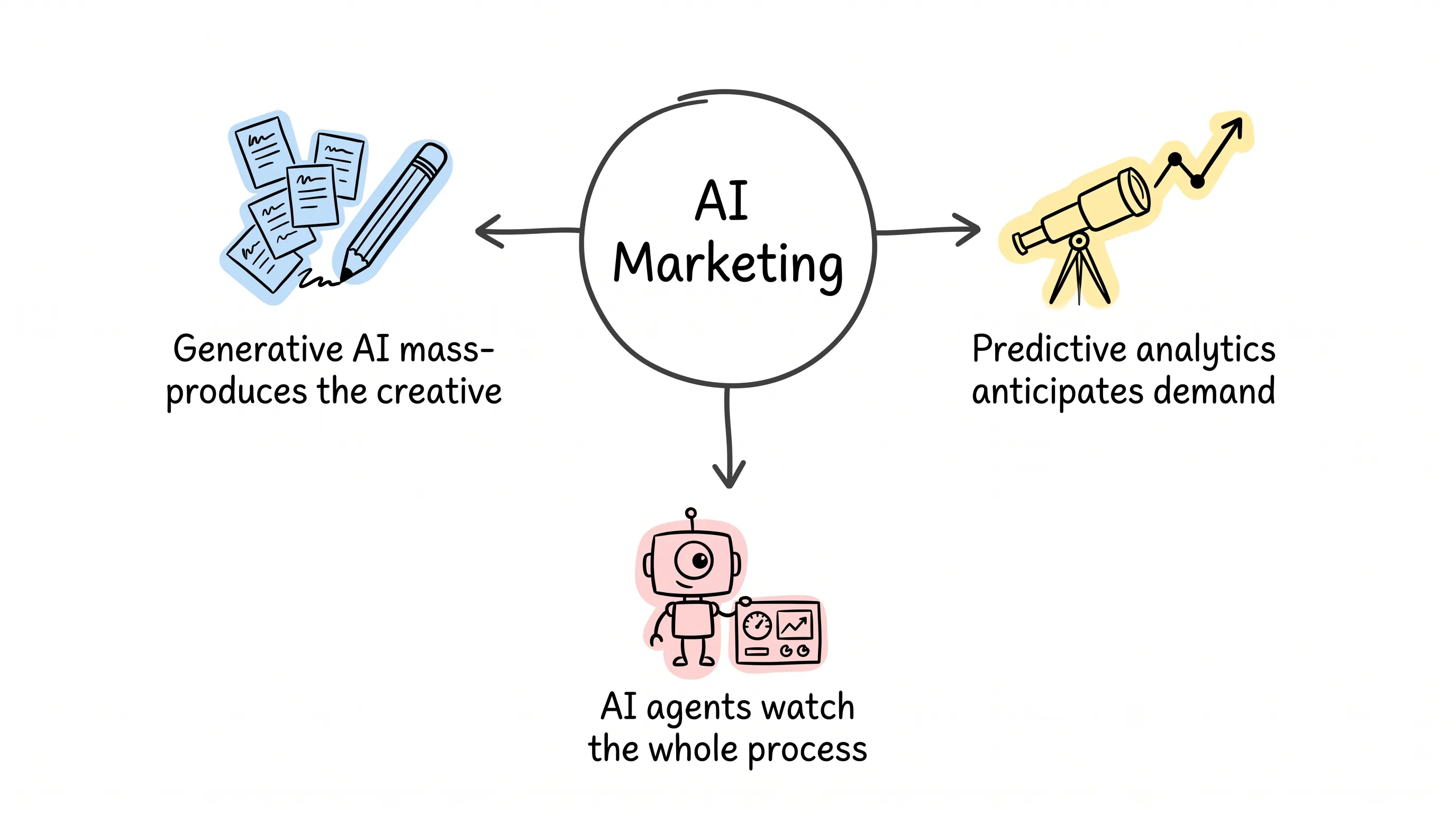
So what is AI marketing, really? Put simply, three things are happening at once.
First, generative AI mass-produces the creative. Hundreds of ad copy variants, hundreds of images — all generated in one night, then tested rapidly in small batches to see which ones people actually want to look at.
Second, predictive analytics anticipates demand. It takes your past purchases and behavior data to guess what you'll want to buy next and when you might be about to walk away — and puts the money where it counts.
Third, and newest of all, AI agents watch the whole process. They follow up with customers on their own and adjust budgets on their own, doing in a single day what used to take a campaign optimizer (the person who tunes ad delivery and budgets) a full week.
That friend from the opening? The third change is the one that set him free.
The truth is, Netflix and Spotify have been at this for a while. They collect which city you're in, what you've watched, which posts you've liked — and then decide which show or song to hand you next. Have you ever had this feeling: it seems to know what you want to watch better than you do?
Exactly — that's machine learning. The more it sees, the better it guesses.
Predictive analytics, meanwhile, is more like an analyst who understands the business. A marketing team, say, might use it to compare how long two groups of users stick around, spot which group is about to churn, and then decide where the money should go. The machine computes the probability; a human supplies the business judgment. That's also what separates it from machine learning: it usually needs someone who understands the business to interpret what it produces.
So How's It Working Out?
Concepts alone won't get us anywhere. Let's run the numbers.
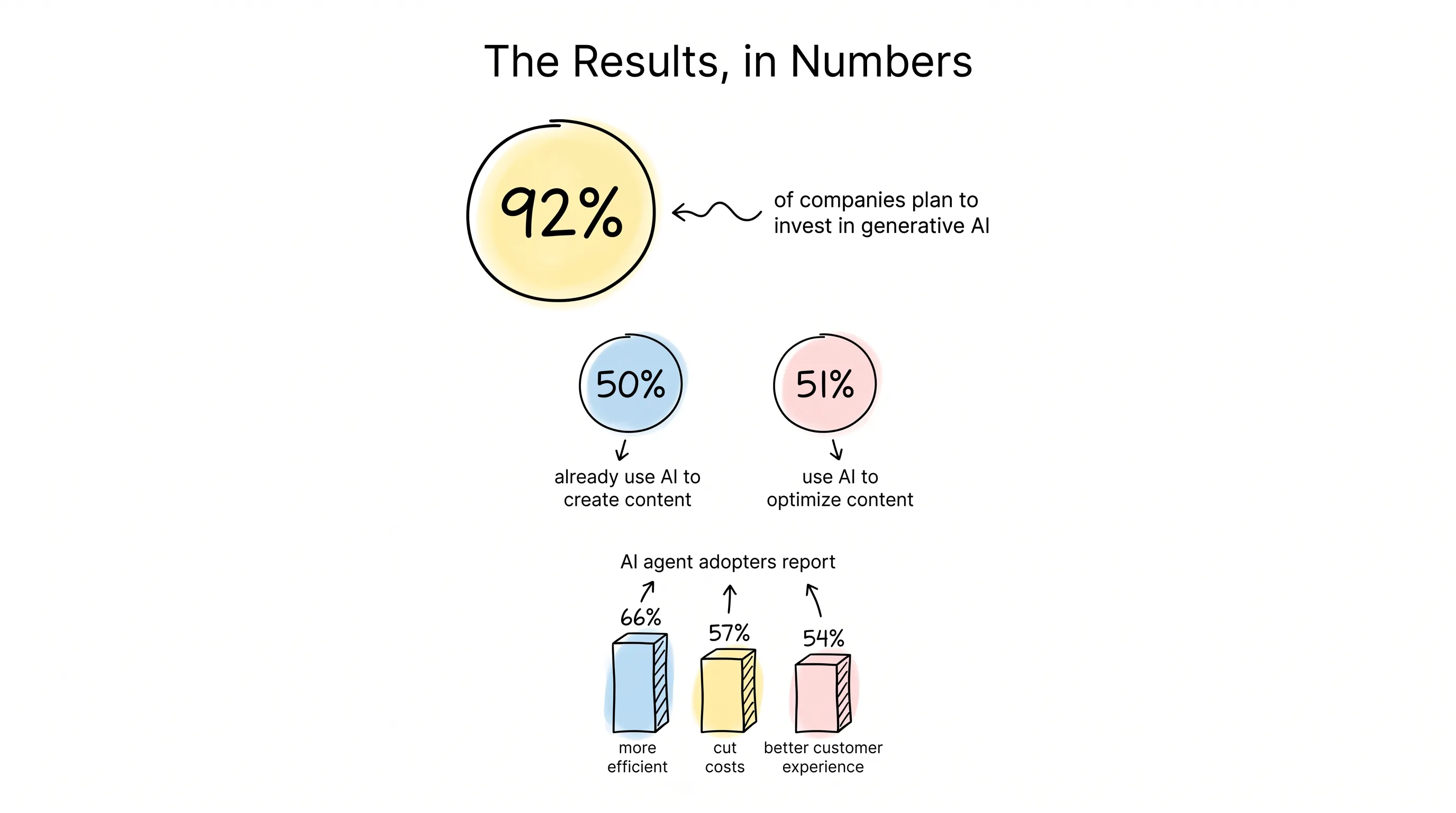
There's a McKinsey figure that stopped me short the first time I saw it: 92% of companies plan to invest in generative AI over the next few years. Mind you — that's every industry, not just tech.
On the marketing side, a SurveyMonkey survey found that 50% of marketing teams are already using AI to create content, and 51% are using it to optimize content — things like email campaigns and SEO.
The agent side is even more striking. In a PwC survey, among respondents who had adopted agent-based workflows, 66% said efficiency had genuinely improved, 57% had cut costs, and 54% felt the customer experience had improved.
Impressive, right?
Why are the results this visible? Think about how advertising used to be done: audiences sliced roughly by age, gender, and city; one version of creative running for months; campaigns tuned once a week or even once a month.
And now? AI can slice audiences into razor-thin segments, give every user a version of their own, and move budgets in real time to whichever ad is performing best.
It used to be humans watching machines. Now machines do the work, and humans watch the direction.
One small thing is worth pulling out on its own. Everyone is tightening privacy and phasing out third-party cookies (cookies used to track you across other sites), so your browsing traces can no longer be freely handed to advertisers. So how do ads still get placed? The thinking now is to let AI read the context of the page itself, instead of peeking at your personal data.
The tighter privacy gets, the more new roads AI finds.
But There's Always a Downside
You might think I'm about to say "AI will take the jobs." No. What I want to talk about are three subtler traps.
The first trap: bias. Cedars-Sinai Medical Center ran a study and found that when large language models (LLMs) recommend mental health treatments for patients of different races, the recommendations differ noticeably — some even suggested "quit drinking" for patients whose files showed no record of drinking whatsoever. What the model learned was the old biases sitting in the data.
The second trap: sameness. AI writes fast, but if nobody is standing guard, a hundred brands will come out sounding like one brand. The more you lean on shallow output, the more soulless the content gets. So-called deep personalization ends up as everyone receiving the same kind of "personalized" message.
The third trap is called AI washing. Some companies are still running entirely human workflows, yet bill themselves outwardly as "AI-driven" — all for the story and the investment money. And once that gets exposed, what's destroyed is trust in the whole industry.
So what do you do? There's only one unglamorous path: humans must stay in the loop. AI produces the first draft; humans check the facts and add the brand's sense of proportion. And before you use AI, set the rules first — which data must never be fed in, which things must never be said, period.
AI makes it fast; humans make it right.
What Happens Next?
My read: the next step is the "fully generative workflow" — images, copy, design, all done by AI in one pipeline; humans retreat to the very back, doing the things machines can't: setting strategy, weighing the ethics, and making the final call on the creative direction.
Beyond that come marketing campaigns that agents run by themselves. The moment the data comes in, they adjust — no human babysitting required. The repetitive work that used to eat people's days, like compiling performance reports or scheduling social media posts, all goes to them.
Cross-channel orchestration gets finer, too. Here's an example: you book a flu shot online, and before you've even left the house, a text message has already arrived with your visit reminder. Email, SMS, app notifications — every step connects, and the experience stays coherent.
Sounds wonderful? It really is. But remember: the more automated the machines become, the more valuable your judgment becomes.
So if you're a marketer, don't spend your energy agonizing over "will I be replaced." Practice three things instead: data literacy, the craft of working alongside AI, and a sharp eye for privacy. All three only get more valuable as time goes on.
A Final Word
Back to that friend from the beginning.
He says that now, on Monday mornings, he finally has time to think about "what should we lead with this quarter" — instead of being buried in budget spreadsheets.
See? What AI takes away is the repetitive labor. What it leaves behind is precisely the most precious part of being human.
The more capable machines become, the more human humans need to be.
Here's wishing you hand off the mechanical work early — and grab the thinking back.
Continue reading
Related articles

Cross-Border Business: Time to Upgrade Your AI Toolbox
A learn article explaining how AI tools help cross-border e-commerce sellers clear five hurdles: language, regulation, logistics, payments, and fraud. It outlines a five-compartment toolbox, a five-step adoption path, and metrics such as conversion rate and CLV, while cautioning against over-reliance on AI.

AI Is Taking Over the Dirty Work of Social Media Marketing, One Task at a Time
This learn article outlines four social media marketing tasks AI can handle — audience analytics, content drafting and design, ad targeting and creative testing, and spam moderation — and cautions that taste, judgment, and data security remain human responsibilities.

AI Is Already This Good — Why Is Your Social Media Marketing Still Pure Manpower?
An overview of 18 AI tools for social media marketing, organized into six categories covering audience research, content creation, scheduling, comment and DM handling, ad management, and visual production, plus notes on personalization, prediction, and emerging trends.