
AI Is Already Posting for You — So What's Left for Social Media Marketing?
An overview of how AI is reshaping social media marketing, covering content production, ad optimization, operations, customer service, and influencer selection, along with risks like fabrication, bias, and loss of brand voice.
Last month, I visited a friend who runs a skincare brand.
His operations team — himself included — is just three people. They run Xiaohongshu, Douyin (China's homegrown TikTok), WeChat Channels, Weibo, and Bilibili: five platforms. They publish a dozen-plus posts a day and answer comments almost instantly.
I had to ask: did you hire superhumans?
He laughed. No superhumans, he said — half the work is done by AI. AI drafts the copy, AI draws the images, AI picks the posting times, AI watches comment sentiment. The three of them just make the final calls and add the bit of "human touch" a brand is supposed to have.
On the way back, I couldn't stop thinking about it.
Two years ago, a team like that would have needed at least eight to ten people. Now three are enough. A lot of marketers still haven't truly grasped the shift that happened in between.
In this article, I'll explain in plain language exactly what AI has changed about social media marketing.
First, What "AI Running Social Media" Actually Means
What does "AI running social media" mean, exactly?
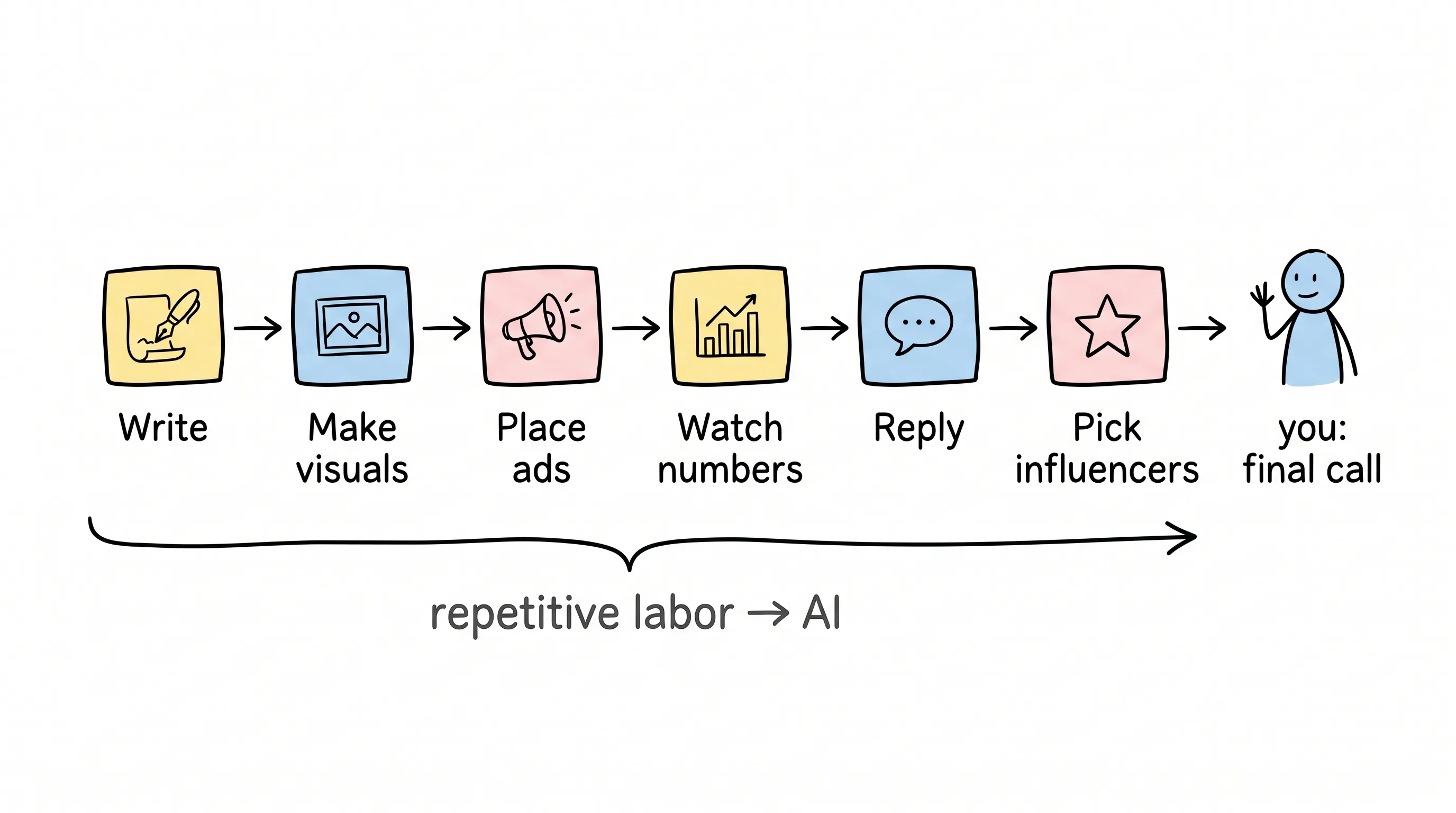
Put simply, it means bolting AI's core capabilities onto every stage of the social media workflow: writing content, producing images and videos, planning ad placement, watching the numbers, replying to comments, and picking influencers.
Many people still picture AI as "help me draft a couple of captions." That undersells it badly.
Think about it: break social media operations apart and it's all repetitive labor — writing about the same product in endless variations, staring at analytics to pick posting times, scrolling through comments one by one to judge whether users are praising or roasting you. You used to solve this by throwing people at it. Now, machines can take all of it.
And they take it better than you'd expect.
What machines take away was never the job — it's the repetitive labor.
Content: From Craft Workshop to Assembly Line
Start with the most visible part: making content.
What did content production look like in the past? A craft workshop. A copywriter would sweat through a day to squeeze out three posts; a designer would spend three days of revisions on a single poster.
And now?
For copywriting, tools like ChatGPT and Jasper are already highly proficient. Feed them your product specs, brand tone, and target audience, and they'll hand you a draft post in minutes; not happy? Just keep tuning. Purpose-built ad-copy tools like Copy.ai and Writesonic can even nail the difference between a hard-sell promo tone and a soft influencer-style "product seeding" tone.
Tools like Runway and DALL·E have leveled image and video production just as thoroughly. One line of description produces several decent images; for short-video scripting and editing, each has a dedicated tool ready to take over.
The really interesting one is the third: personalization.
What does personalization mean?
It's when the same account shows different things to different people. AI looks at each person's interaction history — what you clicked, what you finished, where you lingered longest — and decides what content to feed you.
This used to be called "a thousand faces for a thousand people," and only the big tech giants could afford it. Now a brand team of a handful of people can play too.
Ad Placement: Traditional A/B Testing Is Getting a Bit Slow
Once content is made, the next stage is distribution.
Ad optimization used to run on A/B testing: two versions of creative, each running for three days, pick whichever performs better. A week yields two or three conclusions at most.
AI runs a different playbook entirely.
At the creative level, it's called Dynamic Creative Optimization (DCO). The system combines images, headlines, and video openings on its own, testing hundreds of combinations a day; whichever performs, it doubles down in that direction. You don't wait three days — it's adjusting every minute.
Targeting has changed too. "Precise targeting" used to mean: women aged 25 to 35. Today's targeting looks at behavior: what this person has recently viewed, what they've clicked, whether they resemble your existing customers. Behave like one, get the ad.
Then it goes a step further: prediction. Based on someone's behavioral trail, AI can estimate when they're most likely to buy and push content their way ahead of time.
Stack those three capabilities together and ad placement becomes a different thing entirely: every dollar staked on the highest-probability outcomes.
Operations: The Three Most Draining Chores, All Taken Over
Anyone who has run social media knows: the exhausting part isn't creating content — it's three chores. When to post. How to handle the comment section. Where the next trend is.
Take posting times first. The golden time slot you think you know and the one the real data points to are often not the same thing. AI watches when your followers are online and when they love to engage, and automatically schedules content for that slot.
Next, the comment section. AI scans comments, DMs, and posts mentioning the brand to gauge overall sentiment: is the crowd praising today, roasting, or has something gone wrong? The moment sentiment turns, it flags it for a human to handle. Watched by humans, early mornings and late nights always leave gaps; watched by machines, none.
Third, chasing trends. Trends have brutally short windows. AI constantly scans how topics shift across platforms — which trend is just surfacing and whether it has anything to do with your brand — and it catches the scent half a day before a human would. In trend-chasing, half a day's head start is life or death.
None of these three is creative, yet each directly decides your numbers. Hand them to machines and people finally get their hands free for the work that actually matters.
Customer Service and Influencers: The Two Areas Changed the Most
Two more areas have changed almost beyond recognition.
The first: customer service.
Remember early chatbots? You asked A, they answered B — missing the point entirely, with a plasticky, robotic feel. Users would rather wait for a human.
Today's AI customer service is different. It understands context and reads tone. You say "I'll look around some more," and it knows you're not placing an order — you're hesitating. It resolves most common questions on the spot; for the ones it can't, it filters those people out and routes them to a human, with a judgment attached: is this a casual browser or a high-intent prospect?
And yes, it does one more thing for you: qualifying leads. Which inquiries are worth a salesperson's follow-up — the machine screens them first, and human time is reserved for conversations that are actually worth something. Seven days a week, twenty-four hours a day. No sick leave, no mood swings.
The second: influencer partnerships.
Brands used to pick influencers by follower count and by gut feel. How inflated those numbers can be — anyone who's been burned knows.
Run the math: an influencer claims a million followers and quotes you 50,000 yuan. Suppose 60 percent of that million are purchased bot followers — real reach maxes out at a few hundred thousand, so you've effectively spent 30,000 yuan on thin air. And that's the conservative estimate.
Now AI has turned this into arithmetic: it analyzes engagement rates and follower profiles to find influencers who genuinely overlap with your target customers; it scans engagement quality to spot faked, bought data; and after a campaign, it tallies conversions one by one to decide whether to book them again.
Picking influencers has gone from alchemy to due diligence.
But There's Always a Flip Side
At this point you might think AI has solved everything.
Not so fast.
The first pitfall: fabrication. AI can generate images, videos, and voices indistinguishable from reality; face swaps and faking someone speaking are now easy enough for individuals to pull off. While brands use it to produce content, they also have to guard against others using the same technology to forge your brand. Every piece of AI content you publish needs a human watching, so it never becomes the source of a rumor.
The second pitfall: bias. Algorithms learn from historical data — whatever slants hide in that data, the algorithm learns them too. The result: certain groups of people systematically see your ads less often. That's unfair and non-compliant, and many brands have no idea their ad delivery has already been skewed.
The third pitfall is the most hidden: losing your voice.
What does losing your voice mean?
It's when you hand over all the copywriting, comment replies, and strategy calls to AI. Efficiency does go up. But slowly, your account starts sounding more and more like the other hundred accounts in your market — because everyone's models share the same foundation.
My friend in skincare said something I'll never forget: every piece of AI-drafted content must be revised by a human before it ships. What gets revised isn't the prose — it's making it "sound like us."
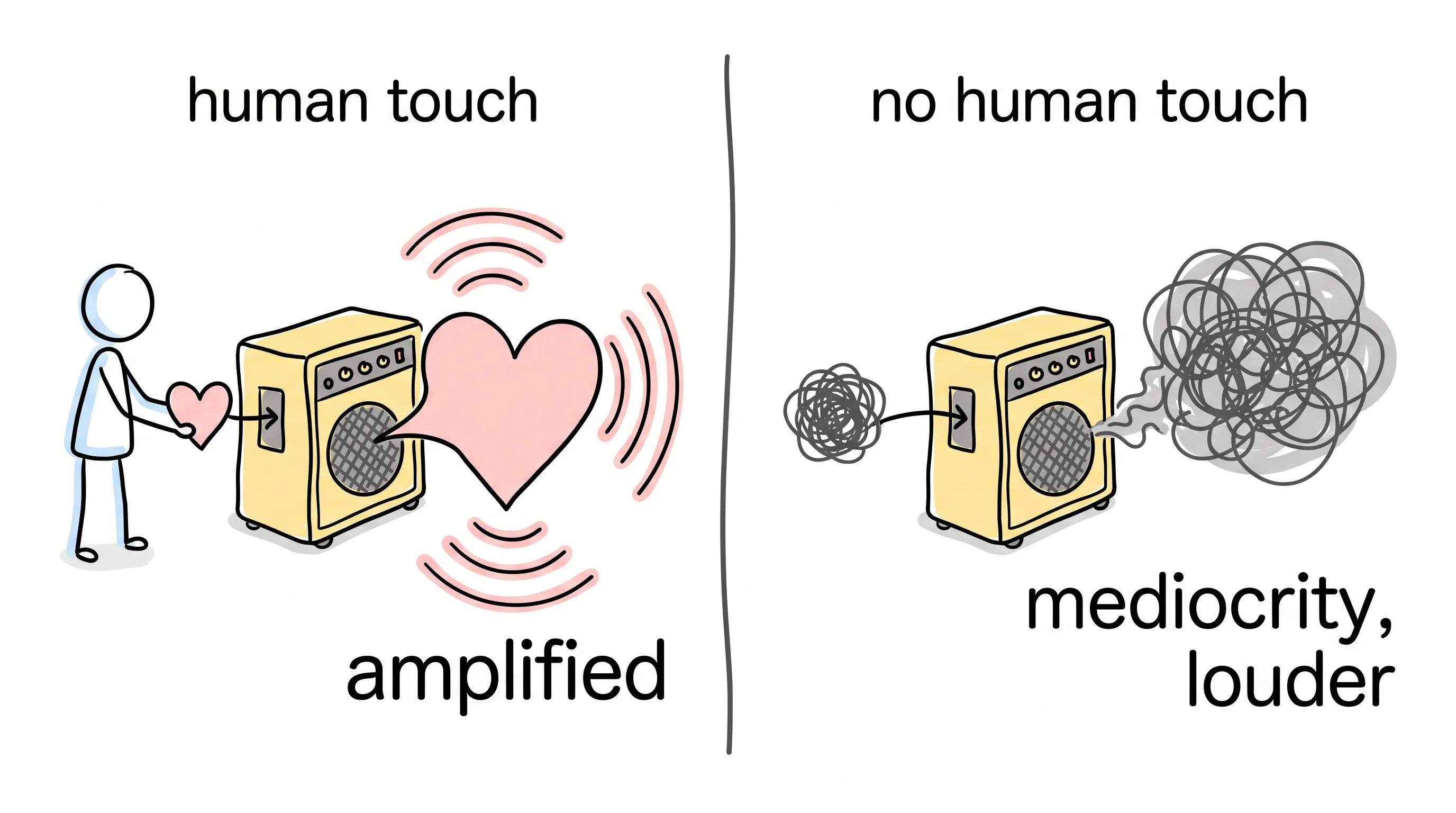
AI is an amplifier. If you have a human touch, it amplifies your human touch; if you don't, it amplifies your mediocrity.
So What Should You Actually Do?
Four recommendations. All simple; the hard part is actually doing them.
One: actually put the tools to work. Stop talking, start using. AI drafts, AI schedules, AI watches comments — let machines take the repetitive labor first. You're already far behind.
Two: before anything is published, a human must go over it. AI writing can be perfectly fluent — fluent enough to say something wrong with total conviction. Before brand content goes out, the last person pressing send must be a living human.
Three: get the division of labor clear. Efficiency to AI, judgment to humans. It crunches the data; you set the direction. Decide in advance when machines rule and when humans make the final call — and write it into your workflow.
Four: let the data run. AI's analytical power is there for the taking. Feed every round of content performance back into the next round of strategy. Your playbook should get sharper month over month.
Finally, Back to My Friend
As I was leaving that day, I asked whether he worried AI would replace his team.
He said something along these lines: AI now does the work of eight people, but the part of the brand that's actually valuable — the part that makes users feel "this is a real person, this brand is kind of interesting" — still comes down to people. Machines handle speed; humans handle being human.
I think that's the whole essence of social media marketing right there.
Leave efficiency to the machines. Keep the soul for yourself.
Whoever figures this out early is the first to start running in the next phase.
Here's wishing your account always sounds like a living, breathing person.
Continue reading
Related articles

Cross-Border Business: Time to Upgrade Your AI Toolbox
A learn article explaining how AI tools help cross-border e-commerce sellers clear five hurdles: language, regulation, logistics, payments, and fraud. It outlines a five-compartment toolbox, a five-step adoption path, and metrics such as conversion rate and CLV, while cautioning against over-reliance on AI.

AI Is Taking Over the Dirty Work of Social Media Marketing, One Task at a Time
This learn article outlines four social media marketing tasks AI can handle — audience analytics, content drafting and design, ad targeting and creative testing, and spam moderation — and cautions that taste, judgment, and data security remain human responsibilities.

AI Is Already This Good — Why Is Your Social Media Marketing Still Pure Manpower?
An overview of 18 AI tools for social media marketing, organized into six categories covering audience research, content creation, scheduling, comment and DM handling, ad management, and visual production, plus notes on personalization, prediction, and emerging trends.