
AI Is Already Choosing Schools for Students — Is Yours Getting Named?
An explainer on Generative Engine Optimization (GEO): how students increasingly rely on AI chatbots for school research, how GEO differs from SEO, and practical steps for making institutional pages more citable by AI.
A while back, my niece was applying to study abroad, so I leaned over to watch how she was researching schools.
I expected a dozen browser tabs open, flipping back and forth between rankings. Instead, she opened ChatGPT and typed a single line: "University of Toronto, computer science — how much is tuition, and what do I need to submit?"
Seconds later, there it was: a tidy, complete answer.
I leaned in for a closer look and felt a chill run down my spine. She never touched a search engine the whole time. She never opened a single blue link. The official website the school had worked so hard on? She didn't glance at it once.
Good grief — this generation of students skips the search results page from the very start.
What Is GEO?
Behind all this sits something new called Generative Engine Optimization, or GEO for short.
So what is GEO?
Put simply: you used to create content for search engines, aiming to rank high on the results page and wait for people to click. Now you have to create content for AIs like ChatGPT and Google AI Overview, aiming to get them to name you and quote you in their answers.
One is about being found; the other is about being cited.
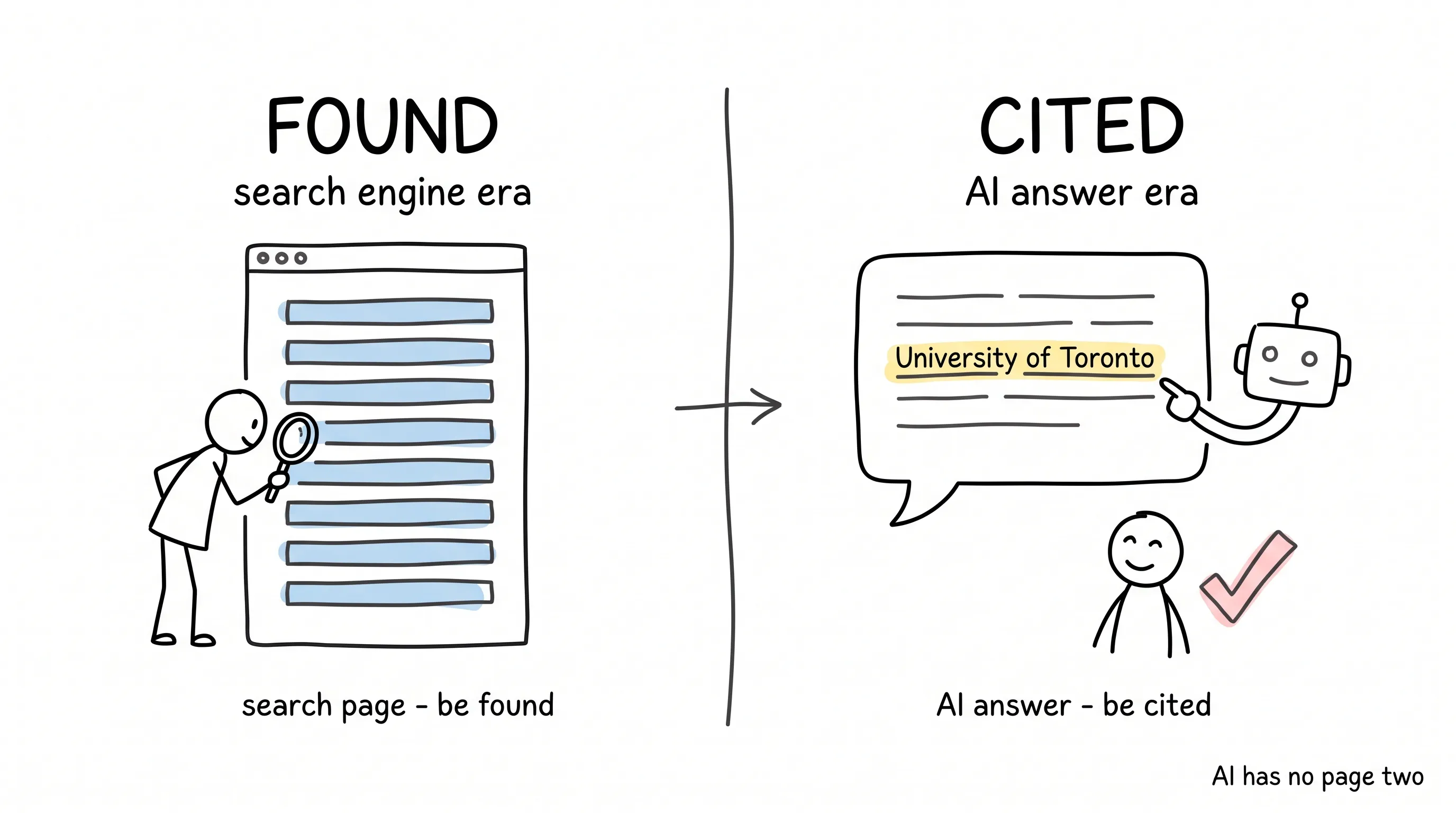
That tiny difference in wording flips the whole game.
Ask an AI "which Canadian schools have good engineering programs," and it won't hand you ten links. It gives you a paragraph that names two or three schools. The ones named have picked up exposure for free; the ones not named may go through this student's entire journey without her ever knowing they existed.
And note this: AI has no page two. That's the single biggest difference from traditional search.
SEO vs. GEO: What Exactly Is the Difference?
You might say, "My SEO has been working just fine — why bother with this?"
Let me break down the ledger for you.
One competes for clicks; the other competes for citations. SEO optimizes your ranking on the search results page — whether anyone clicks is another matter. GEO optimizes the AI's answer — did the AI mention you, and did it get you right?
One stacks keywords; the other speaks like a human. SEO chases high-traffic terms like "MBA Canada." GEO has to catch complete questions: "How many years is the University of Toronto MBA?" "Do I need a standardized test?" These days students speak in full sentences even when they search.
One is layout for humans; the other is structure for machines. AI reads a web page faster than any human skims — and it's far more exacting. Q&A blocks, subheadings, tables, checklists — those are its favorites. A sweeping, lyrical essay? It can't find the point.
One judges design; the other judges credibility. A beautiful website used to earn you points. Now, when AI decides whether you're trustworthy, it looks at whether your facts are accurate, whether the whole site tells one consistent story, whether there are concrete facts and sources. However pretty the design, contradictory numbers still cost you.
The one-line conclusion: SEO helps you get found; GEO helps you get cited. You need both — miss one and you lose half your students.
Why Act Now?
Some think this is a trend you can watch from the sidelines. I'd say don't.
First, students have already adopted it wholesale. A 2024 global survey found that about 70% of prospective international students had used tools like ChatGPT to research school information, and more than 60% relied on chatbots for their homework in the early stages of choosing a school. The early stage is exactly the most valuable stage — get onto the shortlist, and everything after follows. If you're not in the AI's answer, you're not in the student's options.
Second, even search clicks are drying up. Nearly 60% of searches now end in "zero clicks" (searches that finish without a single click — the answer is served right on the results page), with the AI bringing the answer straight to the table. A student asks for "the best engineering universities in Canada," the AI names three schools, and those three win. The attention is fully divided up before it ever reaches your homepage.
Third, AI is becoming an admissions consultant. Current data shows AI's influence on final admissions decisions is still limited, but it increasingly acts like a counselor, helping students build lists and run comparisons. Picture the question "My child wants to study computer science — University A or University B?" If your content is structurally a mess, the AI will either skip you or get your information wrong. You can't live with either outcome.
Fourth, the places to be seen are shrinking. There used to be the front page, page two, featured snippets, ad slots — a whole pile of entrances. An AI answer is one paragraph and a few citations. The spotlight has narrowed; the crowd hasn't.
Fifth, being cited is itself trust. Ranking on Google's front page used to say you were legit. Now, when an AI keeps mentioning you, students feel you carry weight. Some will even go find your official website on that basis alone.
With students getting scarcer and competition getting fiercer, starting late on this one means losing points.
So How Do You Actually Do It?
Theory's done. Time to get hands-on. Here are five moves.
First, reshape your content into "answers to questions."
Stop thinking keywords for a moment; think about what students ask. "How much is tuition at XX University's nursing school?" "Can international students apply for scholarships?" Use those questions as headings, write the answers in Q&A format, and put them on program pages, admissions pages, and scholarship pages. FAQ sections work especially well — AI was literally trained on Q&A format.
And don't forget to mine the data: your site's internal search logs and Google Search Console hold the whole record of what students searched for — and what they couldn't find.
Second, keep exactly one version of every key fact across your site.
Nothing frightens AI like contradictions. If this page says tuition is 40,000 and that page says 38,000, the AI simply stops believing you. So for hard information — tuition, deadlines, admission requirements — build one "single authoritative page," link everything else to it, and never keep a second version.
Third, package your content in a shape AI can chew.
- Put the most important information in the very first sentence. AI often grabs only the first line or two — don't bury your ace in paragraph five.
- Split long paragraphs into subheadings, lists, and tables. One tuition table beats ten paragraphs of prose.
- Keep the vocabulary consistent site-wide. "Application deadline" here and "registration final date" there will confuse the AI.
- Add Schema markup (labels written into a page's code that tell the AI directly: "this section is a Q&A," "this section is a program description"). There are matching types for FAQs, programs, and institutional information.
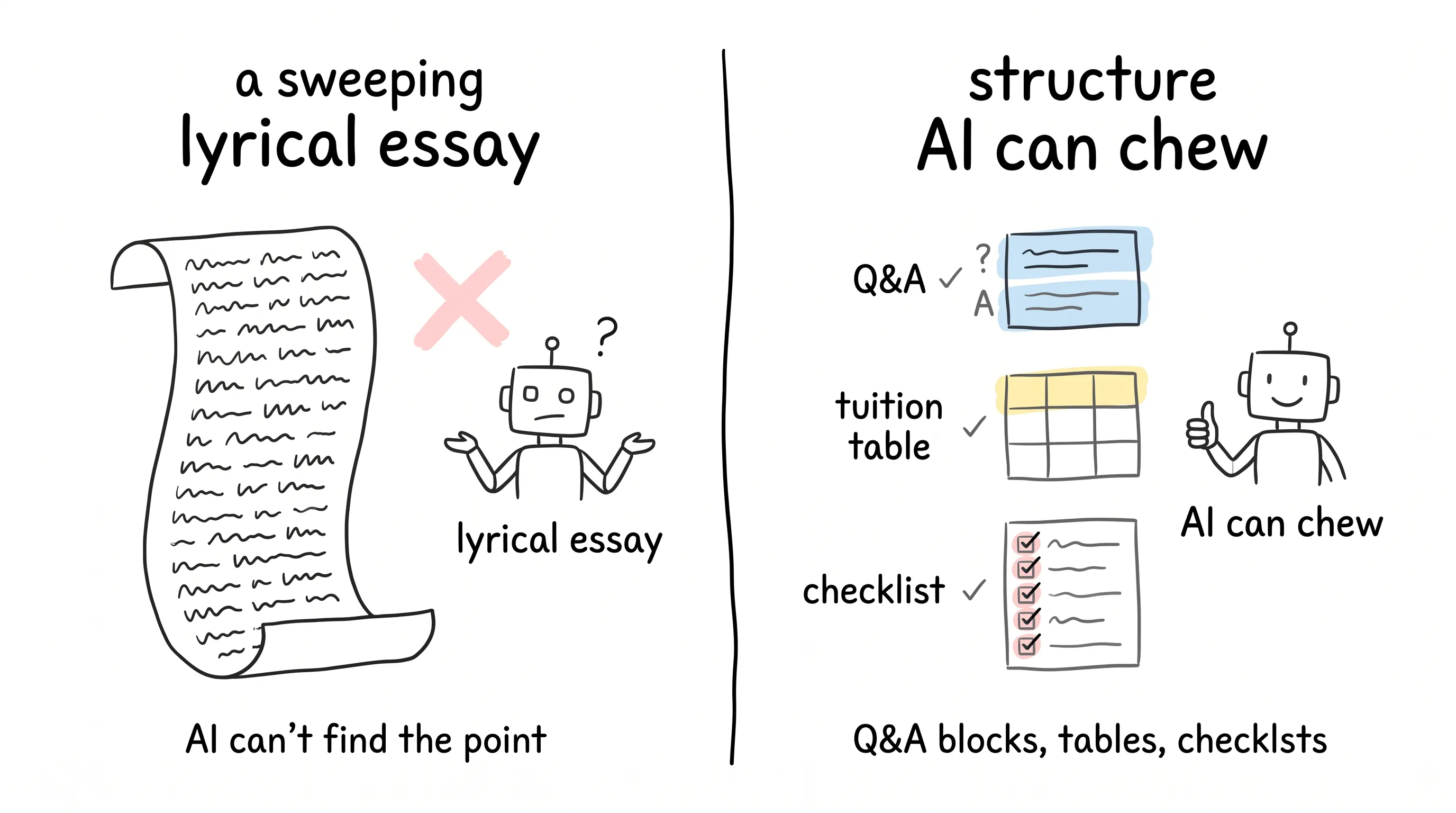
Schools going a step further have started building structured data files (JSON, CSV and the like), turning programs and tuition into machine-readable lists for AI to eat. One American university's digital team has said publicly that after adding structure, Google AI Overview's summaries of their programs got noticeably more accurate.
Fourth, every AI has its own temperament.
Tools like ChatGPT often don't go online in real time; they run on training data. So the more others cite you and the higher your content quality, the more likely the model has "memorized" you. Honestly writing long-form pieces and accumulating citations is the clumsy way — and the right way.
Google AI Overview draws its material mainly from top-ranking search results. That means the better your SEO, the more your GEO benefits. Put a directly usable answer sentence at the top of the page — "Undergraduate admission requires a 75%+ average plus two recommendation letters" — and make sure crawlers aren't blocked by scripts or login walls.
Voice assistants love to read featured snippets aloud. One line — "we have paid internship programs" — is more likely to be read out than a big block of introduction.
Emerging tools like Perplexity love to cite Wikipedia and high-authority sites. So someone needs to watch over your Wikipedia entry, and misinformation on Reddit and Quora should be clarified head-on from your official site — write a debunking post if necessary. Don't let wrong information speak for you.
By the way, none of these AI-optimization moves slows down human readers one bit. Clearer structure, easier-to-find answers — students benefit too. It's a double win.
Fifth, show what you've got.
Professors' research, graduate employment data, unique flagship programs — these are your exclusive weapons, and AI especially loves citing them. For example, writing plainly "95% of graduates employed within six months (2024 in-school survey)" is a hundred times more useful than "broad career prospects." Expert articles with author bylines and bios, data and rankings cited from authoritative third parties — all of it hands the AI credible evidence.
Which Pages Should You Fix First?
Reworking the entire site isn't realistic — spend where it counts. Ranked by how often students ask, here is the priority list, high to low:
- Program pages. Questions like "does XX have a data science program" get answered by AI straight from program pages. Program type, length, teaching format, accreditation, rankings — the first paragraph has to cover it.
- Admissions pages. Split into blocks by applicant type; requirements, deadlines, steps listed in clear checklists, with dates attached.
- Tuition and scholarships. The most-asked-about topic. Use tables, split by program and student type, and state the conditions in plain words — for example, "all applicants are automatically considered for entrance scholarships of up to CAD 5,000."
- Program finder pages. Make sure they're crawlable, use official names, and the information is current.
- Campus life and support services. "Is housing guaranteed?" "Who do I contact about counseling?" Answer directly — no runaround.
- Careers and alumni. "93% of graduates employed within six months," "alumni went to Google and Shopify" — this is exactly the kind of sentence AI loves to quote.
After You've Done It, How Do You Know It Worked?
This is the most annoying part. Much of GEO's effect never shows up in traditional reports. But solutions outnumber obstacles.
- Watch visitors coming from AI. Set up tracking in GA4 for sources like ChatGPT and Perplexity. The numbers may be small, but as long as they're rising, the door has opened.
- Go ask the AI manually. Regularly ask ChatGPT "introduce XX University" and "how do I apply to XX University," screenshot and archive the answers, and record whether yours was mentioned — and whether it got you right. Ask again after updating content, and compare the changes. This clunky method is currently the most direct evidence there is.
- Add one question to the application form. "How did you hear about us?" — with "AI chatbot" among the options. Just because a student never clicked your link doesn't mean they didn't remember your name.
- Watch the pages you optimized. Changes in time on page, bounce rate, and inquiry forms often line up with AI citations.
- Build a simple internal dashboard. AI-source traffic, citation screenshots, the timestamps of every content update — put them next to application data and watch the trends.
The tools are all early-stage, and the playbook will change. But those who move first accumulate citations first and occupy mindshare first — and that head start is real.
Six Schools' Homework, Ready to Copy
Methods alone are too abstract. Look at a few who've done it well.
Harvard's undergraduate application page. How clear is the structure? The page has its own table of contents; application materials, fees, tests, and recommendation letters are each laid out item by item in checklists, with nothing left out. An AI crawling this page can hardly go wrong.
Stanford's first-year applicant page. It opens with a checklist of application materials, followed by a "requirements and deadlines" comparison table — early and regular decision timelines laid side by side, every milestone written out plainly. Humans and AI both get it at a glance.
MIT's "facts" page. This page is practically a masterclass in spoon-feeding AI: 4,576 undergraduates, a 168-acre campus — every piece of information a single self-contained fact, laid out in a list. A student asks "how many undergraduates does MIT have," and the AI lifts the answer straight off and uses it.
The University of Toronto's deadlines page. Tables grouped by faculty and campus — Engineering, for instance, recommended submission by November 7, final deadline January 15, written out crystal clear. A student asks about deadlines, and the AI's answer comes directly from this table.
Oxford's English literature course page. The page opens with an overview box: UCAS code Q300 (UCAS is the UK's central university application service), A-level requirement AAA, three-year program — one fact per line. Anyone wanting to understand this program knows it all after one scan.
Cambridge's application dates page. The whole page is an application timeline sorted by date, starting the spring before enrollment, each date paired with a line on "what to do on this day." That famous October 15 UCAS deadline is bolded for emphasis, as if terrified you'd miss it.
Six schools, one thing in common: no showing off — just facts laid out neatly. And that is exactly what AI rewards most.
Back to Where We Started
My niece did, in the end, narrow her school list based on the AI's answers.
That night I thought for a long time. Twenty years ago, schools competed for position on the search results page; ten years ago, for the mobile experience; now, for the name in the AI's mouth.
The vehicle keeps changing; the essence never has: wherever students go to find schools, that's where you have to be mentioned.
Next time the question gets asked, do you want the AI reading out your carefully organized answer — or the school next door's information?
This is a problem to start working on right now.
Continue reading
Related articles

Cross-Border Business: Time to Upgrade Your AI Toolbox
A learn article explaining how AI tools help cross-border e-commerce sellers clear five hurdles: language, regulation, logistics, payments, and fraud. It outlines a five-compartment toolbox, a five-step adoption path, and metrics such as conversion rate and CLV, while cautioning against over-reliance on AI.

AI Is Taking Over the Dirty Work of Social Media Marketing, One Task at a Time
This learn article outlines four social media marketing tasks AI can handle — audience analytics, content drafting and design, ad targeting and creative testing, and spam moderation — and cautions that taste, judgment, and data security remain human responsibilities.

AI Is Already This Good — Why Is Your Social Media Marketing Still Pure Manpower?
An overview of 18 AI tools for social media marketing, organized into six categories covering audience research, content creation, scheduling, comment and DM handling, ad management, and visual production, plus notes on personalization, prediction, and emerging trends.