
AI in Advertising: Stealing Jobs or Creating Them? 6 Real Cases That Explain It All
An educational piece analyzing six real brand cases of generative AI in advertising, including Coca-Cola, Cadbury, Nestle, Nike, Maybelline, and Lexus, covering co-creation, personalized video, archive revival, and AI-human collaboration.
A couple of days ago, I scrolled past a beauty ad and froze halfway through: the visuals, the pacing, the copy — all of it felt right. Then it hit me: from start to finish, this video didn't seem to involve a single human team.
So I went digging through case studies from brands around the world, and it turned out that using AI for video ads is old news. Coca-Cola, Cadbury, Nestlé, Nike, Maybelline, Lexus — they've all done it, each in its own way.
Today I'm going to break these 6 cases down for you. By the end, you'll walk away with a counterintuitive takeaway.
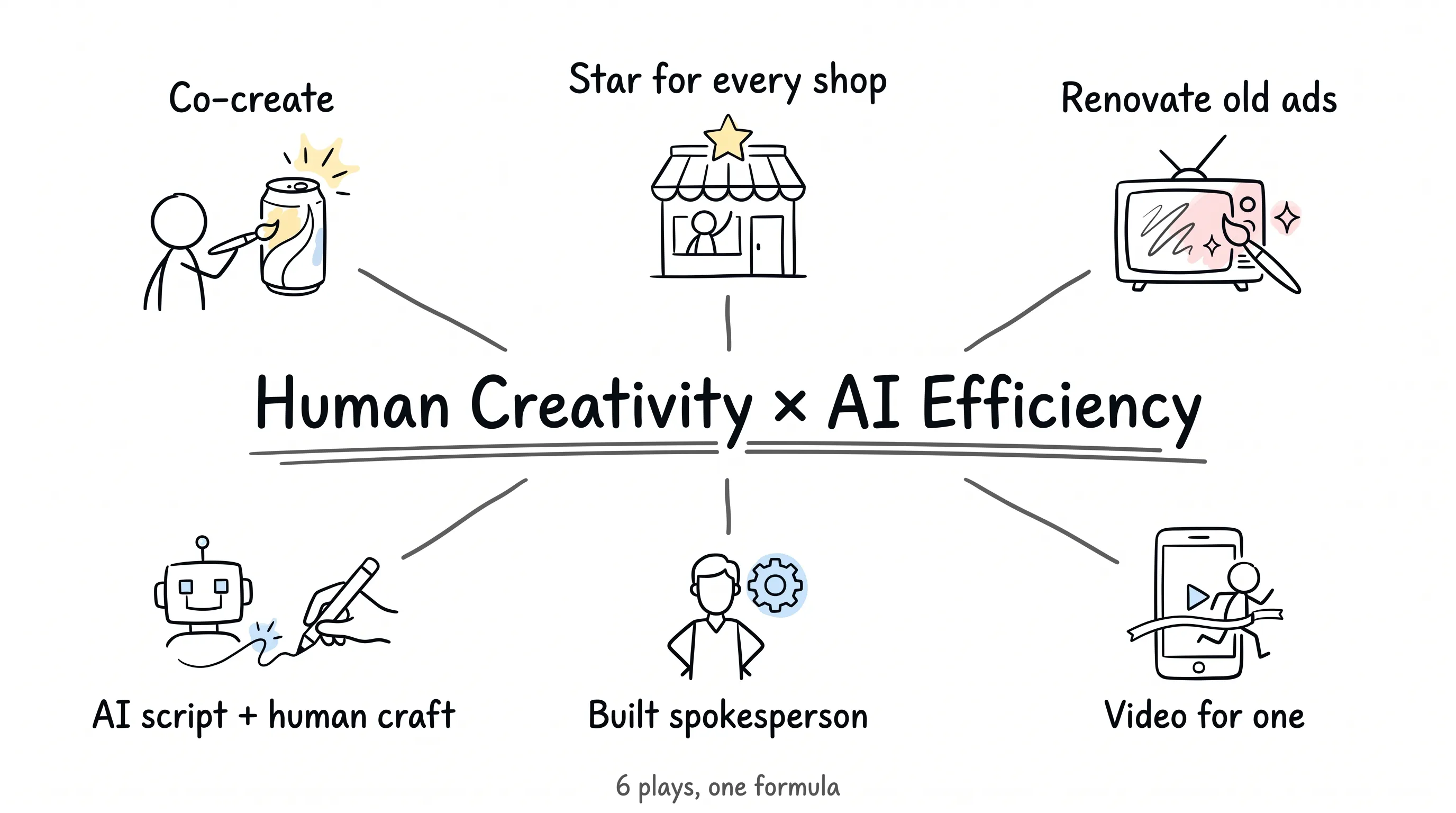
First, let's get one concept straight. What does it mean to make ads with generative AI (AI that creates new content)?
It means letting AI do an ad agency's job: writing scripts, drawing storyboards, doing voiceovers, cutting footage. You feed it material and data, and it churns out endless variations of an ad.
Sounds like creatives are going to lose their jobs?
I thought so at first too. But after reading these 6 cases, I changed my mind.
Story One: Coca-Cola, Turning the Audience into Creators
What does turning the audience into creators mean? Coca-Cola set the template for you.
Back then, it partnered with OpenAI and Bain & Company on a campaign called "Create Real Magic": it opened up Coca-Cola's classic visual elements so that anyone could use DALL·E and ChatGPT to generate their own version of Coca-Cola posters and short films.
The best entries would be made into real, official ads and run on Coca-Cola's own digital platforms.
Honestly, this design is brilliant. Ads used to be something brands made for users to watch; now, users make them for users. AI's role here is more like an entry ticket. It drops the creative barrier down to zero, letting every consumer come in and have a turn.
People who have created something feel completely differently about a brand. Would you disown something you made with your own hands?
AI didn't replace creativity; it amplified it.
Story Two: Cadbury, Letting the Corner Store Afford a Superstar
The second case — after reading it I had just one reaction: absolute genius.
Cadbury India ran a Diwali (India's biggest festival, think Christmas-level shopping) campaign called "Shah Rukh Khan-My-Ad". Who is Shah Rukh Khan? Bollywood's number one superstar. Think about it: a corner grocery store in a small Indian town wants to hire him for an ad. Possible?
Not possible. Not in a lifetime.
But Cadbury did it with AI. It used generative AI and machine learning to replicate Shah Rukh Khan's image and voice, mass-generating personalized ads for thousands of small shops. Each store owner only needed to fill in their shop's name, and the AI would automatically adjust what the superstar says in the video.
A little shop that couldn't afford a star woke up overnight with a superstar endorsement.
That's what makes AI remarkable. Celebrity ads used to be the privilege of giants; now they're a tool small business owners can afford too.
AI's real power is turning expensive creativity into a daily commodity everyone can afford.
Story Three: Nestlé, Using AI to Renovate Old Ads
The third play runs in the completely opposite direction: don't make new things, renovate old things.
Nestlé fed its own decades of advertising archives — old materials from sub-brands like Nescafé and KitKat — to AI, let it fully absorb the advertising language of those years, then remade nostalgic versions of the classic ads for Gen Z.
The emotion is old; the expression is new. The older generation sees memories; the younger generation sees something fresh.
You see, nostalgia used to be depreciation on brand equity. But AI can reprice it: the emotional punch of the old ads is still there, just converted into language this generation understands.
You don't need to rebuild assets from scratch; renovation works. For any brand with history in the bank, that's a lesson worth taking.
Story Four: Nike, Shooting One Film for One Person
The fourth case is about the ceiling of personalization.
Nike has been making ads for many years; later it plugged generative AI into two products, Nike Run Club and Nike Training Club: the AI analyzes your workout data, your preferences, the weather in your city, then generates video content made just for you.
Run five kilometers today and it gives you content cheering you through the finish line; have a race next week and it gives you pre-race reminders. Same brand, a thousand users, a thousand different videos.
What is personalization? In the past, it meant calling your name in an email. Now, it means shooting a film for one person alone.
The scarcer attention becomes, the more valuable the feeling that "this ad was shot for me" becomes.
Story Five: Maybelline, Building Its Own Spokesperson
The fifth case is more radical. Maybelline didn't go hire a bunch of bloggers; instead, it used generative AI to build a virtual influencer, having it star in makeup tutorials, product demos, and even straight-up social media ads.
Every ad also adapts automatically: to your preferences, the language you speak, the makeup looks trending in your area.
How did it land? On TikTok and Instagram, Gen Z responded with real enthusiasm.
Brands' influencer strategy used to be "renting": renting celebrities, renting bloggers, paying per post. Now, AI lets brands "build": build a spokesperson who never flakes, always fits the schedule, and can duplicate itself without limit.
Renting and building are two completely different cost structures. That's no small matter.
Story Six: Lexus, AI Writes the Script, Humans Shoot It
I especially like the last case, because it draws the clearest line for how humans and AI should divide the work.
Lexus shot a short film called Driven by Intuition. The script was written by AI: it analyzed 15 years of award-winning car ads, distilled which emotions and visuals move people most, then wrote the script.
Execution, though, went to a human director, who kept the AI's narrative structure and layered his own emotion and craft on top.
The finished film feels like cinema, yet carries a certain ineffable "data-driven feel".
AI supplies structure and insight; humans supply emotion and art. This film is that sentence brought to life.
What These 6 Cases Are Saying Together
The 6 stories are told. On the surface, 6 different plays; underneath, it's actually the same sentence:
The best AI ads are human creativity multiplied by AI efficiency.
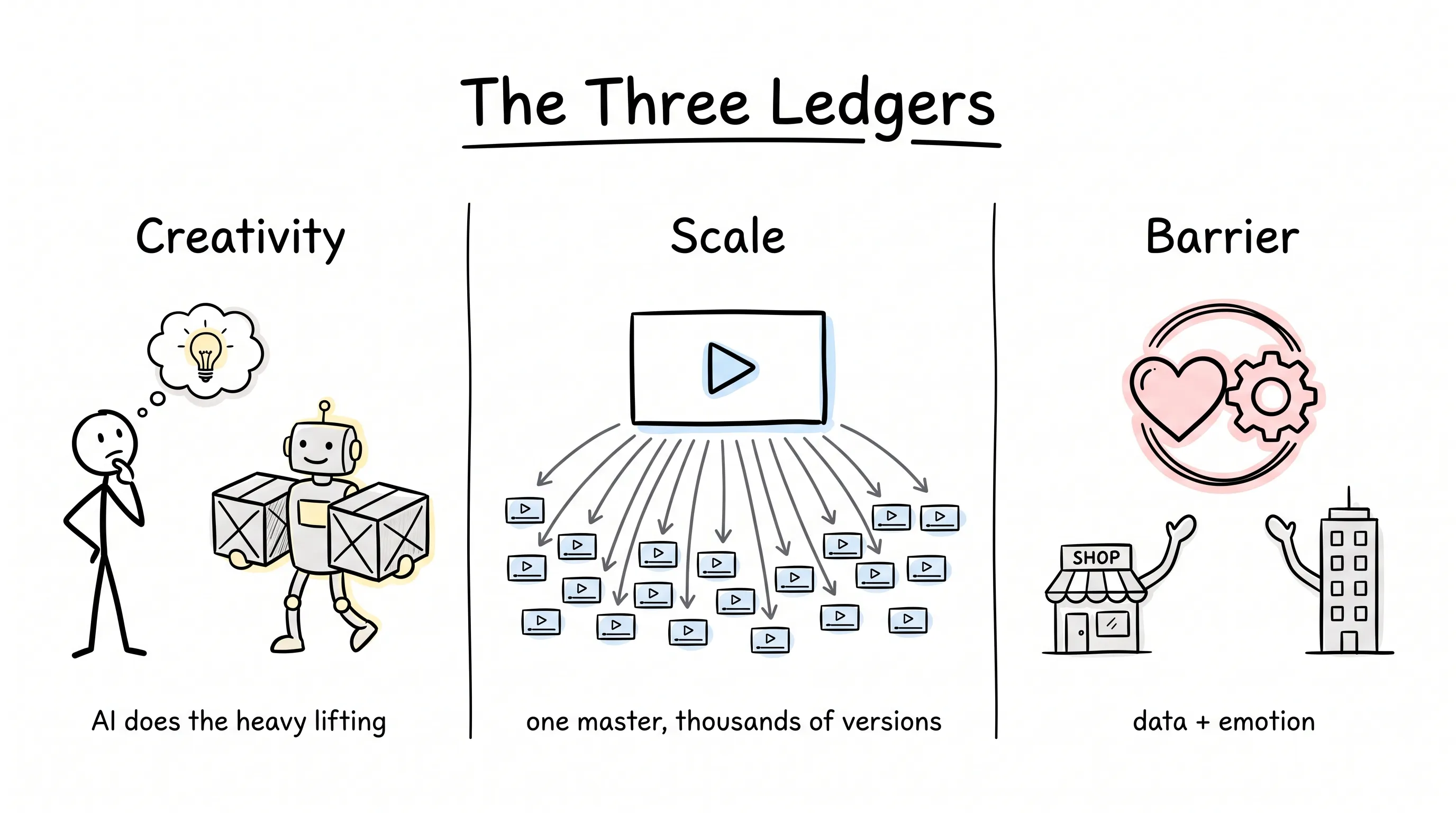
Let me break it into three ledgers for you.
First, the creativity ledger. AI is an assistant, not a rival. It takes over the heavy lifting from idea to production, so people's hands are free for strategy and storytelling. Coca-Cola and Lexus are both proof of that.
Second, the scale ledger. In the past, shooting an ad meant one shoot, one ad; now a generated ad is the master copy for ten thousand. Cadbury used it to reach thousands of small shop owners; Nike used it to reach every runner. Personalization is no longer a privilege — it's the default setting.
Third, the barrier ledger. A good ad takes data plus emotion. AI can compute what will go viral, but only a human can make a heart skip. Big companies could always throw this one-two punch; now small ones can afford it too.
Finally, back to the beauty ad from the beginning.
I stopped obsessing over whether it was shot by humans. Because after reading these cases, I understood: soon, nobody will be asking that question. Just like nobody today asks whether a poster was laid out by a computer or drawn by hand.
The question worth asking is a different one: when every ad can be customized for a single person, what does your brand still hold onto — the thing ten thousand revisions can't erase?
Figure that out first. Then go use AI.
Wishing you well.
Continue reading
Related articles

Cross-Border Business: Time to Upgrade Your AI Toolbox
A learn article explaining how AI tools help cross-border e-commerce sellers clear five hurdles: language, regulation, logistics, payments, and fraud. It outlines a five-compartment toolbox, a five-step adoption path, and metrics such as conversion rate and CLV, while cautioning against over-reliance on AI.

AI Is Taking Over the Dirty Work of Social Media Marketing, One Task at a Time
This learn article outlines four social media marketing tasks AI can handle — audience analytics, content drafting and design, ad targeting and creative testing, and spam moderation — and cautions that taste, judgment, and data security remain human responsibilities.

AI Is Already This Good — Why Is Your Social Media Marketing Still Pure Manpower?
An overview of 18 AI tools for social media marketing, organized into six categories covering audience research, content creation, scheduling, comment and DM handling, ad management, and visual production, plus notes on personalization, prediction, and emerging trends.