
AI Has Started Spending Money for You
This commentary links three news items: Meta's Muse agent shopping in Shopify stores, Scope3's rebrand to Apostra for agent-to-agent ad negotiation, and a Microsoft patent application for game ads that wait for natural pauses, framing them as AI becoming a negotiating counterpart rather than a lookup tool.
This morning, three news stories scrolled past me in a row.
On their own, each one is just an ordinary industry update. Put them together, and things get interesting.
You'll notice that AI is morphing from "a tool that helps you look things up" into "the person sitting across the negotiating table."
Let's take them one by one.
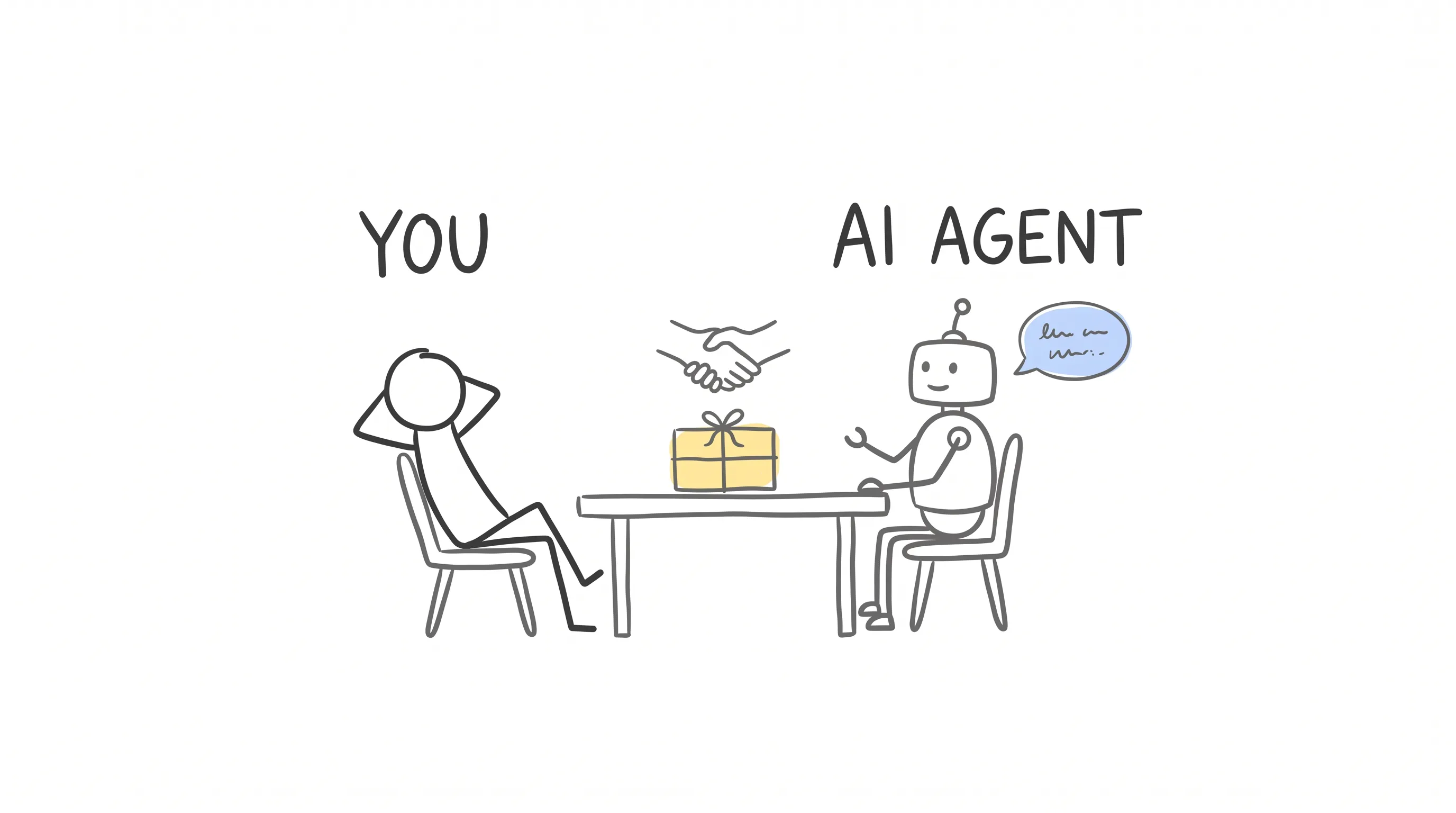
1. AI Shops for You — and Pays
What is an AI shopping agent?
You say "buy me a pair of running shoes," and it goes browsing, comparing prices, placing the order, paying — you never lift a finger. Your only job is to receive the package.
Meta's personal shopping agent is called Muse. It can now walk into every Shopify-powered store and complete purchases on a user's behalf.
Shopify CEO Tobias Lütke says it's a relaxed, delightful way to shop and check out. Meta's Chief AI Officer Alexandr Wang says it lets Muse's users browse more stores.
Take those two quotes with a grain of salt. The information that really matters is hiding in the technical details:
This integration runs on Shopify's existing infrastructure. Merchants stay merchants — same seller of record, same fees, not a cent more.
In other words, millions of merchants are now standing at the entrance to AI shopping without touching a single system.
Why do I say this matters? Because the smaller the friction of the integration, the faster the adoption. AI does the shopping, humans get the delivery.
2. Two Agents Sit Down to Talk Ads
The second one is even bolder.
Ad-tech company Scope3's two co-founders, Brian O'Kelley and Anne Coghlan, have renamed the company Apostra and pivoted the business entirely: from calculating carbon emissions for the advertising industry to agentic AI advertising.
What is agentic AI advertising?
You let the AI representing advertisers negotiate directly with the AI representing media sellers. What do they negotiate? Price, placement. Then the deal is done.
You might ask: couldn't marketers do this themselves before?
Think about it. A large advertiser may need to connect with thousands of media partners. The old way: build integrations one by one, negotiate one by one, by hand. A human can't keep up with that.
O'Kelley's read is that the ad industry has long been trapped by two things: fragmented infrastructure and mountains of manual processes. Programmatic advertising was built around real-time bidding (RTB), yet the most valuable ad placements are precisely the ones that don't suit the RTB way of selling.
So he lets the agents do the talking.
What's more intriguing is Apostra's business model. The usual move for an ad-tech middleman is to skim a fee off every transaction. Apostra doesn't skim. It plans to make money from value-added services, like negotiation support and campaign evaluation for clients.
Not a tollbooth — a toolbox.
Walking away from the easy money of skimming every transaction tells you what it really wants: a seat at the new negotiating table.
3. Ads Learn to Wait Until You Finish the Level
The third story stars Microsoft.
In early September, Microsoft published a patent application under a gloriously convoluted name: "context-aware interactive software application access management." In plain English: show ads to PC and console players, but only at natural pause points — never ramming one in while you're in the heat of the action.
How does it work? Players start with an ad-free stretch, say 30 minutes, or enough to finish a level. When the time is nearly up, the system doesn't nag. It waits — waits for a suitable gap — then plays the ad. Watch the ad, and you get a fresh stretch of ad-free play.
See what's happening? In this design, the ad becomes a currency.
You pay 30 seconds of attention and get 30 minutes of play in return. The game stays free for the player, the publisher earns revenue, the advertiser gets attention. One side willingly watches; three sides willingly supply.
Compared with the crude model of popping a window mid-game, this patent at least signals a stance: attention belongs to the player, and when to give it should be decided by the rhythm of play, not by a popup.
These Three Stories Are Really About the Same Thing
Now, connect the dots.
Story one: AI buys things for you. Story two: AI does deals for companies. Story three: ads start waiting for you to clear the level.
Together they point to one shift: Before, humans adapted to machines. Now, it's the machines' turn to adapt to humans.
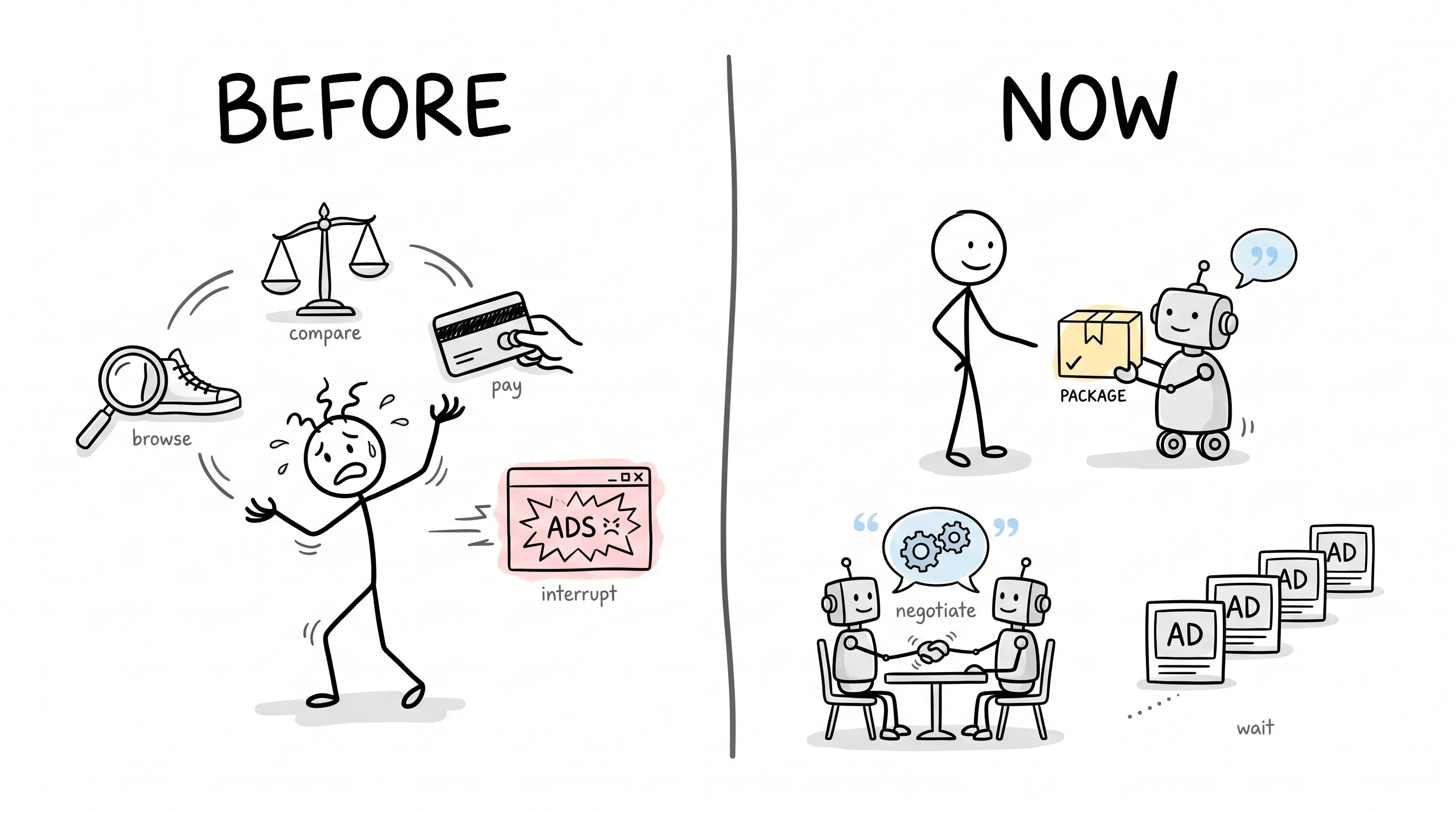
Before, buying a pair of shoes meant browsing yourself, comparing prices yourself, entering your card number yourself. Going forward, those jobs belong to AI. Before, a marketer running a campaign had to hook up with thousands of media sellers; going forward, an agent sits across the table. Before, ads popped up whenever they pleased; going forward, they'll have to queue and wait for you to finish the level.
Of course, whenever something new arrives, there are stumbles. What if the shoes AI bought you don't fit? What if the agent loses the negotiation? Will ads really politely wait for you to clear the level?
I don't have the answers.
But the direction is clear. It's the feeling Lütke described: relaxed, delightful. Shopping was always supposed to feel this way.
And here's wishing you: may every order AI places for you be something you truly want.
Continue reading
Related articles

Cross-Border Business: Time to Upgrade Your AI Toolbox
A learn article explaining how AI tools help cross-border e-commerce sellers clear five hurdles: language, regulation, logistics, payments, and fraud. It outlines a five-compartment toolbox, a five-step adoption path, and metrics such as conversion rate and CLV, while cautioning against over-reliance on AI.

AI Is Taking Over the Dirty Work of Social Media Marketing, One Task at a Time
This learn article outlines four social media marketing tasks AI can handle — audience analytics, content drafting and design, ad targeting and creative testing, and spam moderation — and cautions that taste, judgment, and data security remain human responsibilities.

AI Is Already This Good — Why Is Your Social Media Marketing Still Pure Manpower?
An overview of 18 AI tools for social media marketing, organized into six categories covering audience research, content creation, scheduling, comment and DM handling, ad management, and visual production, plus notes on personalization, prediction, and emerging trends.