
AI Has Muscled Its Way Into the Influencer Marketing Business
An overview of how AI is applied in influencer marketing, covering creator discovery, campaign performance prediction, and fake-follower detection, along with benefits, limitations such as cost and authenticity concerns, and steps for brands to adopt these tools.
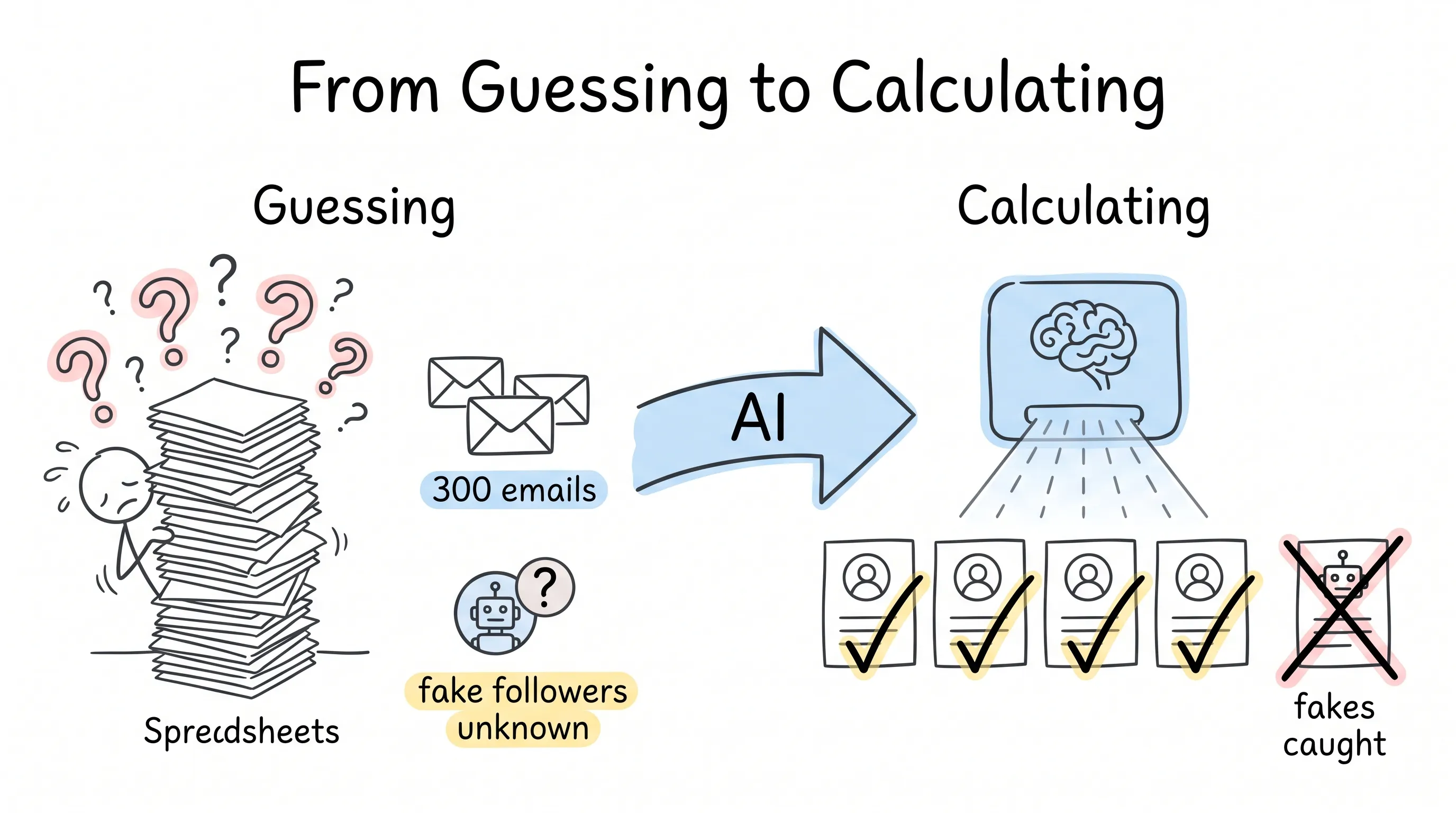
A while back, a friend of mine who runs a beauty brand came to me venting. She wanted a few influencers to push a new product launch, so two people on her marketing team spent an entire week going through spreadsheets, sent three hundred emails, and picked their finalists — and half of those influencers' followers were fake.
The money was spent, and the numbers were ugly.
I told her: this is a job a whole stack of AI tools can now finish in a few hours — and they'll flag every fake follower along the way.
She blinked: "AI has come this far already?"
Yep. So today, let's talk about AI and influencer marketing: where it stands, how it actually works, what the benefits are, and where the traps hide.
What Is AI-Powered Influencer Marketing?
First, the concept. What exactly is AI-powered influencer marketing?
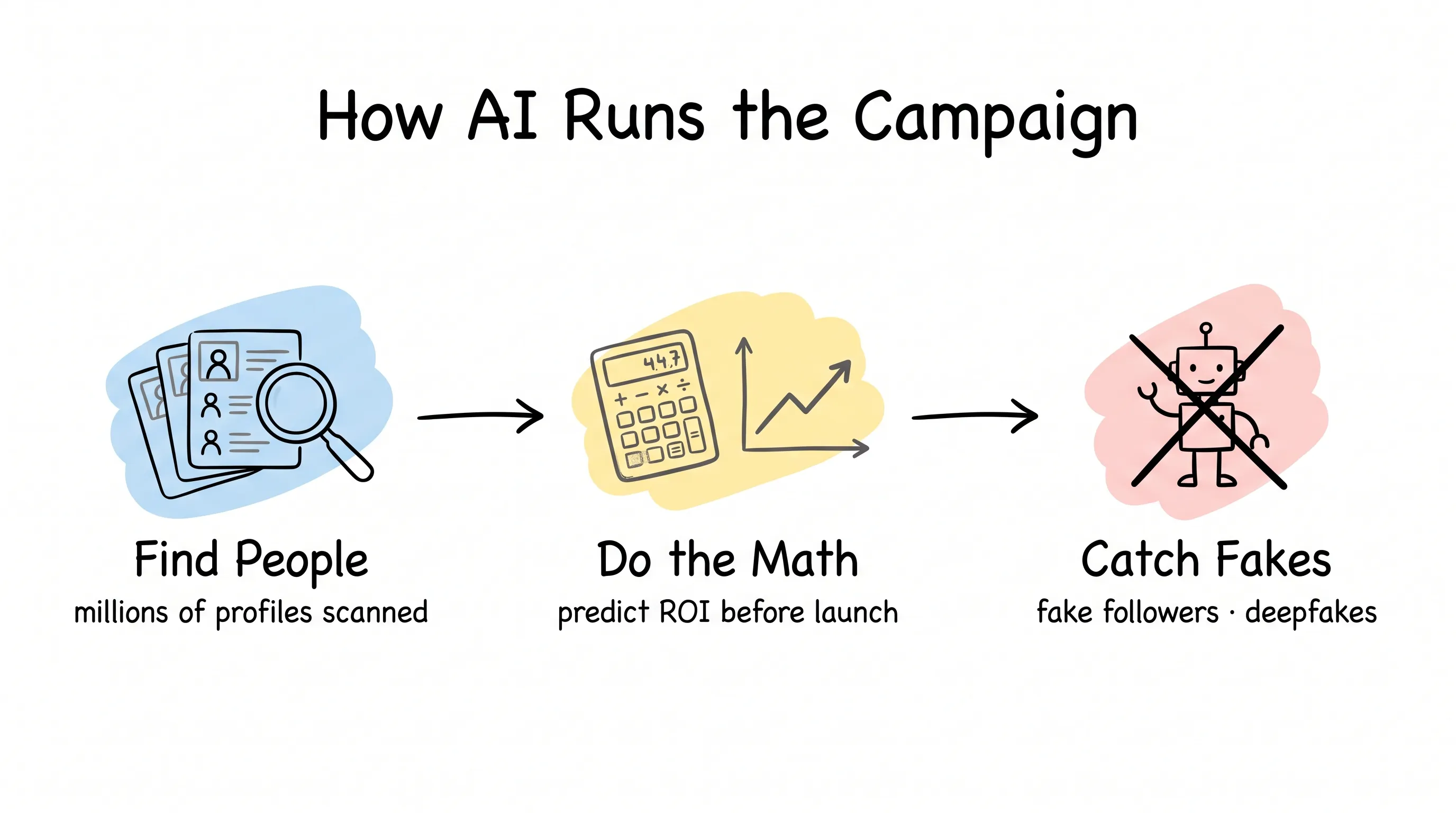
Put simply, it means using artificial intelligence to do three things for a brand: find the right people, run the campaign, and settle the books.
How did brands used to find influencers? By hand. Page after page of scrolling, data point after data point copied into Excel, then a decision made on gut feel.
Now? AI scans millions of creator profiles and analyzes hundreds of data points on each: audience demographics, engagement velocity, content themes, which brands they've mentioned in the past, and the sentiment in their comment sections. Then it tells you: these are the people who fit your brand best.
Fake followers? Caught in the same pass. Which accounts were mass-registered, which are bots, which comments are hollow filler — a machine can tell at a glance.
That is AI-powered influencer marketing: turning "guessing" into "calculating."
How Big Is This Business Now?
Let's look at the ledger.
In 2023, the global influencer marketing market was worth roughly $21.1 billion. Industry forecasts at the time projected it would surge to $32.5 billion by 2025 — a compound annual growth rate (CAGR) of 33%. What does that mean? It's growth that leaves traditional advertising eating its dust.
And standing behind this market is a creator economy worth more than $250 billion a year.
The money is flowing in, and so are the people. A 2025 industry survey found that 63% of practitioners plan to use AI and machine learning for creator discovery, fraud detection, and performance prediction. Venture capital moved even faster: in 2024, AI companies worldwide pulled in over $100 billion in funding; in 2025, AI platforms in the martech space hit new fundraising highs. Leading platforms like CreatorIQ, Grin, and Aspire have all baked machine learning into their core features for finding creators and managing campaigns.
The experimental phase is over. From beauty and fashion to consumer electronics, from food and beverage to travel and hospitality, every industry is putting AI into its influencer spend. Fashion brands are even putting CGI virtual influencers on the same stage as human creators — testing the concept on a small scale first, then scaling up once it proves out.
How Does It Actually Work?
Alright, here's the most interesting part: how does AI actually do the job? Let me walk you through it, start to finish.
Step One: Finding People
AI finds influencers with three moves.
Move one: AI-powered search. It sweeps millions of creator profiles at once, weighs hundreds of data points per profile — even the sentiment in the comments — and only then decides whom to recommend.
Move two: digging into your existing customers. AI first analyzes who your current customers are: age, region, buying habits, interests. Then it turns around and hunts for influencers whose followers look like those people.
Think about it — isn't this just precision "birds of a feather"? Whoever your customers love is who you should work with. The conversion rate takes care of itself.
Move three: match scoring. AI goes through a creator's entire history — captions, hashtags, brands they've partnered with, visual style — and judges whether they genuinely fit you, or will post anything for a paycheck.
Step Two: Doing the Math
This is the part I find most impressive.
AI can predict the ROI of a campaign before a single piece of content goes live. How? It trains on historical data from thousands of influencer collaborations to learn the patterns — which kinds of creators, content formats, and publishing strategies drive which kinds of engagement — then layers on your product's gross margins, industry conversion rates, that creator's track record of driving sales, and their followers' willingness to buy.
The battle hasn't started, but the books are already done.
And once it starts, real-time monitoring keeps watch: dozens of metrics checked every hour — engagement velocity, shifts in comment sentiment, share rates, clicks, conversions. If the wind turns, you adjust immediately.
In 2026, the leading platforms took another step forward: with large language models like GPT-5 built in, they can tell before anything is published whether copy was written by a human or generated by AI, whether it matches the brand's voice, even predict how audiences will react.
Step Three: Catching Fakes
This is the step that stops the bleeding for brands.
What do fake followers look like? AI scans thousands of accounts in seconds, hunting for these telltale signs: a batch of accounts registered on the same day, usernames that are pure gibberish, no profile pictures, following hundreds of people a day, with all their engagement coming from the same region.
Bot accounts? A handful of accounts interacting with the same piece of content over and over, posting identical comments, circling only around paid promotions. Caught every time.
The cleverest part is scoring engagement authenticity. AI uses natural language processing (NLP) to judge comment quality — a wall of "Awesome!" and "So supportive!" gets flagged as low-value engagement on the spot. It also checks whether the comments actually relate to the content, and whether it's the same batch of accounts saying the exact same thing under every post.
Here's the scary part: even the praise might be fake.
And it gets tougher: deepfakes can now be detected in real time. AI-generated faces, cloned voices — one quick check and they're exposed. Brands no longer have to worry about an endorsement video being spliced or swapped without their knowledge.
The Benefits Are Very Real
Time saved. Influencer discovery shrinks from weeks to hours; content review, progress tracking, and payment runs fully automated; overall campaign execution time drops by 40%.
Money saved. Automation cuts operating costs by 30% to 45%; the data steers you away from picking the wrong people and burning budget; and when you negotiate, market benchmark pricing is right there on the table — nobody gets away with wild quotes.
Precision targeting. Spread out the data from thousands of followers and the audience profile is crystal clear; you can fine-tune to reach narrow, high-precision niche circles; and the moment audience sentiment shifts, real-time monitoring sounds the alarm.
But There's Always a Flip Side
First, the Technology Isn't Omnipotent
Stanford HAI's 2024 AI Index report puts it bluntly: AI has surpassed humans on some image classification tasks, but on more complex visual reasoning — common-sense understanding and contextual judgment — it still trails us.
To translate: AI can read the numbers; it can't always read people.
Second, Small Businesses Can Barely Reach It
NEXT's April 2025 survey of 1,500 small business owners found that cost and complexity stand like two mountains between them and AI. Small business AI adoption actually fell from 42% in 2024 to 28% in 2025.
It's not that they don't want to use it — they can't afford to. Premium features like automated creator discovery and fake-follower detection come with premium price tags.
Third, Privacy
AI analyzes users' behavior, demographics, and interaction history — most of the time, users don't know it, and never explicitly consented.
Fourth, and Most Fundamental: Authenticity
What is the soul of influencer marketing? Realness. A living, breathing person who genuinely loves something and tells you about it.
Once brands start using AI to ghostwrite and influencers just read the script aloud, that real connection thins out. Followers aren't fools — they can smell whether there's sincerity in the copy.
AI handles the data; humans handle the sincerity. Don't get that division of labor backwards.
Want to Actually Use It? Here's How to Land It
Boston Consulting Group's October 2024 study, "Where's the Value in AI?", offered one heavyweight number: companies that build their AI capabilities properly grow revenue 50% faster than their peers.
But "properly" doesn't mean one big all-in bet. It means four steps:
- Take stock first: what is this campaign's goal, and which parts can be automated?
- Set the budget: according to the size of your company, not the trend of the moment.
- Pilot small: start with 3 to 5 creators and get the process running end to end.
- Once it works, scale it to all your campaigns.
For choosing a tool, three tests: how long the team will need to get up to speed; whether it integrates via API with your existing marketing stack; and how accurate its data is, how large its creator database is, and how it charges. If you're a small business on a tight budget, don't panic — there are lightweight tools on the market covering discovery, tracking, and basic analytics. Enough to get going.
While We're Here, Three Misconceptions to Clear Up
Are "AI influencer marketing" and "virtual influencers" the same thing? No. Virtual influencers are CGI-built characters like Lil Miquela and Imma, run by creative agencies, with entirely fictional personas. AI-powered influencer marketing means using machine learning to optimize the whole workflow — the stars are still human creators.
Will AI replace human influencers? No. It works for you; it doesn't stand in for the person themselves. The data backs this up: AI-optimized campaigns do convert better, but human-led campaigns build stronger emotional connections and higher repeat purchase rates.
No ethical landmines? Plenty. Data privacy, undisclosed AI content, algorithmic bias (matching systems favoring certain demographics while squeezing out other creators) — every one of these is a live wire. AI even runs the contracts now: auto-generating agreements, tracking deliverables, monitoring compliance, issuing payments automatically. The wider the machine's reach, the more carefully those boundaries need thinking through.
Two Last Things
Back to my friend with the beauty brand. Later, her team ran one trial with AI-powered creator selection: a shortlist in a few hours, a fake-follower check on top, and only then did they launch. She said something that stuck with me:
"If I'd known those spreadsheets were a waste of time, I'd never have touched them."
AI is making every "calculating" part of influencer marketing faster and more precise. But what calculation produces is candidates — not trust.
Trust is something machines, for now, cannot manufacture.
And my wish for you: may you never again have to hunt for an influencer across a few hundred pages of Excel.
Continue reading
Related articles

Cross-Border Business: Time to Upgrade Your AI Toolbox
A learn article explaining how AI tools help cross-border e-commerce sellers clear five hurdles: language, regulation, logistics, payments, and fraud. It outlines a five-compartment toolbox, a five-step adoption path, and metrics such as conversion rate and CLV, while cautioning against over-reliance on AI.

AI Is Taking Over the Dirty Work of Social Media Marketing, One Task at a Time
This learn article outlines four social media marketing tasks AI can handle — audience analytics, content drafting and design, ad targeting and creative testing, and spam moderation — and cautions that taste, judgment, and data security remain human responsibilities.

AI Is Already This Good — Why Is Your Social Media Marketing Still Pure Manpower?
An overview of 18 AI tools for social media marketing, organized into six categories covering audience research, content creation, scheduling, comment and DM handling, ad management, and visual production, plus notes on personalization, prediction, and emerging trends.