
AI Has Done the Shopping for You — So Why Won't We Let It Pay?
An analysis of why consumers let AI research and compare purchases but hesitate to hand over payment, covering trust, merchant liability, and agentic commerce. It also discusses how merchants can respond when customer journeys start inside AI tools.
A few days ago, I asked AI to help me pick out a coffee machine.
It did a great job. It went through a dozen-plus brands, compared prices, dug through the reviews, and came back with three recommendations — reasons included.
And then?
Then I closed it, opened my shopping app myself, and started browsing all over again from scratch.
Sound familiar? I trusted every bit of its work — except the very last step. Payment. That, I didn't dare hand over.
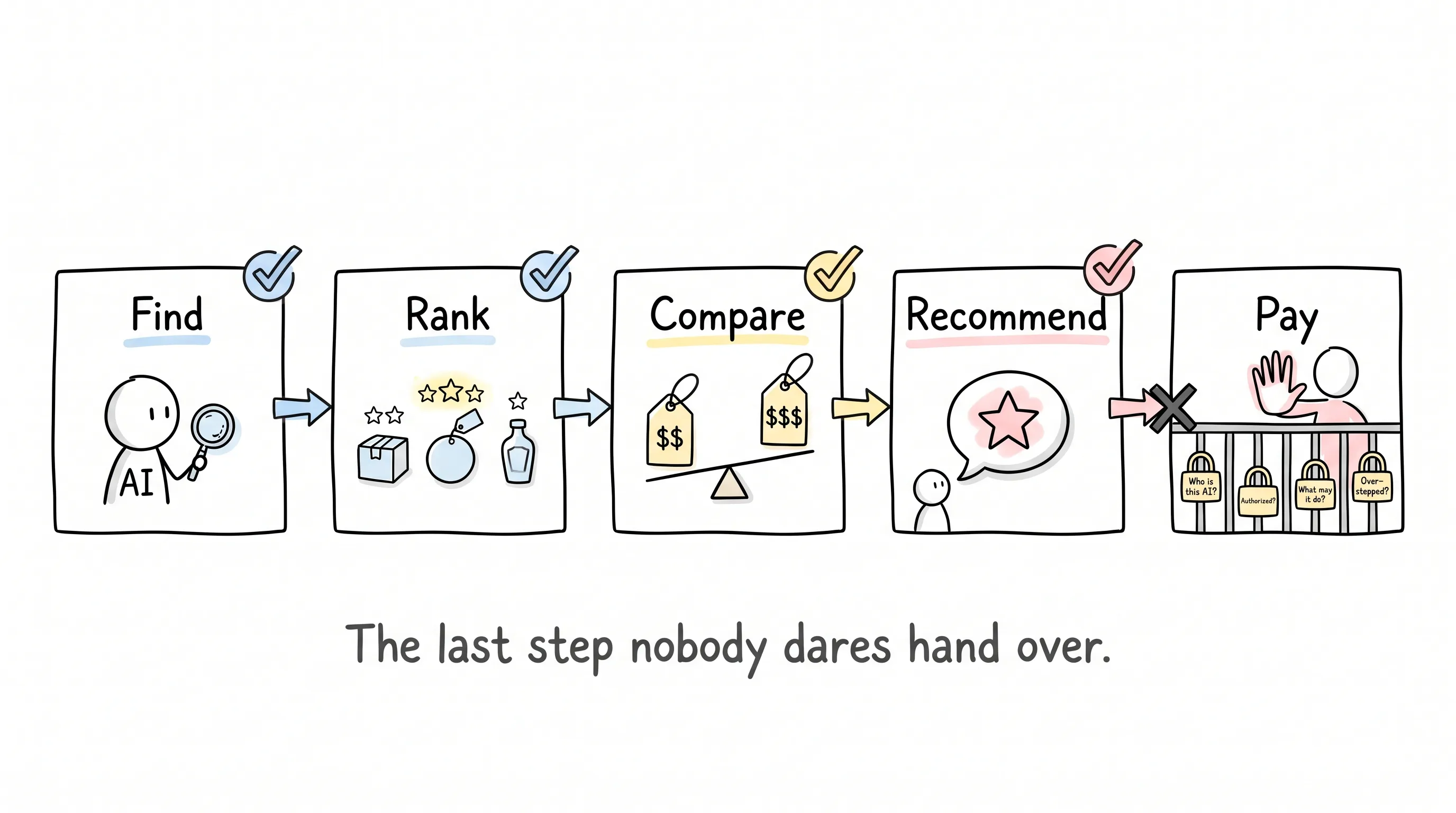
Gaurang Shah, Executive Vice President of Global Acceptance and Merchant Solutions at Mastercard, recently called this out in a conversation: the search has long since happened. Consumers are already using AI to find things, rank options, and compare prices — the barrier is so low that trying it costs nothing. But they all stop at the recommendation.
What does "stopping at the recommendation" mean?
It means the AI has done all of the advisor's work, yet never gets the authority to place the order.
Why Not? Two Ledgers That Don't Reconcile
The reason comes down to one word: trust.
The consumer's ledger is simple: if something goes wrong, you have to take care of me. I don't care whether it was AI that pressed the buy button — I got burned, so somebody has to make it right.
The merchant's ledger reads differently: the order was matched up by that AI, so why should any fallout land on me? The liability should sit with the intermediary on the AI side.
Notice something? Neither side is wrong. But the two ledgers don't reconcile.
That's why Shah offered a remarkably precise line: what the next generation of agentic payments has to move is not just money, but proof.
Proof of what? Of making the system believe four things: who this AI is, whether the user genuinely authorized it, what it is permitted to do, and whether it has overstepped.
Today, not one of the four can be answered.
It's like a company taking on a new assistant and telling him, go buy some office supplies. He walks out with the company card. The CFO's first question isn't whether there's enough money — it's: how do we restrict this card? If he buys what he shouldn't, whose problem is it?
The Merchant's Trust Equation
Shah calls the situation merchants face the trust equation.
A merchant needs to confirm that the AI arriving at its checkout is real, not a counterfeit; that behind the order there is a real person, who is aware and who has consented; and that the AI's actions have stayed inside the authorized boundary the entire time.
Four gates — and not one of them can go unguarded.
And what really keeps merchants up at night is something else: where do customers come from now?
Consumers these days are already using AI to "discover, rank, and compare" — and once they're done comparing, they go back to the familiar old place to place the order. What does that mean? It means the starting point of the customer journey has already moved. Moved to a place the merchant cannot see.
Before a merchant has even decided whether to join agentic commerce, its own customers have already been filtered through a first round on somebody else's turf.
This Wave of Middlemen Is Different
Some merchants will say: I'm not panicking. Every wave of new channels, I have weathered.
Correct. When search engines arrived, merchants learned to do search rankings. When e-commerce platforms arrived, merchants learned to open storefronts. When mobile apps arrived, merchants learned to build their own apps. When social media arrived, merchants learned to drive social product recommendations.
With every layer of new middleman, merchants paid the tuition and built up the muscle.
But Shah flagged one crucial difference.
However strong the middlemen of the past were, they only decided what you see. This time's middleman may decide what you buy.
That's a difference of magnitude.
The Merchant's Choice: Take Both
So do merchants shut their doors and hide, or hand over their fate?
Neither. Shah says the merchants he has talked to almost all want both.
One hand: open their product catalogs to outside AIs, so that wherever customers ask, they can find you. The other hand: build an equally good AI experience on their own turf. Across the two channels, products, prices, and service must be at parity — you cannot let consumers buy two different things depending on whether they're in your store or in an outside AI.
In plain terms: go where the consumers are.
But there is a big landmine buried here.
The War of the Cheapest Qualifying Product
For a shopping AI, what is the simplest optimization target?
Find the cheapest product that qualifies.
For AI, this is the smartest goal: price is quantifiable, sortable in one click, clean and crisp. For brands, it is devastating: if every AI recognizes only price, then competition reduces to one thing — cutting prices.
And where merchants actually make their money is precisely the things AI struggles to encode: brand, service, authenticity, membership benefits, the returns experience, the preferences consumers can't put into words.
Price can be calculated; these cannot. But profit hides exactly in what can't be calculated.
So the real battlefield ahead is not whose AI is more capable. It is what gets written into the optimization target when the industry sets the rules.
The Escalation, One Step at a Time
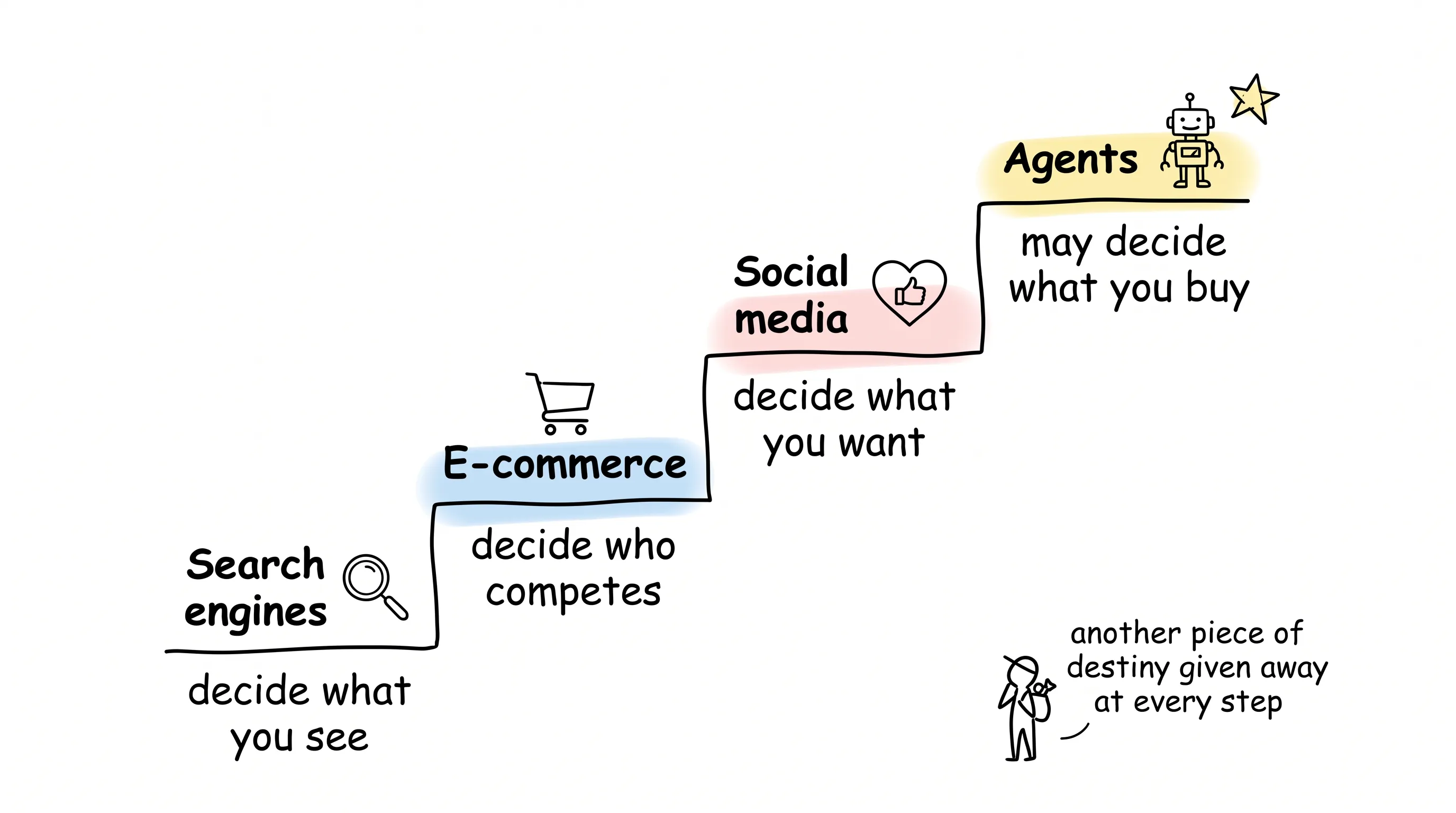
Follow the whole arc and you'll see it climbing one stair at a time:
Search engines decide what you see.
E-commerce platforms decide who competes with whom.
Social media decides what you want.
Agents may decide what you buy.
Every step the middleman advances, merchants give up another piece of their destiny.
Back to That Coffee Machine
So back to the coffee machine from the beginning.
Why didn't I dare let AI pay? Because nobody has yet proven to me: that it knows what it is doing, that it hasn't crossed the line, and that if something goes wrong somebody will make it right.
What the Shahs of the world now need to solve is exactly this proof.
The day the proof is delivered and you dare hand the payment button to AI — that is when real agentic commerce begins. Until then, AI is just the most capable sales assistant in the whole world, and closing the deal is still on you.
This is my judgment. It may not be right.
But think about it: the payment button — who would you dare hand it to?
Continue reading
Related articles

Cross-Border Business: Time to Upgrade Your AI Toolbox
A learn article explaining how AI tools help cross-border e-commerce sellers clear five hurdles: language, regulation, logistics, payments, and fraud. It outlines a five-compartment toolbox, a five-step adoption path, and metrics such as conversion rate and CLV, while cautioning against over-reliance on AI.

AI Is Taking Over the Dirty Work of Social Media Marketing, One Task at a Time
This learn article outlines four social media marketing tasks AI can handle — audience analytics, content drafting and design, ad targeting and creative testing, and spam moderation — and cautions that taste, judgment, and data security remain human responsibilities.

AI Is Already This Good — Why Is Your Social Media Marketing Still Pure Manpower?
An overview of 18 AI tools for social media marketing, organized into six categories covering audience research, content creation, scheduling, comment and DM handling, ad management, and visual production, plus notes on personalization, prediction, and emerging trends.