
AI Exposes What Your Brand Guidelines Leave Unsaid
A learn article on how AI exposes the unwritten half of brand guidelines. Through a story of an AI customer-service refund refusal and off-brand AI artwork, it argues that judgment once carried by people must be written into systems so brands can keep pace with AI execution.
A few days ago, I had dinner with a friend who works in branding.
He has been in the business for more than a decade — the most feel-driven person in my circle. This year his company rolled out AI: AI runs customer service, AI generates the artwork, and even the first-round replies to customer complaints come from AI.
Within two weeks, two things happened.
First: the AI customer-service agent refused a customer's refund. Solid reasoning, every clause in order — technically flawless. But under the company's unwritten rule, this was the kind of case you refund. Eight hundred dollars. The AI didn't.
Second: the AI produced a poster, and everyone who saw it called it premium. But that premium didn't look like their brand.
He tapped the rim of my glass: "Run, isn't that strange? The guidelines are still the same guidelines, and AI works a hundred times faster than people. So how did things go wrong?"
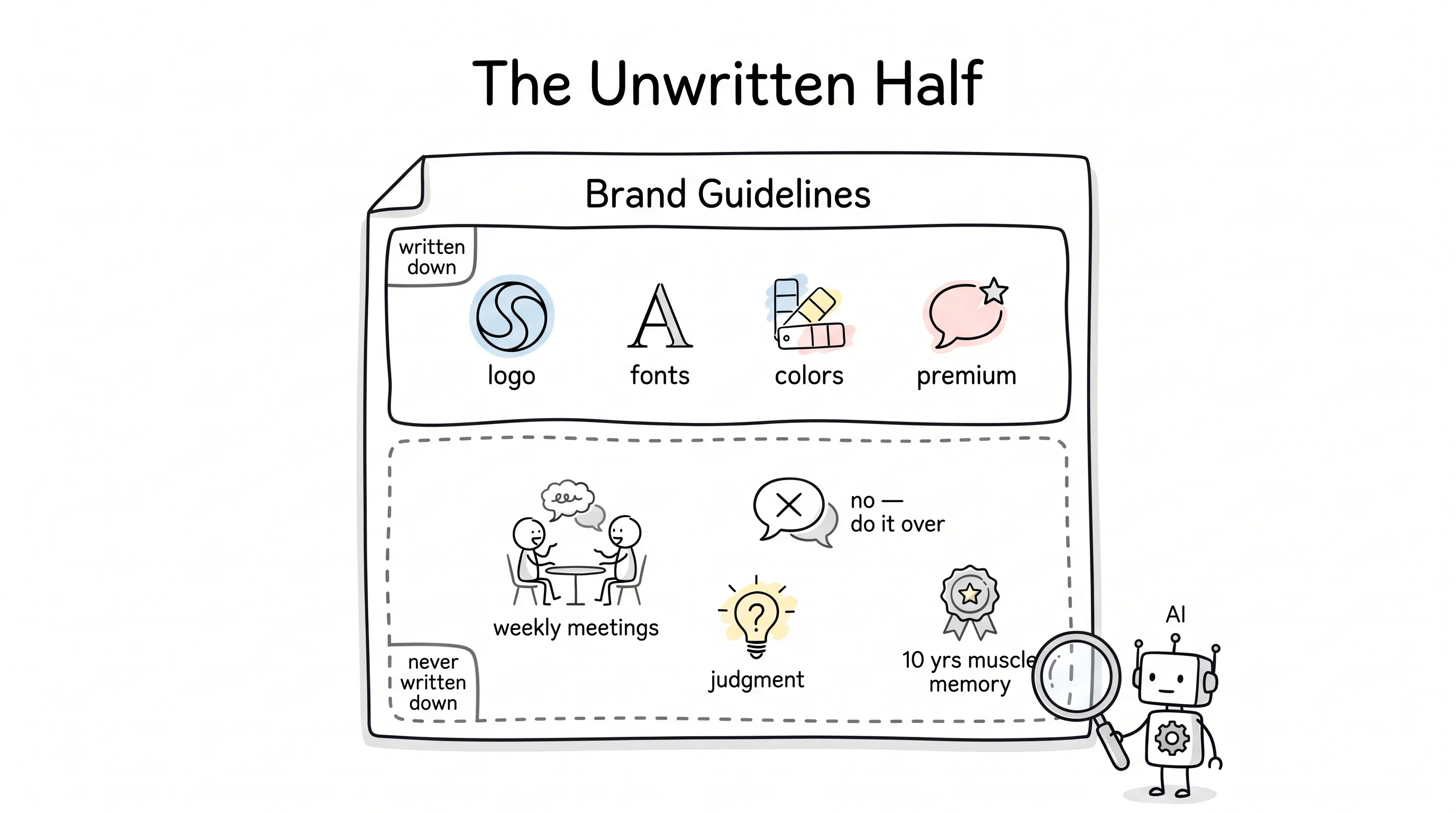
I said this was well worth talking about. Because what it exposes is the half of every brand guideline that exists but has never been written down.
What Does "Premium" Even Mean?
Pull up your company's brand guidelines and you'll most likely find a pile of adjectives: friendly, customer-first, bold, bold but never arrogant.
So let me ask you: what exactly does "premium" mean?
Have ten people in your company each produce one piece of external communication from the same guidelines. You'll get ten different kinds of "premium". By the tenth, it may have nothing to do with the first.
That's brand drift.
So why did this never cause major trouble before?
Because the guidelines are only half of the operating system. The other half lives in people: the training, the culture, the creative director's "no — do it over", the veterans with a decade or more in the trade, the muscle memory built from being burned time and again... These things fill in what the guidelines never said.
The drift was always there. Someone was just always holding it down.
AI Doesn't Attend Your Weekly Meeting
Let's be clear about one thing first: the foundations of branding haven't changed one bit. Positioning, differentiation, audience, culture, values — still the same things.
So what has changed?
The execution environment.
Brand guidelines used to be written for "people". And people can figure things out. Soak in a company for five years, sit in on the founder's meetings every day, and much of what was never written down, you just pick up.
And AI?
AI doesn't attend weekly meetings. AI doesn't learn by osmosis. AI doesn't know that the word "candor" sounds reassuring in a product-update announcement, and sounds like recklessness in a security-incident report.
AI knows even less that the last three times the same situation came up, management quietly made the same exception. And that exception never made it into the guidelines.
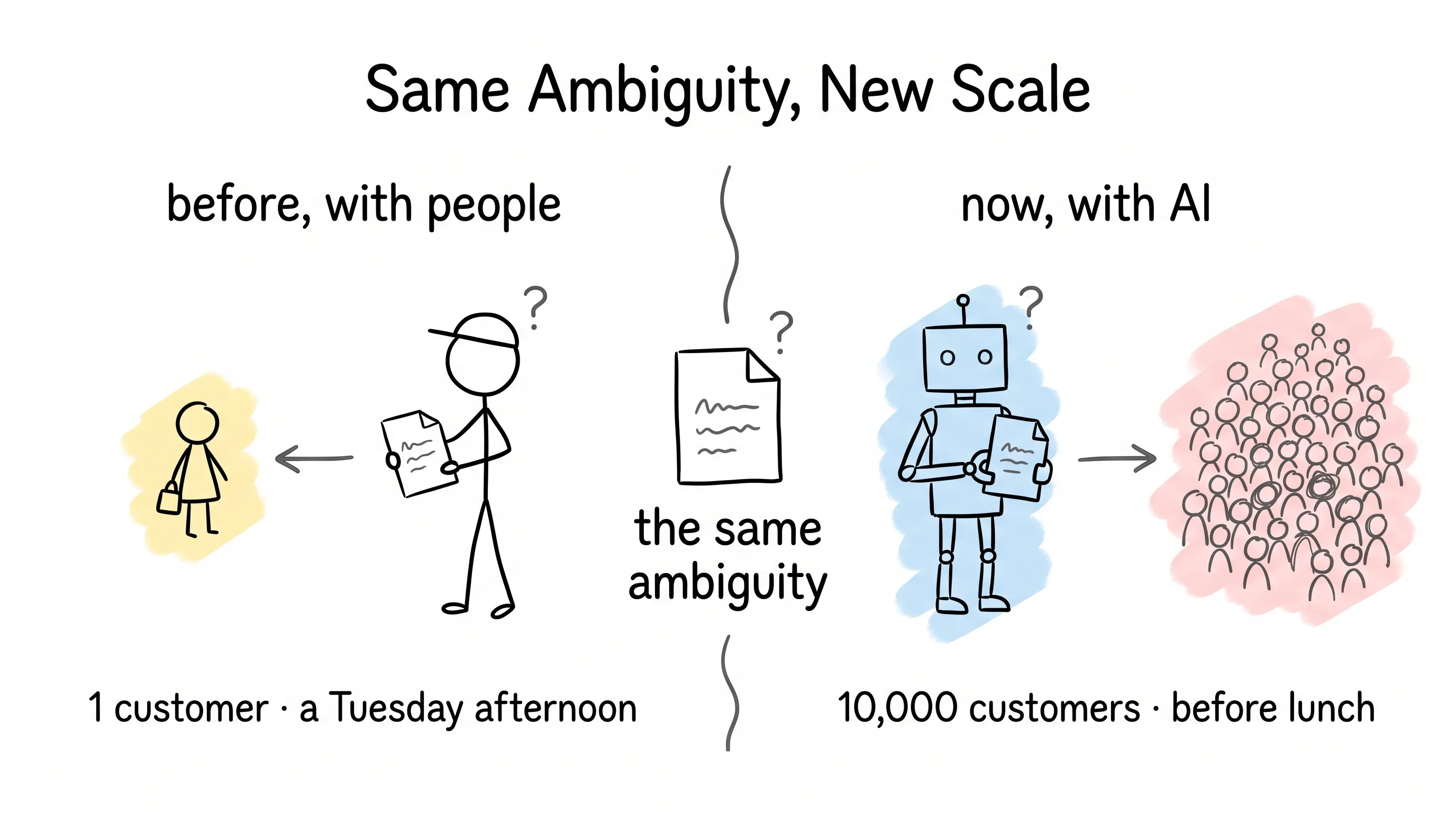
One employee misreads one guideline, and one customer is affected. Maybe on some Tuesday afternoon.
One AI misreads the same guideline, and ten thousand customers are affected before lunch.
The ambiguity is the same ambiguity — but for the first time, it has scale.
That said, a tool that forces you to say things clearly is usually a good tool. Flip this new risk over, and it's a new opportunity.
Let Me Tell You About Someone
At my friend's company there's a branding veteran who's been at it for more than a decade. We all call her Sarah.
The guidelines say: empathetic, but efficient.
What does "empathetic but efficient" mean? What does it mean for a furious customer? And for one who's panicking?
Sarah doesn't have to think. She knows in a second.
She still remembers the time someone requested an over-the-limit discount and the request worked its way up to the boss, who slammed the table: No. From that day on, she never passed one of those requests up the chain again.
Two people just as capable as Sarah could read the same line of the guidelines and land in two different places. For sixty years this was never a crisis. Why?
Because no matter where they landed, there was always a living person who smoothed over the crack before the customer ever noticed.
Sarah was the brick that filled the crack between the documentation and the decision.
Now there's no Sarah in the execution chain. And the crack just sits there, open.
Branding Has Shifted from "What I Say" to "What I Do"
For most of its history, a brand was a static object. The logo hung there, the tagline stood there, and however beautiful the website, it just sat quietly waiting for someone to click.
AI doesn't wait.
It recommends, it reprices, it upgrades, it promises. It acts first, then waits for your review.
Now think again about the map of your brand. The places where the brand is spelled out most clearly have always been the places marketing controls. The further you go toward customer service, toward billing, toward renewals and disputes, the blurrier it gets. Is the brand still present in those places?
It is. Held up entirely by company culture and the split-second judgment of whoever happens to be on shift.
AI has opened up this territory. Brand judgment can now travel the entire decision chain from end to end, instead of governing only the opening tagline.
Within 400 milliseconds, the AI has to decide its next move.
A guideline made of adjectives can't answer a single question inside those 400 milliseconds.
So brand strategy now has to answer a few more questions: What do we do? What do we refuse to do? When something happens that the guidelines never anticipated, who makes the call?
Canva Closes the Easy 10%
On this, Canva has actually offered half an answer.
Enter your logo, fonts, and color palette into Canva once. After that, anyone in the company can produce designs without review, and whatever comes out stays on the brand's rails. And nobody slows down. Quite the opposite — the rails make people faster. Because the constraints no longer depend on someone watching; the rails do the blocking themselves.
Brilliant.
But think about it: colors and fonts are the easy 10% of brand consistency.
What's the hard part?
Tone under pressure. And which value you protect when two values that are both right collide.
Laying rails over that part used to look impossible. Because judgment shifts with context, and hex values don't.
Now, that "impossible problem" is the brand team's homework. What AI needs isn't just a manual of "what the brand looks like and how it talks". It needs part of the company's judgment written down and built into the system.
Finally, Back to That Dinner
As we were leaving, I asked my friend: what happened with that $800?
He said: what we've been doing lately comes down to one sentence — writing out the rules in the boss's head, one by one.
I said: yes. That's exactly it.
In the past, a brand's real edge was hidden in the half that was never written down. From now on, only the brand that writes that half down first will be able to keep up with AI's speed.
And here's wishing you never have to wait for AI to mess up first before you go back and fill in that missing page of your guidelines.
Continue reading
Related articles

Cross-Border Business: Time to Upgrade Your AI Toolbox
A learn article explaining how AI tools help cross-border e-commerce sellers clear five hurdles: language, regulation, logistics, payments, and fraud. It outlines a five-compartment toolbox, a five-step adoption path, and metrics such as conversion rate and CLV, while cautioning against over-reliance on AI.

AI Is Taking Over the Dirty Work of Social Media Marketing, One Task at a Time
This learn article outlines four social media marketing tasks AI can handle — audience analytics, content drafting and design, ad targeting and creative testing, and spam moderation — and cautions that taste, judgment, and data security remain human responsibilities.

AI Is Already This Good — Why Is Your Social Media Marketing Still Pure Manpower?
An overview of 18 AI tools for social media marketing, organized into six categories covering audience research, content creation, scheduling, comment and DM handling, ad management, and visual production, plus notes on personalization, prediction, and emerging trends.