
AI Content Marketing Is Shifting From a Bonus to the Passing Grade
An explainer on why AI content marketing is becoming a baseline expectation, covering AI-driven search visibility, faster ad creative testing, multi-platform content adaptation, and how AI redistributes content teams' time toward judgment and insight.
Last month, an old friend of mine who runs an industrial equipment business invited me to dinner. Halfway through the meal, he started sighing.
I asked what was wrong.
He told me his company cut two content editor positions last year, yet the boss wanted double the content anyway. The website blog needed updating, the WeChat Official Account needed updating, Xiaohongshu needed updating, WeChat Channels too. What stung even more: clients started asking, "Why aren't you doing AI search optimization?"
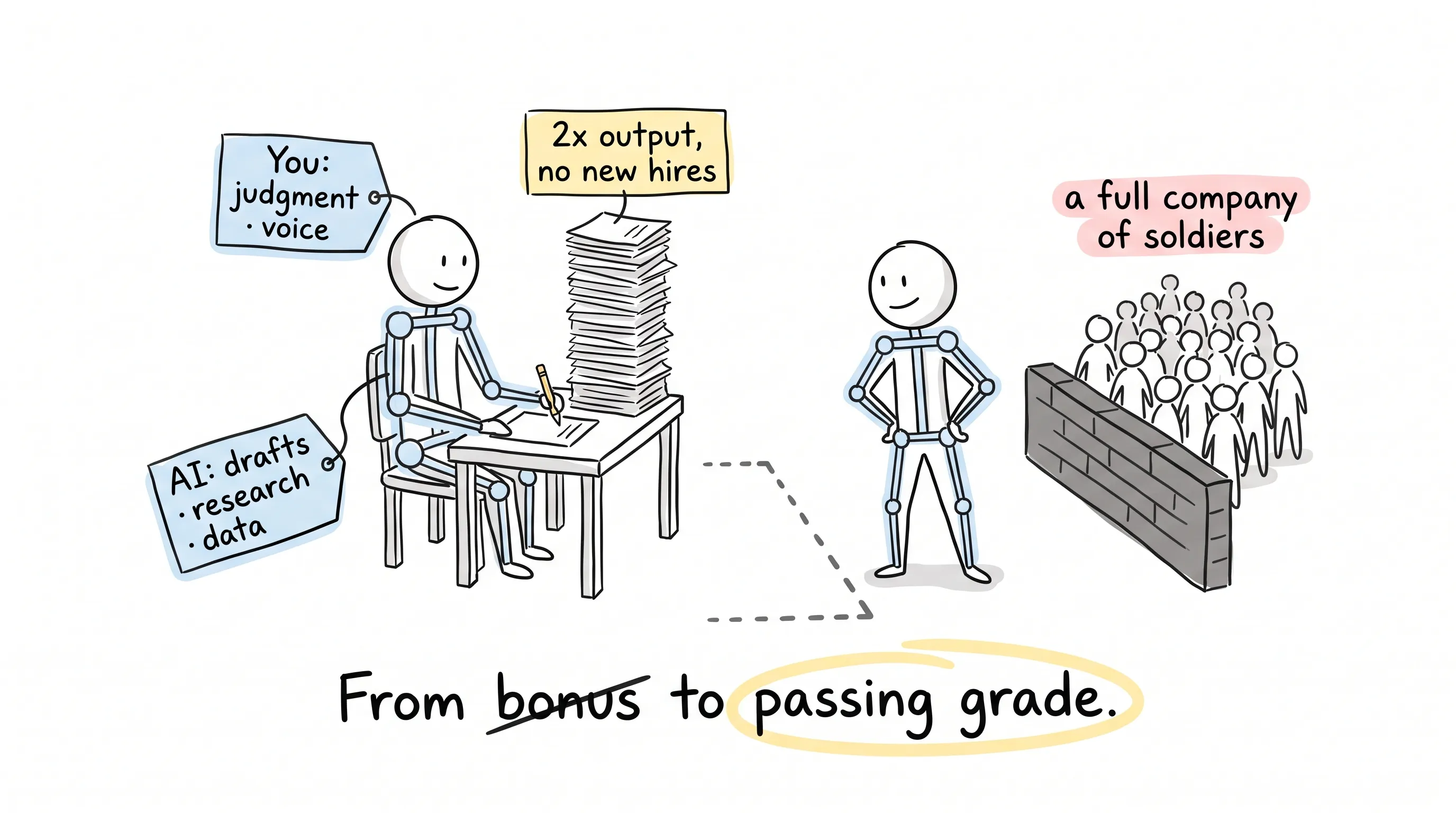
Then he asked me: how am I, one person, supposed to beat a full company of soldiers?
I said, you're right — you can't. But you can gear yourself up with an exoskeleton.
That's what I want to talk about today: AI content marketing. Why I say it's no longer a bonus — it's the passing grade.
What Is AI Content Marketing? Don't Jump Straight to "AI, Write Me an Article"
When many people hear the term, the picture that pops into their heads is: saying "write me a promo piece" into a chat box, then copy-pasting the result.
That isn't AI content marketing. That's cutting corners.
Real AI content marketing is a production model where the machine does the work and the human steers the ship: AI handles the research, finds the topic gaps, produces first drafts, adapts them for each platform, and watches the data; humans set the direction, guard the brand's voice, and make the final calls.
One is the hands, the other is the brain. Lose either, and the whole thing grinds to a halt.
Why has it become impossible to dodge over the past two years? Because you're fighting three battles at the same time.
The First Battle: Search
Have you noticed that when you search for something now, the results page often opens with an AI-generated summary?
Search engines themselves have turned into AI. They no longer match your keywords word by word; they puzzle out what you're really asking, then pick the content they believe understands the question best to answer it.
And that's where it gets interesting.
The old SEO game — stacking keywords and trading backlinks — was like memorizing past exam papers. Now the examiner has changed. What's being tested is whether you cover a topic fully, deeply, and consistently over time.
What does that mean? Say you make industrial dust collection equipment. Users might ask "what are the workshop dust concentration standards," or "bag filters vs. cartridge filters, how do I choose," or "how often should dust collection equipment be serviced." Every single question needs an answer, answered professionally, and all the answers need to link together into a web.
Can you weave that web by hand?
A competent writer — researching, writing, illustrating, formatting — grinds out two or three pieces a week at best. Your competitor, running an AI-backed workflow, rolls out the same volume of work in a few days and, while they're at it, fills in the site structure, internal links, and FAQs too.
Their writing may not be any better than yours. But they've claimed the ground of "covering it all" first.
The examiner has changed the scoring rubric. You can't still be sitting in the classroom memorizing last year's past papers.
The Second Battle: Paid Ads
If search is a slow craft, paid traffic is the fast game. And AI's advantage in the fast game is scary big.
Let me run the numbers for you.
Say you're running a feed ad and want to test 10 headlines and 10 images — combined, that's 100 versions. By hand, that's a week of production. Then another week to launch and collect data.
With AI? 100 versions in a single day. Run them for three days, the data comes back, kill the weak versions, and regenerate a new batch from the winning elements. One iteration cycle shrinks from two weeks to three or four days.
Over a year, you've run 100 iterations; competitors on the old method ran 25. Who do you think knows the audience's appetite better?
And AI can handle one thing people constantly forget: alignment. The ad shouts "30% energy savings," the user clicks through, and the landing page says "industry-leading." When the words don't match, the money leaks. Hand the watching to the machine, and make every layer say the same thing.
Whether your ad budget leaks isn't decided by its size — it's decided by whether every layer is saying the same thing.
The Third Battle: Multi-Platform
The third battle is the most grinding.
One product: a 3,000-character deep dive for the WeChat Official Account, a light and breezy photo-and-text post for Xiaohongshu (China's Instagram-like lifestyle platform), a 30-second cut for Douyin (China's TikTok), a professional long-form answer on Zhihu (China's largest Q&A platform). And now there's a brand-new stall at the market: AI assistants. Users are starting to ask AI directly "which brand is good" — and your content has to be something the machine can read and quote.
Every platform has its own register, too. The seriousness that works on your WeChat Official Account, transplanted as-is onto Xiaohongshu, is a disaster.
So what do you do?
Have you seen the central kitchen of a restaurant chain? Recipes, sauces, quality control — all managed in one kitchen; each branch then fine-tunes to local tastes.
An AI content workflow is that central kitchen: core topics and viewpoints produced in one place; facts and messaging managed in one place; distributed to every platform, rewritten into that platform's shape — but the voice is the same one voice.
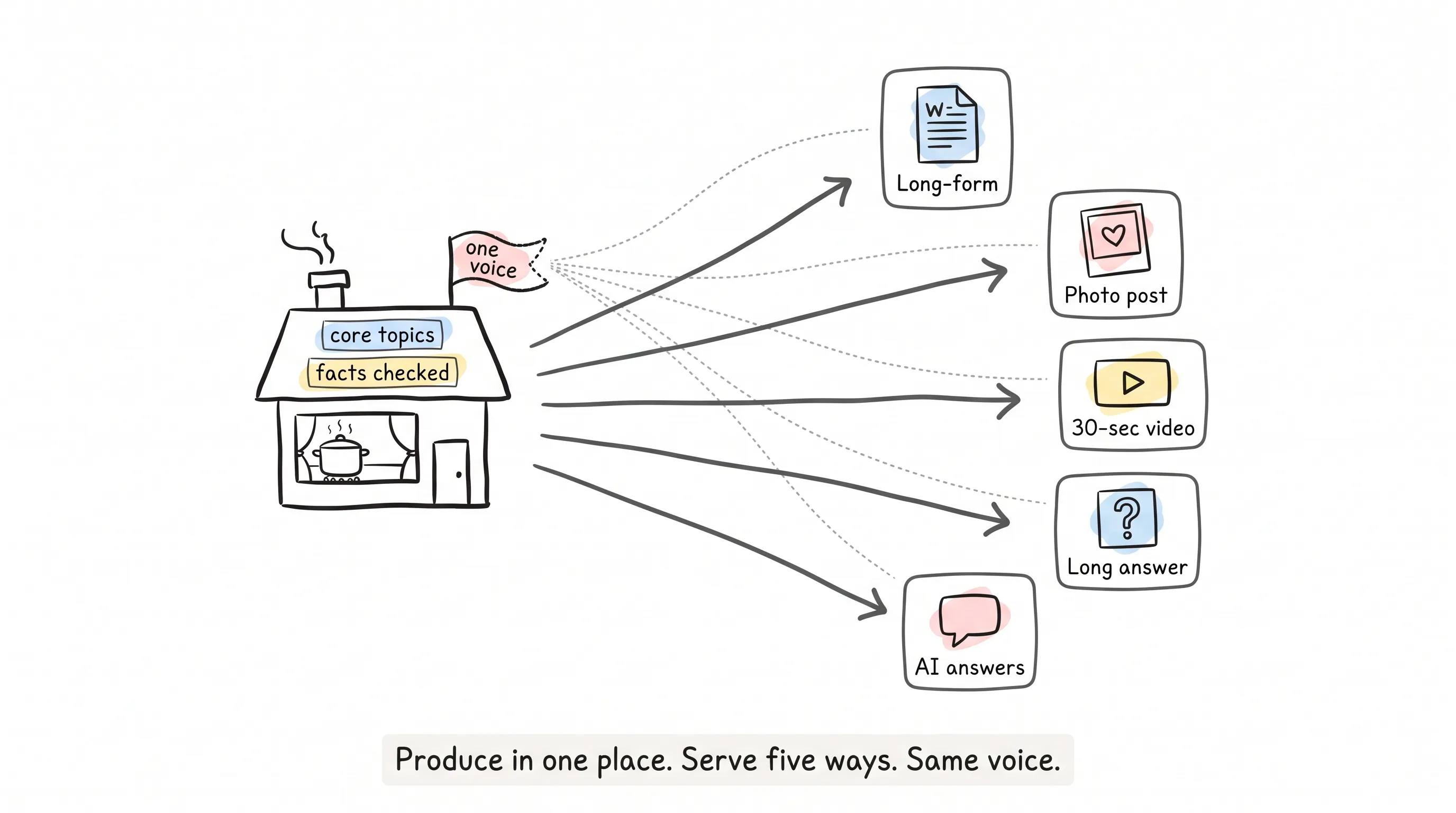
The biggest cost of manual cross-posting isn't even the slowness. It's the scattering. Three platforms, three different stories, and users get lost halfway through: wait, are these two the same company?
So, Will People Lose Their Jobs?
Every time I get to this point, someone asks: is the content team about to be disbanded?
My view is exactly the opposite.
What AI does well is repetitive labor: research, formatting, first drafts, watching data reports. These chores eat up 80% of a writer's time while producing only 20% of the value.
The 20% that's truly valuable is the judgment behind how a brand speaks, and insight into its users. That, AI can't do now — and won't do well any time soon.
So don't be afraid. What you should really worry about looks different: your writer spends half their time on formatting and hunting for images, while your competitor's writer spends half their time sharpening insight.
AI won't replace content people. But it will redistribute their time: the 80% it saves should go back into thinking.
Want to Start? Clear Four Questions First
By now you may be itching to get going. Don't rush to buy tools.
The market is awash with AI tools, and most of them end up the same way: a one-month trial, then gathering dust in your subscription list.
Before you act, ask yourself four questions.
First: does it understand "intent"? Can it help you find what users are asking and where the topic gaps are, instead of just chiming along with whatever you say?
Second: can it transform? Can one piece of content become versions for five platforms, rather than a one-click copy-paste?
Third: is there a feedback loop? After you publish, can the data flow back and tell it which types of content to do more of, and which to stop?
Fourth: will the tone drift? The more a machine writes, the flatter a brand's voice tends to become. Is there a way to nail your tone into every single version?
If you can answer all four, go ahead. If you can't, what you're missing isn't a tool — it's a playbook. Anyone can buy tools. The playbook is what separates winners from losers.
It's like working out. Buy a treadmill for your home, and odds are it ends up as a clothes rack. Hire a coach to set the plan and fix your form, and you'll actually keep training.
Back to That Dinner
A few days ago, I ran into that friend again.
Without adding a single hire, their content output doubled: the question library on their website is filled in, the voice across five platforms is unified, and even the AI search answers about their industry have started citing their material. He said the team's biggest change was going from "we can't write fast enough" to "we think deeper."
He also said something that left a deep impression on me: "We used to compete with rivals on who could write more. Now we compete on who thinks more clearly and covers more ground."
Exactly. Search, paid traffic, multi-platform — three battles raging at once. Nobody wins on typing speed alone.
Here's wishing your content team an early upgrade: from an artisan workshop to a regular army wearing exoskeletons.
Continue reading
Related articles

Cross-Border Business: Time to Upgrade Your AI Toolbox
A learn article explaining how AI tools help cross-border e-commerce sellers clear five hurdles: language, regulation, logistics, payments, and fraud. It outlines a five-compartment toolbox, a five-step adoption path, and metrics such as conversion rate and CLV, while cautioning against over-reliance on AI.

AI Is Taking Over the Dirty Work of Social Media Marketing, One Task at a Time
This learn article outlines four social media marketing tasks AI can handle — audience analytics, content drafting and design, ad targeting and creative testing, and spam moderation — and cautions that taste, judgment, and data security remain human responsibilities.

AI Is Already This Good — Why Is Your Social Media Marketing Still Pure Manpower?
An overview of 18 AI tools for social media marketing, organized into six categories covering audience research, content creation, scheduling, comment and DM handling, ad management, and visual production, plus notes on personalization, prediction, and emerging trends.