
AI Content Is Getting Its "ID Card": Three Stories from the Marketing World This September
A September industry roundup covering three AI-marketing developments: EU AI Act disclosure and watermarking rules for synthetic content, a reported 86% drop in ChatGPT's Reddit citations, and changes to Google Demand Gen, offline conversion uploads, and Meta AI's ad account integration.
The other morning, I was doing my usual routine — scrolling through industry group chats over breakfast. In half an hour, three messages landed one after another, each more interesting than the last.
One said the EU's big AI law is finally getting serious — even Anthropic has signed on.
One said ChatGPT has all but stopped citing Reddit — citations are down 86%.
And one from the ads side: Google has pushed Demand Gen into the spotlight.
I turned all three over in my head and realized they point to the same question: in an era when AI is everywhere, what exactly should marketers stand on?
Let me take them one at a time.
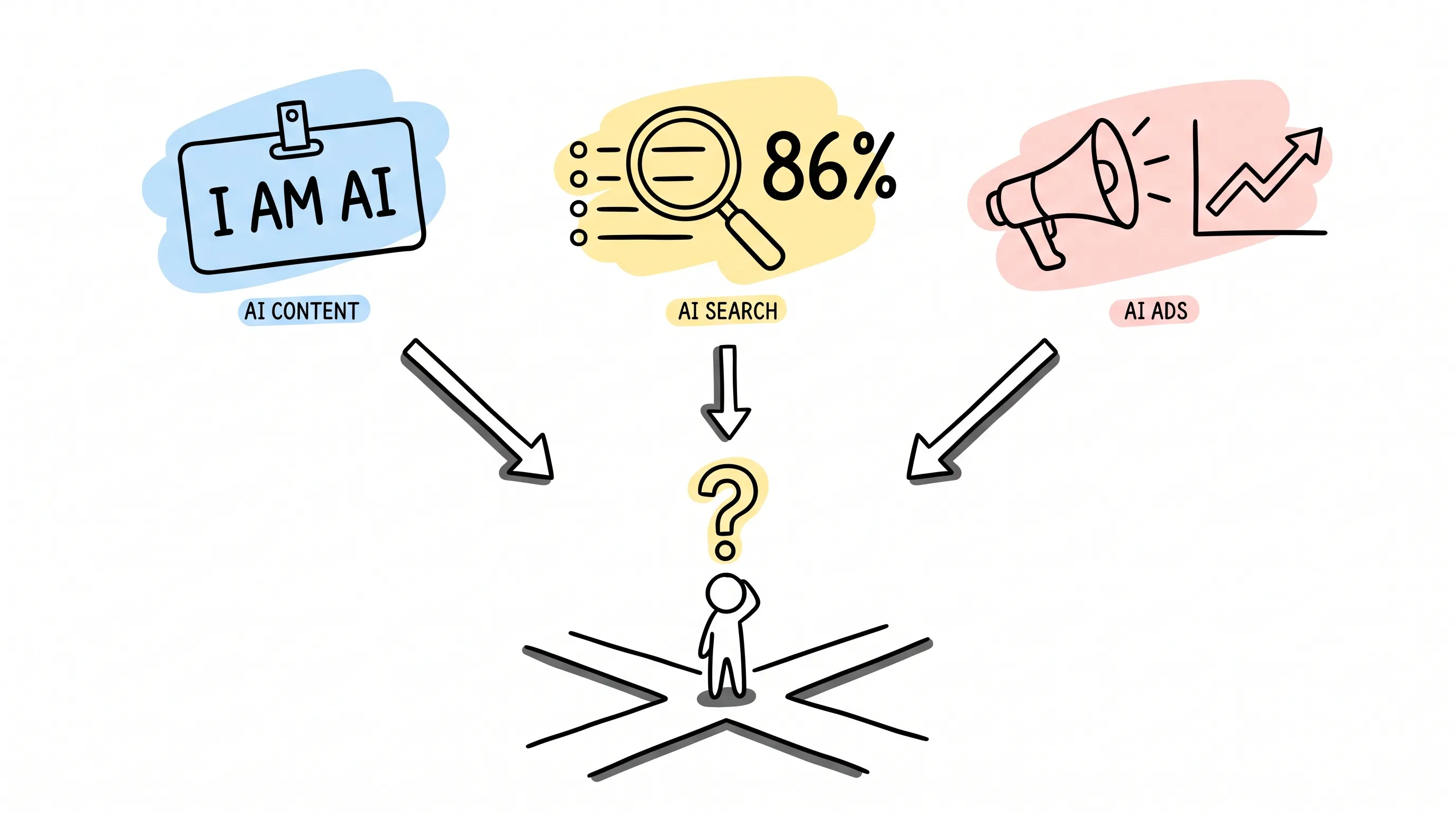
1. AI Content Is Getting Its "ID Card"
The EU AI Act began growing teeth on August 2: new companies have to get their AI-disclosure compliance fully in order before they can distribute products, while companies already on the market were given a four-month grace period.
Do the math. It's September now, so the window for those existing companies has about three months left.
What does this new rule actually cover?
It covers all synthetic content that "looks real." Text, images, video, audio — anything generated by AI and deliberately made to look human-made must carry a prominent "I am AI" label, plus a built-in digital watermark to prove its artificial origins.
The law was written to fight deepfake-style disinformation. But its actual reach is far wider: if you do business in the EU and use AI in your products, there's no dodging it — and of course that includes marketers.
What's interesting is Anthropic's reaction. It announced compliance right away and published a document laying out exactly how Claude's watermark works. And this watermark isn't just for the EU — Claude output carries it worldwide.
What's a watermark? You might be picturing the kind on banknotes — an image you can only see when you tilt the bill toward the light.
No. A banknote watermark is meant for human eyes. Claude's watermark is the other way around: invisible to humans, readable by machines.
The mechanism, once you spell it out, isn't complicated. As the model generates each word, it quietly picks from a pool of synonyms: this one, not that one. Each sentence on its own reads naturally, with nothing amiss. But analyze a whole passage together, and the word-choice distribution reveals a statistical "fingerprint" — and machines can verify it with perfect accuracy.
So what does this mean for search marketing?
The debate online is already in full swing. There are two main worries. First: will the watermark make it easier for Google to identify AI content — and suppress it while it's at it? Second: could this secret-code way of choosing words drag down output quality?
On the first worry, my read is: not a big deal. Google's stance on AI content has always been clear: it doesn't punish AI-generated content, only worthless AI spam. As long as what you publish offers searchers unique value — real human experience and professional judgment woven into it, with AI serving merely as your efficiency tool — there's nothing to worry about.
The second worry, though, has some real merit.
Think about it: if word choice has to serve the fingerprint, language gets pulled toward "statistically safe" territory. Could everything the model writes start sounding more and more alike?
Here's my take: the cost is real — but who does it mainly fall on? On the people who type in a single prompt and publish the output verbatim. That crowd was never going to win in search results anyway.
Meanwhile, the people who seriously train AI to write with their own industry expertise just need to spend a bit more time on human review — making sure they don't get swept into that sea of sameness.
Honestly: the lazy are finding it harder to get by, and the diligent are the ones who benefit. How is that bad news?
2. ChatGPT Has Fallen Out of Love with Reddit — the Change Behind It Deserves More Thought
The second piece of news came with a scary-looking number.
Promptwatch, an AI-tracking tool, published a report in mid-August: the number of Reddit citations in ChatGPT's answers had plummeted 86%. And it wasn't a flash in the pan — that low has held steady for more than two weeks.
Why?
A group of technical SEO researchers have offered a hypothesis: it's tied to an adjustment in how ChatGPT's search mechanism works. One researcher ran the most rigorous test of all. He took apart how ChatGPT's new search actually operates and found a detail nobody had noticed before: before ChatGPT searches the web, it first brings along a "known-brand list."
What does that mean?
In his test, he asked ChatGPT: which is the best AI note-taking app? Then he dug into the source code of the conversation and found that before fetching any web results, the model had already searched for three specific brands: Granola, Notion, and Otterly.
Notice what happened? The model had a list in its head first, then went online to look for evidence.
The process is a lot like asking a friend which restaurant is good. He says "let me look it up," but in his head he's already cycled through Haidilao and Xibei a few times — checking the web is just a way to fill in details for the list he already has.
To be fair, the researcher himself is careful about this: between his finding and the collapse in Reddit citations, what we have so far is correlation, not necessarily causation — there could be other factors behind it.
But even if it's only correlation, sit with this trend for a moment: if AI models are pre-ranking candidate lists by "fame" in their training data, then small brands will find it far harder than before to squeeze into the model's recommendations.
So my advice is actually simple: stop chasing quick-hit traffic that's here today and gone tomorrow, and just do the honest work of building your brand. Platform recommendation mechanics can change on a whim — Reddit was the flavor of the month yesterday; today it's the one cast aside. But what your brand is worth in users' minds — that, no model can take away.
3. On the Ads Side, Google Wielded the Knife Twice, and Meta Snapped One More Block into Place
The third part is about ads — also three things.
First: Google has formally made Demand Gen the main event.
The most telling signal: Display ads — the old product we've been running for over twenty years — will be retired within the year, and from now on all display advertising goes into Demand Gen campaigns.
Some people hear "another migration" and feel a headache coming on. But look closely at this migration's terms and you'll find Google kept the on-ramp low: moving the old campaigns over is simple to do; YouTube placements aren't mandatory — you can choose not to run them; and Demand Gen is now the only ad type on the platform that still supports "Similar Audiences" — essentially, the sharpest knife from the display-prospecting era has been handed back to you.
The budget threshold dropped too. The old starting recommendation was $100 a day, or 20 times your target cost per acquisition (tCPA); now that line has come down to 10x tCPA. What does that mean? Small-budget advertisers who previously couldn't even get a seat at the table can now sit down and give it a try.
Google also shipped a new tool to go with it: brand search conversions. When a user finishes watching your video and then searches for your brand, that action can now be measured on its own, with a 7-day lookback window. It amounts to installing a dashboard for the question "did the video actually drive branded searches or not?"
Second: a new rule that's easy to trip over.
Google Ads has drawn a 7-day red line for offline conversion uploads: if a conversion is uploaded more than 7 days after it happened, it still shows in standard reports — but data-driven attribution won't count it.
And that distinction matters enormously.
Your reports look complete, but when the attribution model runs the numbers, it has already thrown that portion of data away. From now on, reports and attribution may be two sets of books.
Here's an analogy: it's like filing receipts for reimbursement. Past the deadline, finance won't reimburse you — yet the receipt is still pinned to the notice board. Looks like it's there; effectively it isn't.
This rule deserves a place in the operating manual of every advertiser doing offline conversions: data doesn't just have to be accurate, it has to be fast. Be late, and accuracy counts for nothing.
Third: Meta's AI butler has been plugged into a new socket.
Meta AI can now connect directly to your ad account, and it can also hook into Google Workspace — Gmail, Google Calendar, Google Docs and the like. For advertisers, the most practical change is this: it can analyze your campaign data for you, output reports directly in Google Sheets and Google Slides, and dig creative opportunities and budget-optimization suggestions out of the data.
Plainly put, it's turning from a "chat-companion assistant" into an ads assistant that actually does hands-on work. Whether it's any good is another matter, but the direction is already clear: AI entering the ads workflow is no longer a concept — it's on the schedule.
A Few Closing Words
The three messages I scrolled past that morning turned out, by the time I finished writing, to be three faces of the same story:
The watermark arrived — AI content now needs an ID card. The list arrived — AI recommendations check the brand first. The plug went in — AI has started doing the reporting work for you.
However fast platforms and tools change, one thing stays the same: whoever takes content seriously and takes brand seriously will always end up in the front row when the next reshuffle comes.
Here's to a front-row seat for you in this round of the reshuffle.
Continue reading
Related articles

Cross-Border Business: Time to Upgrade Your AI Toolbox
A learn article explaining how AI tools help cross-border e-commerce sellers clear five hurdles: language, regulation, logistics, payments, and fraud. It outlines a five-compartment toolbox, a five-step adoption path, and metrics such as conversion rate and CLV, while cautioning against over-reliance on AI.

AI Is Taking Over the Dirty Work of Social Media Marketing, One Task at a Time
This learn article outlines four social media marketing tasks AI can handle — audience analytics, content drafting and design, ad targeting and creative testing, and spam moderation — and cautions that taste, judgment, and data security remain human responsibilities.

AI Is Already This Good — Why Is Your Social Media Marketing Still Pure Manpower?
An overview of 18 AI tools for social media marketing, organized into six categories covering audience research, content creation, scheduling, comment and DM handling, ad management, and visual production, plus notes on personalization, prediction, and emerging trends.