
AI Comes Back with Just One Answer — What Do You Do?
A learn article introducing GEO (Generative Engine Optimization): why brands may be missing from AI-generated answers, how GEO content platforms improve AI crawlability and citation analysis, and an overview of the emerging market of AI visibility tools.
A few days ago, an old friend of mine who runs an e-commerce business invited me to dinner. Halfway through the meal, he pulled out his phone to show me something.
He'd had a colleague ask ChatGPT one question: in this category, which brands are actually worth buying?
The AI reeled off three brands in one breath.
He wasn't one of them.
His words: we're the genuine number one in this industry, planted in the top three search results year after year. Yet of the three names the AI listed, none was ours. You tell me — is that spooky, or what?
I told him it wasn't spooky. Traffic has a new front door, that's all.
So What Is GEO?
First, a word you'll probably be hearing a lot: GEO.
Generative Engine Optimization.
What does GEO mean, exactly?
Here's the simplest way to put it. SEO used to mean optimizing your content for search engines. The goal was clear: make your pages legible to crawlers, crack the top ten, squeeze onto the front page.
And now?
Now a growing number of people don't search at all. When they have a question, they go straight to ChatGPT, Google's AI Overviews, or Perplexity. The AI doesn't hand you ten blue links. It hands you one answer.
Think about what that means.
You used to be a shop on a pedestrian street. Customers strolled past storefront after storefront; with a big enough sign and a good enough spot, business always found you.
Now your customer has hired a personal assistant. No more window-shopping — anything they need, they ask the assistant. And the assistant comes back from each errand with only one or two names.
However beautifully you've dressed up your shop, if the assistant doesn't notice you, you might as well not exist.
Traffic used to follow people. Now people follow AI's answers.
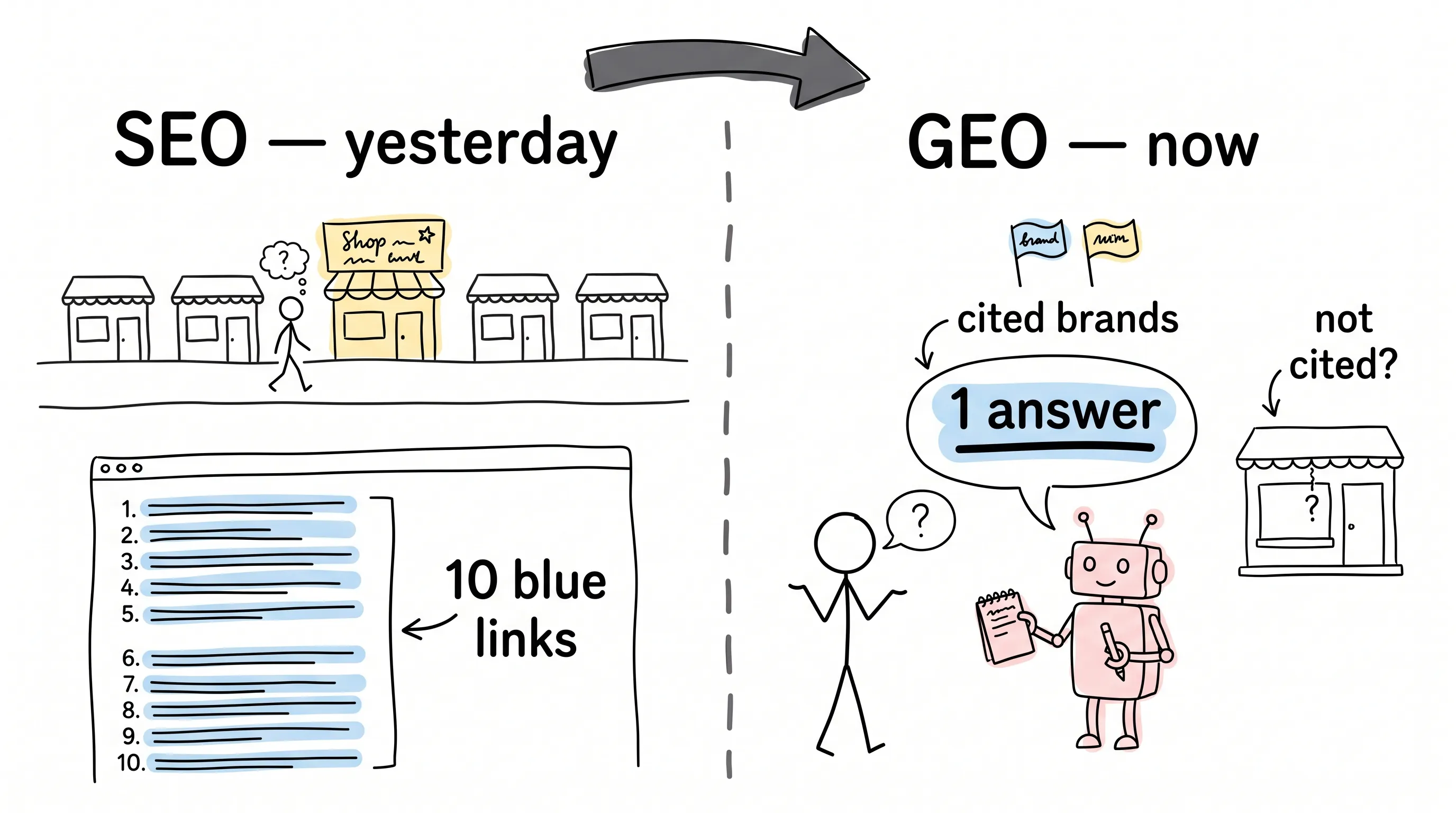
The craft of getting your brand "seen and cited by AI" is called GEO. And the tools built to do it for you have already grown into a market of their own.
What Does This Business Actually Do?
Here's the interesting part: CB Insights, a research firm, has already carved this space out as its own category — GEO content platforms. When something earns its own category, it means there are enough players to need a map.
What do these platforms actually do? Break it down, and it comes to two things.
The first: make your site crawlable for AI.
Yes, you heard that right — AI crawls your website too. If your pages are a mess and your structured data is patchy, the AI can't make sense of them. So these tools run a technical health check: whether your content is friendly enough to AI crawlers, how to add structured data, and how to mark up entity information.
The second: make AI actually want to mention you.
This cuts deeper. When AI answers a question, it cites its sources. So why does it cite them and not you? These tools run a "citation gap analysis": when the AI gets asked about your industry, they break it down line by line — who got cited, who got left out, and on what grounds. Pair that with a real-time GEO score — a checkup report focused entirely on AI — and you can see at a glance whether you're up or down today.
See it? This is a business that turns black magic into a checkup.
In the AI world, not being cited means not existing.
Who Lives in This Market?
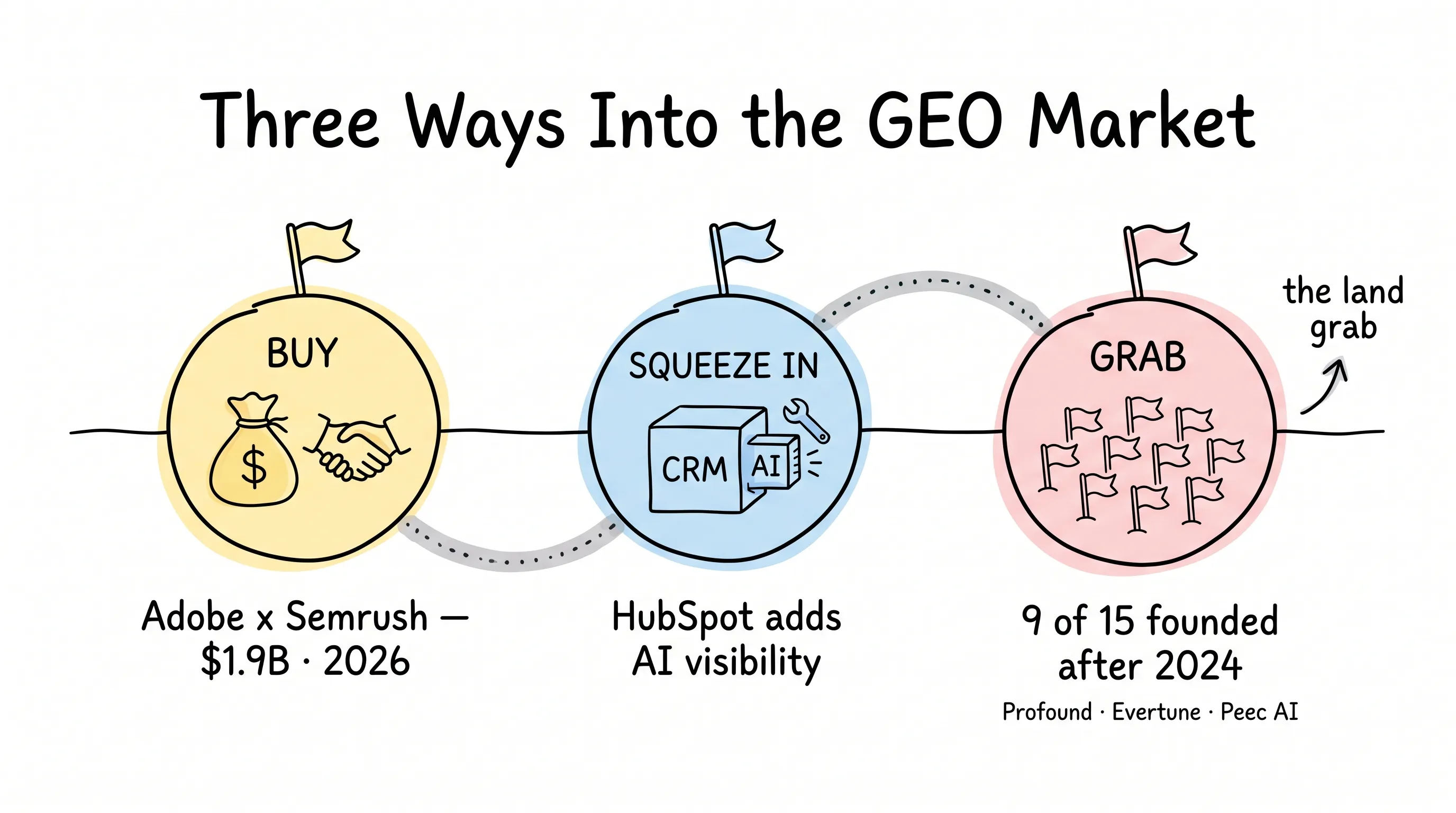
So let me walk you through this market. By the end, you'll see that the players here have three distinct ways of surviving.
The first way to survive here is "Buy."
The giants have no patience for building from scratch. Semrush, an SEO veteran founded back in 2008, spent over a decade fighting on the old battlefield of search. In April 2026, Adobe brought it home at a $1.9 billion valuation. And what did Adobe buy, exactly? Not a company — a ticket to the AI era.
The second way is "Squeeze in."
Look at HubSpot. How does a company that sells CRM elbow its way onto this list? Because customers now open their mouths and ask for AI visibility. If you're selling "the whole package," you can't be missing this piece. The veteran pivots — and the pivot means bolting new capabilities onto its own suite.
The third way is "Grab."
This is where things get really lively. Let me run the numbers for you.
On the CB Insights list there are 15 companies in all. Nine of them were only founded after 2024.
Nine. More than half.
Profound, 2024, New York — brand visibility analytics for AI search. Evertune, 2024, New York — for industries like finance, retail, and pharma, it watches how AI recommends them. Peec AI, 2025, Berlin — puts your AI visibility side by side with your competitors'. In London there's Searchable, tracking how often your brand shows up on ChatGPT, Claude, and Perplexity. And going back a bit further, AirOps, founded in 2021, looks at AI search performance and content opportunities together, serving content teams and marketing agencies.
One or two years from founding, and they're already at the top.
Grab what? A shared conviction: whoever turns "how does AI talk about me" into a tool first gets to plant the flag first.
Walk deeper into the market and it gets even more interesting. Some of them specialize in niches you'd never imagine.
There's one called Unusual. What it does is "interview" AI models — so, what do you think of this brand? — then create content to sway the AI's opinion. Sit with that image for a second. The client for brand PR is now the AI itself.
There's The Prompting Company, which converts your web pages into clean markdown for one purpose only: so AI can cite them more accurately. To win the AI over, humans have started producing "AI-friendly reading editions" especially for it.
And there's Azoma — formerly Ecomtent — optimizing product data for shopping agents. If an AI is going to shop on your behalf, you'd better make sure it knows its way around your shelves.
Notice what's happening? This is no longer just "another channel to run campaigns on."
This is an entirely new species: content written not just for humans, but for AI too.
And Then the Giants Showed Up
Does this script feel familiar?
Newcomers rush in first to claim the territory; the giants move in afterward to harvest. Scrunch, founded in 2023, monitors and optimizes how brands appear in AI search — and in June 2026, Sitecore acquired it for $225 million. From birth to buyout, under three years.
Brutal.
Now look at the map. San Francisco has 5 companies on this list, New York 3, and Berlin, London, and Barcelona one apiece. The whole world is racing to grab.
Which tells you this market has moved past the storytelling stage and into the pricing stage. When giants are willing to put up $1.9 billion and $225 million in cold, hard cash, it means they've done the math: the gateway to traffic in the AI era is worth exactly that.
Back to That Dinner
After that dinner, my friend went back and did three things: had his team restructure the content on their website, filled in the information the AI was missing when it went to cite sources, and started checking where his brand ranked inside AI once a week.
Last month he messaged me: of the three names the AI listed, ours is one of them now.
Here's the thing: AI doesn't know you, and it isn't out to get you. It just hasn't "read" you yet.
On the old battlefield, rankings decided the winner. On the new one, the answer does.
The wheels of the era keep rolling. Some people always board the train early; others are still standing on the platform asking: did we really change trains?
Here's to you being one of the three names AI says out loud.
Continue reading
Related articles

Cross-Border Business: Time to Upgrade Your AI Toolbox
A learn article explaining how AI tools help cross-border e-commerce sellers clear five hurdles: language, regulation, logistics, payments, and fraud. It outlines a five-compartment toolbox, a five-step adoption path, and metrics such as conversion rate and CLV, while cautioning against over-reliance on AI.

AI Is Taking Over the Dirty Work of Social Media Marketing, One Task at a Time
This learn article outlines four social media marketing tasks AI can handle — audience analytics, content drafting and design, ad targeting and creative testing, and spam moderation — and cautions that taste, judgment, and data security remain human responsibilities.

AI Is Already This Good — Why Is Your Social Media Marketing Still Pure Manpower?
An overview of 18 AI tools for social media marketing, organized into six categories covering audience research, content creation, scheduling, comment and DM handling, ad management, and visual production, plus notes on personalization, prediction, and emerging trends.