
AI Can Write You Ten Thousand Headlines — and Write Your Brand Out of Existence
A learn article revisits risks that PR and marketing executives flagged about AI-generated content, grouping them into four themes: content homogenization, factual errors and bias, unsettled copyright questions, and volume rising while value falls.
Lately, every chat I've had with friends in marketing comes around to the same thing: nearly everyone is using AI to write copy, create images, edit videos. The efficiency gains are real. But by the end of every conversation, almost everyone adds the same caveat: deep down, they're uneasy.
Uneasy about what, exactly?
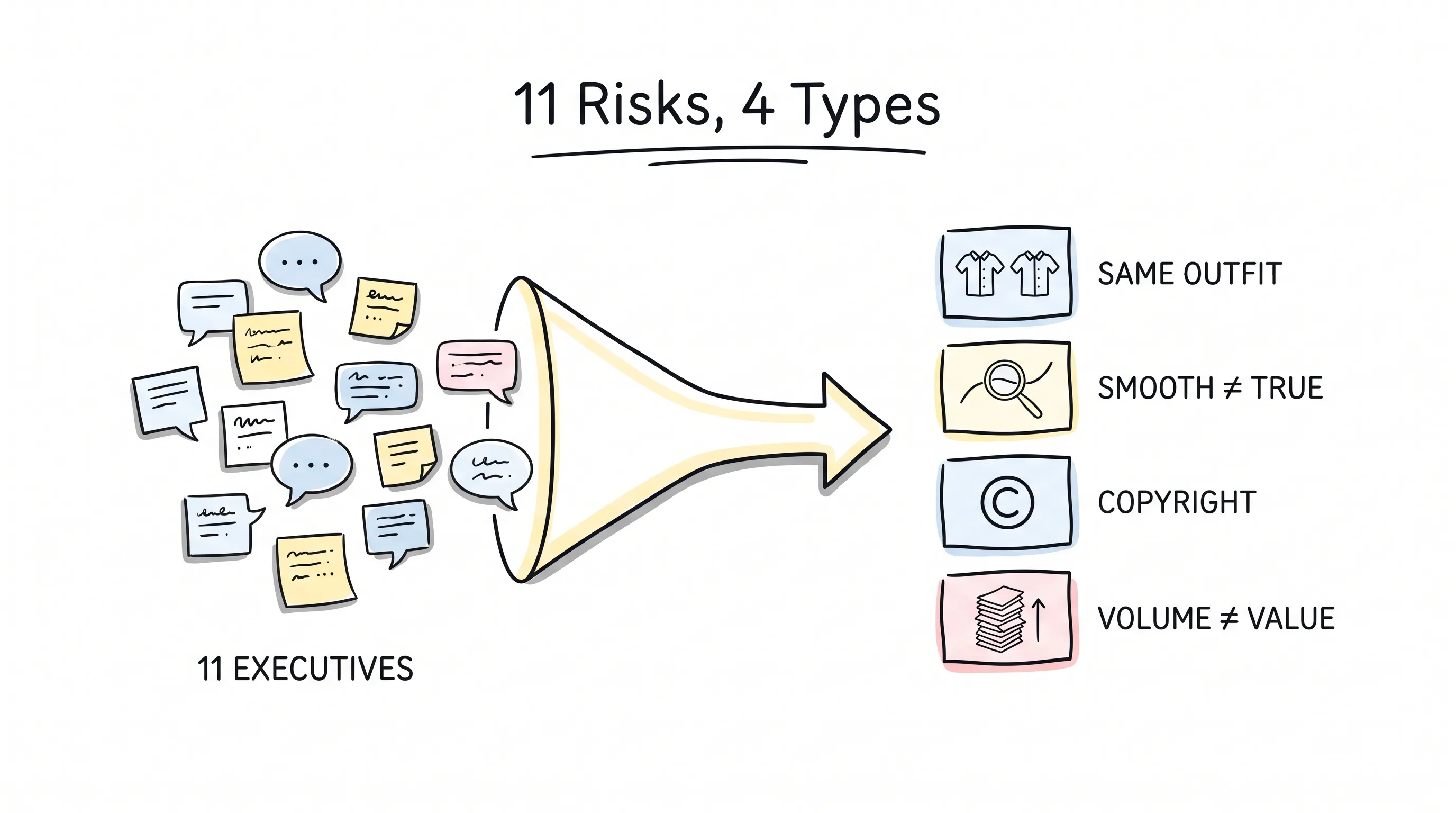
People were asking this question in earnest more than two years ago. In April 2024, a circle of executives from PR and marketing communications firms ran a collective Q&A: 11 executives, each naming the one risk they worried about most.
11 people, and they counted out 11 pitfalls.
A while back, I dug out those 11 points and reread them. How should I put it — not a single one has aged. And when I counted, those 11 points were really talking about 4 types of problems.
Today, I'm laying them out for you.
01 The Whole Internet Starts Wearing the Same Outfit
What is homogenization? It's when you scroll through 10 brands' accounts and everything feels like it was written by the same person.
The executive at WunderLand put it bluntly: the more marketers rely on AI to produce content, the faster sameness sets in. And the very core of a brand is differentiation.
A brand is like a person: the thing it fears most is showing up in the same outfit as someone else. Do it often enough, and no one remembers what you look like.
An executive at Sage Dental offered a thought experiment. Think about it: if every company's marketing campaigns run through the same process, on the same model, where does your brand's uniqueness go?
It quietly disappears into 10,000 pieces of content.
Does that mean AI is unusable? Not quite. The executive at Dimensional Insight shared an approach I genuinely agree with: treat what AI gives you as a starting point, never the final draft. Between that starting point and a finished piece lie your point of view, your sense of proportion, the way you talk. Fill those in, and the content becomes yours.
The executive at The Right Thing Marketing Communications added a piece of plain truth: quality matters just as much as speed. AI can write 800 words in a minute — fast. But fast doesn't mean right.
AI can give you efficiency. It can't give you "different."
02 The Smoother It Sounds, the Closer You Need to Look
The second type of problem is saying the wrong thing. It comes in two layers.
The first layer, factual errors. The executive at NEORIS put it incisively: the quality of AI's output depends on the data you feed it. Skew the data a little, and the content comes out a little crooked. The most troublesome part: it's wrong with remarkable fluency — the standard is yours to enforce.
The second layer is bias. The executive at SAS put it harshly: biased data trains biased models; biased models generate biased content. The fix is plain enough: keep the training data as diverse as possible, add bias detection, and put together a team diverse enough to review the content. Every step of the way, a human must be there.
360 ONE WAM laid out a ground-level playbook: first set content standards, then build a QC process, then staff human gatekeepers, and finally train the team. Four steps — not one can be skipped.
The warnings from these three executives all point to the same thing: the smoother AI sounds, the closer you need to look. Because the smoother it reads, the less likely you are to doubt it.
03 The Copyright Bill Hasn't Been Settled
The third pitfall is the law.
The executive at TERRITORY Influence, part of Bertelsmann, came right out and said it: as for who generative content actually belongs to — at least as of 2024, even the legal world hadn't finished arguing.
The law moves slower than technology. Until an answer arrives, brands have no choice but to fasten their own seatbelts.
So what to do? His advice is pragmatic: use AI as a researcher, an inspiration partner, a polishing tool. But don't take AI-generated text, images, or audio and push them out without even a look.
Generation is AI's job. Accountability is yours.
04 Volume Went Up, Value Came Down
An executive at Bombora offered an analogy that left a deep impression on me.
A lot of teams using AI look just like the crowd that did email marketing in the early days: the moment the tech upgrades, the first instinct is to max out volume. Mass emails pile higher and higher, open rates sink lower and lower, and what remains in the end is all noise.
AI is the same. A writer used to grind out 3 pieces a day; now AI hands you 300 a day. Output jumped 100x. But are the extra 297 pieces for users to read, or filler to pad the platform's count? Do that math yourself.
The executive at Anteriad twisted the knife, this time for B2B: business is ultimately done person to person, and customers see through a cold mass blast at a glance. Either make personalization real — or send in an actual human.
UPRAISE's warning cuts to the root: relationships with the media, with customers — you have to tend those yourself. Technology can be outsourced. Trust can't.
A Closing Note
Back to the question we started with: what were they uneasy about?
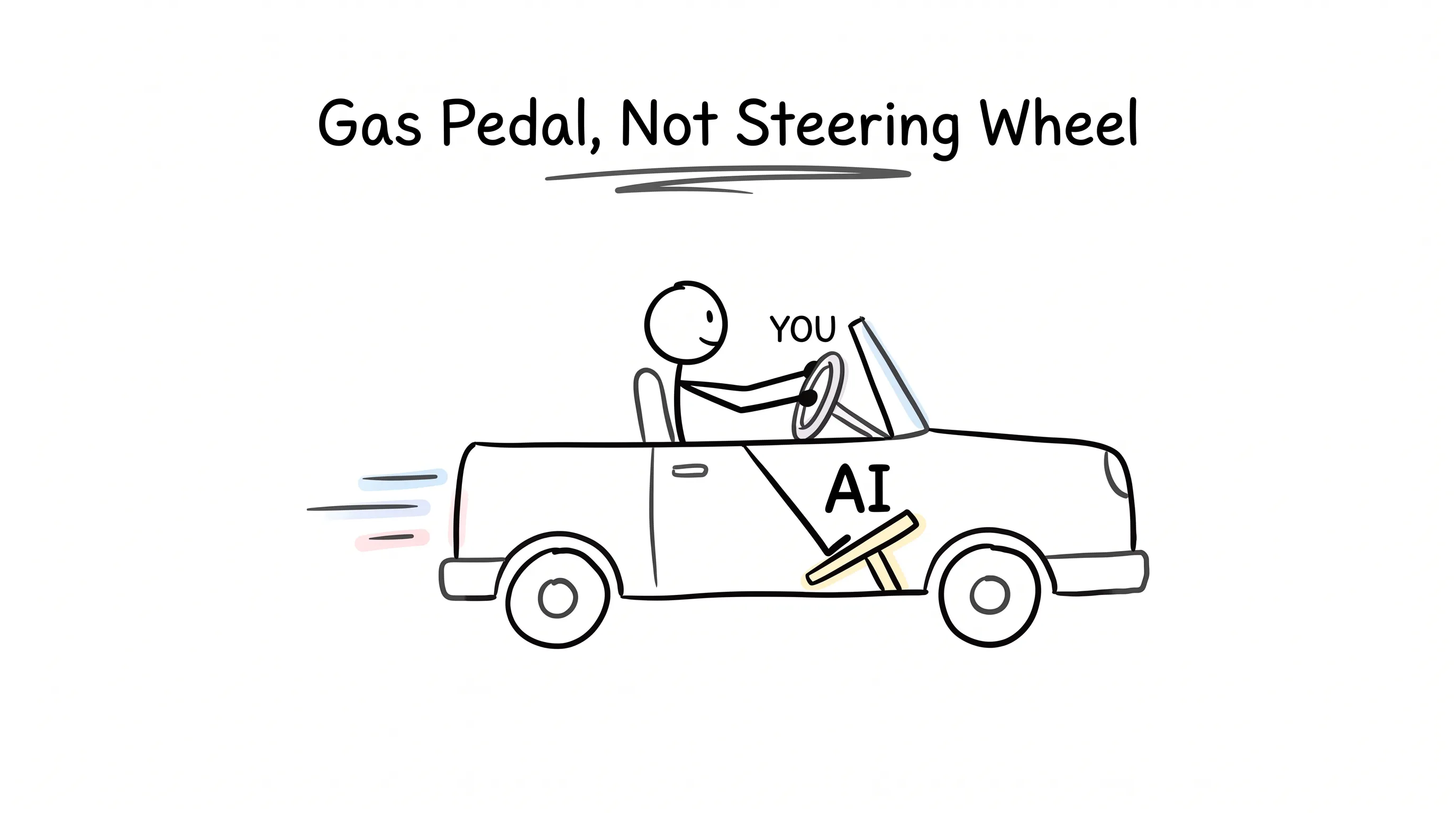
Now we can answer. 11 executives, 11 answers — really the two halves of one sentence: AI is the gas pedal, not the steering wheel.
Everyone wants the gas pedal. The steering wheel — don't let go.
AI's job is speed. Your job is being human.
Here's wishing you a smooth ride as you put AI to work. And more than that — may every piece of content you send out wear your own face.
Continue reading
Related articles

Cross-Border Business: Time to Upgrade Your AI Toolbox
A learn article explaining how AI tools help cross-border e-commerce sellers clear five hurdles: language, regulation, logistics, payments, and fraud. It outlines a five-compartment toolbox, a five-step adoption path, and metrics such as conversion rate and CLV, while cautioning against over-reliance on AI.

AI Is Taking Over the Dirty Work of Social Media Marketing, One Task at a Time
This learn article outlines four social media marketing tasks AI can handle — audience analytics, content drafting and design, ad targeting and creative testing, and spam moderation — and cautions that taste, judgment, and data security remain human responsibilities.

AI Is Already This Good — Why Is Your Social Media Marketing Still Pure Manpower?
An overview of 18 AI tools for social media marketing, organized into six categories covering audience research, content creation, scheduling, comment and DM handling, ad management, and visual production, plus notes on personalization, prediction, and emerging trends.