
AI Can Draw Santa Claus. It Can't Draw Christmas.
A case study of Coca-Cola's AI marketing: its 2023 'Masterpiece' film and 'Create Real Magic' co-creation platform succeeded with humans as storytellers, while its 2024 fully AI-generated Christmas ads drew backlash for uncanny visuals and perceived cost-cutting.
Let me start by showing you a comment.
In late 2024, Coca-Cola released three fully AI-generated Christmas ads in one go: Unexpected Santa, Secret Santa, and Silver Santa. The most-liked comment under the videos read:
"This might be the most profitable ad in Pepsi's history."
32,000 people liked that comment.
What does that mean? It means you spent serious money on a campaign — and drove customers straight to your competitor. That knife went in — precise, and merciless.
And that was far from the only merciless one. Some called the visuals "soulless." Some flat-out slammed them as "fake." Others said "creepy." Still others dug up the slogan Coca-Cola has used for years — Real Magic — and fired back a question: a machine-generated ad, where exactly is the magic?
Here's what makes this interesting: just over a year earlier, in 2023, Coca-Cola was still one of the most impressive AI marketers in the world.
Same company. How did it crash and burn?
This story deserves a close look from anyone who builds brands.
First, the Fight They Won Beautifully
In 2023, Coca-Cola released a short film called Masterpiece.
The plot is simple: a student slumps in an art museum, drained of every last volt. Then an iconic bottle of Coca-Cola starts traveling between famous paintings — sailing out of Warhol's Pop Art, diving into Munch's The Scream, then sliding into Vermeer's Girl with a Pearl Earring. Every time the bottle crosses into a new painting, the visual style shifts with it. At the end, the bottle returns to the real world, the student takes a sip — and genuinely comes back to life.
Technically, it was a hybrid play: live-action footage and traditional effects as the base layer, with AI (Stable Diffusion handling style transfer) making the bottle switch between wildly different painting styles seamlessly.
The scoreboard was just as good. It took home the Yellow Pencil, D&AD's top design award. The film racked up millions of views. And the digital collectibles released alongside it sold $543,000 worth in 72 hours.
But the most valuable discovery was hiding somewhere unexpected.
A later neuromarketing analysis re-tested the two-minute film segment by segment, using eye-tracking and facial coding. The finding: viewers said all the right things — "so creative," "so magical" — but in the middle of the film, their subconscious genuinely flashed signals of boredom.
Bored in the middle, thrilled at the end. The film's overall impression score was rescued by its final 30 seconds.
Think about it: what does that tell you?
It tells you that what pins viewers to their seats has never been the dazzling visuals. It's the moment the Coke slides down and the person lights up. It's the story. All AI did was make the fantasy of "a bottle traveling through famous paintings" faster and cheaper. The storyteller, from beginning to end, was human.
Hand the Paintbrush to Consumers
In March 2023, Coca-Cola made another move: it teamed up with OpenAI and Bain and launched a co-creation platform called Create Real Magic.
Put plainly: Coca-Cola opened up its most valuable possessions — the brand visual assets anyone can recognize at a glance — paired them with GPT-4 and DALL-E, and handed them to the whole world: here, take our bottle, our Santa, our red trucks, and paint your own work.
The best creations went straight up on the big screens of Times Square in New York and Piccadilly Circus in London — the whole world looking up at your name.
What's so clever about this play?
Before, the brand was the boss calling the shots and consumers were just the audience, with a one-way broadcast street between them. Now the audience has climbed into the driver's seat. Coca-Cola's head of creative strategy said it amounted to "democratizing" the brand's totems.
And notice: behind every piece of user-created work stands a specific person — specific emotions, specific memories, a specific intent to create. All AI did here was pour out what was inside that person, fast. Just a tool.
The protagonist, once again, was human.
Of course, throwing your front door open isn't free. How do you handle copyright? Will the art style drift off-brand? Will the models make things up? All new entries in the ledger. But set that against millions of users creating for you and spreading the word for you, and the math works out overwhelmingly in your favor.
Then, They Swapped Out the Humans Entirely
Okay, here's the question: after winning the first two battles so beautifully, how did everything fall apart in late 2024?
Only one thing changed: this time, Coca-Cola took the "human" out.
All three Christmas ads were generated by AI, start to finish. No actors, no crew, no director calling "cut." Even the 1995 red-truck classic "Holidays Are Coming" got the AI remake treatment.
The result? In Secret Santa, fingers and teeth glitched out every so often; in Silver Santa, animal anatomy kept going wrong. Shot after shot looked "almost human" — but something was off, and it sent a chill up your spine.
Where the tech couldn't hide the flaws, the editing did: rapid cuts, wide shots, cameras dodging human faces.
Why didn't audiences buy it?
What's the uncanny valley? The more human something looks, the more we like it — but once it's about ninety percent there, just a sliver short, our fondness plunges off a cliff into pure creepiness. That missing sliver is expression, breath, the living spark in someone's eyes. AI can get the shape right; filling in that sliver is the hard part.
And this was a Christmas ad, of all things.
Think about it: Coca-Cola has been making Christmas ads for decades — red trucks, Santa, a family gathered around the table. The brand, with its own hands, welded "Christmas equals Coca-Cola" into generations of collective memory. Every year, audiences wait for it the way you wait for that one fixed dish at the annual family reunion dinner. Emotional expectations: maxed out, all year round.
And this year, they served up a printed dish.
It's like coming home for the holidays: the sweater your mother knitted by hand versus the "handmade-style" one you bought online. The stitches can look identical, but you know the moment you put it on — it's not the same. The little something that's missing has a name: "someone made this just for you."
Sentiment analysis of the comment section confirmed the split: overall scores tilted only slightly positive, but a large bloc of very loud, very intense detractors emerged, their anger and disgust spelled out in plain words.
And this time, the visuals weren't the only thing getting roasted.
It was the math. What audiences calculated: hiring real actors and a professional crew costs money; going all-in on AI costs next to nothing. A company pulling in tens of billions of dollars a year cut the crew, cut the actors, and passed not one cent of the savings back to customers — so all anyone could see was one word: cheap.
When the visuals fall apart, audiences at most shake their heads. When the attitude is wrong, audiences hold grudges.
So, Where's the Line?
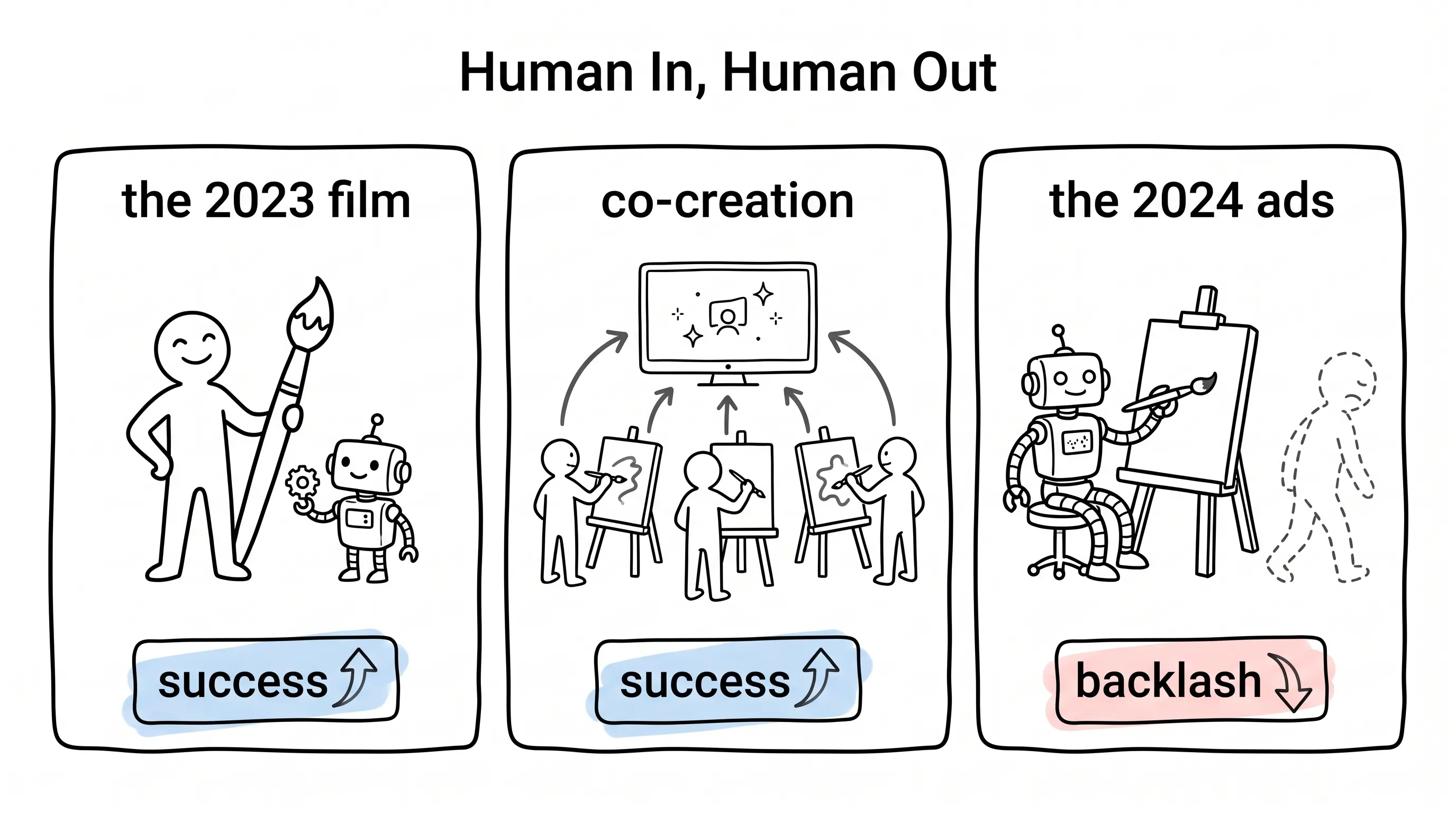
Put the three episodes side by side, and the pattern is almost frighteningly clear:
Masterpiece: human as protagonist, AI as tool — a roaring success.
Create Real Magic: human as creator, AI as paintbrush — a roaring success.
Christmas 2024: AI as protagonist, humans gone — reputation collapsed.
The same AI: hand it to humans, and it's augmentation. Use it to swap humans out, and it's replacement. The outcomes are worlds apart.
Some might say: the glitched hands, the clipping teeth — technology will improve, and these flaws will be fixed in a couple of years.
True, most likely they will. Hands will get better. Teeth will get better. Animal fur will get better.
But there's one thing technology can't fix.
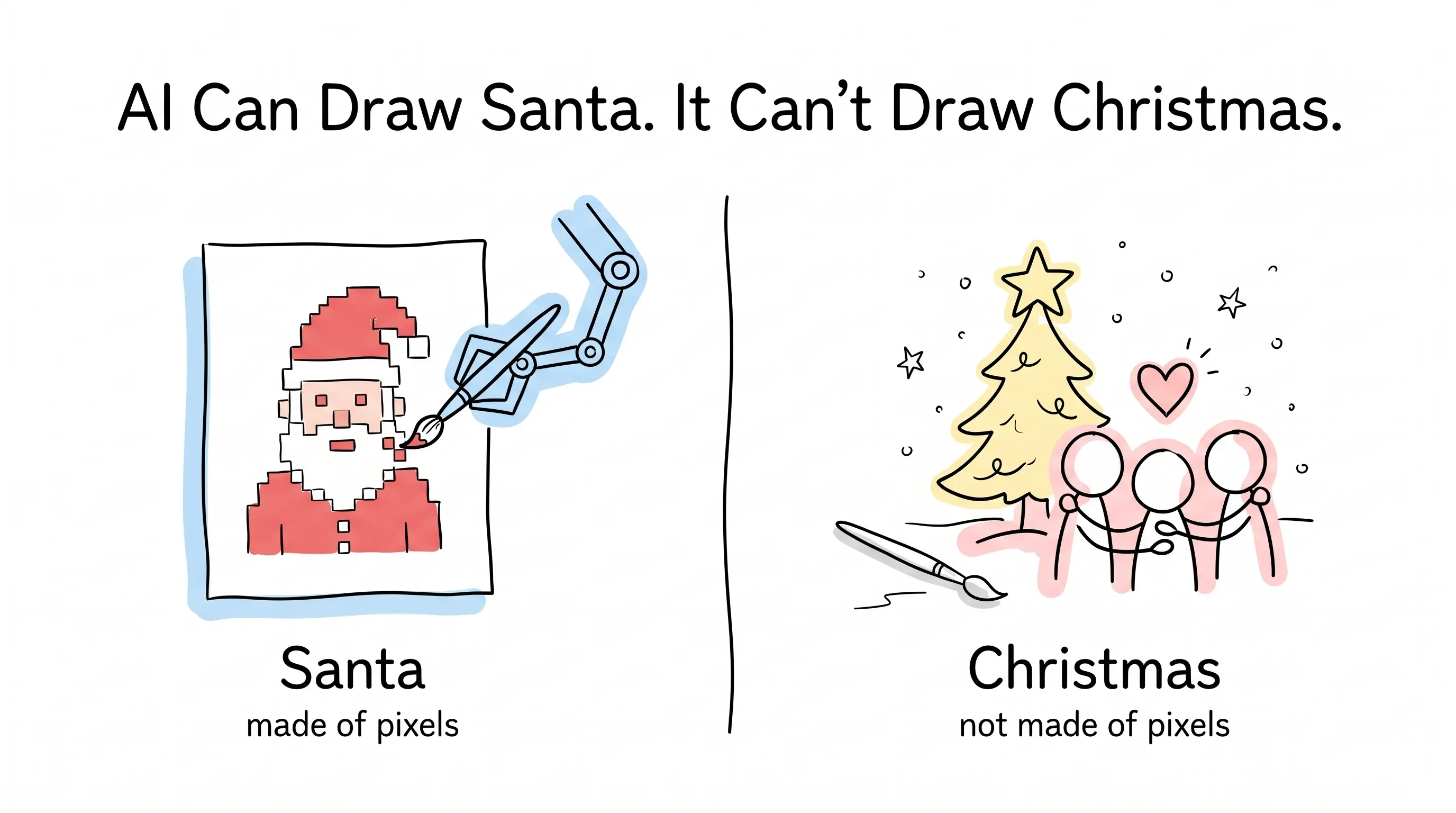
A photograph used to be the shadow of reality — the moment the shutter clicked, something had actually happened in the world. An AI-generated image has nothing behind it, because nothing happened. AI can draw what Santa looks like; it can't draw why a family has to be together on that one day.
Santa can be made of pixels. Christmas can't.
So the real problem with those three 2024 ads is this: Coca-Cola outsourced storytelling — the one part of the job that should never be outsourced.
And don't be too quick to laugh at Coca-Cola. The thing worth laughing at isn't even AI.
Go back and read that 32,000-like comment again. It wasn't the visuals it was skewering. It was the half-heartedness.
AI is the sharpest paintbrush of our era. But who the brush gets handed to — and whether what it paints is a work of art or wastepaper — that decision, for now, still has to be made by humans.
May the AI in your hands always be just that — a paintbrush.
Continue reading
Related articles

Cross-Border Business: Time to Upgrade Your AI Toolbox
A learn article explaining how AI tools help cross-border e-commerce sellers clear five hurdles: language, regulation, logistics, payments, and fraud. It outlines a five-compartment toolbox, a five-step adoption path, and metrics such as conversion rate and CLV, while cautioning against over-reliance on AI.

AI Is Taking Over the Dirty Work of Social Media Marketing, One Task at a Time
This learn article outlines four social media marketing tasks AI can handle — audience analytics, content drafting and design, ad targeting and creative testing, and spam moderation — and cautions that taste, judgment, and data security remain human responsibilities.

AI Is Already This Good — Why Is Your Social Media Marketing Still Pure Manpower?
An overview of 18 AI tools for social media marketing, organized into six categories covering audience research, content creation, scheduling, comment and DM handling, ad management, and visual production, plus notes on personalization, prediction, and emerging trends.