
AI Can Do the Work for You—It Can't Make the Call
An essay on using AI in marketing: delegate checkable work like ad copy variants, but keep judgment on positioning, budgets, and pacing. Covers asking AI for sources, running small tests, logging changes, and counting rework time when measuring efficiency.
A while back, a friend of mine who runs an e-commerce business couldn't wait to show me a plan.
AI had generated it. Beautiful formatting, clear logic, meticulous structure. It came down to one core recommendation: invest more, and double the traffic to the company website.
I asked him one question: the people who land on your site every day—who are they? And after they've read a page, what do they do?
He froze.
He didn't know. He'd never checked.
I said: then doubling that traffic will most likely just double the number of people who don't buy.
The plan itself wasn't flawed. The flaw was that nobody was capable of judging it.
What Do I Mean by Judgment?
Let's get one thing straight first. What exactly do I mean by "judgment"?
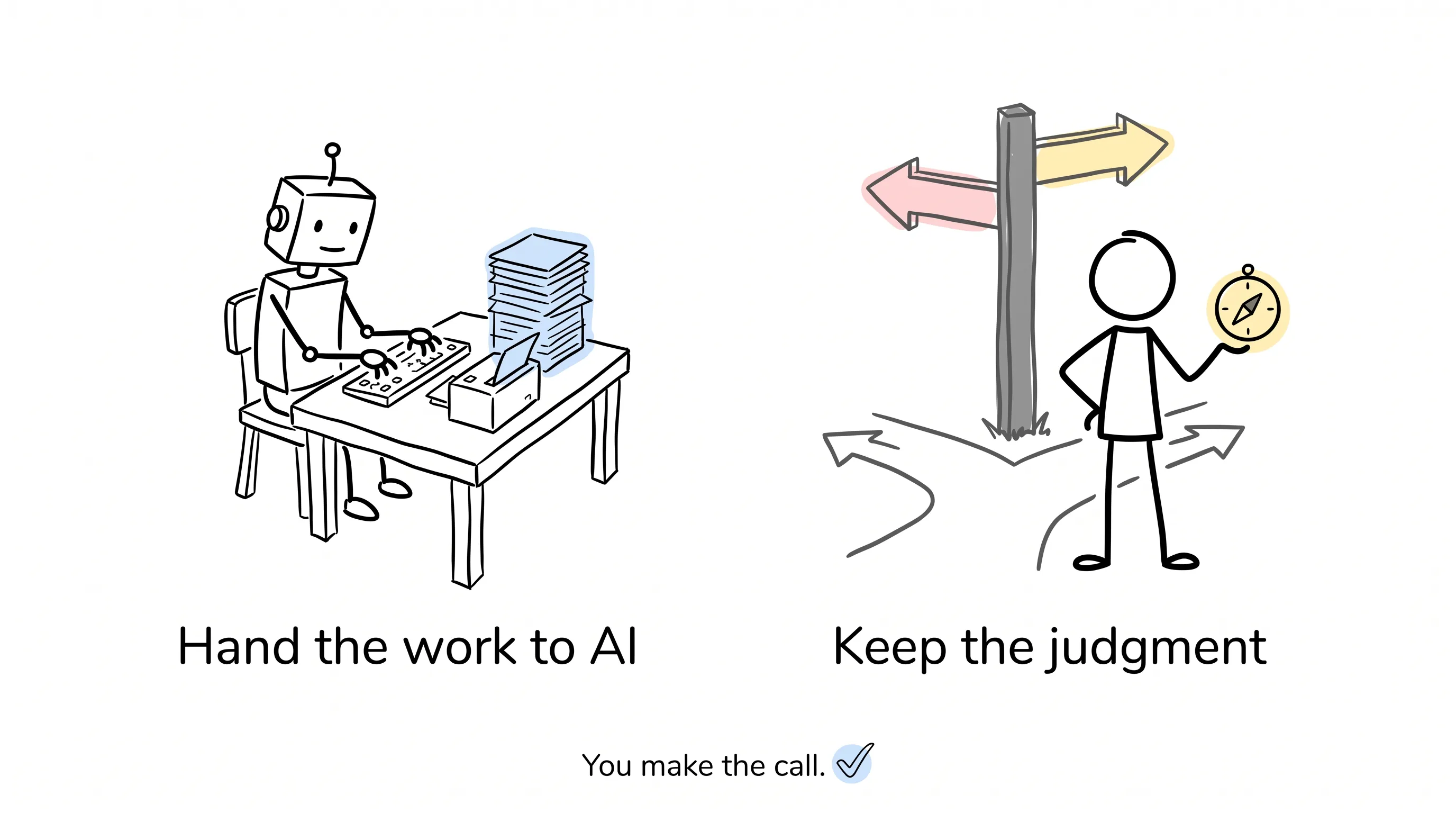
Judgment means you can tell whether a piece of advice is good or bad, and whether it fits you. It means that even without asking AI, you roughly know what the next step should be—and what AI says merely helps you verify it.
What is this like?
Suppose you bought a full dental chair setup for your home, complete with every tool. Now tell me: could you fill your own teeth?
You wouldn't dare.
The tools are in your hands; the craft is not. Marketing is the same. Knowing how to prompt AI is not the same as understanding marketing. At the very least, you need to know how customers buy, how ads are run, and why one message gets replies while another gets ignored. Only with that foundation can you actually absorb what AI hands you.
Otherwise, how would you judge what it gives you—is it gold, or a rock wrapped in beautiful packaging?
When I bring new people on, I build this into their training: first, review a campaign on their own and say what they'd change; only then look at AI's suggestions and compare the two side by side. What you're comparing isn't the answers—it's the thinking process.
Some Work Can Go to AI. Some Decisions Cannot.
So which tasks can you hand to AI?
My standard is simple: if you can check the work, hand it over. If you can't check it, don't.
Take advertising. For any ad, three things should be crystal clear: what's being sold, who it's sold to, and what you want the reader to do. Have AI produce ten versions, then check each one against those three things—kill any that over-promises or commits to something the business can't deliver. For this kind of work, AI is a great helper.
Or slogans and headline ideas. It rattles off twenty options, you pick the one you like and tweak it. Perfect.
But there are things I'd urge you not to hand over.
Positioning. What you are, what you are not, why customers choose you over the shop next door—this decision must not be touched. Before you change your positioning, you must first understand: why did your existing customers choose you in the first place? AI doesn't know any of this. It only knows phrasing that "sounds stronger," and in doing so it often edits away the very sentence that keeps your customers.
There's also budget and pacing.
Here's an example. Say you sell an enterprise service, and from first contact to signed contract takes six months on average. Under AI's plan, if three weeks pass with no results, it tells you to stop.
Sounds very "agile," right?
But for a six-month business, three weeks isn't even long enough for customer intent to surface. What you should be watching at this point isn't closed deals—it's how many potential prospects you started conversations with this month.
The yardstick for evaluating results has to follow your business, not AI's expectations.
Accepting AI's advice wholesale is the easiest path—and the most expensive one.
Make It Show Evidence, Then Test Small
There's another place that's especially easy to stumble: AI's advice on search marketing.
For instance, it says: you don't have enough content—publish more pages.
Is that right? No way to know. You have to keep asking: who are these pages for? What kind of information is the site actually missing? Does one more piece of content help a customer make up their mind, or does it just pile more work onto the team?
In many cases, the problem isn't a lack of content at all. Maybe visitors arrive and can't find an explanation that convinces them to decide, or an entry point to book a chat. If that's the situation, what you need to fix first is the pages, not the volume.
So my habit is three steps:
Step one: make it cite sources. It claims this tactic works—where did that come from? If it gives a link, go read it. Then ask yourself one question: are their conditions anything like mine?
Step two: test small. Don't go and overhaul the whole site on day one. Pick one small piece, and spell out first: what improvement do I expect, what metric will measure it, and when will I come back to check the results.
Step three: keep a record. Write down in black and white what you changed and why. If you change the content, the navigation, and the contact flow all at once, and the numbers later go up, you won't even know who to thank.
A small test beats an all-site gamble.
AI Can't Take the Responsibility Off Your Hands
Last, let me say something that stings.
The article was written by AI, the ads were produced by AI, the plan was drafted by AI. So who does the outcome belong to?
Yours.
AI won't explain to your boss why the money ran out. So before a single word goes out, you have to run it through once yourself: are the facts right? Is the message consistent with the brand? Can the company actually deliver what's being promised?
There's another calculation many people never make: efficiency.
AI produces a draft in ten minutes—fast. But if an experienced colleague then spends two hours fixing it, the math may come out worse than having a person write it from scratch. So when you calculate the efficiency gain, include the rework time.
You also have to watch for one signal: output is rising, but results aren't.
When that happens, don't rush to have AI produce more. Stop and think: is it time to adjust the pricing? Is it time to refresh the old content? Is it time to ask sales what customers have been asking about lately?
Doubling output is not doubling results.
One Last Thing
Remember that friend from the beginning? He didn't go with that plan. He spent two days first mapping out his visitor data and the path people take to a purchase, and only then went back to AI—and the questions he asked were completely different.
See? AI didn't change. The person asking changed.
Over the past few years, AI has grown stronger and stronger, taking on more and more of the work you can delegate. That's a good thing.
But more and more, I keep coming back to one line: the stronger the tool, the greater the test of the person using it.
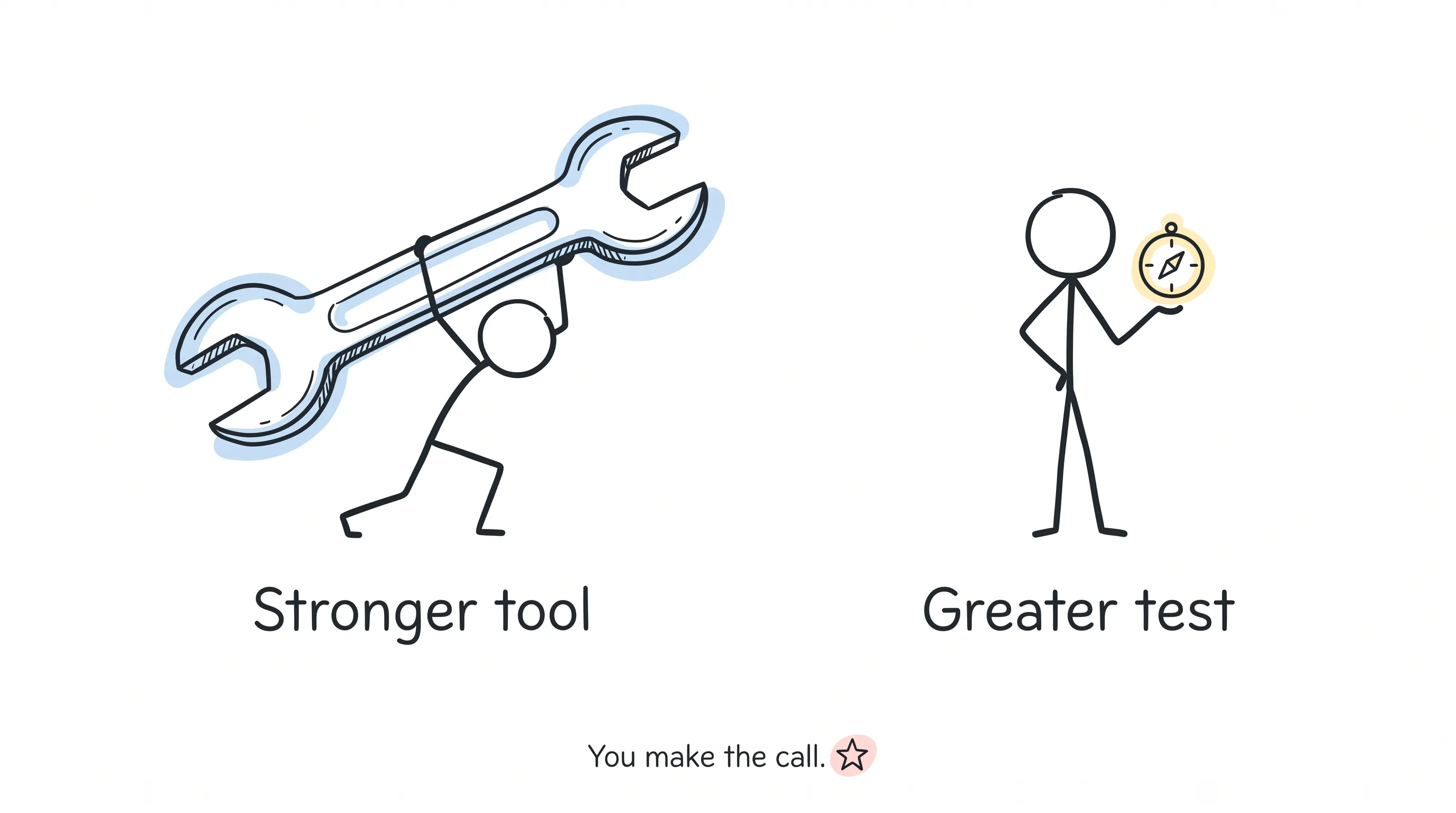
Hand the work to AI. Keep the judgment for yourself.
Here's wishing you this: may you always be the one who makes the call.
Continue reading
Related articles

Cross-Border Business: Time to Upgrade Your AI Toolbox
A learn article explaining how AI tools help cross-border e-commerce sellers clear five hurdles: language, regulation, logistics, payments, and fraud. It outlines a five-compartment toolbox, a five-step adoption path, and metrics such as conversion rate and CLV, while cautioning against over-reliance on AI.

AI Is Taking Over the Dirty Work of Social Media Marketing, One Task at a Time
This learn article outlines four social media marketing tasks AI can handle — audience analytics, content drafting and design, ad targeting and creative testing, and spam moderation — and cautions that taste, judgment, and data security remain human responsibilities.

AI Is Already This Good — Why Is Your Social Media Marketing Still Pure Manpower?
An overview of 18 AI tools for social media marketing, organized into six categories covering audience research, content creation, scheduling, comment and DM handling, ad management, and visual production, plus notes on personalization, prediction, and emerging trends.