
AI already writes your articles — so why are you still swamped?
A learn article explaining AI content marketing as a full pipeline: topic selection, first drafts, SEO optimization, and multichannel distribution. It pairs generative AI with AI decisioning for 1:1 delivery, keeps humans on judgment calls, and warns against traps like hallucinations and flattened brand voice.
A while back, I met an old friend for tea — one who works in content marketing.
He'd barely sat down before the grievances started pouring out.
It used to be that one team could keep one WeChat official account fed, and that was enough. Now? Website, email, SMS, app push notifications, communities… every channel is holding out a hand for content — and each one insists it be "custom-made."
Headcount didn't grow. Channels multiplied several times over.
"So what do you do?" I asked.
"Everything on AI," he said. "Who's still got a team hand-writing all their content?"
He wasn't exaggerating. One survey of B2B marketers found that 95% of companies are already using AI applications — and for 89% of them, the number-one use case is content creation.
My God. 95%. That's about as close to "everyone" as it gets.
But halfway through that pot of tea, I spotted a problem: the AI he kept describing was doing exactly one thing — writing articles.
Topic selection? Gut call. Distribution? Copy and paste.
I said, "Buddy, you're only using a quarter of this machine."
What is AI content marketing?
For most people, the phrase conjures up one picture: AI drafting my articles.
Right. But that's only a quarter of it.
AI content marketing means pushing AI into the entire content assembly line. Picking topics, writing first drafts, optimizing, distributing — four stages, and it has a seat at every one.
Crack it open, though, and you find three machines inside.
The generative model writes. First drafts, headline options, five tone variations of the same paragraph.
The data analysis system guesses. It combs through historical performance to predict which topics, in which formats, your readers are most likely to buy into.
Workflow automation delivers. It routes reviews, publishes on schedule, and gets the finished piece to every channel.
So what is the human doing?
Making the final call.
AI drafts, suggests, and sorts. But what to write, whether it's right, and whether it sounds like your brand — those three questions get answered by a human. Every time.
AI does the repetitive work. Humans make the judgment calls. With that division settled, content can finally scale.
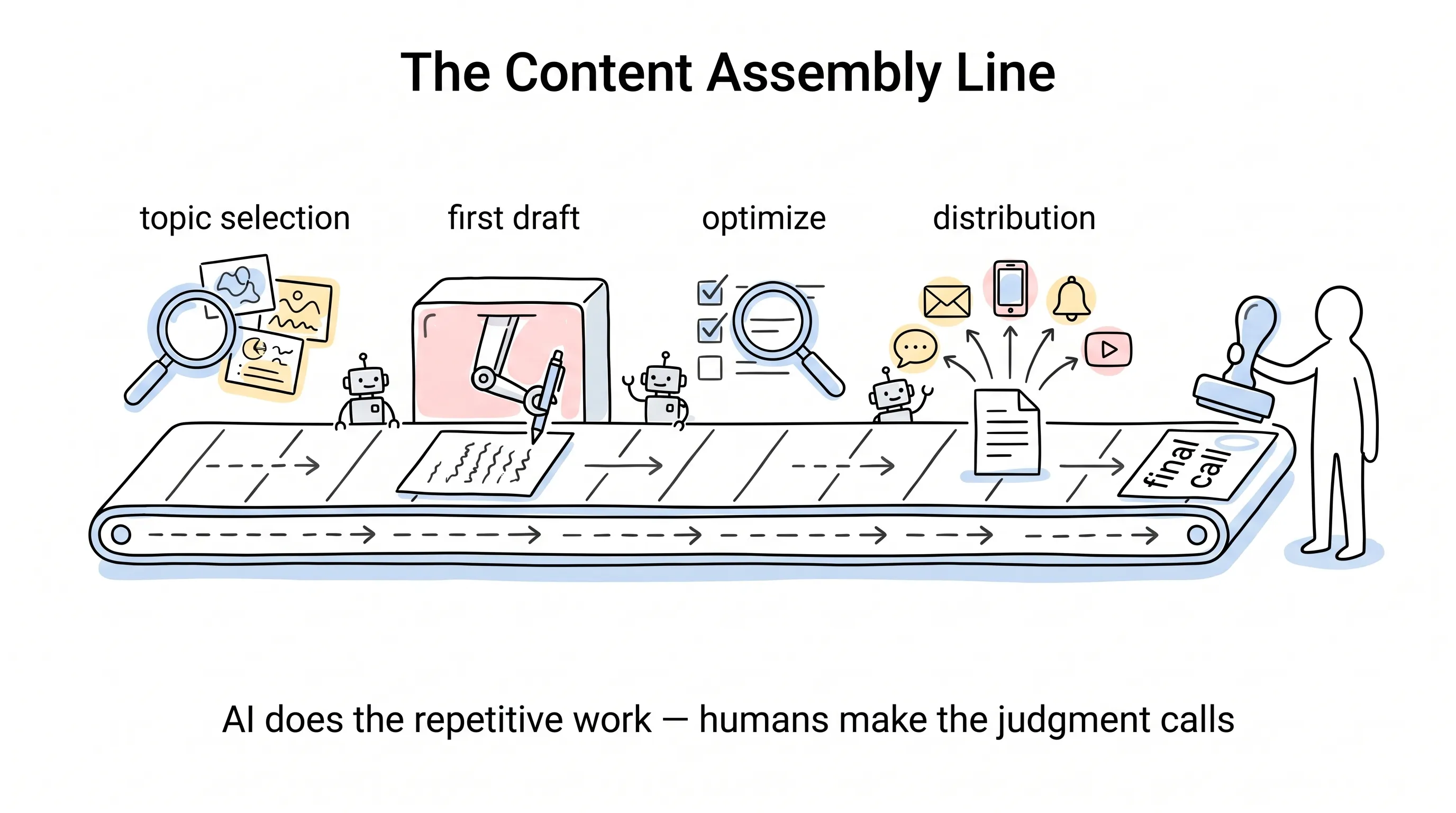
The life of an article
Let's walk one article through its entire life, start to finish.
Step one: picking the topic.
That dazed feeling before you start writing is the most painful part: what on earth should I write about? AI digs through search data and audience data, auto-clusters related topics, checks them against competitors to flag the gaps — "they've covered it, you haven't" — then hands you a ranked list of candidates.
Which one to pick, and when. Your call.
Step two: the first draft.
Every writer fears the blank page. AI's trick is laying a few stepping stones across it first: outline built, draft out — a matter of seconds.
So the writer's job shifts from "zero to one" into "one to ten." Fill it with real experience, real detail, and a point of view nobody else has made.
And those are exactly the things a model can't give you.
Step three: optimization.
Finished writing doesn't mean findable. AI takes your draft and runs it against the articles already ranking: which semantic keywords aren't covered, which subtopics got skipped, where an internal link belongs.
Remember, these are suggestions, not commandments. Whether to adopt them comes down to one test: is the piece clearer, or just longer?
Step four: distribution.
One long article splits into social posts, an email summary, a short-video script. One piece of content, five meals.
Give the copy-paste work to the machines; an editor gives each channel's version one final look — right version, right tone?
Walk all four stages and the pattern is unmistakable: AI does the repetitive labor; humans keep the judgment.
An arsenal doesn't fight wars
Only now do we get to the part I most wanted to tell you today.
A lot of people think "AI writes for me" is the finish line.
Actually, all you've done is stock the warehouse.
What is generative AI? The one hauling goods into the warehouse. Writing articles, producing a dozen or so headlines, splitting one version into five, attaching images. Take Braze Creative Studio — this is exactly its job: assets stored in one central place, brand templates applied, and AI-generated copy and images checked for one thing: do they look and sound like "your brand"?
At this point, you're holding an arsenal.
But an arsenal, by itself, doesn't fight wars.
What is AI decisioning? The role that decides which bullet goes to whom. It reads each customer's behavior and determines which piece of content this person sees, through which channel, at what moment. BrazeAI Decisioning Studio, for example, ingests first-party data and unified customer profiles, makes 1:1 choices for every individual, and has exactly one goal — lift the KPI you designate.
One makes the content. One ships it.
Each running alone is just an efficiency gain. Wired together, that's AI content marketing.
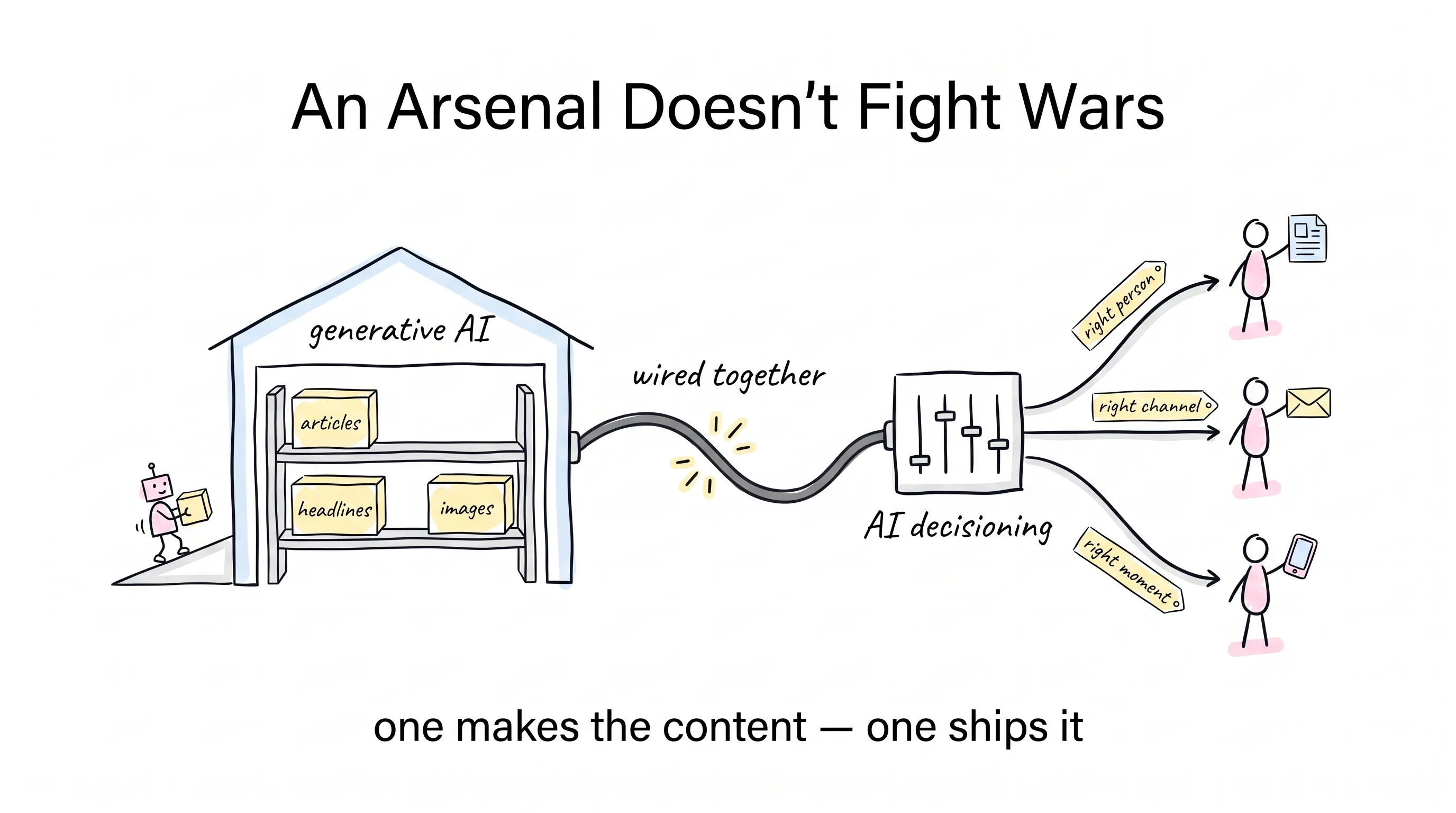
Think about it: personalization used to mean manually spinning one asset into N variations — by version three you were ready to quit. Now a single core asset fans out into versions for each audience, and AI decisioning distributes person by person. That's when personalization stops being a slogan and becomes a process.
But everything has a flip side
None of this works straight out of the box, either. Four traps — I've watched far too many people leap into every single one.
Trap one: trusting the draft completely.
Publish the model's draft as-is and what you get is a correct, readable article that could sit on anyone's account. Look like everything else, and you might as well not have published at all.
Treat the draft as a rough frame. The rhythm, the detail, and the lived experience — a human has to supply them.
Trap two: your voice gets sanded flat.
AI has a default register of its own. Left unchecked, it takes the brand personality you spent a decade building and irons it into a one-size-fits-all garment.
Feed it your brand rules and banned-words list, plus a few of your best-written pieces as examples. Only then does the first draft land somewhere near you.
Trap three: it will lie.
This is the deadliest one. What a model optimizes for is sounding confident, not being right. When data is missing, it may invent a statistic on the spot — and attach a plausible-looking source.
The industry calls this hallucination.
So your publishing workflow needs one non-negotiable step: every number, every quote, checked against the primary source.
Trap four: it has no heart.
A long-time customer got burned by your service and is seething. The model can't feel that fury — and at moments like this, its tone can easily turn a small issue into a full-blown PR incident.
Any high-emotion content must get human review. Make empathy a fixed checkpoint in the process — don't wait for the incident and then scramble to fix it.
How do you build this pipeline right?
My advice comes down to four rules.
One: document your brand voice. Which words you use, which clichés you ban, what rhythm your sentences carry — black on white — then distill it all into a shared prompt library for the team. Don't let everyone reinvent the wheel.
Two: humans stay in the loop. One gate on creative, one gate on the final draft. No model output ships naked.
Three: train the team to write prompts. Audience, goal, constraints, tone — not one of them is optional. Garbage in, garbage out.
Four: audit. Keep an eye on engagement rate, dwell time, and conversion. Find out whether AI-assisted content actually performs, then feed those conclusions back into the prompts. Run it as a closed loop.
Where do humans go from here?
This whole setup is evolving toward AI agents: generating options on their own, choosing who gets what, sending, then learning from what comes back.
Sounds a little scary, doesn't it?
But the human seat doesn't disappear — it just moves up a level: set the guardrails, set the goals, draw the boundaries.
As we got up to leave that day, my friend asked me: will AI eventually replace everyone who makes content?
My answer: it can't. What it replaces is the scrambling.
Because content marketing hasn't changed since day one: put something worth reading in front of the right person, at the right moment.
The tools keep changing. That one thing never does.
My wish for you: may you write faster and faster — and still sound like yourself.
Continue reading
Related articles

Cross-Border Business: Time to Upgrade Your AI Toolbox
A learn article explaining how AI tools help cross-border e-commerce sellers clear five hurdles: language, regulation, logistics, payments, and fraud. It outlines a five-compartment toolbox, a five-step adoption path, and metrics such as conversion rate and CLV, while cautioning against over-reliance on AI.

AI Is Taking Over the Dirty Work of Social Media Marketing, One Task at a Time
This learn article outlines four social media marketing tasks AI can handle — audience analytics, content drafting and design, ad targeting and creative testing, and spam moderation — and cautions that taste, judgment, and data security remain human responsibilities.

AI Is Already This Good — Why Is Your Social Media Marketing Still Pure Manpower?
An overview of 18 AI tools for social media marketing, organized into six categories covering audience research, content creation, scheduling, comment and DM handling, ad management, and visual production, plus notes on personalization, prediction, and emerging trends.