
AI Advertising, Geeks360 Style: How Do They Actually Do It?
A Geeks360 learn article on using AI for advertising creative production, covering briefs, image and video generation tools, prompt iteration, human finishing touches, and batch creative testing.
A while back, I had dinner with an old friend who runs a cross-border e-commerce business. The moment he sat down, he shoved his phone in my face: look, this tool makes images, that one makes videos, and there's another one that… He scrolled for a long while, then looked up and asked me: this wave of AI — should I ride it? And if so, where do I even start?
I laughed. I've been asked that question at least ten times lately.
Here's the answer up front: Yes, get on board. Just not the way you think.
Why do I say that? Let me start with our own story.
At Geeks360, we run creative for paid campaigns. We've been testing models with real work since ChatGPT first showed up — all the way through the latest visual models from ByteDance and Google. A year-plus of testing has made one thing increasingly clear: the brands doing well all use AI to speed up creative production, but none of them hand the steering wheel to AI.
First, a Splash of Cold Water
A lot of people believe AI can do the creative work for them.
It can't.
What is creativity? The brand concept, the hook that stops the scroll, the feel for what moves the user emotionally — that's creativity. AI can't do that.
What AI can do is take an idea you've already thought through and turn it into images, videos, and copy at lightning speed. You bring the brains; it brings the craft.
So here's my judgment, in one sentence: AI is your production assistant, not your creative director.
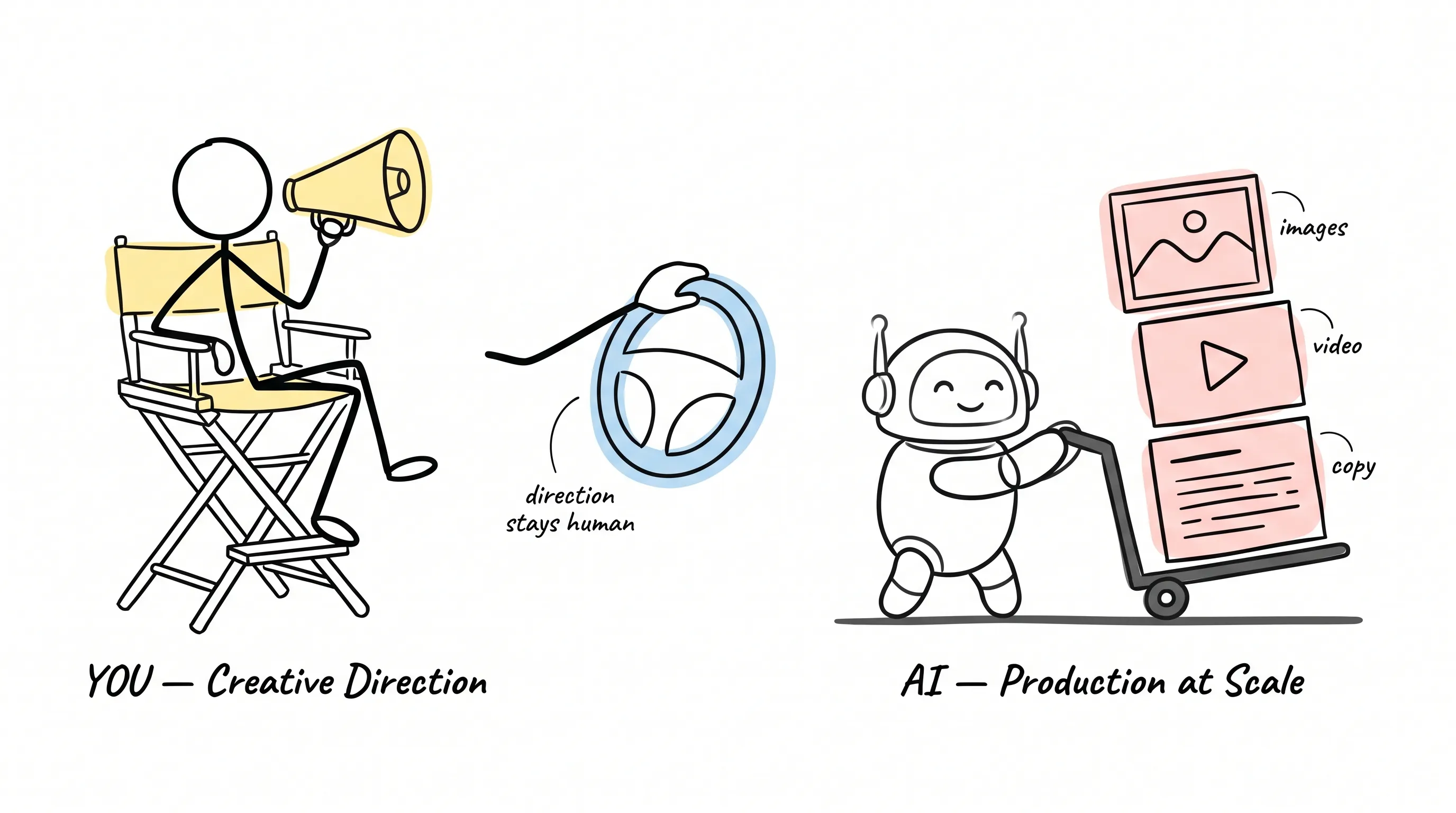
The best-running ads still start with a person. You arrive with the insight and the story; AI spreads them across every channel you buy.
Everything Starts with a Brief
So where exactly do you start?
Before you open any AI tool.
You first need a decent brief. What does decent mean? Imagine you're handing an assignment to a copywriter, a photographer, and an art director at the same time. What would you tell them? The tone, the lighting, the mood of the frame, where the emotional hook is buried.
Think about it: feed AI a three-word brief that just says "premium feel," versus a two-hundred-word brief that spells out the lighting, the palette, the emotion, the style in full detail. How far apart do you think the results will be?
Worlds apart.
The vaguer the brief, the more AI is a blind lottery; the sharper the brief, the more AI is your trusted old partner.
By the way, you can have AI write the brief itself. We built a small internal tool on ChatGPT to do exactly that, and paired it with models like Claude and Kimi. In a few minutes you can grind out a detail-rich prompt. Don't treat the brief as a sticky note. Treat it as a miniature strategy document. It's the ground everything else stands on.
So Many Tools — Which One Do You Pick?
Brief in hand, time to pick your tools.
There really are a lot of them. My advice: don't get greedy. Pick one or two, get them running smoothly, then expand. Here's the landscape, sorted by what you need.
Image generation first. ByteDance's Seedream 3.0 handles both Chinese and English, produces a 2K image in about 3 seconds, and its composition and in-image text hold up impressively well. ChatGPT's built-in GPT-4o Vision can generate and edit images too; Sora's visuals are more dramatic, but there's a catch — use it long enough and you'll notice its style is recognizable, and everything starts to look alike. One small trick from experience: for image generation, working inside the OpenAI Playground actually beats asking in the chat window.
Video next. Seedance 1.0 generates short clips of around 5 seconds with remarkably good continuity between shots. Google's Veo3 goes a step further: high image quality, plus sound and music. Want a static product photo to start moving? Use Kling.
Image editing? Flux Kontext. Local replacements, style swaps, detail fixes — high precision, and it supports training your own signature style with LoRA.
If opening accounts on platform after platform feels like too much, look at Fal.ai. It's a developer-friendly aggregator — one API to call Veo, Kling, Flux Kontext, and the rest. The trade-off is that some features are dialed down versus the native tools, but you manage a single account, and it's very convenient for building automated pipelines.
So: image generation, video generation, image editing, aggregation — four categories. Start with the one where your pain is most concentrated.
Prompts: Just Talk Like a Human
Tools picked. This is where many people get stuck: do prompts have to be studied, formally?
No. You don't need to become a prompt engineer. You just need to say what you mean clearly.
The one thing to remember: every platform has its own taste. Sora, for instance — you don't need to go into much detail. Midjourney is the opposite: you have to break it down and spell everything out.
Here's an example. "Natural light, a young woman unboxing an eco-friendly beauty product, clean background, warm tones." That's image generation. Want her to move? Add: "Short video — she smiles and brings the product close to the camera."
That's how plain it is.
Also: the first result is almost never what you wanted. Don't be discouraged — it's the starting point, not the finish line. Iterate on top of it, use negative prompts to rule out what you don't want, run several rounds. One new trick that genuinely surprised me: in Veo3, you can paint and scribble your edits directly on the image instead of struggling to write a prompt.
The first time I saw that, I stared for a good while. You can do that?
AI loves specifics. But it loves experiments even more.
That Last 20%? That's on You
AI can take an asset to 80 points.
What about the remaining 20? Fix the eyes and expressions, repair the hands it always gets wrong, drop in your own brand fonts and logo, rewrite the too-generic copy in your own voice.
Think about it: in the two seconds a consumer spends on your ad, what decides whether they stop is often exactly those 20 points.
And brand personality. Playful? Loud? Quietly premium? It has to come through in every single asset. That's something AI can't give you. You have to watch for it.
AI turns ideas into images. Humans make the images worth watching.
AI's Biggest Dividend: Trial and Error Just Got Cheap
Everything above is craft. Now for what I consider the most valuable point of all.
The common line is that AI advertising's biggest dividend is speed, or savings. I think it's neither.
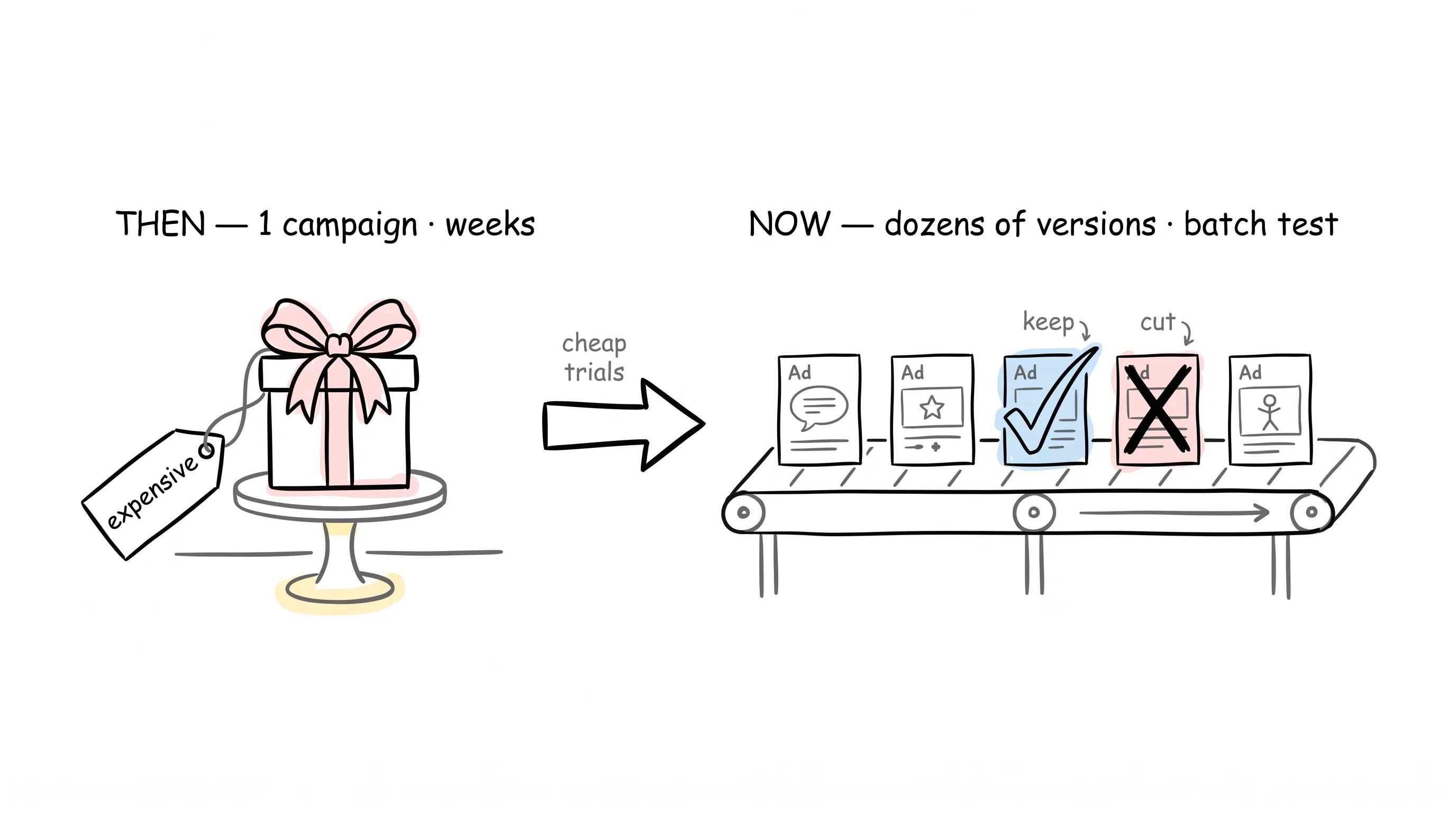
It's that trial and error became cheap.
Run the numbers. A campaign used to take weeks, and every revision meant running the whole process again. Now, the time that used to produce one campaign is enough to generate and test dozens of versions. New headline, new background, new model, new product staging — produce in batches, test in batches, watch the data, keep what performs, cut what doesn't.
What does that mean? It means the high-frequency testing that used to be a big-brand privilege is now within reach of a small team of a few people.
Trial and error went from luxury good to fast-moving consumer good.
A Case in Point: An Auto Repair Shop
Here's how we do it ourselves, so you can see how far this playbook goes.
For a video ad for an auto repair shop, we don't expect AI to generate the whole film in one go. We break the film into micro-scenes of 3 to 5 seconds each: a customer pushes open the door, chats with the staff, circles a car, and finally sits down to sign.
Each micro-scene gets made with Seedream and Veo3. Then we stitch them together.
Where's the hard part? The seams. The lighting, the people, the color tone in every little scene have to line up, so the result feels like one story rather than several unrelated takes. Get the alignment right, and a whole coherent narrative emerges — you can even do the dialogue.
People who watch the finished film won't say "this was made by AI." They'll think: this shop shot a really nice video.
That is creativity amplified, not replaced.
When Should You Call in the Professionals?
So does everyone have to wrestle with this whole stack themselves?
Not necessarily. When you hit any of these, I'd say don't grind it out alone: the business is growing so fast your asset production can't keep up; your ad performance has plateaued and no tweak moves it; or you simply don't have the energy this week to learn yet another new tool.
In moments like these, hiring a professional team is nothing to be ashamed of.
Take us at Geeks360. What we do comes down to one sentence: humans guard the creative direction; AI handles the scale of execution. We help brands ramp up asset production without losing quality or control. What we deliver isn't just assets — it's assets that actually perform.
Back to My Friend
By the end of that dinner, here's what I told him: stop agonizing over whether AI will make you obsolete. Ask yourself instead — is your brief written clearly? Do you know what actually moves your customers?
The tools change every week; that hasn't changed to this day. But one through-line never changes: humans set the direction, AI adds the acceleration.
The brands winning hardest in the market right now want both. They tell fuller stories and run faster tests. Because they've understood one thing:
AI doesn't replace creativity. AI amplifies it.
Go try it. Start with a brief written all the way through, produce one version, then revise it.
Here's wishing every version of your assets beats the one before it.
Continue reading
Related articles

Cross-Border Business: Time to Upgrade Your AI Toolbox
A learn article explaining how AI tools help cross-border e-commerce sellers clear five hurdles: language, regulation, logistics, payments, and fraud. It outlines a five-compartment toolbox, a five-step adoption path, and metrics such as conversion rate and CLV, while cautioning against over-reliance on AI.

AI Is Taking Over the Dirty Work of Social Media Marketing, One Task at a Time
This learn article outlines four social media marketing tasks AI can handle — audience analytics, content drafting and design, ad targeting and creative testing, and spam moderation — and cautions that taste, judgment, and data security remain human responsibilities.

AI Is Already This Good — Why Is Your Social Media Marketing Still Pure Manpower?
An overview of 18 AI tools for social media marketing, organized into six categories covering audience research, content creation, scheduling, comment and DM handling, ad management, and visual production, plus notes on personalization, prediction, and emerging trends.