
Agentic AI Is About to Run Your Ads — and KNOREX Wants to Be the Door
A learn-style commentary on KNOREX's advertising API for agentic AI, covering its stated compatibility with the Amazon Ads MCP Server and the AdCP protocol, and how AI agents could build campaigns, adjust budgets, and pull cross-channel reports.
A while back, I was scrolling through the news and came across a quiet little item: a company called KNOREX had released an advertising API built for agentic AI.
Honestly, I skimmed right past it. Product launches like this? No fewer than eighty of them a day, probably a hundred.
But on my evening walk, the thing crept back into my head. The more I thought about it, the more interesting the spot it had landed on seemed.
What is agentic AI? Simply put, it's AI that can get work done on its own. You don't have to walk it through each step — hand it a goal, and it breaks the work into tasks, executes them, checks the results, and adjusts.
Apply that to advertising, and the change becomes very concrete.
Ad buying used to be a human operating the tools. You set the budget, you placed the bids, you read the reports, you changed the strategy.
From here on, chances are you'll tell your goal to an AI agent, and it will go build the campaigns, watch the data, shift the budget, and tune the bids by itself.
While you sleep, it's still working.
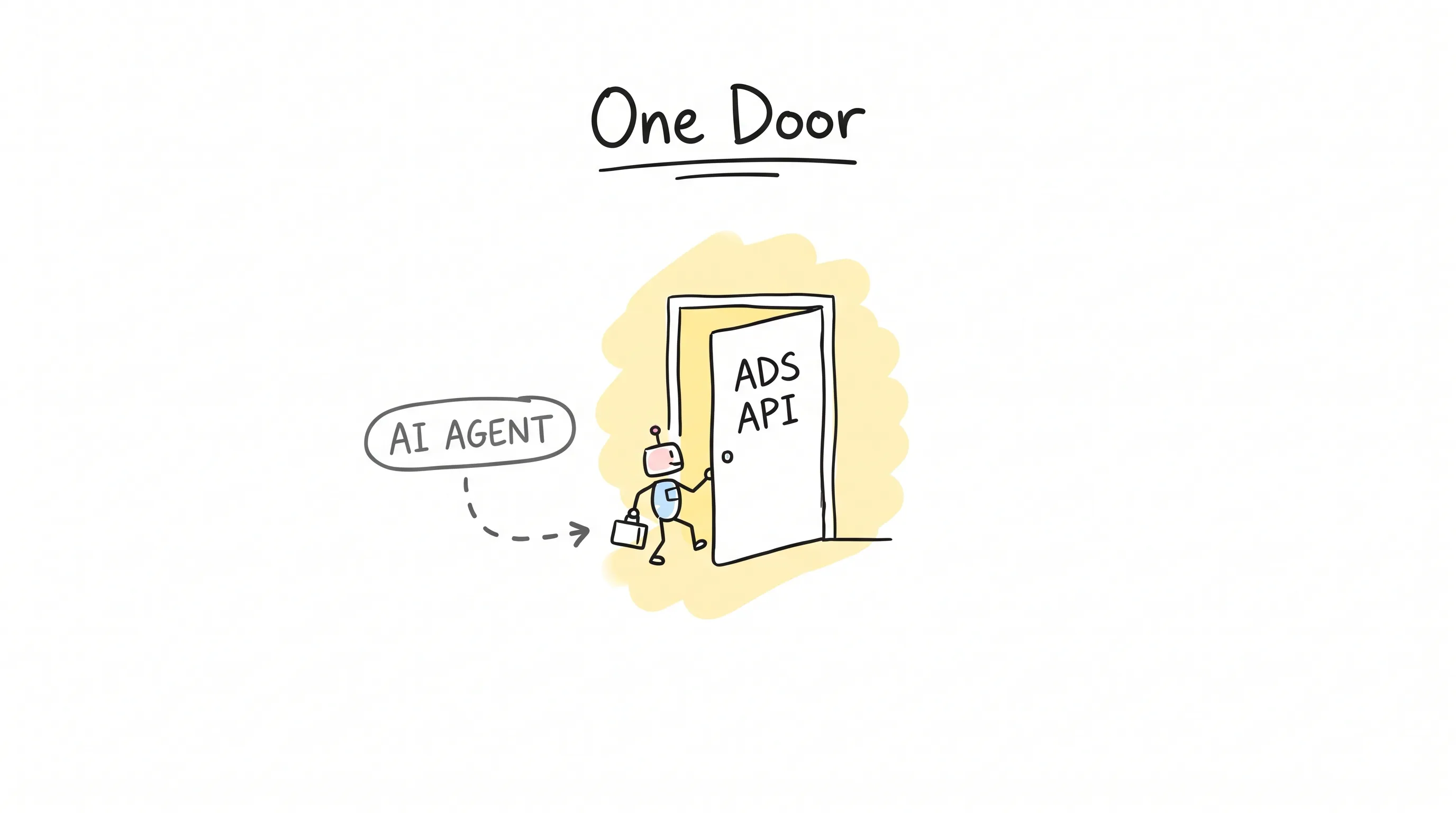
But none of that happens unless the AI agent has a door to get in.
Think about it: today's advertising platforms basically each run their own show. Meta has one backend, Google has another, and LinkedIn, TikTok, and the various programmatic platforms are each separate yet again. If you want one AI agent to manage five channels across the board, it has to integrate with them one by one. Every connection means writing a set of integrations; every change down the road means maintaining them all over again.
This is the curse of point-to-point. More platforms, more dedicated lines, heavier engineering. Add a channel, add another pile of code. Nobody does this math in day-to-day work — but run the numbers at year-end, and it's a shock.
What KNOREX's Ads API wants to do is open every door in one unified place.
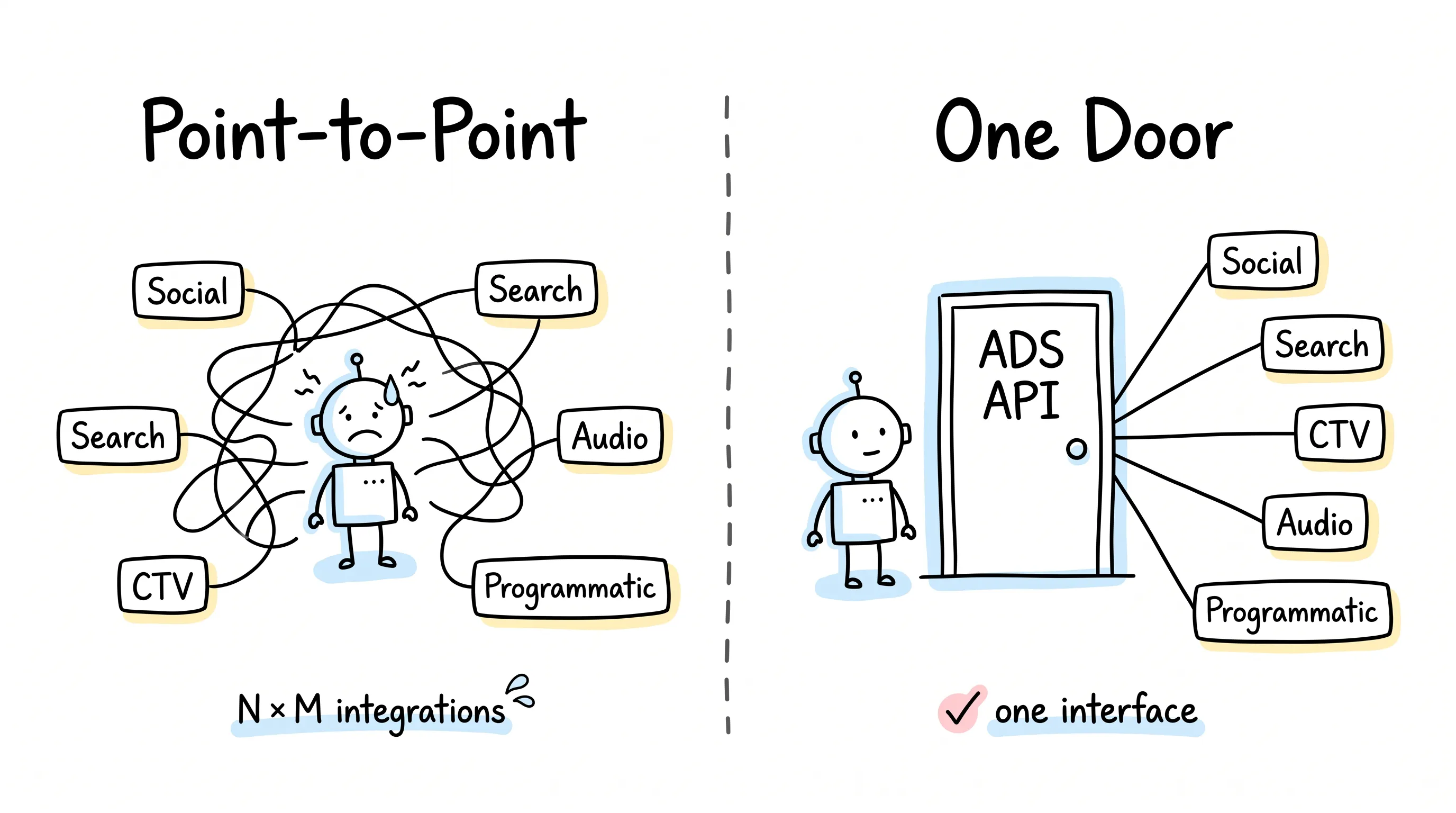
It's compatible with the Amazon Ads MCP Server. Think of MCP as the USB port of the AI era: an AI agent plugs in, speaks a line of natural language, and can call KNOREX's advertising capabilities directly, using the campaign features inside the KNOREX XPO platform — no custom development needed.
It also supports an open protocol called AdCP. What is AdCP? In one sentence: it sets a single, universal socket standard for the industry. Each platform used to measure with its own ruler; once the protocol is unified, an AI agent can hook into every participating ad platform through one interface.
Yes — a bit like Qin Shi Huang standardizing weights and measures across ancient China. Only when the ruler is standardized can business scale.
So the door is open. What can an AI agent do with it?
Build ad campaigns, pull performance data from every channel, adjust budgets and change bids on the fly, run cross-channel optimization, generate reports. The repetitive chores of ad operations can basically all be handed over.
Here's an example. It's 11 p.m., and the customer acquisition cost on one channel suddenly spikes. In the old days, you wouldn't notice until you read the report the next morning — by which point a chunk of budget had already burned. Now, your AI agent moves that budget out on the spot.
My God. That is what the word "agent" actually means.
And this isn't just talk on paper. Back in February this year, KNOREX already had three partners running on this API — two in the US, one in Southeast Asia. As of today, it has been in commercial use for 7 months.
The company was founded back in 2009. Its flagship product is KNOREX XPO, an AI-powered cross-channel advertising platform covering the major channels — social, search, CTV, audio, programmatic — with teams in the US, Vietnam, India, Malaysia, and Singapore.
Abhishek Kumar, KNOREX's VP of Product and Engineering, says agentic AI is the next structural shift in digital advertising. In his view, as marketers begin using autonomous systems to manage ever more complex cross-channel strategies, scalable infrastructure becomes a matter of survival.
I like that word — a lifeline. Water, power, roads: nobody gives them a second glance on a normal day, but if any one of them goes down, no building ever rises.
My read is simple: how fast AI agents enter the field depends on how fast those doors get built. Whoever turns a unified entry point into the de facto standard first is the one holding the faucet.
The industry's widely held forecast is that global digital ad spend will break through $740 billion in 2026. A rough conversion puts that north of 5 trillion RMB. Every inch the flow of money changes course is a redistribution.
Of course, a company's own press release can hardly avoid polishing its own halo. What those three partners ultimately deliver — we'll have to see the data that follows.
But the direction? I buy it.
Back to that unremarkable little news item from the start. Next time you hand your budget to an AI agent, remember to ask one question: which door did it walk in through?
Whoever builds the door well stands at the entrance to the next market.
And here's wishing you hand all the repetitive work over to your AI agent sooner rather than later.
Continue reading
Related articles

Cross-Border Business: Time to Upgrade Your AI Toolbox
A learn article explaining how AI tools help cross-border e-commerce sellers clear five hurdles: language, regulation, logistics, payments, and fraud. It outlines a five-compartment toolbox, a five-step adoption path, and metrics such as conversion rate and CLV, while cautioning against over-reliance on AI.

AI Is Taking Over the Dirty Work of Social Media Marketing, One Task at a Time
This learn article outlines four social media marketing tasks AI can handle — audience analytics, content drafting and design, ad targeting and creative testing, and spam moderation — and cautions that taste, judgment, and data security remain human responsibilities.

AI Is Already This Good — Why Is Your Social Media Marketing Still Pure Manpower?
An overview of 18 AI tools for social media marketing, organized into six categories covering audience research, content creation, scheduling, comment and DM handling, ad management, and visual production, plus notes on personalization, prediction, and emerging trends.