
After a Marketing Veteran Moved His Entire Workbench into AI, I Finally Saw Where Marketers Fit Now
A learn article recounting a B2B SaaS marketing veteran's live AI demo: he encodes his playbooks as skill files, then has AI run keyword research, programmatic SEO landing pages, and cross-source analytics, framing the marketer as a navigator who directs AI execution.
A few days ago, I watched a live demo that ran over an hour.
The man demoing has spent a decade or so in B2B SaaS marketing. He publishes a marketing newsletter called Swipe Files, founded a marketing agency called Conversion Factory, and his open-source marketing skills library, Marketing Skills, has racked up more than twenty thousand stars on GitHub.
What does he use AI for? Right in front of me, he generated 10 SEO landing pages in 30 seconds.
My biggest takeaway wasn't those pages. It was that this man's position had changed.
First, how it clicked for him
His story is a good one.
In 2023, he had just gotten his agency off the ground when he got laid off. He made a bold decision: fly to Atlanta, move into the home of a stranger he knew from Twitter, and spend two weeks locked in a garage learning to code alongside nine other people who were just as much strangers to him.
Those two weeks were when it clicked.
While the group was heads-down debugging, someone called out: "I found a code editor with AI built directly into it."
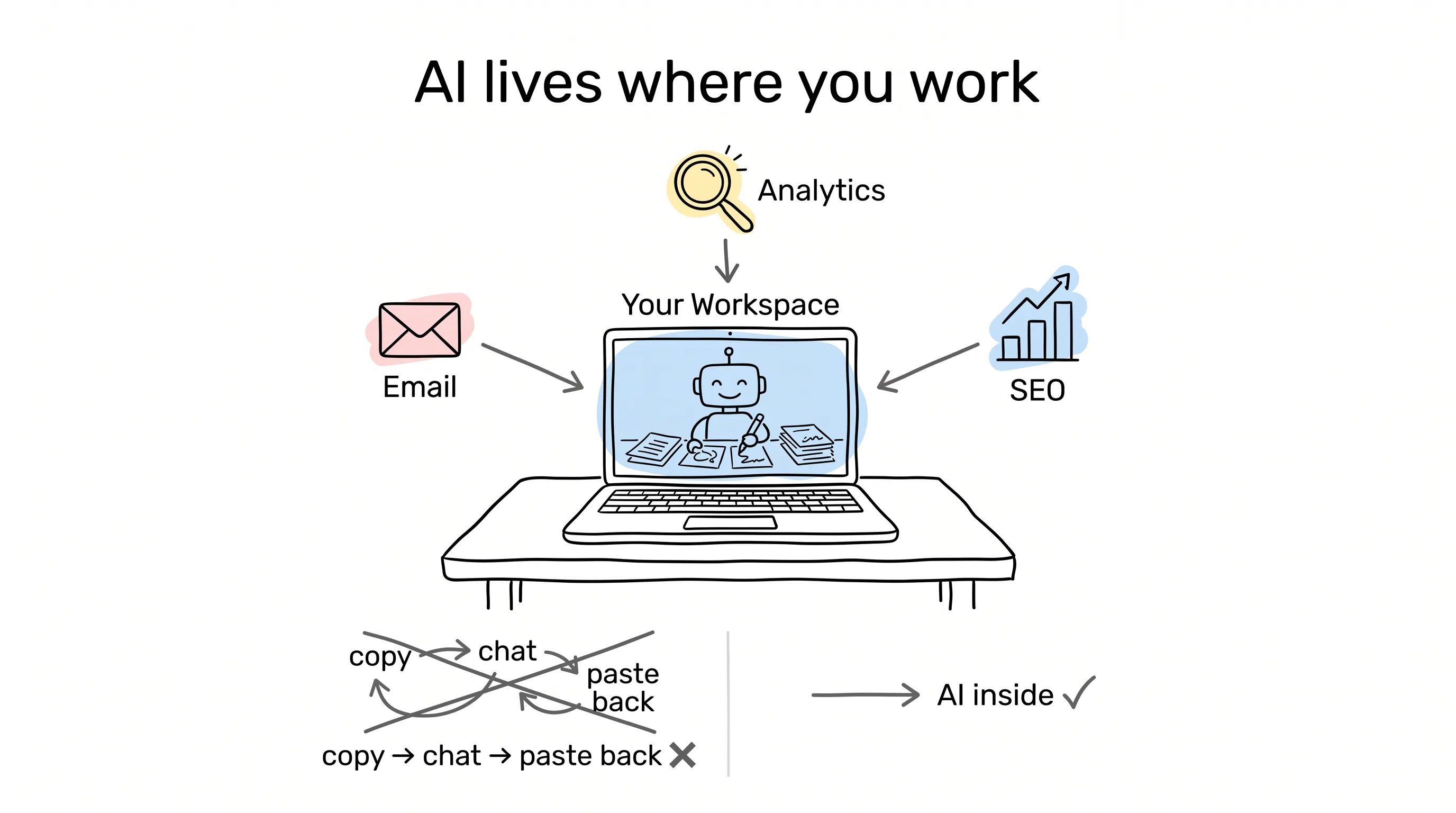
That editor was Cursor. The key wasn't that its AI wrote better code than anyone else's. It was that the AI lived inside your workspace. It could see all of your files and every line you were changing. You no longer had to copy your code out, paste it into some chat box, then paste the answer back.
The realization hit him on the spot: AI should live where you work — not have you serve it.
Interestingly, programmers got to enjoy this epiphany two years before marketers. Only recently have marketers started asking: can an AI live inside my email tool? Can one live inside my analytics?
Now, the answer is yes.
What is a skill?
First, let's be clear about the thing his whole operation depends on: skills.
What's a skill? Understand it as an operations manual for AI, written down and made permanent.
AI is smart, but it never went through your company's onboarding. It doesn't know your playbook, your templates, your rules. A skill is where you write all of that down in advance and store it on your own computer. Before doing any work, the AI reads it through — then follows it to the letter. No freelancing allowed.
He moved his entire brain into it: the case-study library from his newsletter, the agency's SOPs, the full set of methodologies accumulated over years of writing — all of it became individual skill files.
What really struck me about this: for the first time, a personal playbook can be captured, reused, and open-sourced like software.
And you don't have to start from scratch. There are now public skill marketplaces carrying more than ninety thousand ready-made skills, covering everything from writing emails to making videos. Find one you like, change a couple of lines, and it's yours. One company, Ramp, went further: employees built up 300 skills for the company, turning every repetitive task into an on-demand manual. If you want company knowledge to stop living in one person's head, this is how.
In front of me, he did three things in 30 seconds
Let's look at the three things he demoed live.
First: keyword research.
He hooked the AI up to an SEO data interface and gave it one sentence: "Run a round of keyword research for this form-builder tool. Quickly."
30 seconds. The AI pulled back a keyword list, including long-tail items like competitor-alternative keywords — 30,000 combined monthly searches, and most of the terms barely contested.
So what, it's just a table? Think about how this used to get done: first guess what customers would search for, then study what terms competitors were ranking for, then burn half a day in Ahrefs, and finally assemble a spreadsheet. He says that over the years he has spent tens of thousands of dollars on SEO projects, and the deliverable he bought back was, well, a table.
Next, picking up right where he left off: programmatic SEO.
What is programmatic SEO? Using one template plus a batch of real keywords to mass-produce landing pages — one keyword, one page — casting a wide net for search traffic.
He said to the AI: "Invoke my programmatic SEO skill. Use the keywords from just now. Produce 10 pages first, and open them for me when done."
On screen, 10 pages spilled out one after another. Every page had a clean URL, body copy, an FAQ, and a call-to-action button. This used to be a months-long project; that day, the first version took 30 seconds. To publish? Say the word to the AI — push to GitHub, sync to the hosting platform, live.
The third one moved me most: cross-source analysis.
He used one of his own products, an email-validation tool called TrueList, as the example. He fed the AI data from three sources at once — Google Search Console, Fathom Analytics, plus keyword data — and said only one sentence: "Cross-analyze these for me. I don't know what I should look at. You figure it out."
The AI returned a report. Which channels were growing, which were soft, a page-by-page comparison across all three data sources, and finally five key conclusions. It even flagged two places where the data contradicted itself, and explained what the contradiction meant.
He followed with a piece of blunt honesty: this is the kind of deliverable an SEO consultant used to work three months and charge you five figures to produce.
Even better, this work can run on a schedule. Have the AI set itself a routine: every week, pull the latest data and run the analysis again. Before, when the boss slammed the table and asked "why did traffic drop this month," all you could do was scratch your head. Now, at least something is there to answer for you.
A few more, while we're at it
He also demoed editing a video live in the browser. The video was rendered with code by AI, using Remotion, an open-source library. He knows nothing about editing — he said just one line: "The pacing at the beginning and end is too fast. Hold it an extra second or two. Let it breathe." The AI made the change. He never touched a timeline.
There was also sales operations. He wrote a RevOps skill containing a lead lifecycle framework, a scoring model, and stage-management rules. Hooked up to his own HubSpot, he said "audit this for me," and the AI went in and checked the pipeline stages one by one, discovered there was no lead-scoring model, and built one on the spot. With enough permissions granted, it acts directly; without them, it writes out the steps for you to follow.
There's a present-day reality here that has to be spelled out. He stressed it again and again: what limits marketers today is not how smart AI is — it's how many interfaces each tool is willing to open up. If a tool offers no API and no command line, no matter how capable the AI, it can only stare helplessly from outside. So when you pick tools going forward, ask one extra question: is it open to AI? That question will only keep getting more valuable.
And one more bit of math. His AI subscription runs $100 a month, $2,400 a year. His words, in essence: this is the best money I've ever spent.
You're the navigator, not the driver
Why is all of this worth marketers' serious attention?
He offered an analogy I find especially precise.
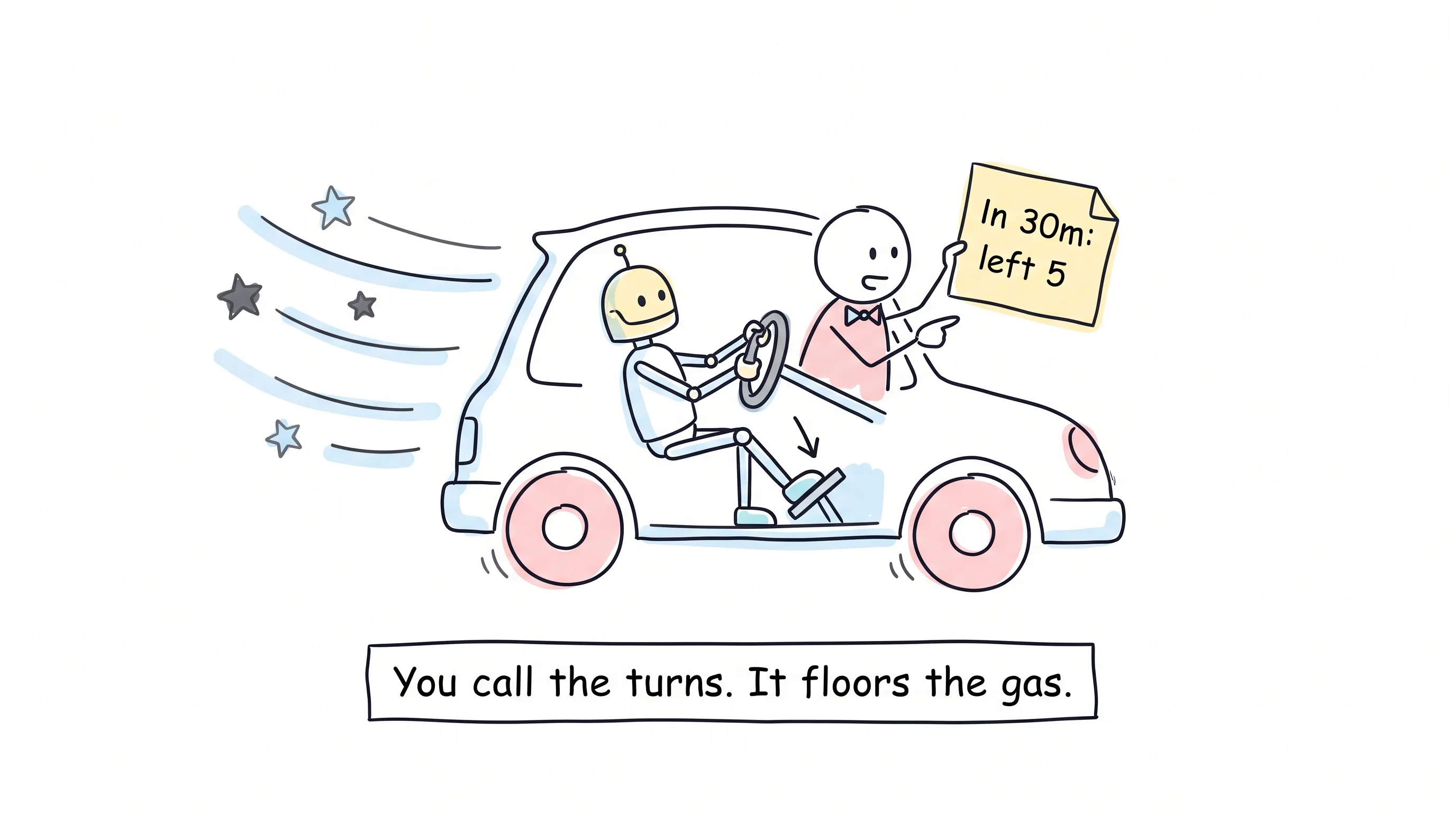
You've seen rally racing. The driver pushes the car past a hundred miles an hour while the co-driver in the passenger seat holds the pace notes, calling out: "In thirty meters, left turn, five degrees." The driver does nothing but press the gas; the direction comes from the navigator.
In the AI era, the marketer is that navigator. You call the turns; it floors the gas.
One more of his preferences, which gave me ideas too. He insists on using Claude Code in the terminal, on the grounds that the closer you are to the foundations, the more permissions you get and the more you can do — the browser layer is a stripped-down version for ordinary users. If you want to build something real, you have to move closer to the foundations. That logic holds in any line of work.
Finally, a reason for optimism
When many people hear "AI taking over marketing," their first reaction is: it's over — the jobs are gone.
His view is the opposite. And I stand with him.
He likes the Mad Men analogy. Don Draper thinks of an idea — and then? He calls Peggy in to write the copy, hands it to the art department for mockups, waits several weeks, sits through meeting after meeting, and in the end it becomes a poster. That's what doing marketing looked like back then.
Later we got computers, documents, templates, and efficiency improved a great deal — but one thing never changed: you supply the idea, then wait for other people to execute.
It's different now. AI is your one-person full-stack team. Copy, design, web pages, emails, video — you supply the ideas, it delivers the work. You no longer have to be the typist in the queue; you can go back to being the creative director.
This also explains something that hung unresolved for years. Everyone says marketers should run more experiments — put out a thousand versions of one ad. But if you've tried it, you know: there is simply no time. Just pulling data, writing reports, and sitting in meetings devours the whole day. Now that the grunt work goes to AI, the time actually comes back.
These days, all this veteran does is the one thing left: the creative work.
Looking back at the days of typing into documents after working with AI will probably feel the way we look back today at making posters with pen and paper.
Here's to you claiming the navigator's seat — the sooner the better.
Continue reading
Related articles

Cross-Border Business: Time to Upgrade Your AI Toolbox
A learn article explaining how AI tools help cross-border e-commerce sellers clear five hurdles: language, regulation, logistics, payments, and fraud. It outlines a five-compartment toolbox, a five-step adoption path, and metrics such as conversion rate and CLV, while cautioning against over-reliance on AI.

AI Is Taking Over the Dirty Work of Social Media Marketing, One Task at a Time
This learn article outlines four social media marketing tasks AI can handle — audience analytics, content drafting and design, ad targeting and creative testing, and spam moderation — and cautions that taste, judgment, and data security remain human responsibilities.

AI Is Already This Good — Why Is Your Social Media Marketing Still Pure Manpower?
An overview of 18 AI tools for social media marketing, organized into six categories covering audience research, content creation, scheduling, comment and DM handling, ad management, and visual production, plus notes on personalization, prediction, and emerging trends.