
Advertisers Are Turning Into Passengers
An analysis of how Meta's AI-driven ad automation is shifting control from advertisers to platforms, and how retail media channels are expanding from last-click conversion ads into brand advertising. It advises advertisers to stay clear about brand positioning as platforms take over execution.
A couple of days ago I had dinner with a friend who runs an e-commerce business, and from the moment he sat down, he spent the entire evening complaining about his company's ads on Meta.
He said that in the old days, when you launched a campaign, your team called every shot: who to target, how to split the budget, which images to run, when to run them. Now? The platform is forever "thinking on your behalf." Look away for a second and the backend has sprouted a few new toggles — all switched on by default.
Mid-rant, I asked him: so did you turn all those switches off?
He paused for a beat, then said: actually, no — not all of them. Some of them really do perform better.
Hearing that, I thought of something else I'd come across recently.
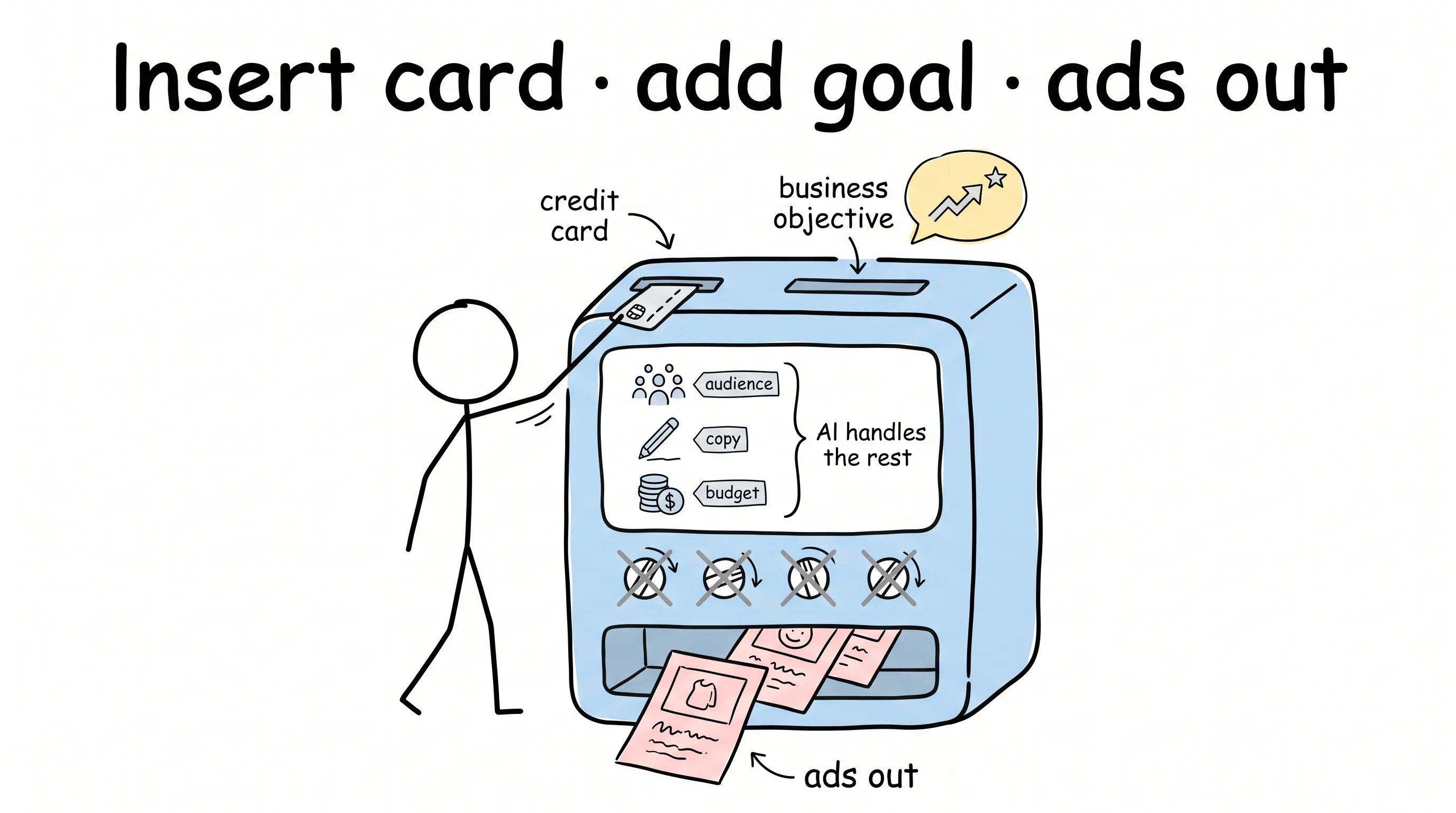
Zuckerberg has described a future. In his vision, how simple could advertising on Meta's platforms get? All you'd provide is two things: a credit card number, and a business objective. Everything else, AI handles.
Picking audiences? Not needed. Writing copy? Not needed. Adjusting budgets? Also not needed.
You put up the money; it puts out the work.
Doesn't that sound like a vending machine? Insert coins, get product.
Meta itself has put a date on this future: as early as the end of 2026. That was the claim as reported last year.
But the advertisers actually spending money on the front lines mostly shake their heads: it won't be that fast.
What Does "Fully Automated Ad Buying" Mean?
Put it this way: advertising used to be a stick shift. Your hands on the wheel, your foot on the gas. Audience targeting was yours, budget allocation was yours, the creative was yours. The money was yours — and so was the muscle.
What Meta is doing is swapping the stick shift for self-driving.
Look at its moves over the past year or two: the new Andromeda ad retrieval system rebuilt the whole logic of matching ads to people; the Advantage+ suite of AI tools keeps spreading, taking over creative, targeting, and budgets; even Manus, the AI agent Meta acquired just late last year, has already shown up in the ads backend.
Any one of these, taken alone, is impressive.
But packed into one sentence, they say: hand over the wheel.
Audiences — stop hand-picking them, widen them, let the algorithm decide. Budgets — stop slicing them, merge them, let the algorithm decide. Creative — stop fiddling with it, generate it automatically, let the algorithm decide.
Aaron Edwards, founder of The Charles Group, put it even more bluntly. His observation: Meta is constantly simplifying the act of buying ads — audiences get broader and broader, the dials you can turn get fewer and fewer, and the number of ad sets (the sub-groups inside a campaign that hold targeting and budget) you're allowed keeps shrinking.
The reason? Meta's line is: the more data there is, the better the algorithm works.
Sounds reasonable. And a lot of the time, it really does work better.
But.
What Are Advertisers Afraid Of?
What bothered my friend was never the results. It was the right to know.
A lot of these new features weren't chosen by you — they came switched on by default. Say nothing, and it turns them on for you.
At the ad agency Deutsch, a media lead named Hayley Owen described the routine: every so often the team has to go dig through the backend to see what the platform switched on this time without telling anyone, and quickly test it to figure out what they're actually going to get.
What's it like? Like hiring an extremely diligent housekeeper. She tidies your house every day, her intentions are good, and the work isn't bad. But you never know which drawer she moved today.
Some brands can live with this. Results talk — if the numbers are good, everything else is negotiable.
For other brands, there is one line they will never give up: creative. What the brand looks like, what it says, what voice it speaks with — that's the brand's lifeblood. If that part gets fully automated too, sooner or later all the brands in the world will end up wearing the same face.
Interestingly, Meta isn't deaf to all this.
As of this past March, if you opt out of Advantage+'s creative automation, that preference sticks. New campaigns you launch later won't have it quietly switched back on.
See — they did give you the stairs. You just have to find them yourself, and walk down them yourself.
So will that "credit card plus a goal" future Zuckerberg described actually arrive?
My judgment: the direction is not in question — the only question is speed. End of 2026? Certainly premature. But "a long way off"? Not necessarily either. The momentum the platforms are bringing to this is just too strong.
What you're saving is the hands-on work. What you're handing over is the control.
When the Grocers Start Chasing Brand Money
If Meta's story is the platform charging toward "full automation," then the other story runs exactly the opposite way: a crowd of "merchants" is charging up the advertising food chain.
What is retail media?
You walk through a supermarket, and there's an ad on the small screen next to the checkout. You open a shopping app, and certain products rank at the top of search results with an "Ad" tag. That's retail media: the channels that sell goods turning their shelves, their foot traffic, and their data into ad slots — and selling them to brands.
This business never used to worry about demand — brands lined up to pay. Why? Because it sits so close to the transaction. The user is one second away from placing an order; show them a product ad at that moment, and conversion rates are scary-good.
In industry jargon, this is "the last shot before the goal" advertising.
But the last shot has a ceiling. The really big brand money isn't spent on the final kick. It's spent further upstream, on "making people remember you."
Hence the 2025 WPP forecast: by 2030, retail media will account for nearly one-fifth of the total advertising pie.
Let me redo the math for you: of every $5 of ad spending, $1 will flow into the pockets of the people who sell the stuff.
The pot has grown so big that the supermarkets are no longer satisfied with taking just the "last shot."
This year, Albertsons Media Collective, the advertising arm of the American grocery chain Albertsons, joined NewFronts for the first time. What kind of place is NewFronts? It was originally the TV networks' and streamers' annual "screening and booking fair," where brand advertisers gather and book next year's partnerships in advance.
The grocers just took that stage for the first time.
Liz Roche, who runs the business, said it plainly: retail media shouldn't just stand guard over conversions; what they're running is a full-funnel (covering everything from first awareness to final purchase) brand-building business. And the confidence? Scale. They hold 49.8 million loyalty members.
Forty-nine point eight million — what does that mean? More than the entire population of Spain.
And they're not alone. Walmart came too, bringing Vizio, the TV company it bought in 2024, to tell a new story of "big screen meets big box." Amazon went ahead and threw its own event, called unBoxed. Home Depot has its own InFront too.
The business has even spilled beyond the word "retail" — banks and airlines are squeezing in as well. The industry has given this wave a new name: commerce media.
Every Channel Ends Up a Media Company
Have you noticed? What these selling channels are doing looks more and more like what TV stations did back then.
Convenience stores have in-store screens, food-delivery apps have splash screens, ride-hailing apps have screens in the car. Any channel that holds the setting, the users, and the data in its hands at the same time will, sooner or later, grow into a media company.
Why? Because advertising is the business with the best margins.
Goods have a cost. Ad slots have almost none.
The Money Is Changing Places
Meta is charging forward; retail media is charging upward. They look unrelated, but they're two sides of one thing: the rules of the advertising business are being rewritten.
On one side, the way ads are bought is being rewritten by AI. The more the platform does for you, the more control the advertiser hands over. That trade of efficiency for control quietly takes place in the backend every single day.
On the other side, the ad money is changing places. Brand budgets flowed from traditional media to digital platforms, and now they are flowing back from "last shot" performance ads to brand advertising that "makes people remember." Only this time the ones collecting the money are supermarkets, not TV stations.
The advertisers caught in the middle are starting to look more and more like passengers.
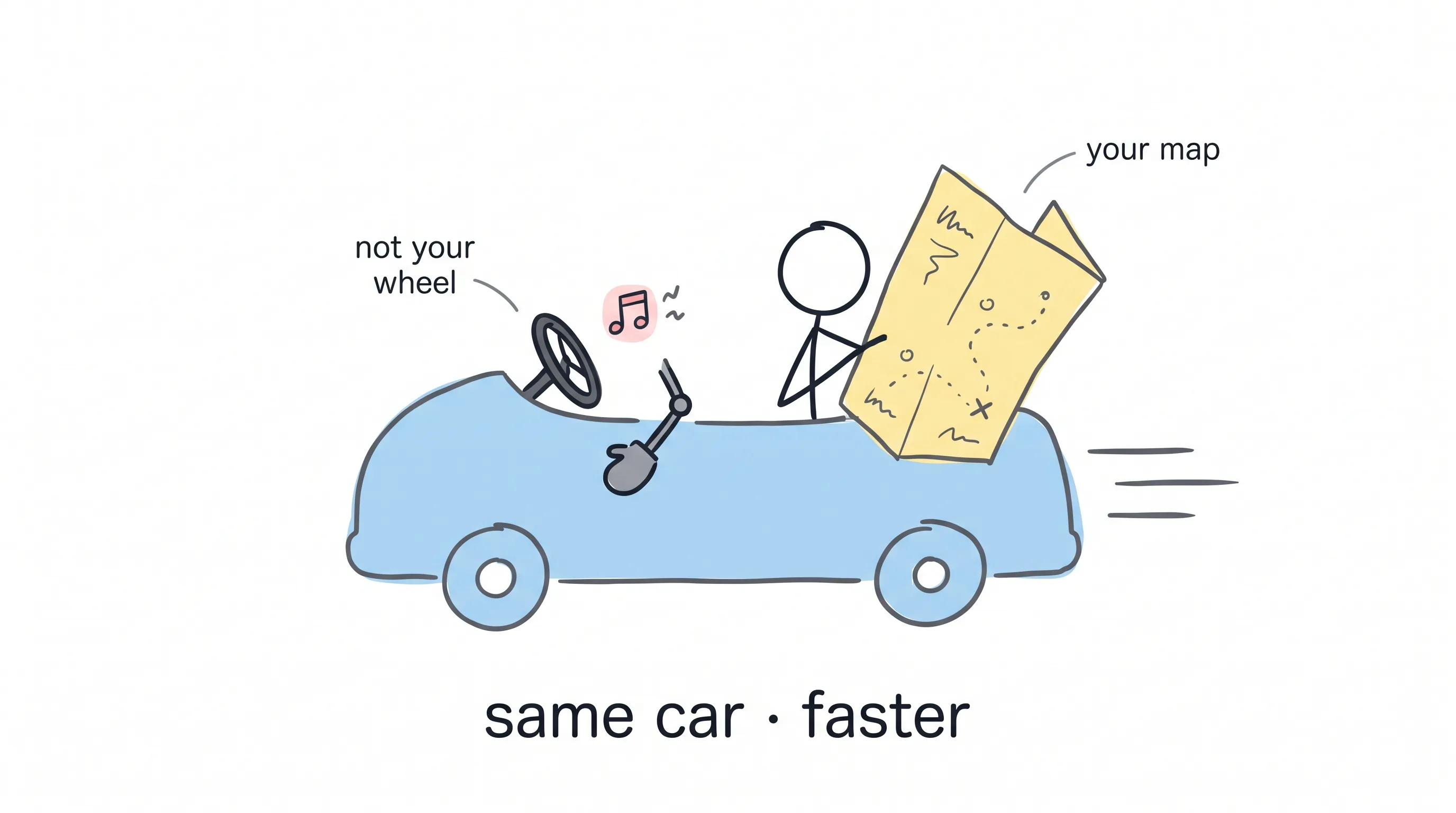
It's still the same car — even faster, steadier, cheaper. But the wheel isn't in your hands, the route isn't fully yours to decide, and even the music playing in the car might get "optimized."
Have objections? You can raise them. Didn't they give you back an off switch?
Back to the friend from the beginning. What I told him later was: don't just sit there fuming. The more work the platform does for you, the clearer you need to be about the work it can't do for you: what your brand looks like, why users should remember you, where you differ from everyone else.
The algorithm won't think about these things for you. And Meta doesn't want to think about them for you either.
Handing over the wheel is never hard. What's hard is having that map in your head first.
Here's my wish for you: before you climb into any self-driving car, may the map already be in your own hands.
Continue reading
Related articles

Cross-Border Business: Time to Upgrade Your AI Toolbox
A learn article explaining how AI tools help cross-border e-commerce sellers clear five hurdles: language, regulation, logistics, payments, and fraud. It outlines a five-compartment toolbox, a five-step adoption path, and metrics such as conversion rate and CLV, while cautioning against over-reliance on AI.

AI Is Taking Over the Dirty Work of Social Media Marketing, One Task at a Time
This learn article outlines four social media marketing tasks AI can handle — audience analytics, content drafting and design, ad targeting and creative testing, and spam moderation — and cautions that taste, judgment, and data security remain human responsibilities.

AI Is Already This Good — Why Is Your Social Media Marketing Still Pure Manpower?
An overview of 18 AI tools for social media marketing, organized into six categories covering audience research, content creation, scheduling, comment and DM handling, ad management, and visual production, plus notes on personalization, prediction, and emerging trends.