
Adobe turned AI into Photoshop's most-used feature in just 9 months. How?
The article explains how Adobe trained Firefly on licensed Adobe Stock and public-domain images, shipped it into Photoshop and other apps in 9 months on AWS infrastructure, scaled training 20x in 6 months, and used RLHF feedback plus C2PA Content Credentials to build trust in AI-generated images.
A while back, I had dinner with an old friend who has been a designer for over a decade.
When the topic turned to AI-generated images, he had nothing but complaints. His studio had tried every AI tool out there. Sure, the images came out fast. But then a client asked one question that stopped him cold: where did the material for this image come from? What if the copyright holder comes knocking one day?
So all those AI tools got shelved after the trial run. Nice to look at. Too risky to use.
But this time, when we met, he pulled out his phone and showed me: the screen was all Photoshop. Half the studio's work, he said, now runs on "Generative Fill" inside it.
Hold on, I said. Weren't you scared stiff about copyright? How come you dare to use it now?
He smiled: Adobe figured this thing out, end to end.
The whole way home, I kept turning it over. Once I'd worked it out, I realized Adobe's playbook deserves a close look from every team trying to build on large models. Here it is.
The first cut: data
Many people assume Adobe started building AI with the model.
No. It started with the ingredients.
What do I mean by ingredients? The data used to train the model.
What do most generative models on the market eat? Whatever data they can scrape off the internet. They eat whatever they can scrape, and whether those images carry copyright, or who they belong to, the model doesn't ask. It learned to draw, but nobody can trace where any single image came from.
In a lab, that doesn't matter. But the moment you want to put AI inside Photoshop and sell it to designers, photographers, and ad agencies around the world, it's a different story.
Your customers intend to use these images commercially. If the ingredients have no provenance, no matter how good the dish, nobody dares eat it.
Adobe has been building creative software for more than forty years. It knows better than anyone that this business runs on trust.
So Adobe did something remarkably "dumb": instead of taking an off-the-shelf open-source model, it trained its own. Why? In the words of Adobe's executive in charge of generative AI, the quality and capability of the model had to stay under its own control.
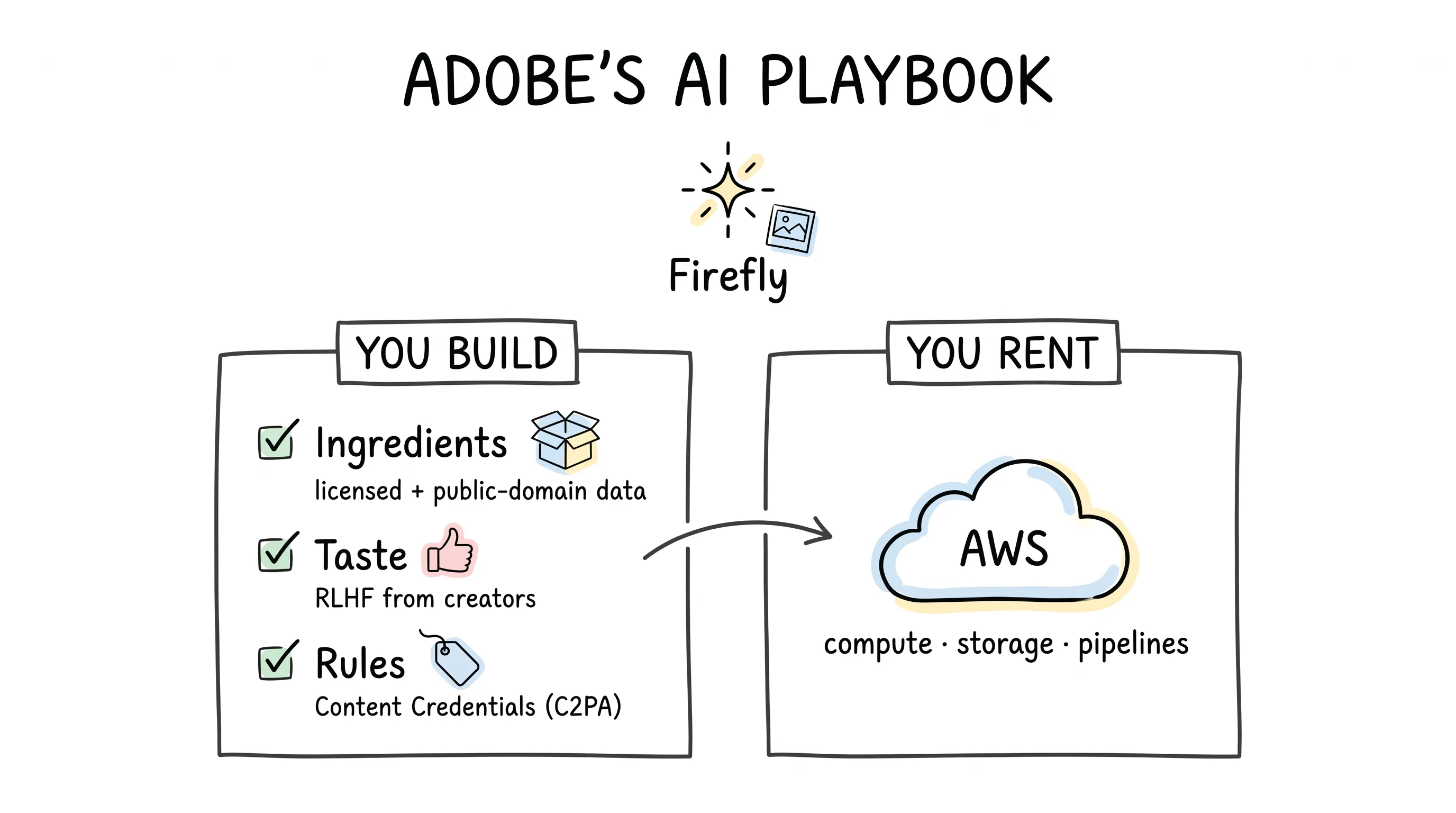
Even more critical is what you feed it. Adobe used only two kinds of data: images licensed for commercial use from Adobe Stock, and content whose copyright had long expired and passed into the public domain.
Every single image, traceable.
Think about what this amounts to. It's a restaurant that refuses to buy untraceable bulk goods at the wet market — everything is grown on its own farms and bought under contract, with every batch traceable to the source.
The cost is high. But an image generated by Firefly — a designer can drop it straight into a client project.
This cut landed where no one else dared to touch.
9 months. How?
Ingredients settled, next comes the kitchen.
By the conventional script, when a company decides to build its own large model, the plot that follows should be: hire hundreds of infrastructure engineers, rent a data center, buy GPUs, assemble a cluster, and find out how it turned out two or three years later.
Adobe didn't do that. In just 9 months, it shipped the Firefly model family — and folded it straight into Photoshop, Illustrator, Substance 3D, and Adobe Express.
9 months. From zero to the full suite.
How did it move this fast?
Because it never intended to pour its own foundation. The training platform, the data pipelines — all of it sits on AWS. Compute on EC2 instances with NVIDIA GPUs, orchestration on EKS, network acceleration with EFA, and mountains of training data parked in S3 as a data lake.
So what did Adobe do itself? The one thing only it could do: make the model truly understand creative work.
There's a detail in here especially worth savoring.
Training a large model burns money by the GPU-hour. What's the scariest thing at a moment like that? GPUs sitting idle waiting for data. The data pipeline clogs, and the compute spins its wheels — burning nothing but cash.
Adobe used FSx for Lustre, a high-performance file system, to solve exactly this "can't feed it fast enough" problem — keeping data in step with compute, making sure the GPUs never idle.
It's like hiring a Michelin-starred chef and then making him stand in the kitchen waiting for delivery. The prep work, the plating runs — every chore has to be arranged to perfection.
If you can rent the foundation, don't pour it yourself. The house you build on top is your differentiation.
Where does a model's taste come from?
Data solved "dare to use." But another question remains: is it good to use?
A model can run flawlessly on a technical level, and still not produce images designers are happy with. Taste — how do you teach that to a machine?
Adobe's answer: let people teach it.
The mechanism is called RLHF — in plain words, tuning the model with human feedback. Stripped down, it's remarkably simple: every action a user takes inside the software — thumbs up, thumbs down, download, abandon — gets collected and flows back into training.
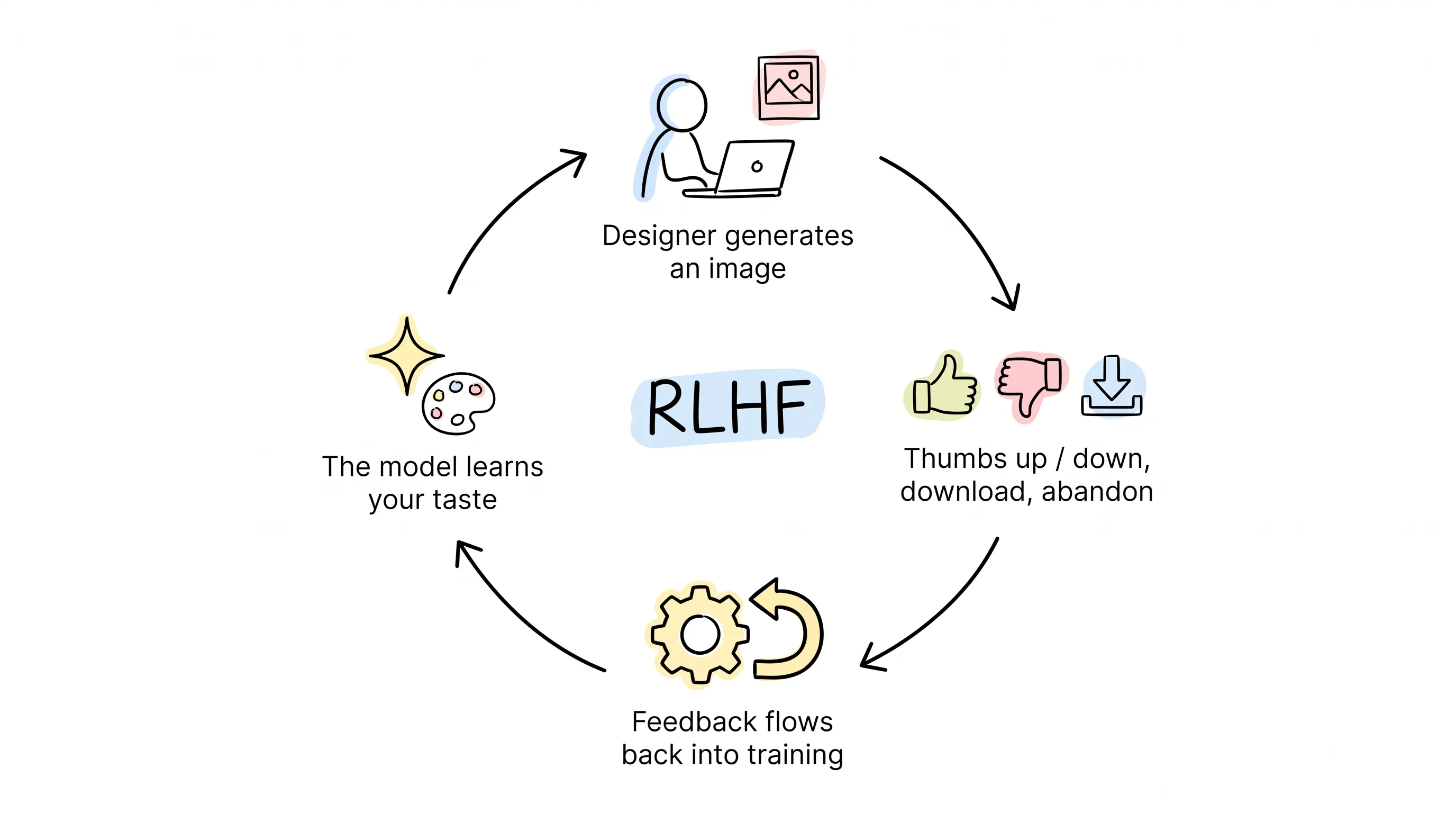
A thumbs up tells the model this direction is right. A thumbs down tells it this is wrong. And when you download the image and deliver it to your client, the model learns that this is not just right — it's genuinely useful.
The aesthetic preferences of legions of creators, fed to the model day after day.
The first time I truly understood this loop, all I could say was: formidable.
It's like a restaurant that watches, after closing every night: which dish got finished off, which dish came back half-eaten. The next day's menu changes. Changing it once is easy. What's hard is changing it every single day, for years.
The menu grows to know its diners. That is exactly how Firefly grows to know designers.
Meanwhile, Adobe keeps running tests to keep the model from generating harmful or biased content, and it leaves users a channel for feedback — find a problem, fix it right away.
The machine understands people better and better. And in the process, people find the tool more and more natural to use.
What happens when the flood comes?
The story doesn't end here. What truly tests a company is the surge.
After Firefly launched, users flooded in, and training demand exploded with them. What do you do?
In 6 months, Adobe scaled its training 20x.
20x. That's not "add a few more machines." That's copying the entire kitchen twenty times over — and still guaranteeing every plate comes out tasting the same. Adobe locked in resources with reserved instances, and used distributed-training techniques like pipeline parallelism to squeeze every compute unit of every GPU.
Beyond training comes inference — the process behind every press of the "Generate" button — also entirely on AWS. Adobe built its inference system stateless, spread across multiple regions, serving demand wherever it shows up. And to cut costs and gain speed, it is evaluating dedicated inference chips like Inferentia2.
Performance on one side, cost on the other, with the freedom to move hardware around whenever needed.
From one restaurant to a chain. Only when the kitchen is standardized do you dare open new locations.
Do you dare admit it was made by AI?
One last thing — the move I consider most underrated.
As AI-generated images multiply, a question surfaces: how do you know whether the image in front of you was shot, or generated?
Adobe's answer is called Content Credentials. Every image Firefly generates automatically carries tamper-resistant metadata, like a "nutrition label," that tells you what's in this content: whether AI took part in creating or editing it.
All of it is built on C2PA, an open standard. And the Content Authenticity Initiative that Adobe leads? Launched back in 2019.
That's 2019 we're talking about. Back then, this whole wave of generative AI hadn't even cast a shadow.
In the competition for AI, the first half was fought over models. The second half will be fought over trust.
A model, you can chase down and catch up to. Trust is something you accumulate slowly — with a year of clean data at a time, with one credentialed image at a time.
Finally, a word for the industry
Adobe's VP in charge of generative AI once left the industry a piece of advice that stuck with me.
He said: talent in AI research, engineering, and applied machine learning is brutally hard to hire. If you can't hire them, don't force it — use the ready-made AI services on the cloud, like Amazon SageMaker and Amazon Bedrock. Spend your effort on your own differentiated value. Rebuilding every layer of that foundation yourself will be harder than you can imagine.
And one line I find even sharper: wanting to build your own AI cloud is an easy thought to have. But it was precisely the partnership with AWS that let Adobe focus on its own differentiation.
Put plainly, this is a multiple-choice question: what should you do yourself, and what should you hand to others?
Adobe's answer: choose the ingredients yourself. Teach the taste yourself. Set the rules yourself. Hand the server rooms, the compute, the pipelines to others.
Back to my friend from the beginning. Before we parted that day, he said something I remember well: I used to fear AI taking the work. Now what I fear is not knowing how to use it.
Tools were never the frightening thing. What's frightening is that others are already running with the tool while you're still agonizing over whether to use it.
And I wish you even more: that you catch this wave — without having to burn your own foundation.
Continue reading
Related articles

Cross-Border Business: Time to Upgrade Your AI Toolbox
A learn article explaining how AI tools help cross-border e-commerce sellers clear five hurdles: language, regulation, logistics, payments, and fraud. It outlines a five-compartment toolbox, a five-step adoption path, and metrics such as conversion rate and CLV, while cautioning against over-reliance on AI.

AI Is Taking Over the Dirty Work of Social Media Marketing, One Task at a Time
This learn article outlines four social media marketing tasks AI can handle — audience analytics, content drafting and design, ad targeting and creative testing, and spam moderation — and cautions that taste, judgment, and data security remain human responsibilities.

AI Is Already This Good — Why Is Your Social Media Marketing Still Pure Manpower?
An overview of 18 AI tools for social media marketing, organized into six categories covering audience research, content creation, scheduling, comment and DM handling, ad management, and visual production, plus notes on personalization, prediction, and emerging trends.