
Ad Buying Is Shifting from Stick Shift to Automatic
An explainer on how automated ad buying across Google, Meta, TikTok, Amazon, Snapchat, Pinterest, and Microsoft shifts advertiser work from manual bid management toward feeding goals and creatives to machine-driven systems.
A while back, I had dinner with an old friend who has spent his career buying ads.
He's been in the trade for over a decade, going all the way back to the keyword-buying era. I assumed he was once again pulling all-nighters watching dashboards and tweaking bids by hand.
Instead, he told me: "These days I barely 'buy' ads at all."
I blinked. Then what do you do?
He said: "I mostly 'feed' them."
What does "feeding" ads mean? You put your budget, your goals, and your creatives into the system. The rest — who sees them, when they see them, which version they see — the machine decides on its own. Google works this way, and so does Meta. Even the day-to-day work on his team has changed along with it.
I said, "Doesn't that mean you're about to be out of a job?"
He laughed: "Not out of a job — just a different seat. I used to sit in the driver's seat; now I ride shotgun. The steering wheel is still there. I just hardly ever touch it."
After that dinner, I went through every major platform's "automatic transmission," and the more I dug, the more I felt this deserved a proper telling.
From Manual to Automatic
So what is automated ad buying, exactly?
Think about it: buying ads used to be like driving stick. Picking keywords, defining audiences, adjusting bids — you pressed every pedal yourself, and the moment your attention slipped, the car would lurch out of line.
And now? Google, Meta, TikTok, Snapchat, Amazon, Pinterest, Microsoft — nearly every one of them has built its own "automatic transmission." You just say where you want to go, and the car drives itself.
Advertisers' hands are moving off the steering wheel and into the passenger seat.
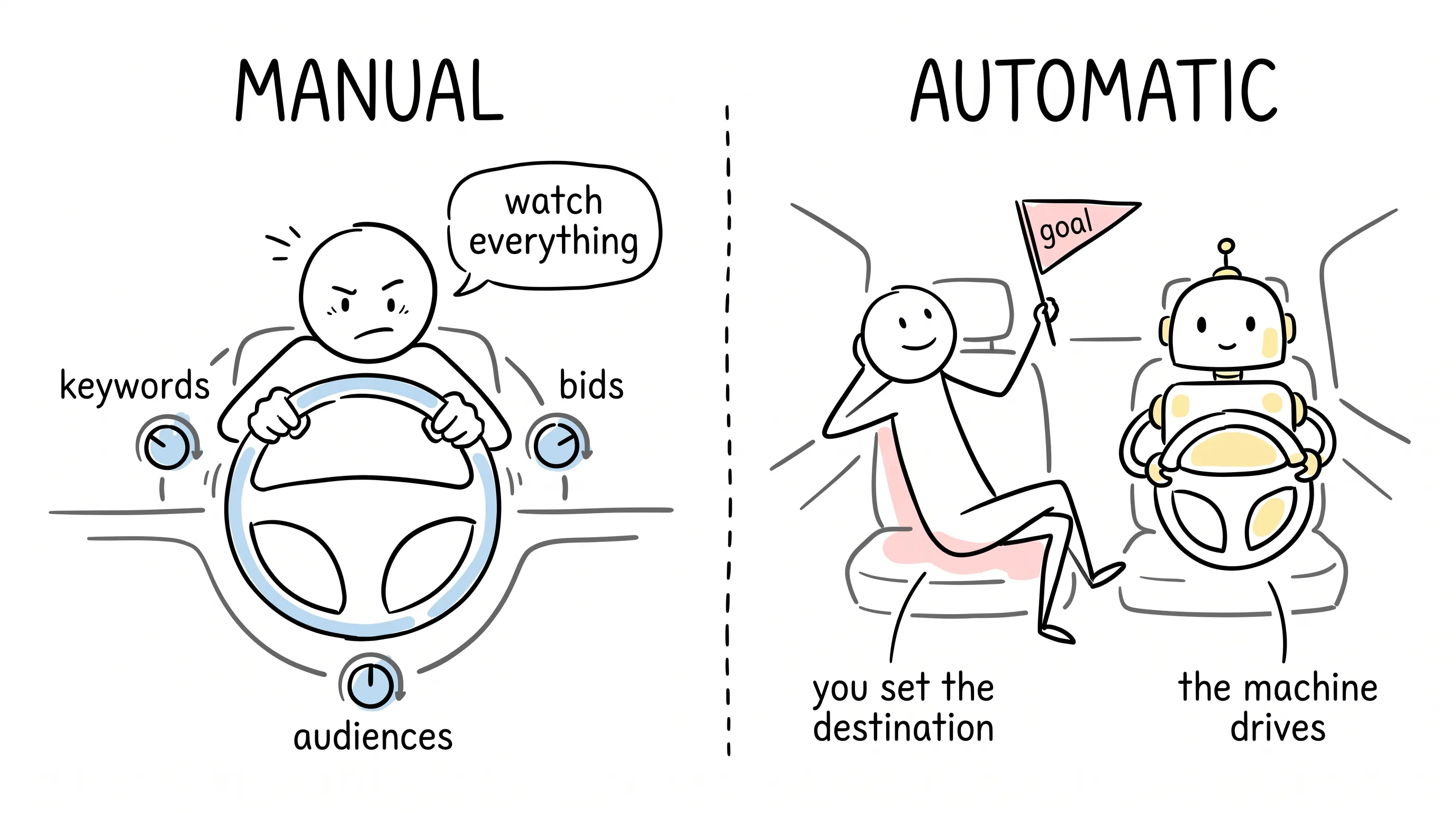
What's more interesting is that each platform tuned its "automatic" differently. Let's take them one at a time.
Google: One All-Access Pass, Valid Storewide
Start with Google.
What is Performance Max, exactly?
Plainly put: one all-access pass. Advertising on Google used to mean separate lines — search was search, display was display, video was video, shopping was shopping: four counters, four queues. Now you hand over one set of creatives, set one goal, and the machine starts running at every counter at once — adjusting bids in real time, swapping audiences, picking creative combinations, and raising its stake wherever the odds look best.
It's as if you once had to hire four agents, one posted at each counter. Now you hire a single all-round manager who watches all four counters at once and keeps moving the goods to whichever one is doing the best business.
That's Performance Max.
And Demand Gen? It covers an earlier stretch of the road.
Between "just browsing" and "I've decided to buy," a customer crosses a long hesitation window. Demand Gen's job is to work that window: it combs through signals across the entire Google ecosystem — search behavior, interest preferences — recognizes the prospective customers who haven't made up their minds yet, and puts an ad right in front of them.
So if you want people to remember you before they've made their decision, this is the tool for it.
By the way, this all-access-pass play isn't Google's alone. Over at Microsoft, the same ticket runs under the very same name — Performance Max — laid out across Bing, LinkedIn, and its audience networks. When two giants push in the same direction, what does that tell you?
It tells you the whole industry is driving down the automatic road together.
Meta: A Budget Butler That Rebalances on Its Own
Now for Meta. Facebook, Instagram, WhatsApp, and Messenger all sit under its roof, and its automatic transmission is called Advantage+.
What is Advantage+?
Think of it as a budget butler. Choosing audiences, splitting budgets, picking creatives — the entire process of running your campaign is in its hands.
Its sharpest trick is "rebalancing."
What is rebalancing? Picture a fund manager in charge of ten stocks — whichever one is trending strongest, that's where he adds money. Advantage+ does exactly the same thing: as the campaign runs, the moment the system notices that one version of a creative, or one group of people, is clearly outperforming, it moves the budget over without a second thought.
Fast, precise, and utterly unsentimental.
You don't have to watch the dashboard. It watches for you.
Budgets aren't loyal to plans. Only to results.
That line is my own summary. The upside is obvious: it's efficient, and it reacts fast. But you've also sensed the catch — the decision-making power has been handed over. That "but" is a thread we'll pull on later.
TikTok and Amazon: The Closer to the Money, the Sharper the Machine
Next, TikTok. Its advertising battleground is e-commerce.
What does e-commerce look at? GMV — gross merchandise value — the lifeline of every e-commerce brand.
So what is GMVValue?
It's an ad-buying tool built squarely around GMV. The machine learning does exactly one thing: predict who will actually pay. It digs through users' browsing behavior and shopping habits, separates "the people who'll be tempted" from "the people who'll place an order," and then concentrates the ad spend on the latter.
Think about it: the same 10,000-yuan budget — before, you sprinkled it like pepper; now it lands like a precision drip. For an e-commerce brand, that difference is your profit margin.
What about small merchants, then — the kind who can't afford a professional media buyer?
TikTok handed them something else: Smart Campaigns. I call it the "point-and-shoot."
A DSLR makes you fiddle with aperture and shutter; with a point-and-shoot, you just press. Smart Campaigns works the same way: if your goal is reach, it goes looking for people who love to engage; if your goal is sales, it goes looking for people who've been on a buying streak lately. Bids, targeting, placements — all automatic.
No technical knowledge required. A few clicks, and it runs.
Over at Amazon, the thinking is similar, but the venue sits even closer to the money. People who come to Amazon arrive with their wallets already in hand. Its Performance Plus adjusts bids and pairs creatives automatically, based on purchase intent, product relevance, and historical performance — all in pursuit of one thing: conversion rate and ROAS (return on ad spend) a little higher, and the human a little more at ease.
One helps you find "the people who will buy"; the other hosts "the people who already want to buy." The closer to the money, the more precisely the machine calculates.
Snapchat and Pinterest: Handing the Right Thing to the Right Person
Two more take an even more personal approach.
Snapchat's offering is called Dynamic Catalogs.
What is a dynamic catalog? You hand over your entire product library, and the machine generates personalized ads on the spot, based on each user's interests, behavior, and past interactions with your brand.
Doesn't this remind you of an old shopkeeper with a perfect memory? A regular walks in the door, and without asking a single question he brings down the pair of shoes you were mulling over last time: "This is the one, right?"
And the longer he works, the better he knows you. Every click, every lingering pause is feeding experience into the next batch of ads.
Pinterest's Performance+ borrows the strength of its own search and recommendation algorithms: automatically finding high-potential audiences, tuning bids, arranging placements.
Pinterest has something special: many people don't open it to scroll aimlessly — they arrive carrying "this is what I want." That's closer to search. The demand comes built-in; the machine's job is to catch it.
Where users arrive with demand of their own, catching it is cheaper than conjuring it out of thin air.
But There's Always the Other Side
By now, you may be thinking: wonderful — humanity has been set free.
Not so fast.
Ask yourself: what is automation, at its core? It's handing your decision-making power to a machine whose insides you can't see. It shows you the results. It doesn't show you the process.
A butler certainly saves you worry. But you've handed over the keys, too.
So the teams that truly run these systems well keep their eyes on both ends.
Upstream: translate business goals into goals the machine can understand, and keep producing creatives the machine is willing to use. Even the cleverest cook can't make a meal without rice — however smart the machine, if the creatives you feed it have gone stale, there's nothing for it to put in the pot. Downstream: read the data well enough to know when to trust the machine and when to hit the brakes yourself. That judgment, no machine can make for you.
Machines handle the how of advertising. You handle the why.
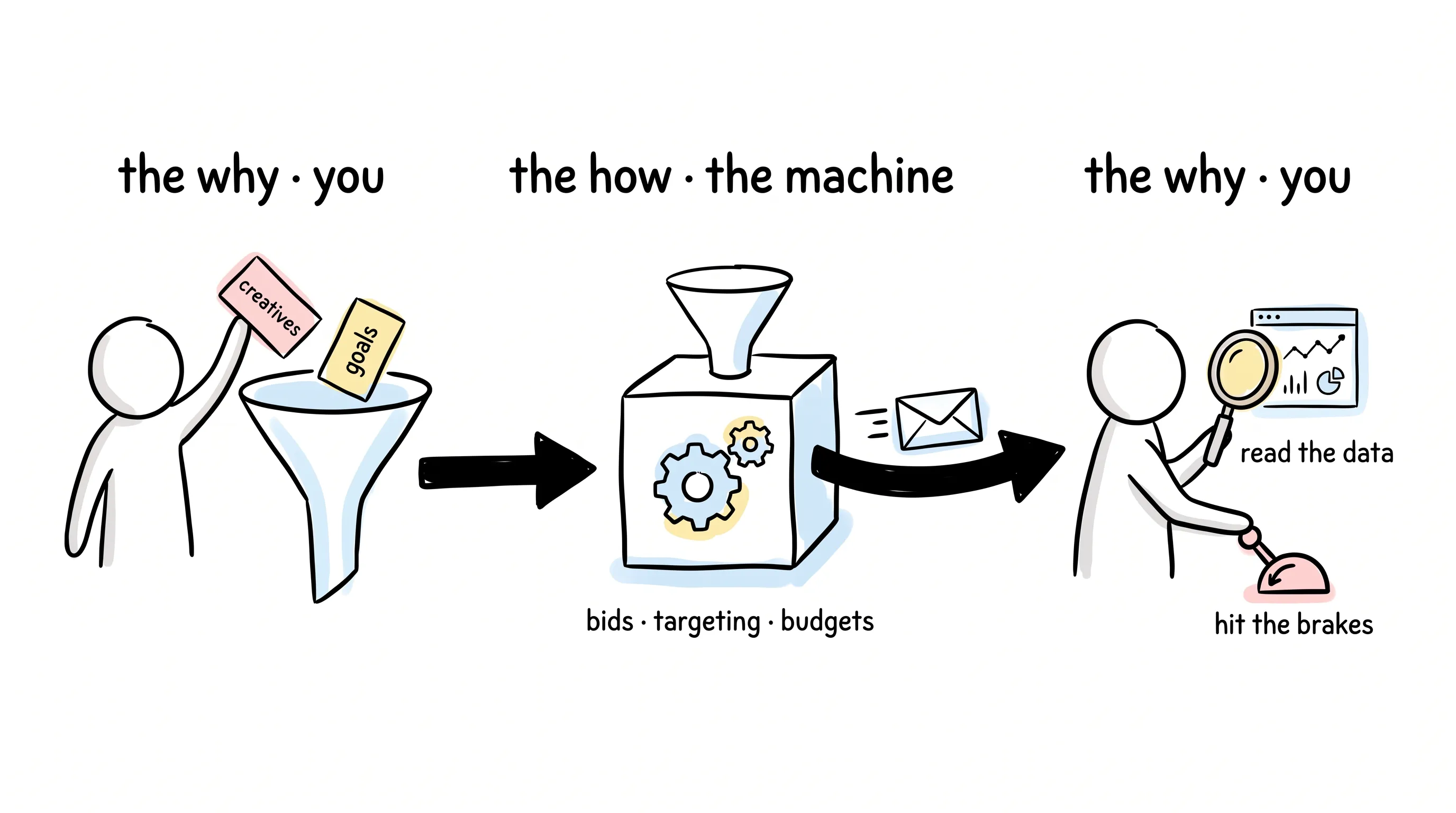
Advertisers used to earn their keep in execution: adjusting bids, watching dashboards. The machines have taken over all of that. The craft has moved upstream. The seat didn't move to lighten your load — it moved because the exam questions changed.
Back to That Dinner
Near the end of that dinner, I asked him: "And your team — what does everyone do now?"
He said: "Manage the creatives, set the goals, and when it's time to hit the brakes — be able to hold them. The work didn't shrink — it just turned into a different kind of work."
I thought of another line of his: "I used to be a player. Now I'm more like a coach. The machine is the one out on the court — but the playbook is still in your hands."
The next time an ad finds you and you mutter, "How does this know me so well?" — odds are a machine computed it, in a fraction of a second. No media buyer ever pulled an all-nighter for you.
Don't be surprised.
That's what automatic really means: you can let go of the steering wheel — but where you're going is always your call.
Here's to you: whatever you drive, stick shift or automatic, may the lights stay green all the way.
Continue reading
Related articles

Cross-Border Business: Time to Upgrade Your AI Toolbox
A learn article explaining how AI tools help cross-border e-commerce sellers clear five hurdles: language, regulation, logistics, payments, and fraud. It outlines a five-compartment toolbox, a five-step adoption path, and metrics such as conversion rate and CLV, while cautioning against over-reliance on AI.

AI Is Taking Over the Dirty Work of Social Media Marketing, One Task at a Time
This learn article outlines four social media marketing tasks AI can handle — audience analytics, content drafting and design, ad targeting and creative testing, and spam moderation — and cautions that taste, judgment, and data security remain human responsibilities.

AI Is Already This Good — Why Is Your Social Media Marketing Still Pure Manpower?
An overview of 18 AI tools for social media marketing, organized into six categories covering audience research, content creation, scheduling, comment and DM handling, ad management, and visual production, plus notes on personalization, prediction, and emerging trends.