
Act Three of the Creator Economy: From Brand Deals to Equity Deals
An explainer on how creators are moving from paid brand deals toward equity, covering angel investing, sweat-for-equity, eligibility standards, and the lack of market benchmarks for terms.
A few days ago, a friend of mine who runs her own media brand asked me out for coffee. She said the rates she negotiates with brands get talked down year after year, deal after deal — she has hit a ceiling.
I asked her: have you heard of "sweat for equity"?
She shook her head.
Then this is something you need to care about, I said. The creator economy's game is moving to a new table.
A Three-Act Play
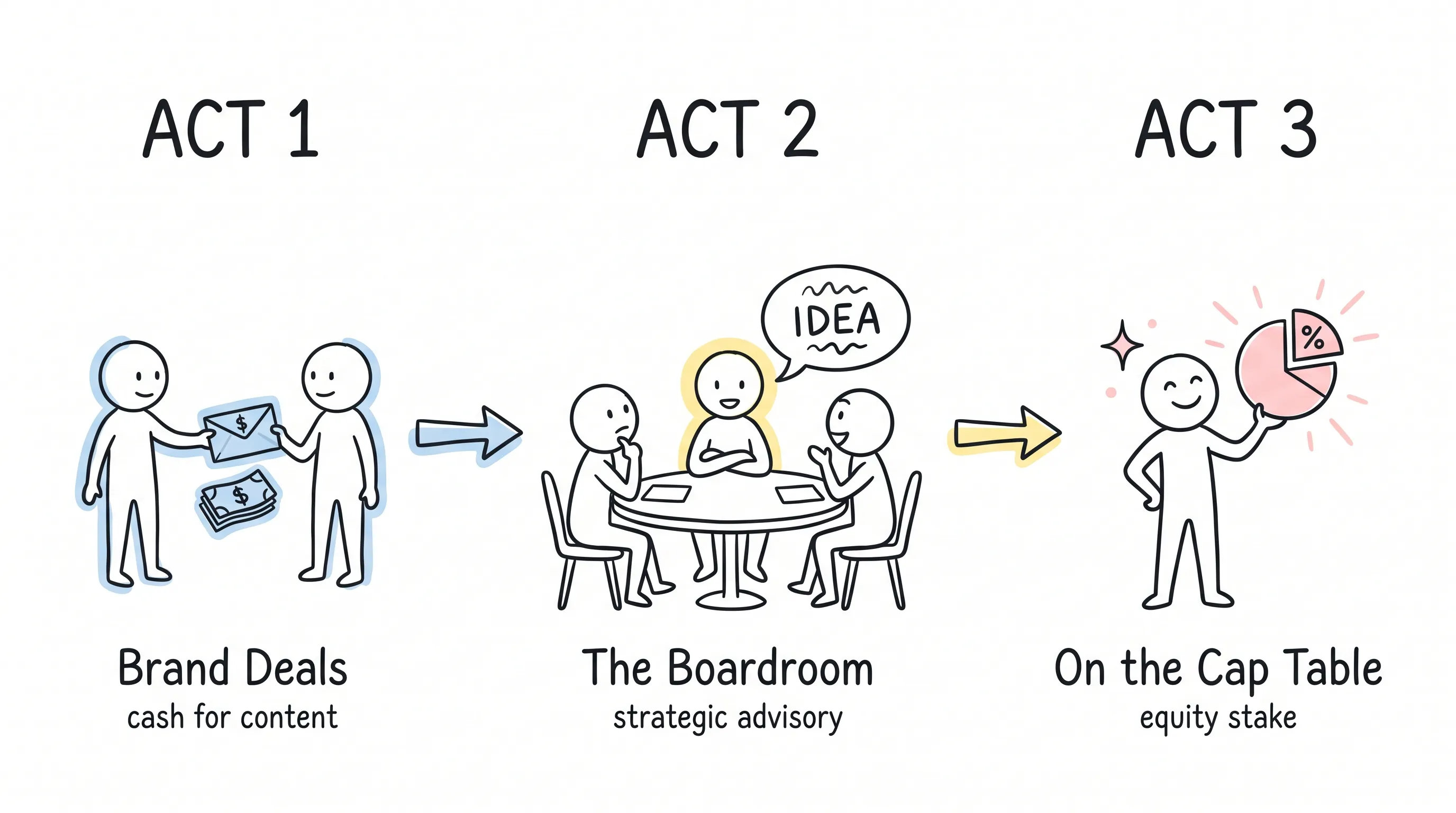
The drama of the creator economy plays out in roughly three acts.
Act one: taking deals. The brand pays, the creator delivers content — cash for content, hand to hand. Then everyone goes home.
Act two: into the boardroom. The creator is no longer just the contractor; they start joining executive teams and advisory boards, weighing in on brand decisions.
Act three, just beginning: onto the cap table.
What does "getting on the cap table" mean? It means the creator actually puts in money — or puts in work — in exchange for a stake in a company, becoming one of its early shareholders.
The landmark starting point of this act was 2024. That year, the top creator Alix Earle invested in the sparkling water brand Poppi as a strategic investor.
In truth, the dress rehearsal had been going on for a while. Kate McAndrew, co-founder of a venture fund called Baukunst, recalls that as early as 2017 and 2018, founders in her portfolio came to ask her: is there a way to get creators to invest? How do I even get to know a creator? Smart founders had long wanted to pull creators onto the cap table.
The rehearsal ran for years. Now the show officially opens.
Someone Has Started Building Roads
Before any new market takes off, someone has to build the roads first.
Earlier this month, Cherub — a platform that matches founders with angel investors — held a private summit. Application-only, capped at 100 seats, and everyone attending was a creator, all learning the same thing: how to invest in early-stage companies.
On the other side, JERi, a newly founded creator-marketing agency, is doing something else: building "creator councils." It pre-vets a roster of creators, sorted into categories like tech, sports, beauty, and B2B, so startups can come and pick directly.
Emily Ward, JERi's co-founder — who is also the founder of an early-stage fund called Love X Money Ventures — puts it bluntly: creators want to diversify their income. Moving up from "delivering campaigns" to "strategic advisory" is a career that lasts much longer.
Her fund recently screened a group of creators to join a social fashion app called Driptail as strategic shareholders. How did it go?
From March to July this year, Driptail's user count grew 60x.
Sixty times. That's not a number ad spend can buy.
JERi's other co-founder, Ross Yellowlees, added one thing: creators today are no longer just creators — they are small media companies, one after another. And every business, at some level, asks the same question: how do I make my revenue predictable?
A one-time ad fee is cash flow. A line on the cap table is an asset.
Two Roads
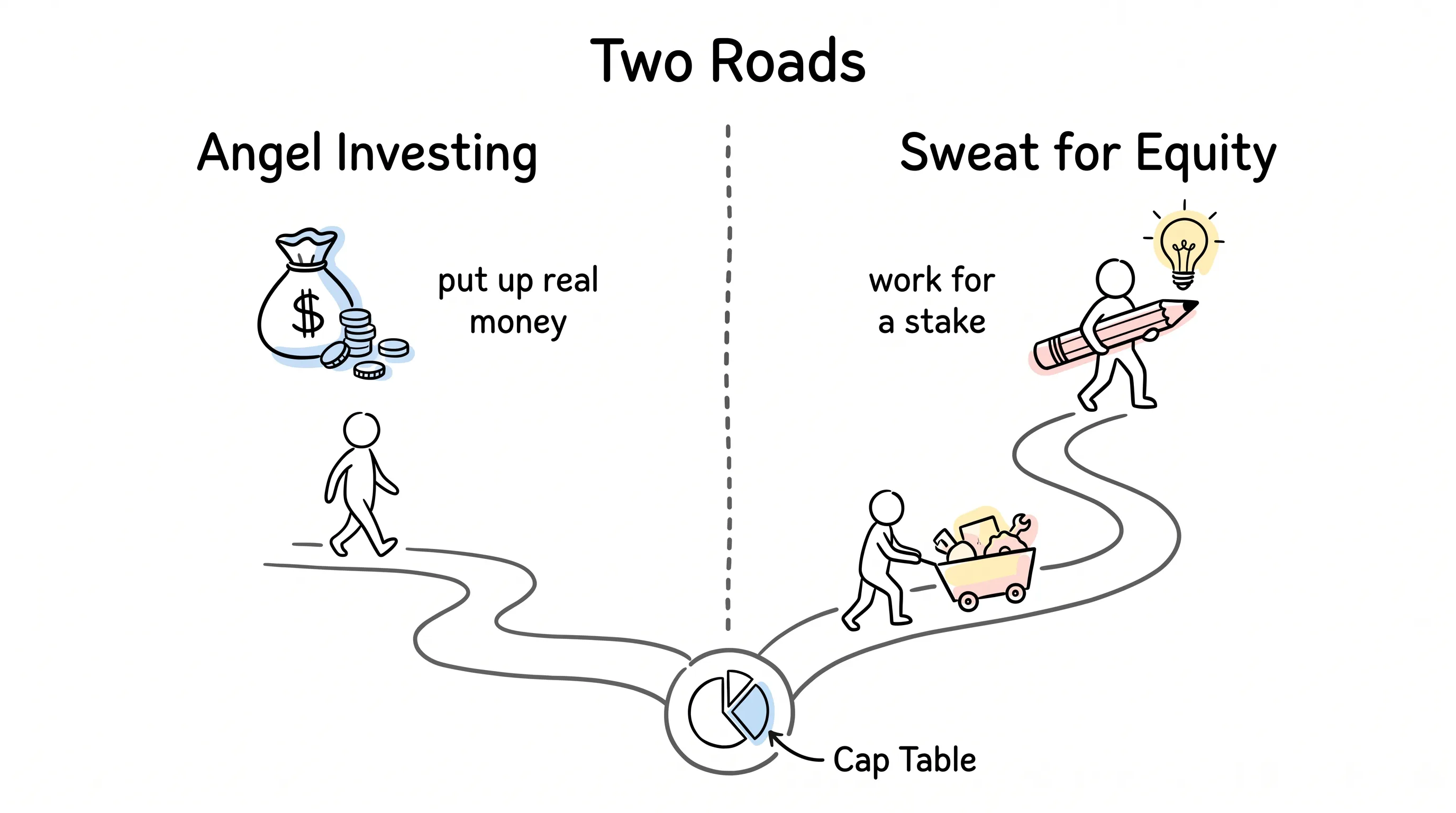
For a creator who wants to become an early shareholder, there are two roads.
The first: angel investing. Put up real money and buy shares directly.
The second: sweat for equity (trading work for a stake). No money, just work — contribute strategy, resources, content, and get partial ownership in return.
Which road is easier? Depends on what you've got.
For now, the angel-investing road is open only to top creators. McAndrew spoke a plain truth: creators are earning real money today. A few years ago, it was hard to imagine people in their twenties becoming millionaires by making content. Behind these creators are serious finance teams and complete businesses. They have the capital, and they have the ability to read an investment.
Sweat for equity, meanwhile, has left a door open for creators who haven't reached that scale.
Who Qualifies for a Seat at the Table
Next comes the key question: on what grounds does a company let a particular creator onto its cap table?
Yellowlees's standard: growth and engagement. If your numbers are solid, you earn the right to negotiate.
Sarina Virk Torrendell, founder of YouPop — an AI operating system for creators that already has several creators on its cap table — applies a finer-grained standard. Interestingly, she deliberately avoided the very top tier; everyone she has brought to the table is a smaller or mid-tier creator.
Why?
Here is her math: paid marketing is barely adequate for mature companies, and for early-stage startups it is genuinely precious. You spend the money with no guarantee it lands. But when a creator is willing to stake their own time and money in a company, it shows they truly believe in it. That kind of trust cannot be bought with ads.
For a no-name early-stage company, a creator coming on board is the cheapest trust endorsement there is.
McAndrew put it even more bluntly: taking equity is not about buying posts at all. She has seen too many misunderstandings — people think creators invest for the content. They don't. It is because many founders do not understand the creator-marketing business at all, and need someone to teach them from the inside how to play. The value of a post can be bought at market price; the brain that understands this business is what the equity should be paying for.
How Much Equity Is Fair
So, at the negotiating table, how much?
This is exactly what is most missing today: market benchmarks.
Jaclyn Johnson, CEO and co-founder of Cherub, has told the story of how the platform came about. Cherub started out matching angel investors with brands, but once it got running, it found that many of the people asking about investment opportunities were themselves big players in the creator world. Johnson found Aly Grant, who runs the creator business at the Hollywood agency UTA, and in one conversation they discovered the agency side was equally in the dark: clients would occasionally stumble into an investment opportunity or two and get interested, but nobody knew where to look. So they simply turned "creators on the cap table" into an official business line.
Cherub's equity guide gives three tiers of benchmark pricing:
Advisor only — offering strategic advice and the occasional post: roughly 0.1% to 0.3%, vesting quarterly over two years, with a 3-month cliff.
Advisor plus work — guaranteed content, paid social whitelisting, event appearances: roughly 0.25% to 0.75%, two-year vesting, 6-month cliff.
Long-term partnership, creative director — deep involvement in operations, co-branded products, ongoing campaigns: roughly 0.75% to 3%, four-year vesting, 1-year cliff.
Why does this price list matter? Because terms in the market today are a mess.
Yellowlees said the terms each company offers vary enormously — that is probably one reason this has never scaled. He also worries: will some creators get burned — put in a pile of work, and end up with barely any equity?
That worry isn't paranoid. The early days of any new thing are a hunting ground for information asymmetry.
Which is why education matters. Creators need to understand terms; brands need to understand boundaries. Without standards, there can be no scale.
Epilogue
How will this play out?
The people inside it judge with striking unanimity: it will become more and more common. Torrendell's reasoning is plain: every category is packed right now, too noisy. If you want to be heard, you have to change your playbook.
McAndrew's view is wider. She says creators are only the entry point. This cohort has high incomes and high hustle, and — most importantly — they can influence the companies they invest in. They are also this era's traffic-distribution machines. When creators start angel investing, guess who follows?
Other high-net-worth individuals. They will follow the creators.
I told all of this to my friend over coffee.
She said: then how much equity is my account worth?
I said I don't know. But that question is far more interesting than "how much can I negotiate on next month's rate?"
Continue reading
Related articles

Cross-Border Business: Time to Upgrade Your AI Toolbox
A learn article explaining how AI tools help cross-border e-commerce sellers clear five hurdles: language, regulation, logistics, payments, and fraud. It outlines a five-compartment toolbox, a five-step adoption path, and metrics such as conversion rate and CLV, while cautioning against over-reliance on AI.

AI Is Taking Over the Dirty Work of Social Media Marketing, One Task at a Time
This learn article outlines four social media marketing tasks AI can handle — audience analytics, content drafting and design, ad targeting and creative testing, and spam moderation — and cautions that taste, judgment, and data security remain human responsibilities.

AI Is Already This Good — Why Is Your Social Media Marketing Still Pure Manpower?
An overview of 18 AI tools for social media marketing, organized into six categories covering audience research, content creation, scheduling, comment and DM handling, ad management, and visual production, plus notes on personalization, prediction, and emerging trends.