
A Tiffany Diamond Ring Must Pass Five Algorithm Gates
A learn article tracing how a heritage jewelry brand applies AI at five stages of a diamond ring's journey — archive-based design assistance, demand forecasting, virtual try-on, in-store recommendations, and social listening — with machines kept backstage and final calls left to people.
A while back, a college classmate asked me to help him pick out an engagement ring.
This is a guy who comparison-shops for socks. This time he went even further: he built a spreadsheet and scored several jewelry brands, item by item. In the end, Tiffany & Co. won.
I asked him why. He gave me an answer that sounded completely amateur and completely expert at the same time: the odds of buying a fake from this brand are the lowest in the world.
See, that's how concrete a brand's trust is. It comes down to one sentence: buy with your eyes closed and you can't go wrong.
Later I happened to dig into some of the public ways this company uses AI. Honestly, the more I read, the more astonished I got.
A brand with more than 180 years of history. In craftsmanship, in heritage, in ceremony, it ranks at the very top of the jewelry world. Who would have guessed that this — of all brands — is the one quietly setting five algorithm gates around a diamond ring, in places you never see?
Today I'll walk you through it from the beginning. From the moment the ring is sketched to the moment it lands on my classmate's ring finger — exactly where the algorithms had a hand in it.
First, Something Counterintuitive
Many people assume that the more a brand trades on its age, the less it cares about new technology.
You've got it backwards.
Think about it: what do luxury brands fear most? Not high costs — losing their shape. Service drifting, design drifting, and once the "exactness" is gone, the brand is finished.
So with anything new, they ask one question first: can you help me protect the exactness? Yes, you're in. No, get out.
And AI, as it happens, has gotten its hands into several of the most exacting matters of all.
Gate One: The Design Desk
Start with the drawings.
What is a brand archive? In plain language, it's a brand's whole family fortune: manuscripts, product photos, old catalogs, client orders — accumulated from the 19th century to today, tens of thousands of items.
In the past, this pile sat locked away in storage. Artifacts.
Now the company has trained a generative model on all of it.
A designer types a line on the screen — "I want a retro-style floral pendant" — and within seconds, several options appear. Which stone to pick, what finish for the metal, how to build the clasp: it lays everything out clearly. If a stone is out of stock or a material has gotten expensive, it gives a real-time heads-up too.
Note that the final call is still human. How much to change the curve, how big the gem should be — the designer adjusts one by one. The machine's job is to put a hundred possibilities in front of you; the person's job is to pick the one that's "right."
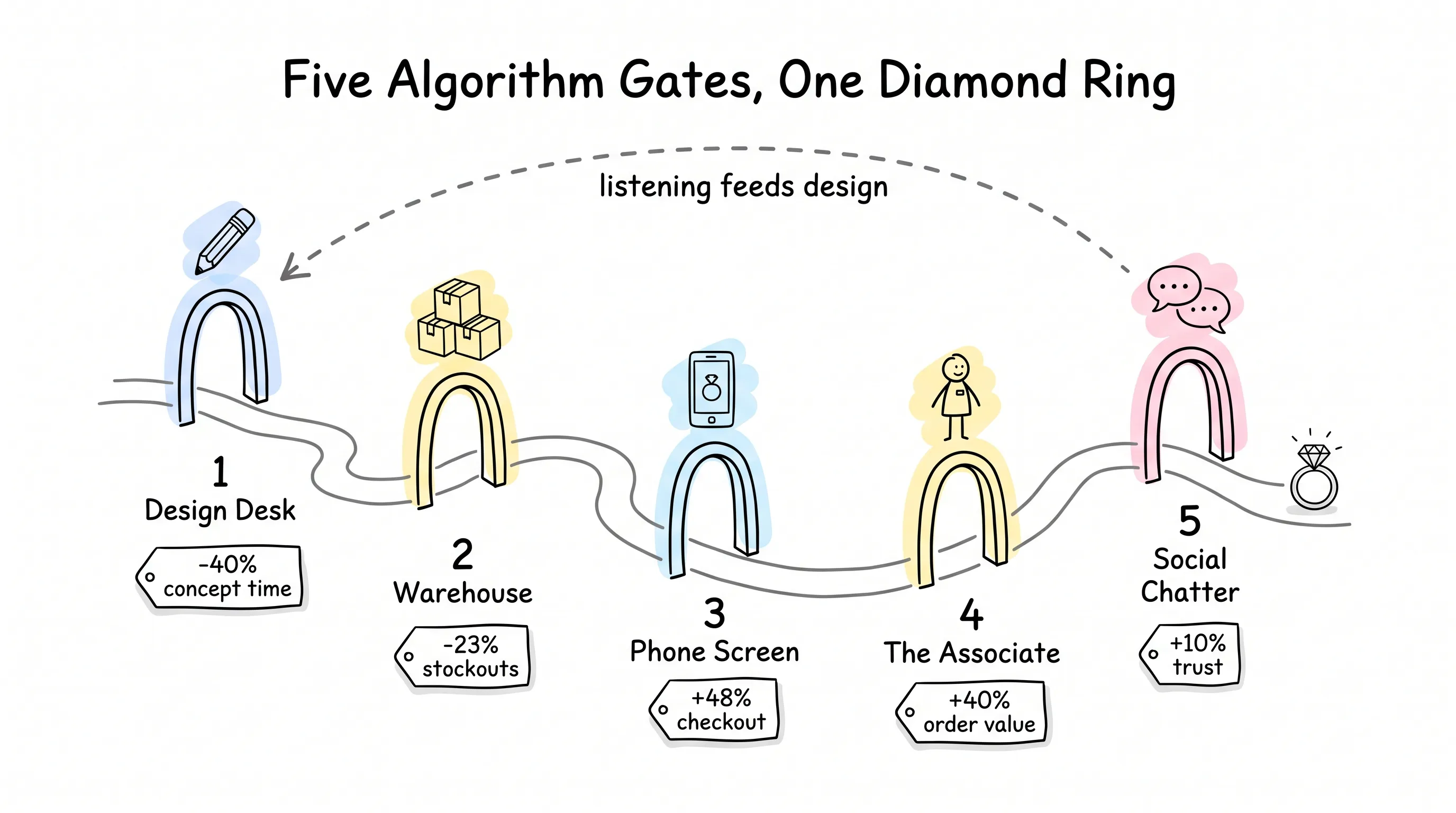
The results, in numbers: the concept cycle for a new design has shortened by 40%.
In 2025, one of their AI-assisted redesigns of a classic key pendant became a bestseller as soon as it hit the market. And a design that people and machines worked out together won international recognition at that year's world jewelry design awards.
Here's the beauty of it. The old brand's deepest moat is that archive. Feed the archive to the machine, and what grows out of it still looks like the old brand.
The thicker the family fortune, the more the algorithm feels like one of its own.
Gate Two: The Warehouse
Design settled, next question: where does the merchandise come from?
In the jewelry business, inventory is the make-or-break. A hot piece goes out of stock and the customer turns and walks; slow pieces pile up in the warehouse — capital sitting still.
So they built a forecasting system. What goes into it is a messy mix: historical sales, promotion calendars, each store's real-time transactions, macro numbers like inflation and consumer confidence — even who's been showing off their pieces on social media.
Every bit of computing power goes exactly where it counts. Every product, every store, every region, calculated separately.
One example. Some influencer casually posted a pendant, and overnight it blew up. In the past, the purchasing department might have caught on two weeks later. Now, the system sees the social media heat climbing that same day and alerts automatically: move the stock, fast.
It also runs war-gaming. If a batch of materials is delayed at port, which stores will run short? If demand in one region suddenly doubles, can the replenishment cycle hold up?
Six months after launch, the tally was in: forecast accuracy up 30%, excess inventory down 18%, stockouts down 23%.
Think about what that last number, 23%, means.
It means that on Valentine's Day, you walk into the store, and the exact ring you want is lying in the case.
Conservative brands strike hardest at the link that matters most.
Gate Three: The Phone Screen
The stock is ready. But one big problem remains: how do you get someone who has never walked into a store to spend tens of thousands online?
Diamond rings are a category you have to experience in person. The weight, the fire (the flashes of rainbow light a well-cut diamond throws off), that little feeling on the ring finger — all of it disappears through a screen. That's why expensive jewelry has always been hard to sell online. So many people put a piece in the shopping cart, hesitate for a few days, then quietly close the page.
Later, they built virtual try-on into the website and the app.
You turn on the phone camera: first it models the shape of your hand and your neckline, then "puts" the ring or the necklace onto you. When the light changes, the diamond's reflections change with it; different skin tones get a different rendering. If you like what you see, you can save the try-on photo and book a video call with an advisor to keep the conversation going.
The numbers came in. People who used try-on spent 65% more time on the website; their probability of reaching checkout was 48% higher; conversion on high-priced items rose 22%; the return rate fell 19%.
Staggering.
Let me decode these numbers for you. A 19% drop in returns means that the moment the customer opens the box matches what was on their screen. When what you imagined is what arrives in your hand, people dare to keep buying.
There was an unexpected bonus too. Lots of people posted their try-on photos straight to their own social accounts, shooting one customer showcase after another for the brand, free of charge.
The experience can go on screen. The exacting standards can't be discounted.
Gate Four: The Associate's Hands
All right — you're hooked, and you walk into the store.
You'd think the most human part of the journey has arrived, and the algorithm has no business here.
It's precisely here that the algorithm goes deepest.
On the associate's iPad there's a set of live prompts: what you browsed on the website, what you've bought, which product pages you lingered on longest, what's saved in your wishlist — even the notes customer service jotted down by hand. All of it is there.
Say you spent an hour online late at night last week looking at a platinum bracelet. Today you push open the store door, the associate walks up, and the first thing they bring out is that bracelet. They've even paired a set of earrings alongside it.
This is taking the offline "white-glove" service and moving it, unchanged, into data.
The ledger: customers who interacted with AI recommendations converted at a rate 25% higher than ordinary visitors; their average order value was 40% higher. Why? The system recommends in sets — necklace with earrings, ring with bracelet — and people take both together.
What is luxury? At bottom, it's being remembered. A preference you mentioned in passing — half a year later, someone is keeping it for you.
In the past, this job lived entirely in the veteran salesperson's head. Now, behind every associate stands a brain that never forgets.
The essence of luxury is being remembered.
Gate Five: In the Chatter of the Crowd
The last gate is outside the store, in places you can't see.
Where does a brand's reputation get decided today? Not in the commercials. In TikTok's comment sections, in Reddit threads, in chat groups you can't even search for.
The language in these places is the hardest to understand. Irony has to be sensed, memes come with their own slang, one sticker is worth ten lines of text. A line like "this price? thanks, I hate it" — run the old keyword analysis on it and you can't read any praise or blame at all.
So they deployed a social listening system. It can read text and scan images too: someone posts a box with the logo, that counts as a mention; a necklace shows up in a video, that counts too. Even the small circles that aren't open to search engines can be heard.
The report card: negative sentiment gets handled 35% faster; social media engagement rose 15%; the brand trust score in annual tracking is up 10%.
There's a hidden use I find the most interesting: the listening data is fed straight back to the design desk. Whatever young people are discussing, whatever they're rolling their eyes at — that's what next season's products change.
Have you noticed? This gate loops around and connects right back to the first gate.
Five Gates, Really One
Design, stocking, try-on, the sales floor, reputation. Strung together, the five gates are the life of one diamond ring.
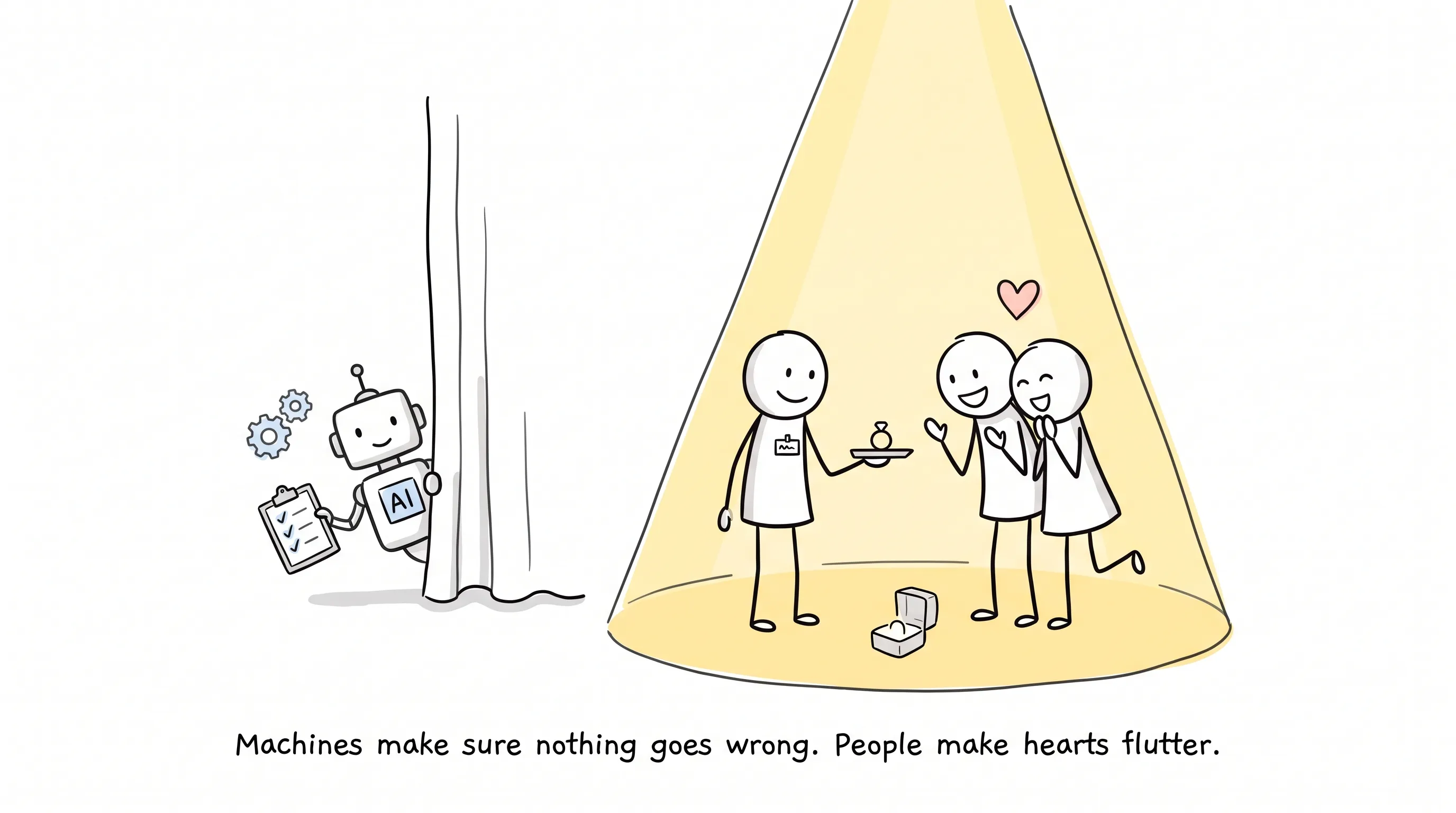
Count them again: in none of these five scenes does an AI stand in the spotlight.
Standing in the spotlight, it's still the designer, the buyer, the associate. The machines all hide backstage.
This is an old brand's sense of proportion with AI. Machines handle what's certain; people handle what demands exactness. Counting inventory, calculating light, computing preferences — hand those to the algorithm. Adjusting a curve by a millimeter, saying "congratulations" — those stay with people.
Machines make sure nothing goes wrong. People make hearts flutter.
Back to That Ring
My classmate's wedding is set for next year. The ring is already in hand.
What he doesn't know is that, from drawing board to counter, that ring passed five algorithm gates.
But what he'll most likely remember is: the associate remembered the style he kept mentioning; when he tried it on, the ring on the screen looked real enough to already be on his hand; and in the case, his size was waiting.
That's enough.
The algorithm didn't steal a single bit of the romance. It just cleared a few potholes off the road the romance travels to reach your hand.
Here's to being remembered by your customers the same way. And if you run a business, ask yourself: which link of yours is worth an algorithm standing guard?
Continue reading
Related articles

Cross-Border Business: Time to Upgrade Your AI Toolbox
A learn article explaining how AI tools help cross-border e-commerce sellers clear five hurdles: language, regulation, logistics, payments, and fraud. It outlines a five-compartment toolbox, a five-step adoption path, and metrics such as conversion rate and CLV, while cautioning against over-reliance on AI.

AI Is Taking Over the Dirty Work of Social Media Marketing, One Task at a Time
This learn article outlines four social media marketing tasks AI can handle — audience analytics, content drafting and design, ad targeting and creative testing, and spam moderation — and cautions that taste, judgment, and data security remain human responsibilities.

AI Is Already This Good — Why Is Your Social Media Marketing Still Pure Manpower?
An overview of 18 AI tools for social media marketing, organized into six categories covering audience research, content creation, scheduling, comment and DM handling, ad management, and visual production, plus notes on personalization, prediction, and emerging trends.