
A Million People, a Million Experiences
A learn article explaining hyper-personalization: how real-time AI builds individual-level experiences, the three-layer stack (CDP/MDM, AI orchestration with agentic AI, headless CMS), B2B account-based differences, and privacy and trust considerations.
A few days ago I had dinner with a friend who runs an e-commerce business. He pulled out his phone and showed me two homepage screens: his, and a courier's.
Same app. His feed was fishing rods and pour-over coffee makers. The courier's was work gloves and power banks.
This wasn't two page layouts configured by an ops team, he said. It was computed on the spot, by AI. What each person sees is entirely their own.
Wow. That was it. That was the whole reaction.
On the way back I couldn't stop thinking about it. After two days of thinking, I became more and more convinced: this is not just an upgrade in marketing tactics. It is a redo of the customer experience itself. So today, let me tell you about it.
What exactly is hyper-personalization?
First, let's be precise about the word.
What did "personalization" used to mean? Sorting people into piles. One set of offers for young mothers, one for programmers, another for loyal regulars. Once the piles were sorted, each pile got its own piece of content.
That was already pretty good. But at its core, it was still "one message for a crowd."
Hyper-personalization shatters the "crowd" into pieces too small to break any further — down to a single person. A real-time AI system builds millions of experiences for millions of users, all at the same time. You haven't been sorted into a group. You are your own group.
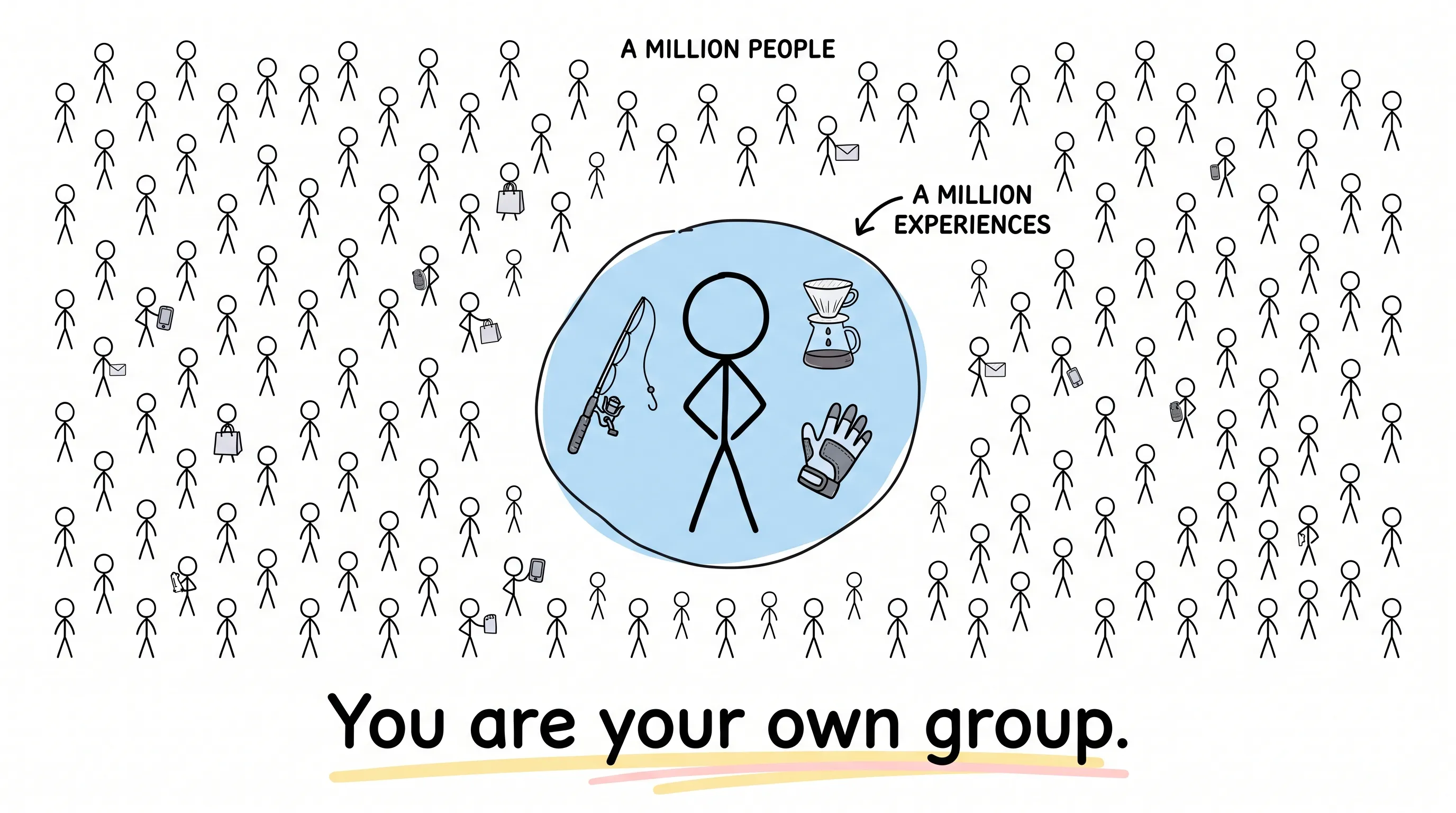
And that group is alive. Last week you were browsing strollers; this week your baby is born, and the page changes instantly.
Put simply: old personalization "slapped on labels." Hyper-personalization "grows a memory."
Is it worth doing? Let's do the math
Some will say: sounds exciting — but what is it actually worth?
Boston Consulting Group (BCG) ran the numbers: companies that use AI for personalization see sales grow an extra 20% on average. The most advanced of them can capture up to 40% more incremental revenue than competitors still running static strategies.
McKinsey looked at the other end of the ledger: once personalization is scaled up, marketing efficiency improves by 10% to 30%; and by aiming high-value content only at high-response segments, customer acquisition cost can be cut by as much as half.
Cut acquisition cost in half. You know better than I do how expensive traffic is these days.
Gartner looked at retention: companies that fully deploy a personalization system can lift conversion rates by up to 30% and reduce churn by 28%.
And there is a longer-term ledger. A 2025 study from Accenture confirmed it: brands that genuinely achieve hyper-personalization enjoy a customer lifetime value (CLV) 40% higher than rivals still running on piles.
Sell 20% more, spend half as much to acquire, lose fewer customers, and keep your loyal ones with you longer. Put those four numbers side by side, and the question is no longer "whether to do it" — it has become "how fast."
Oh, and one more finding that often gets overlooked. Salesforce surveyed B2B buyers: 80% of them believe the experience a company provides matters just as much as its products.
The experience is the product. That sentence deserves a place on your office wall.
So why can't most companies pull it off?
The problem is not the idea. It's the warehouse.
Walk through most companies and you'll see it: one copy of the customer record lives in the ERP, another in the CRM, a pile of chat logs is sitting in the support system, and the website's event tracking holds yet another. Four or five systems, four or five silos, none of them talking to each other. The customer has passed through five places inside your business — but your systems only recognize five unrelated shadows.
However smart the AI, if the data you feed it is fragmented, the answers it computes will be fragmented too.
So the first enemy of hyper-personalization was never weak algorithms. It is data that never got pieced together.
So what do you do? Companies that have made this work are, almost without exception, building the same three-story house.
Three floors. How do you build them?
Floor one: the foundation. An enterprise-grade customer data platform (CDP), paired with cross-domain master data management (MDM). It works like a master warehouse keeper: it takes in every kind of data scattered across the business — structured, semi-structured, unstructured — and then resolves identities, stitching the five shadows back into one person. The result is what the industry calls a "golden customer profile": one complete, always-current you.
Floor two: the brain. Once the data flows in, the AI orchestration layer goes to work. It does two things.
One is prediction. Drawing on purchase history, visit timing, and behavioral trails, it computes in real time: how likely is this person to churn? How likely are they to buy? What should they be shown next? The industry calls this next-best-action.
The other is the genuinely new part: agentic AI. Personalization used to mean picking things from a ready-made content library and pushing them to you. However precise the picking, the inventory stayed the same inventory. An agent doesn't pick — it creates on the spot. A large language model writes the copy, generates the image, assembles the layout, all tailor-made for your intent at this very moment.
One is a librarian; the other is a tailor. Old personalization helped you pick something off the rack. The new kind takes your measurements and cuts the cloth right in front of you.
Floor three: the hands and feet. A headless, composable content management system (CMS), plus a high-speed API gateway. The moment a user touches any touchpoint, the CMS injects the AI's freshly generated offers, layouts, and content modules into any terminal, instantly. Website, app, in-store IoT self-service kiosks, even corporate procurement networks — all treated exactly the same.
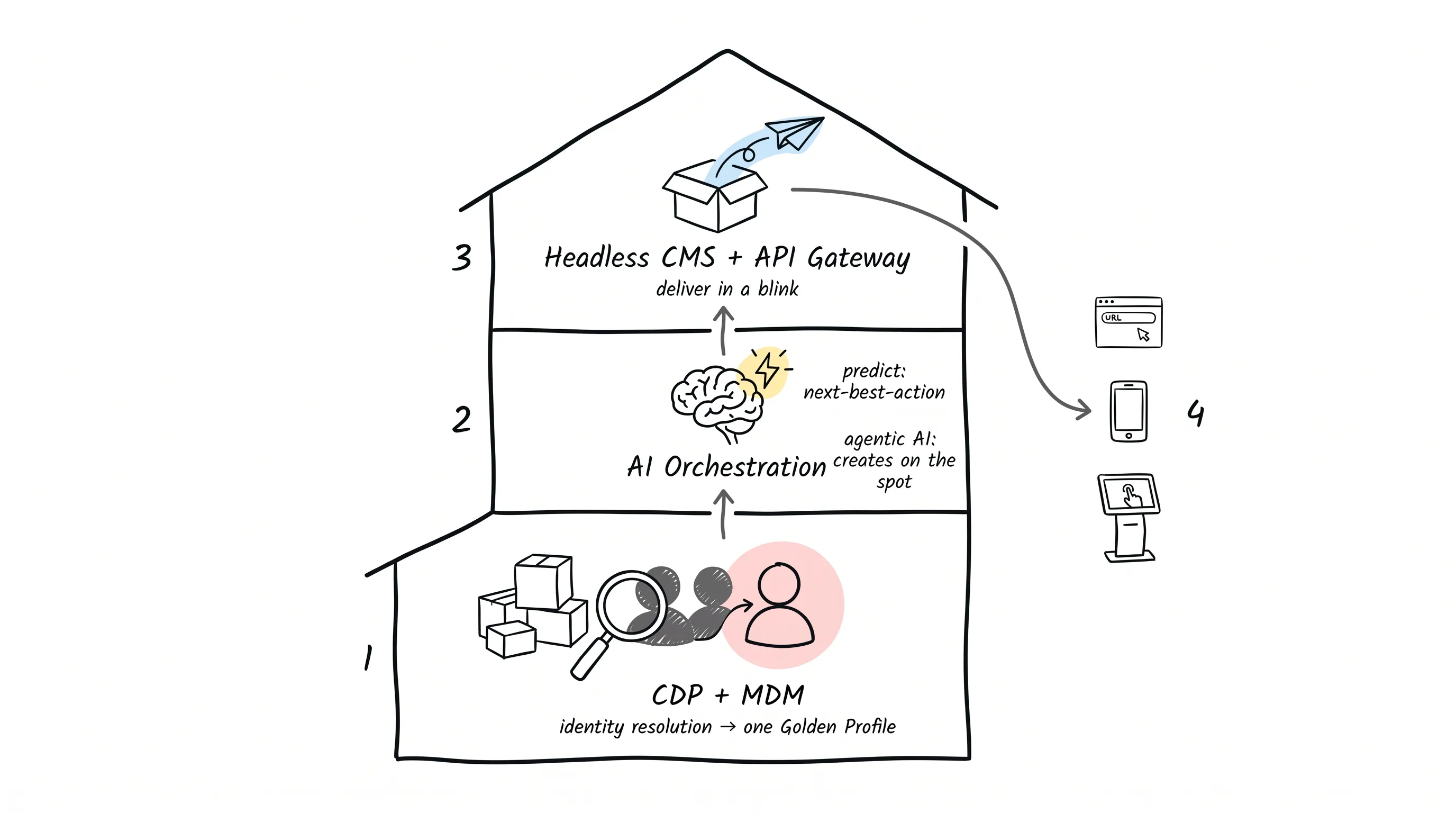
The foundation remembers who you are. The brain decides what to give you. The hands and feet deliver it to your eyes in a blink.
B2B is harder — and far more interesting
At this point you might be thinking: this whole thing is a B2C playbook, isn't it? B2B is different.
It is indeed different. And much more interesting.
A B2C decision is one person's emotion in a single moment. See it, want it, buy it — three seconds.
A B2B decision? A group of people, over months. Procurement, finance, operations, IT security — a committee that reviews layer by layer. You are never facing a customer. You are facing a "buying committee."
So for B2B hyper-personalization, the unit of analysis has to change: from the "individual" to the "account." What the system watches is no longer one person, but an organization's jigsaw puzzle of behavior.
Here's an example. At one company, the head of engineering downloads a technical API document. Two weeks later, a financial analyst at the same company opens the pricing page.
Viewed separately, these are two unrelated browsing events.
But the AI engine connects the dots: this is a cross-departmental group investigation. So on the next visit, on the same website, the two people see entirely different things. The engineer sees technical documentation and a sandbox to test things in; the finance analyst sees compliance materials and an ROI worksheet.
One website, two conversations at once — and landing every sentence exactly where it should.
One level deeper, and a B2B personalization engine governs more than just "what content to push." Contract parameters, regional pricing, industry compliance constraints — all of it must align in real time with the customer's SLA (service-level agreement).
B2C is about delight. B2B is about precision.
How do you land it? Three steps
That's the theory. So where do you start?
Don't try to leap to the top in one bound. Mature companies climb in three steps — and every step pays for itself.
Step one: lay the foundation. Take inventory of which systems hold your customer data, and how much duplication and how many blind spots exist; deploy an enterprise CDP and pipe in the web, app, CRM, and support data streams; define the rules for identity resolution and the red lines of data governance. Only when this step is done do you truly "meet" your customers for the first time.
Step two: install the brain. Plug in predictive models and train them to read intent signals and cross-channel behavior — computing customer lifetime value, scoring purchase intent, flagging churn risk early. Once this step is done, you start to "anticipate" your customers.
Step three: unleash the hands and feet. Deploy an agent engine, connect a composable CMS, and let the system assemble layouts, write copy, and adjust offers on its own; then keep a continuous cycle of algorithmic A/B testing running, so it gets sharper with every pass. Only after this step does personalization begin to "grow itself."
Every step delivers its own return. There is no wasted investment.
The more it knows you, the more you fear how much it knows
Finally, one thing we can't dodge.
You have probably already felt the awkwardness underneath all this: users delight in "how does it know me so well?" while a chill creeps in — what gives it the right to know me this well?
This is the "personalization paradox." The more attentive the service, the deeper the tracking behind it; the deeper the tracking, the easier it is to step on users' fears and regulators' red lines. GDPR, CCPA, and the AI governance rules now taking shape in country after country do not go easy on fines. And once trust shatters, the settlements are the least of your problems.
That's why companies that mean it weld "privacy by design" into the architecture, instead of patching after something goes wrong. A few key moves:
Zero-trust data. Encrypted in transit and at rest, end to end, with role-based control over who can see what.
Real-time consent orchestration. A user changes a privacy setting in one place, and the tracking policy across every channel syncs immediately.
Anonymized training. Train the models on de-identified, aggregated, or even synthetic data — never feed real people's privacy to a model.
Auditable algorithms. Be ready, at any moment, to answer "why was this shown to this user," and strangle bias while it's still within explainable bounds.
Put simply: the ceiling of personalization is trust. When users hand you their data, that's not a right you own — it's something they've entrusted to you.
In closing
Back to that dinner.
My friend's app shows fishing rods to anglers and gloves to couriers. Technically, it's a story about a three-story house. But the real foundation is an attitude: stop treating people as "a type of person," and start treating every single person as the only one of their kind.
Whoever truly understands this — their product has warmth.
That's just how it feels to me. I could be wrong. But the next time your system is about to blast one message at a "target audience," pause for a second, and think about that courier.
He wants work gloves. And he also wants — to be taken seriously.
Continue reading
Related articles

Cross-Border Business: Time to Upgrade Your AI Toolbox
A learn article explaining how AI tools help cross-border e-commerce sellers clear five hurdles: language, regulation, logistics, payments, and fraud. It outlines a five-compartment toolbox, a five-step adoption path, and metrics such as conversion rate and CLV, while cautioning against over-reliance on AI.

AI Is Taking Over the Dirty Work of Social Media Marketing, One Task at a Time
This learn article outlines four social media marketing tasks AI can handle — audience analytics, content drafting and design, ad targeting and creative testing, and spam moderation — and cautions that taste, judgment, and data security remain human responsibilities.

AI Is Already This Good — Why Is Your Social Media Marketing Still Pure Manpower?
An overview of 18 AI tools for social media marketing, organized into six categories covering audience research, content creation, scheduling, comment and DM handling, ad management, and visual production, plus notes on personalization, prediction, and emerging trends.