
A Marketing Team of 100+ Wants AI — So I Went Through All Six Platforms
A learn-style comparison of six AI marketing automation platforms — Salesforce, Adobe, Oracle, HubSpot, ActiveCampaign, and Acoustic — framed around choosing between copilot-style assistance and agent-style automation, with selection guidance and rollout steps for large marketing teams.
Last month I visited a big consumer-electronics company. The person hosting me was their VP of Marketing, who runs a global marketing team of more than 100 people, scattered across a dozen-plus countries.
He got straight to the point: when it comes to AI marketing automation, whose product should we buy?
I told him: don't rush to pick one yet. First, answer another question for me.
Are you buying a copilot, or an employee?
He paused for a beat.
What's a copilot? You write the copy; it chimes in with ideas, reworks the phrasing, picks the images. If you don't lift a finger, it never does either.
What's an employee? You spell out the task, and it goes off on its own — scheduling the sends, generating the content, scoring the leads, deciding who a message goes to. You sleep; it works.
A copilot offers ideas. An employee does the work.
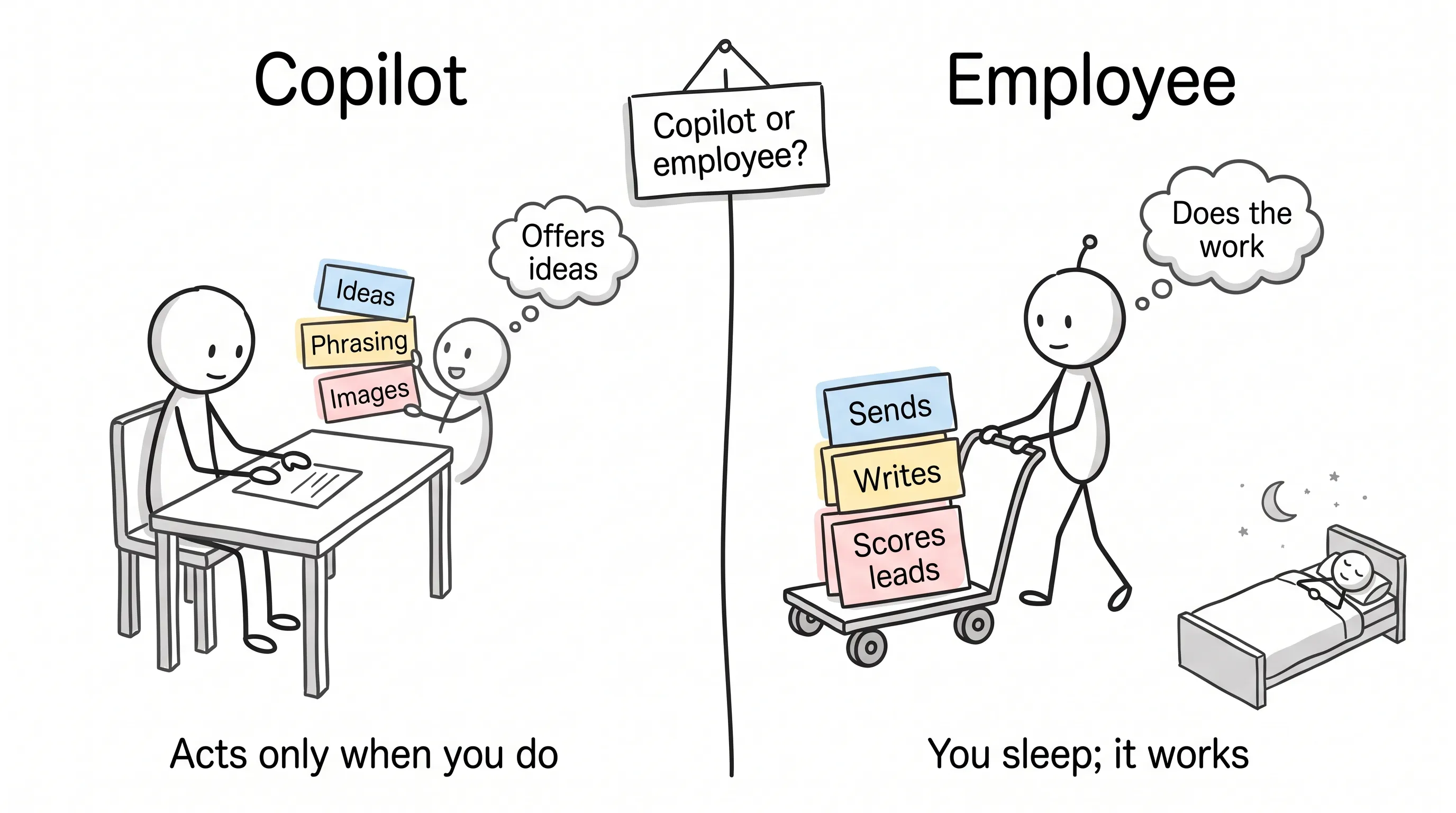
These two come with different price tags, different implementation difficulty, and different teams to staff. Every platform on the market fits into one of these two buckets.
Let's take it from the top.
First, Understand What Enterprise-Grade AI Automation Adds
A lot of people assume AI marketing automation is just traditional automation workflows with an AI shell slapped on top.
It isn't.
What is traditional marketing automation? Plainly put: a vending machine. You hard-code the rules in advance — customer opens the email, send a coupon; no reply for seven days, send a follow-up. It executes flawlessly and never complains. But it will never stop to ask: should this email go out today at all?
AI-powered automation is a different animal. It reads historical data and learns on its own; when customer behavior shifts, it adjusts. As of this year, the leading platforms have gone all-in on AI agents: planning campaigns, writing content, scoring leads — whole stretches of work they handle themselves, with humans only checking the results.
Starting in the second half of 2025, several major vendors simply tore their products down and rebuilt them — new names, with agents under the hood.
For a small team of a dozen or so, this shift may barely register. A few rules and workflows, and you're covered.
Enterprise is different.
Think about it: a global company with millions of customers, spread across a dozen-plus countries, dozens of audience segments, seven or eight channels. Personalization by hand? Not a chance. By writing rules? The rule library will crush you first.
So when big teams adopt AI, what they want is refreshingly simple: personalization that reaches millions, content capacity that can feed dozens of channels, and someone to keep the dozens of data pipelines across CRM, advertising, and customer service flowing on their own.
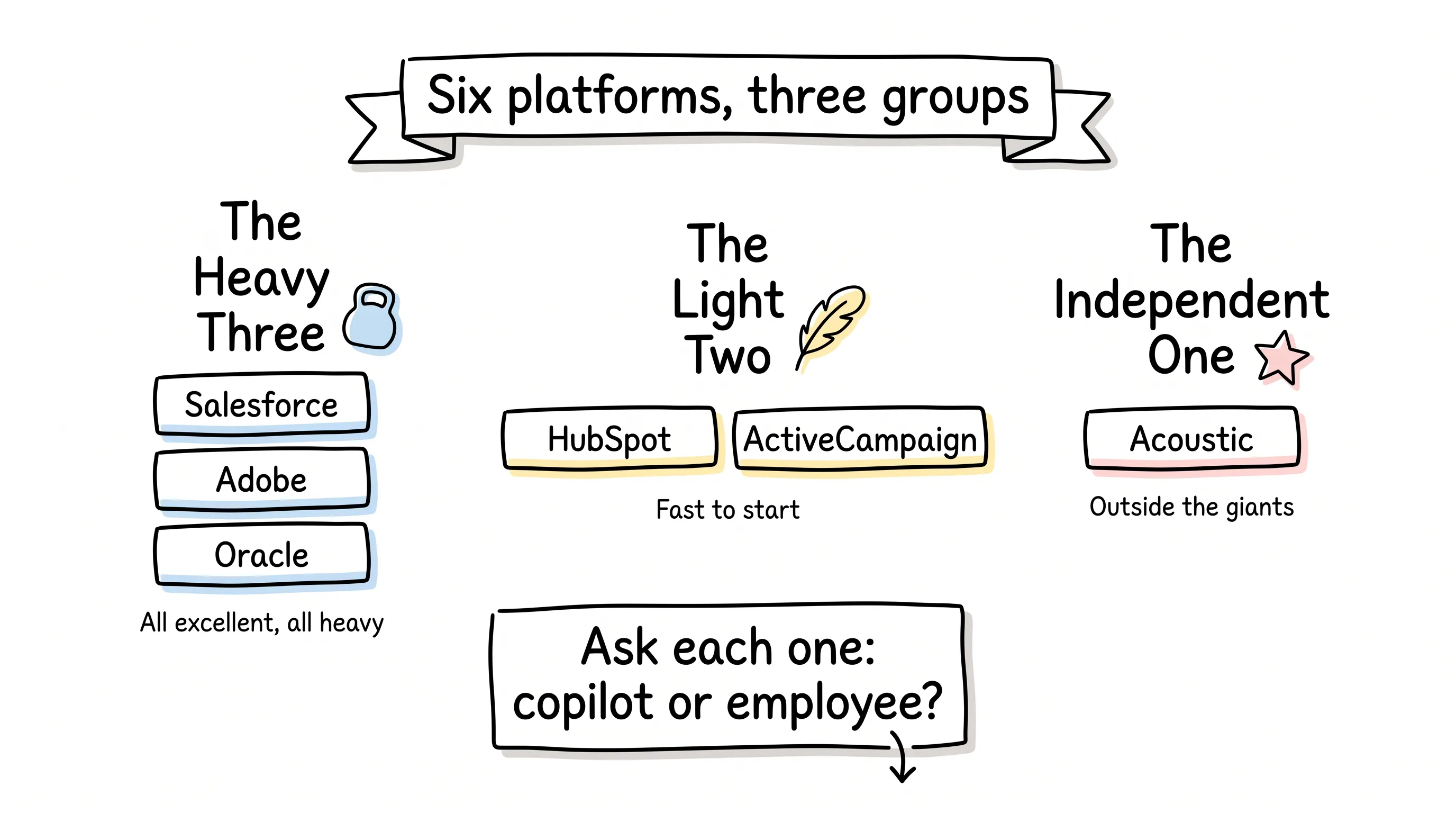
The Heavy Three: Salesforce, Adobe, Oracle
Start with the three big ones. All excellent. All heavy.
First, Salesforce. Its marketing cloud is now called Marketing Cloud Next; the AI it built years back was called Einstein, and the whole thing now lives under Agentforce. The new name isn't just new signage — the engine really did change: agents orchestrate customer journeys on their own, personalize across the full funnel, and run everything from acquisition through repeat purchase.
Who is it for? Marketing departments of 100-plus people, with data scattered across sales, service, and advertising systems, who want a real employee instead of manually pulling lists and scheduling sends.
The cost is plain to see: high complexity, long implementation cycles, and you need seasoned experts on hand.
Second, Adobe. The flagship is Marketo Engage, a veteran B2B player whose signature strength is complex lead nurturing. What has really shone these past two years is on the content side, called GenStudio: AI generates campaign content, but brand guidelines are enforced automatically — tone of voice, fonts, assets — every output goes through security screening on its own, so nobody has to review page by page afterward. Agents can also build Smart Lists and assemble programs for you.
Who is it for? B2B companies doing big-account business, with long sales cycles, long approval chains, and strict brand control. Complexity: equally high.
Third, Oracle. The veteran ABM (account-based marketing) player Eloqua now sits inside Fusion Cloud CX. This past February it launched 16 role-based AI agents in one go — handling campaign planning, writing briefs — like giving every marketing role its own assistant. Heavy data volumes across multiple departments: Oracle's chassis can take the load.
For companies doing dedicated account-based marketing. Complexity: still high.
The Light Two: HubSpot, ActiveCampaign
First, HubSpot. The fastest of the six to get up and running.
Its AI is called Breeze, in three parts: Copilot as the copilot, Agents as the employees, Intelligence for predictive scoring. Why is it fast? Because the AI lives right inside content creation and the workflow builder — it's at your elbow the whole time you're building. No separate purchase, no wiring up data all over again.
It has the lowest budget requirements and the lowest implementation difficulty of the six, and it works for companies of any size.
Next, ActiveCampaign. Its whole thing is being light. Underneath it all is an engine called Active Intelligence that does two things: predicts the best time to send, and groups your audience intelligently.
For budget-sensitive companies with lean teams. If you want to get AI up and running without any major upheaval, starting here is a safe bet.
And One Independent: Acoustic
Most people haven't heard of this one. It began life as IBM's Watson marketing business, then spun out on its own.
Its selling point is the AI teammate: assigning real-time intent scores to user behavior, figuring out who is about to buy. It also has one more card to play: it's one of the few independent options outside the big vendors.
Who is it for? Companies that don't want their marketing lifeline tied to the three giants — Salesforce, Adobe, Oracle. Complexity: moderate.
Four Quick Answers
Want speed and peace of mind? Pick HubSpot.
Massive scale, multi-department data? Salesforce's Agentforce, or Oracle's agents.
Brand content generation is a must-have? Look at Adobe's GenStudio, or HubSpot's Breeze Agents.
Tight budget, lean team? ActiveCampaign.
One more word on cross-app orchestration. Salesforce, Adobe, and HubSpot have the widest ecosystems — native connectors plus open APIs can string dozens of systems together. Don't expect single-point players like ActiveCampaign to run the whole show.
On pricing, I can't give you exact numbers. Enterprise quotes from these vendors are essentially negotiated with sales. Don't trust any article's prices — including this one. Go book a demo.
Don't Swipe That Card Yet — Six Things to Do Before Rollout
Pick the wrong tool, and you waste some money. Botch the rollout, and you can drag the entire marketing team into the mud.
First, take inventory. Go through your existing workflows, CRM, and data pipelines one by one. Map out where AI can plug in and where the holes are.
Second, get clear on what you want AI to do. Email personalization? Dynamic ad placement? Lead prioritization? The more specific the goal, the smoother everything after.
Third, when evaluating platforms, ask one more question: of all this AI capability, how many are copilots, and how many are employees? Skip the demo videos; read the capability list.
Fourth, feed it clean data. An AI's judgment is only as good as your data quality. A CRM full of duplicate, missing, and expired records turns the strongest AI into garbage in, garbage out.
Fifth, teach your people. A global team spans time zones. Which steps go to the agents, which steps a human watches — there have to be rules. The final call on creative stays with people.
Sixth, watch the results. Use the AI's own reporting to test the process, run experiments, check ROI. Going live isn't the end — it's the start.
While We're Here: Should You Bring in an Agency?
Some companies bring in outside help. The better-known names in AI marketing implementation: Cognizant Interactive, Accenture Song, Wunderman Thompson, Publicis Sapient, R/GA.
If you want to use them, fine. But my advice: get your internal team running first. Outside consultants can set the systems up, but nobody understands your customers better than your own team. Brains don't outsource well.
What You'll See Next
Agents will grow from "handling single tasks" to "running entire campaigns."
Voice and conversational marketing will be rebuilt from the ground up by AI assistants.
Personalization will get fine-grained down to "this one person, right now."
Marketing data will connect fully with sales and product data, closing the loop.
None of these four is a prophecy — the first three are already underway. The companies that move early widen their lead every year.
Finally
Back to the VP from the beginning.
He didn't rush to sign anything. He started with the fastest one to get up and running — HubSpot Enterprise — and ran a three-month pilot: straightening out the data pipelines, training the team. Last month he messaged me: their nurture emails now have agents deciding who gets them and when, and he only glances at the report at month's end.
He said something I've remembered ever since: before, it was one of us blasting a million people with the same message; now, it's a million people, each receiving a letter that reads like it was written just for them.
Tools change every year, but there's only one question: is your AI there to offer ideas, or to do the work?
Here's hoping you hire a good employee of your own.
Continue reading
Related articles

Cross-Border Business: Time to Upgrade Your AI Toolbox
A learn article explaining how AI tools help cross-border e-commerce sellers clear five hurdles: language, regulation, logistics, payments, and fraud. It outlines a five-compartment toolbox, a five-step adoption path, and metrics such as conversion rate and CLV, while cautioning against over-reliance on AI.

AI Is Taking Over the Dirty Work of Social Media Marketing, One Task at a Time
This learn article outlines four social media marketing tasks AI can handle — audience analytics, content drafting and design, ad targeting and creative testing, and spam moderation — and cautions that taste, judgment, and data security remain human responsibilities.

AI Is Already This Good — Why Is Your Social Media Marketing Still Pure Manpower?
An overview of 18 AI tools for social media marketing, organized into six categories covering audience research, content creation, scheduling, comment and DM handling, ad management, and visual production, plus notes on personalization, prediction, and emerging trends.