
A Flat Marketing Budget Is a Cut in Disguise
A learn article arguing that a flat marketing budget is a cut in disguise as ad and acquisition costs rise, and laying out three moves for CMOs: protect proven mid- and lower-funnel programs, adopt AI and weigh agency versus in-house, and use measurement to show finance that marketing drives growth.
A few days ago, I had dinner with a friend who runs marketing. Midway through the meal, he said something that stopped my chopsticks in midair.
"Not a cent more. Exactly the same as this year."
So what are you going to do next year?
He shrugged: the board wants growth.
Absurd? Not at all. This is the shared predicament of many CMOs right now. The money hasn't changed, but every dollar buys less. Ad placements are getting pricier, keywords are getting pricier, customer acquisition is getting pricier — and prices overall are climbing too.
So a budget that doesn't move sounds like "holding steady."
A budget that doesn't grow is a cut in disguise.
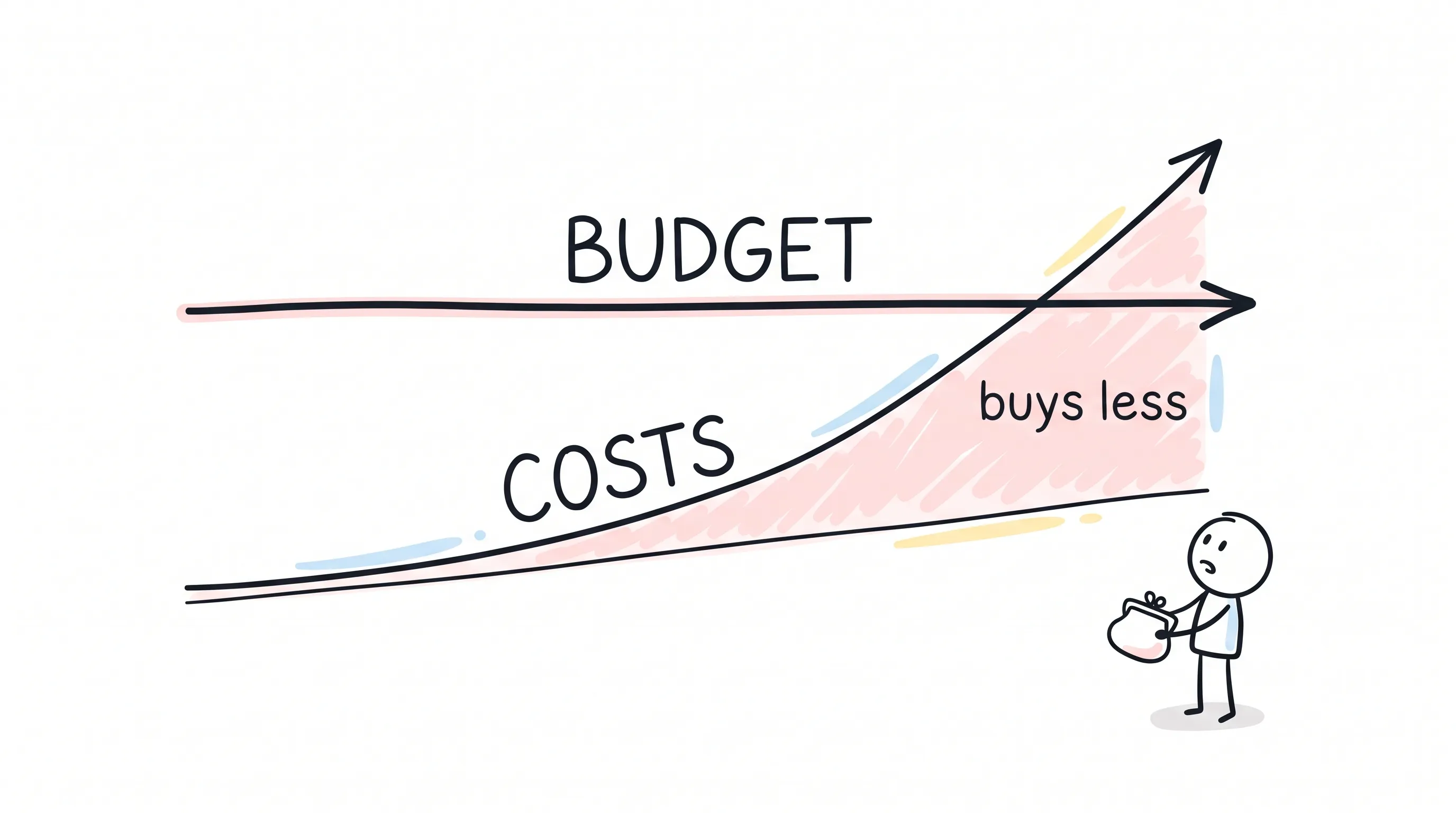
Most people have never done this math. Fewer still have done the next piece of math: this kind of cut hurts on a delay.
How to understand that? Think of farming. This year you get lazy and leave one field unsown. This year you feel nothing — last year's crops come in as usual, the money keeps flowing. The real disaster arrives the following autumn: the field is bare, and you're left empty-handed.
A budget freeze works on exactly this rhythm. The first year, you can coast on what you've stockpiled. Freeze it two or three years running, and trouble comes knocking.
My friend later worked out three moves. Protect what's still making money. If the freeze drags on, cut into the trunk. Then move to a different table to talk budget.
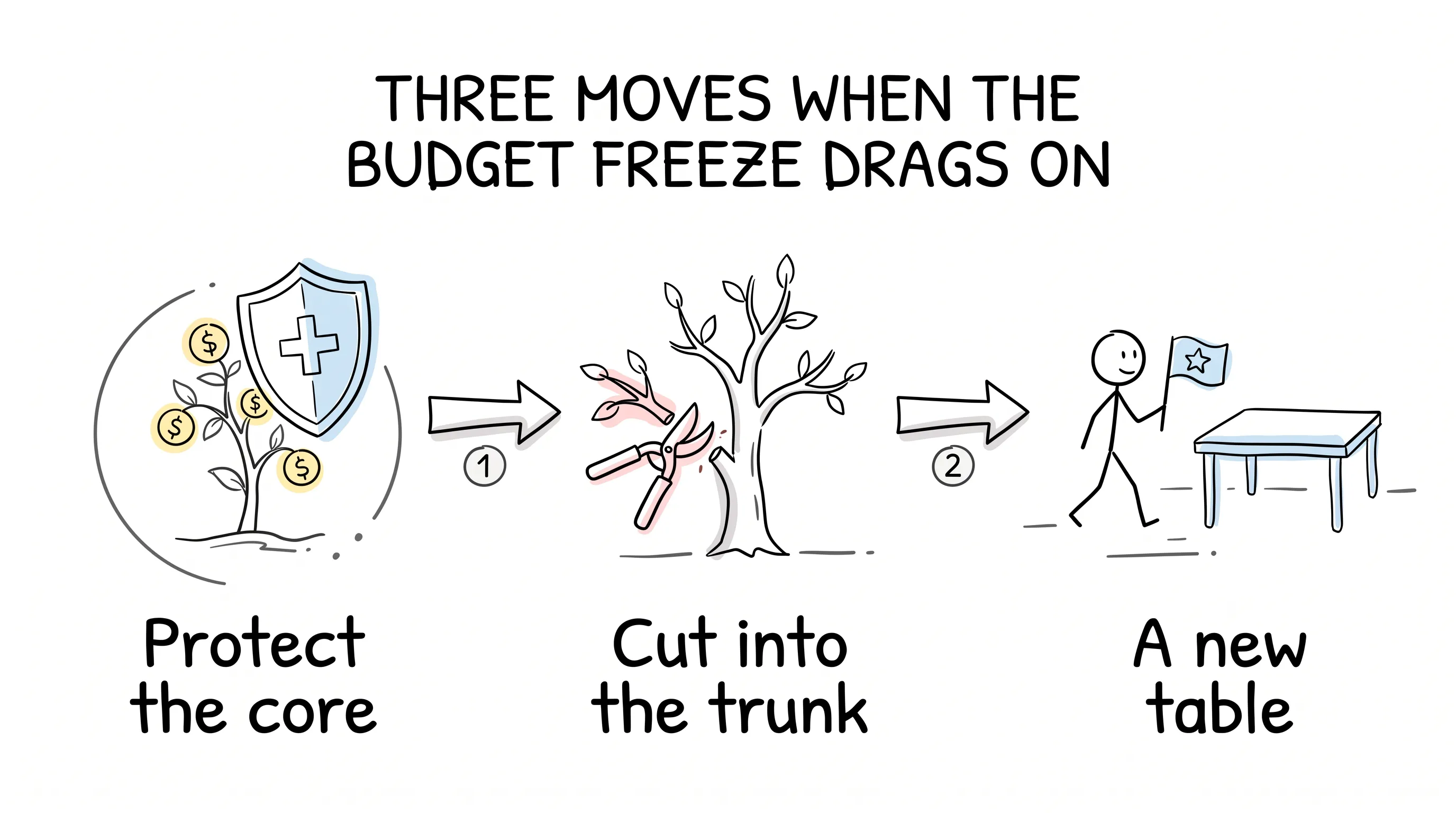
Let's take them one at a time.
Step 1: Protect What's Still Making Money
Before the knife comes down, get clear on where it should land.
The answer: protect the core programs that have been proven to work — most of which sit in the mid and lower funnel. The cost is that the top of the funnel takes the hit, like that unsown field. Effective short term, short-sighted long term. But if it's the only plan finance will approve, then so be it — for now.
But there's a trap here I need to warn you about.
The moment budgets tighten, many CMOs' first move is to shut down every experimental campaign. The reasoning sounds airtight: no revenue attached, so cutting them is "safest." The impulse is natural — but it's an illusion.
Kahneman and Tversky ran a famous experiment: a 50/50 bet to win $100 or lose $100 — do you take it? Most people won't press the button until the potential win rises to $200. The pain of losing $100 stings far more than the pleasure of gaining $100. That's loss aversion.
The experimental campaign is that "might lose $100" option in your head. You overestimate its risk — and in the same motion, toss away its chance to become the next growth engine. If you're the one making the call, you need to know you're wearing this filter — and not let the filter make the call for you.
Once that cut is made, there's still a pile of housekeeping to do — the unglamorous work nobody bothers with while budgets grow every year:
- Several software tools with overlapping features — can they be consolidated into one?
- Any purchased licenses gathering dust?
- With agency plus AI handling the work, can vacated roles simply stay vacant?
- Which contracts are worth sitting down to renegotiate?
None of it is sexy. But every line is real money.
Step 2: If the Freeze Drags On, Cut Into the Trunk
If the freeze lasts only a year, everything above is enough.
But if the freeze runs several years while acquisition costs keep climbing, you'll find that the same money brings in fewer new customers year after year. At that point, optimization can no longer save you.
Up to here, what you've been doing is pruning. Now you have to cut into the trunk.
First, AI. Honestly, even without a freeze, this step was coming sooner or later. Workflow automation, content production — savings everywhere. The budget freeze just forces you to play this move harder and faster.
Next, agencies.
If you've never used an agency, now is the time to look seriously — even if you outsource just one campaign. Building in-house means feeding a team, technology, and processes; the right agency brings the whole capability, people and tools included, on a per-project basis — at a fraction of the cost. And the bonus is a fresh pair of eyes: so many opportunities hide in the blind spots of a veteran team.
Already using one? Don't rush to cut it.
Cutting agencies and pulling marketing in-house the moment budgets tighten is a script decades old. But in 2026, the ANA (Association of National Advertisers) put out a report that made one thing clear: there is no standard answer on bringing marketing in-house.
You have to run the numbers. What's the upfront investment to build in-house? How much agency spend do you actually save? And don't forget: agencies offset a big chunk of their fees through discounted rates, value-added services, seasoned teams, ready-made technology platforms, and shared talent. Contract structure is negotiable, too.
Do a true value-for-value comparison before the knife falls.
Step 3: Move to a Different Table to Talk Budget
The first two steps are defense. This is the one that flips the game.
Pull in your analytics team and dig through the data: after years of frozen budgets, how much market share did the company leave on the table? How did underfunding, step by step, push acquisition costs higher? Work it out, then put it in front of finance.
You only have to prove one thing: marketing is not a cost center.
Marketing is a growth multiplier.
Why is marketing always the easiest budget to cut? Because so many companies have never connected brand-building investment to revenue. Until that line is drawn, finance assumes you contribute nothing to growth.
That line has to be drawn in advance, with a proper measurement system — so that by the time you sit down at the budget table, you have cards in hand.
As we wrapped up that night, I told my friend: this hand is tough, but it isn't dead. Move fast, and make your case plainly. Don't wait until next autumn to find the fields bare.
And may every quarter bring its harvest.
Continue reading
Related articles

Cross-Border Business: Time to Upgrade Your AI Toolbox
A learn article explaining how AI tools help cross-border e-commerce sellers clear five hurdles: language, regulation, logistics, payments, and fraud. It outlines a five-compartment toolbox, a five-step adoption path, and metrics such as conversion rate and CLV, while cautioning against over-reliance on AI.

AI Is Taking Over the Dirty Work of Social Media Marketing, One Task at a Time
This learn article outlines four social media marketing tasks AI can handle — audience analytics, content drafting and design, ad targeting and creative testing, and spam moderation — and cautions that taste, judgment, and data security remain human responsibilities.

AI Is Already This Good — Why Is Your Social Media Marketing Still Pure Manpower?
An overview of 18 AI tools for social media marketing, organized into six categories covering audience research, content creation, scheduling, comment and DM handling, ad management, and visual production, plus notes on personalization, prediction, and emerging trends.