
A Course That Sold $60 Million — and She Took It Down Herself
A commentary on Amy Porterfield taking her Digital Course Academy, reported to have sold over $60 million, off the market, drawing on her podcast episodes about AI dictation tools, delegating tasks, hyper-independence, and paid-ads budget minimums to argue that structural change beats extra effort.
Recently I was wandering around Apple Podcasts and came across a show. I did a double take.
The Amy Porterfield Show, a podcast about building an online business. A 4.9 rating from more than 4,500 people, running since 2013 — 892 episodes, a new one every week. The host, Amy Porterfield, writes books, teaches courses, and runs an online business; by her own account, cumulative revenue has reached $139 million.
None of that is unusual.
What's unusual is what she talked about in a recent episode.
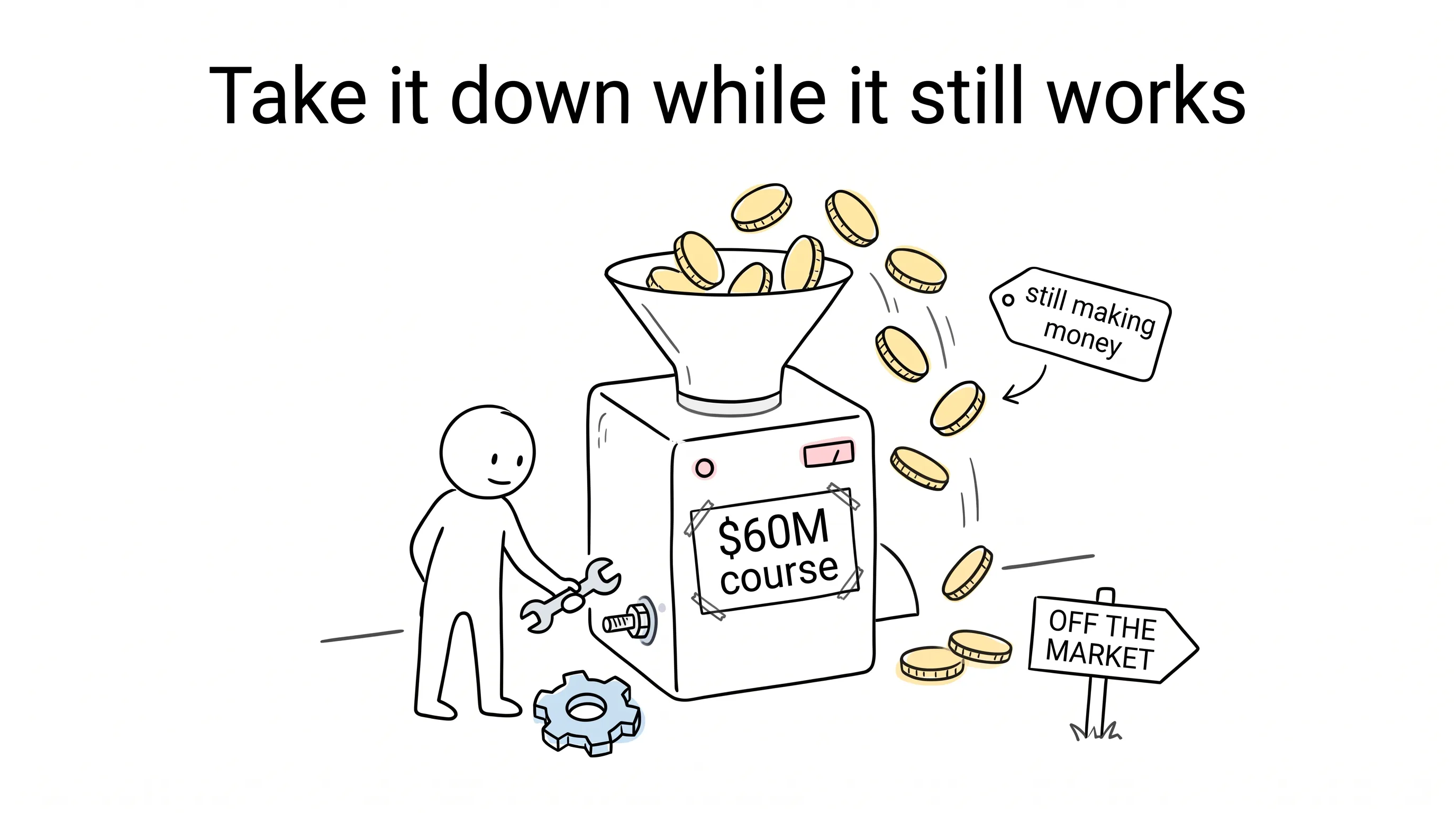
She has a course called Digital Course Academy that has sold more than $60 million cumulatively and served over 100,000 students. About six months ago, she took it off the market.
Yes — off the market. Not a redesign, not a sale. She simply stopped selling it.
Tearing down a machine that's still making money, with your own hands — that is something most people can't do.
Think about the people around you: someone holding on to a business that still generates revenue, that they lost their excitement for long ago, but every time they remember the income it still brings in, they hold on for another year. And then another. It's not that they don't know things need to change — plainly put, they just can't bear to let it go.
She let go. And six months after taking the course down, she devoted an entire episode to accounting for those six months.
The business has become three coaching programs, with every entry point now flowing into a single weekly live masterclass. Revenue and profit are both still on track. But she said that some days it hurts so much she wants to crawl out of her own skin.
God, what a way to put it. A person who has built a business past $100 million tears everything down and starts over — and it hurts all the same.
She also said that this very discomfort taught her who she is really serving — taught her more than the course she spent over a decade teaching.
This got me thinking for a long time. But what truly made me decide to write this piece was a few other episodes of hers.
I pulled up the titles of the last few episodes and laid them side by side, and a throughline emerged.
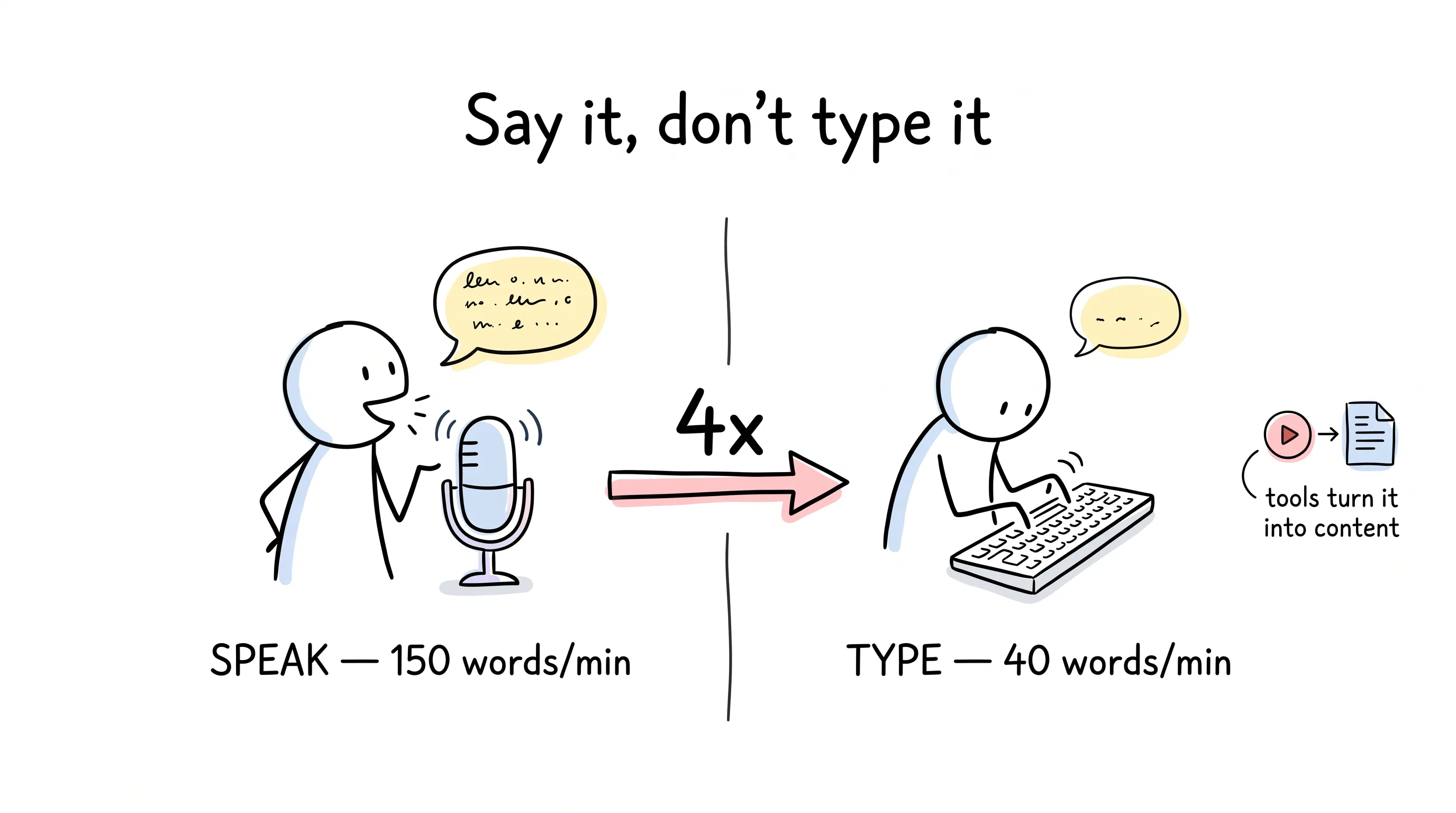
First, one of them. She talked about four AI tools she uses every single day: Claude, Wispr Flow, MacWhisper, Granola. The tools themselves don't matter; what matters is the arithmetic she opened with:
You speak — a minute gets you 150 words. You type — a minute gets you only 40.
So every email you write, every set of meeting notes you take, is naturally four times slower than just saying it out loud. Capture the words by recording them, let tools turn the recording into content, and you win that 4x right back.
Another episode was about hiring. One line of hers stuck with me: making millions of dollars, she was still editing her own course videos — for years. The reasoning sounded solid: I'm fast at it, and it saves money.
Does that sound reasonable to you too?
She offered a way to break it down: dump every task in your head onto paper and sort it into piles. Which ones only you can do, and which ones anyone could. Once you're done sorting, you find that the "only I can do this" pile is much smaller than it felt.
And there was one more episode, with Nedra Glover Tawwab, a psychotherapist of nearly twenty years. She brought up a term: hyper-independence — carrying everything yourself until carrying it all becomes a habit. Nobody is born this way; everyone learned it back when they had no one to lean on but themselves. Just because something works doesn't mean you should keep using it forever.
Even better was what a guest on another episode said: the sentence that makes you shrink inside a meeting room — you didn't come up with it yourself. Some teacher, some boss, some ex said it to you long ago. You've merely been carrying it for them all these years.
The one that hits hardest was an episode about advertising. Ashley Brock, a paid-ads expert who has managed over $100 million in ad spend, gave her verdict: with a $380 monthly budget, you will never get results — the money is too little for the algorithm to learn who buys what you sell. The floor is $1,000 a month. Run it a full 90 days first, then look at the data.
Did you notice — not a single one of these episodes was about "just try a little harder."
They were all about the same thing: take the work off yourself. Hand it to tools. Hand it to other people.
Problems that effort cannot solve are problems only a structural change can solve.
Of course, the comment section isn't all praise. One critical review stung. The gist: you teach people starting from zero, yet every example you give is tens of millions in revenue — how is someone in their first year or two of building a business supposed to relate? Speak to the 99% of your listeners, not just the 1%.
That review, I think, wronged her by half — and by half didn't.
Where it wronged her: a great deal of her content is precisely about small things — how to hire your first person, how to hand off a small task, how to decide whether to run ads. All of it useful while the business is still small.
Where it didn't: once a person's frame of reference climbs into the hundreds of millions, numbers she considers "tiny" may be someone else's ceiling. A frame of reference is invisible to its owner; someone else has to poke it.
That review was exactly the poke.
Writing to this point and looking back at her decision to take the course down, you'll see that all of these things are the same thing.
Taking a $60 million course off the market, and admitting that a $380-a-month ad budget is money burned — vastly different in scale, identical at the core:
You have to admit, first, that what you have now isn't enough.
Admission is the first step of every change.
And the hardest one.
May you have that courage too — to act while it's still making money.
Continue reading
Related articles

Cross-Border Business: Time to Upgrade Your AI Toolbox
A learn article explaining how AI tools help cross-border e-commerce sellers clear five hurdles: language, regulation, logistics, payments, and fraud. It outlines a five-compartment toolbox, a five-step adoption path, and metrics such as conversion rate and CLV, while cautioning against over-reliance on AI.

AI Is Taking Over the Dirty Work of Social Media Marketing, One Task at a Time
This learn article outlines four social media marketing tasks AI can handle — audience analytics, content drafting and design, ad targeting and creative testing, and spam moderation — and cautions that taste, judgment, and data security remain human responsibilities.

AI Is Already This Good — Why Is Your Social Media Marketing Still Pure Manpower?
An overview of 18 AI tools for social media marketing, organized into six categories covering audience research, content creation, scheduling, comment and DM handling, ad management, and visual production, plus notes on personalization, prediction, and emerging trends.