
A Brand Film About Antarctica, Made 100% with AI — Why Did Only 44% of Viewers Cheer?
A learn article analyzing 2025 AI-generated marketing campaigns, from a fully AI-made Antarctic brand film with 44% positive sentiment to a Palace Museum AIGC short with 96%, arguing that a final human review checkpoint separates successes from failures.
A while back, a brand film popped up in my feed, and for a moment I could have sworn some crew had camped out in Antarctica for half a year.
Antarctic ice fields, polar blizzards, expedition members trudging forward step by step, the camera pushing up from the ice into the sky. BY-HEALTH's 30th-anniversary brand film tells the story of China's Antarctic research expedition.
The footage was genuinely beautiful. The texture of the ice, the grain of the snow, the wind-chapped red on people's faces — all of it delivered.
After watching, I went and looked up the team behind it, curious which production company had landed the job.
What I found stopped me cold. One line: the entire film was 100% AI-made. Not a single shot was filmed in Antarctica — not a single shot was "filmed" at all.
Good grief.
You Can't Get to Antarctica, but AI Doesn't Feel the Cold
Why not shoot it for real? Simple: you can't afford to.
Antarctica is not a film set you can just fly to. Research permits, polar logistics, equipment freight, weather that turns on a dime — pick any one of them and the price is astronomical. Later, someone in the comments ran the numbers: a polar shoot of this scale costs over 1 million yuan (roughly US$140,000) for a single day of filming — and that's before asking whether everyone makes it back in one piece.
Think about it: suppose you're the brand manager, and the budget sheet reads "live polar shoot, 1 million yuan a day." Do you sign off?
So the team flipped the problem: send the AI instead. Humans can't take the cold; graphics cards don't mind.
That's the first way to win with AI marketing: do the things humans can't do, or can't afford to do.
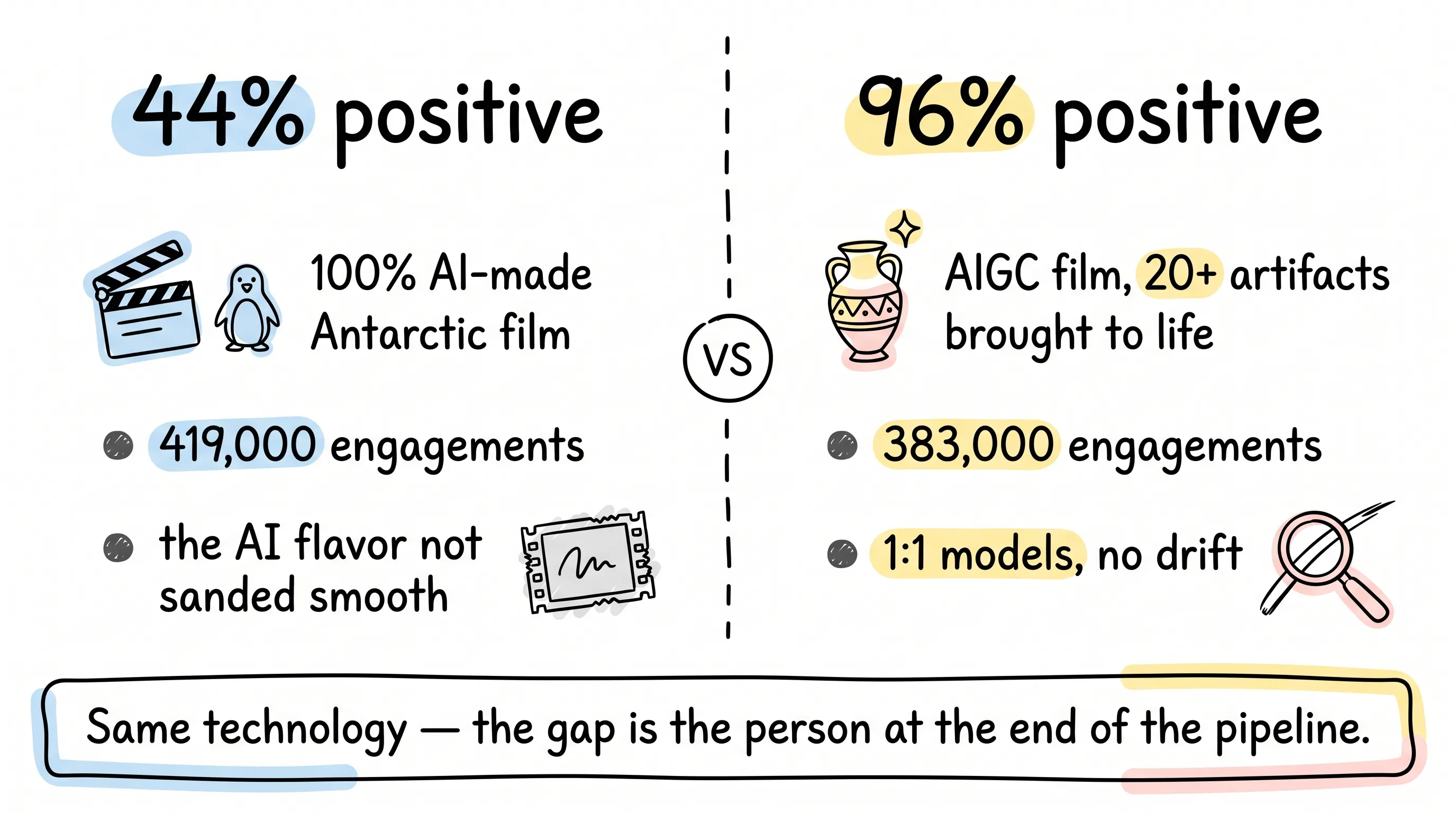
The film went out and pulled 419,000 social media engagements. Sounds good?
Hold the applause. A second number was hiding underneath: only 44% of user comments carried positive sentiment.
Less than half.
But You Can't Count Only Half the Ledger
Blame the 44%? Not one bit.
Slide into the viewer's seat for a moment: you couldn't care less whether the film was made by AI. You only care whether it looks good and feels real.
One line of praise in the comments was especially telling: "That's the best AI video I've ever seen."
Sit with that sentence. Is it praise? Yes. But praise measured against what? First place within the "AI video" category. The ruler inside viewers' heads no longer measures just "is the film good" — it also measures "how strong is the AI flavor."
In other words, "the AI flavor is faint" has become the highest compliment you can get right now.
So what did that remaining 44% of votes go to? To the machine traces that hadn't been sanded smooth.
Here's the interesting part: the production team knew it too. Their method was to hold the AI to the standards of a live shoot — real light-and-shadow logic, real physical texture — and tune every expression, every movement of the characters through rounds upon rounds of massive prompt engineering, hundreds of passes, all to grind out a trace of "human touch."
What does "removing the AI flavor" look like? This.
A Formula Maker That Built the Math Into Its Workflow
If BY-HEALTH was "breaking boundaries," Yili Jinlingguan was "beating the clock."
In July 2025, Yili Jinlingguan produced a series of animated shorts for Youzi Xiaoyang, the little-lamb mascot of its infant formula line — the lamb sets off on an adventure to find the freshest milk sources. Among leading infant-formula brands, it was the first animation IP series produced end to end with AIGC (AI-generated content).
Six episodes, three minutes each. But the number that really matters is this: total production time was compressed from the traditional six months to under two months.
Six months becomes two. For the brand, that's not four months saved — it's two extra rounds of ideas tested inside the same window.
The report card: 126 million views and 540 million impressions across the web.
Staggering.
How did they pull it off? Three moves.
Move one: translate the old masters' craft for the AI. Storyboarding at a traditional animation studio is a skill polished over a decade or more. They transcribed that experience, item by item, into instructions the AI could understand. The old craft wasn't wasted — it just found a new use.
Move two: feed the AI real data. AI-rendered animals tend to "float" — the motion reads as fake at a glance. They brought in real animal movement data for training and pressed the "fake" back down.
Move three — the killer move, in my view: AI generates, humans fix frame by frame. Structure, color consistency, light calibration, one frame at a time.
Remember this move. There's a test coming.
The Near-Perfect Score Came From the Palace Museum
Also in 2025, the Palace Museum turned in an exam paper worth nearly full marks.
That Mid-Autumn Festival, the Palace Museum partnered with Volcano Engine on an AIGC short film that brought more than 20 artifacts "to life" on festival night: treasures from different dynasties gathering for a reunion that spans the dynasties. It was also the first time 4K, cinema-grade artifact animation had ever been made.
Artifacts are the hardest subject to fool. One wrong stroke in a pattern, one degree off in the glaze, and audiences spot it immediately. So the team built 1:1 models of every piece — features, textures, materials all pinned down — and no matter how many shots a piece crossed, it was not allowed to drift.
The report card: over 3 million views, 383,000 engagements, 96% positive sentiment.
96%. Now look back at BY-HEALTH's 44%. Same technology — the score more than doubles.
Where does the gap come from?
Not the model. The person at the end of the pipeline.
One comment put it beautifully: "Thank you, AI, for making the Palace Museum's treasures no longer cold exhibits."
See? Audiences never cared about AI — not for a second. What audiences care about is what you created for them with AI.
Bolder Still: AI Started Playing the Lead
In every case so far, however capable, AI stayed behind the curtain. By 2025, some brands pushed it straight onto the stage.
Last back-to-school season, Lenovo released a set of AI-created shorts in which the Terracotta Warriors start talking, form a squad, and head off to school — with the Great Qin Academy and Lenovo stores stitched into one shared universe. The cleverest part: it's AI telling the story of AI. AI is both the production tool and the content itself.
Tongrentang went even further. The centuries-old pharmacy partnered with Kling AI to riff on ancient Chinese mythology and literary classics, letting the brand take a spin through the "abstract" meme culture (the absurdist, deadpan humor young Chinese netizens love). Related topics racked up 2 billion views.
Mixue teamed up with Kuaishou: Kling AI handled a promo film end to end in a single month, then Mixue launched Snow King-themed AI effects, letting every user generate their own "Snow King" avatar. Related topics drew over 1 billion impressions.
Last May, Douyin Mall ran a campaign called "Call Me AI Edison" that dropped the barrier to design down to the floor — ordinary people could turn their wildest ideas into finished works — and pulled in 10 brands for a relay of co-created posters. Engagements: over 3.4 million.
Notice something? In these cases, AI's identity changed.
It's no longer just a tool that saves you money. It is itself the topic — the protagonist being watched and discussed.
AI has gone from tool to protagonist.
This Isn't a Handful of Companies Placing Reckless Bets
You might think this is just big companies being rich and reckless.
Look at a few numbers.
In 2025, buzz around AI marketing doubled within a year. 53.1% of advertisers already use AIGC in creative content production. And nearly 20% of advertisers now hand more than half of their video production workflow to AI.
The AIGC market as a whole reached 25.7 billion yuan (~US$3.6 billion) in 2025. The advertising and marketing segment alone is expected to surge to 150 billion yuan (~US$21 billion) by 2030.
The pie keeps growing, and more players keep arriving. What does that mean? Every Mid-Autumn Festival and every back-to-school season from now on, audiences will see more AI-made content. Those who sharpen the blade first, win first.
But Everything Has a Flip Side
For every full score, someone crashes. And each crash is more spectacular than the last.
A billboard at Kunming Airport: an AI-generated girl whose right hand had six fingers — five of them fused together.
In Bestore's product imagery, peanuts were growing on trees. Even the peanuts would want to come out and issue a correction.
Google's Super Bowl ad declared, with a perfectly straight face, that more than half of the world's cheese consumption is Gouda. The data was wrong.
Then NetEase: its Qixi Festival (Chinese Valentine's Day) membership copy was accused of skirting the line of innuendo and shot up the trending charts. The official response: the copy was AI-generated.
The harshest user comment of all: "If they can't even be rigorous with an image, can you imagine them being rigorous with their products?"
One sentence, from one image, straight through to the whole brand.
Think about it: what is advertising, at its core? Making a promise on the brand's behalf. One extra finger in an AI-generated image, and the promise cracks.
So Where Exactly Is the Line?
Review the wins and the wrecks together and you'll find it: the dividing line between success and failure isn't technology at all.
Every one of them in 2025. Some scored 96%, some 44%, some went straight to the trending charts.
There is exactly one dividing line: that final human checkpoint — did you skip it, or not?
The Palace Museum: 1:1 models. Jinlingguan: frame-by-frame fixes. BY-HEALTH: hundreds of prompt rounds grinding the details. Every winning case pinned a human to the end of the pipeline, using manual review to correct the AI's drift.
And the crashes? Six fingers, tree-grown peanuts, wrong data — all generated and posted as-is. The missing step in between is called "one last human look."
AI generates; humans sweat the details. AI is the productivity; humans are the quality inspector.
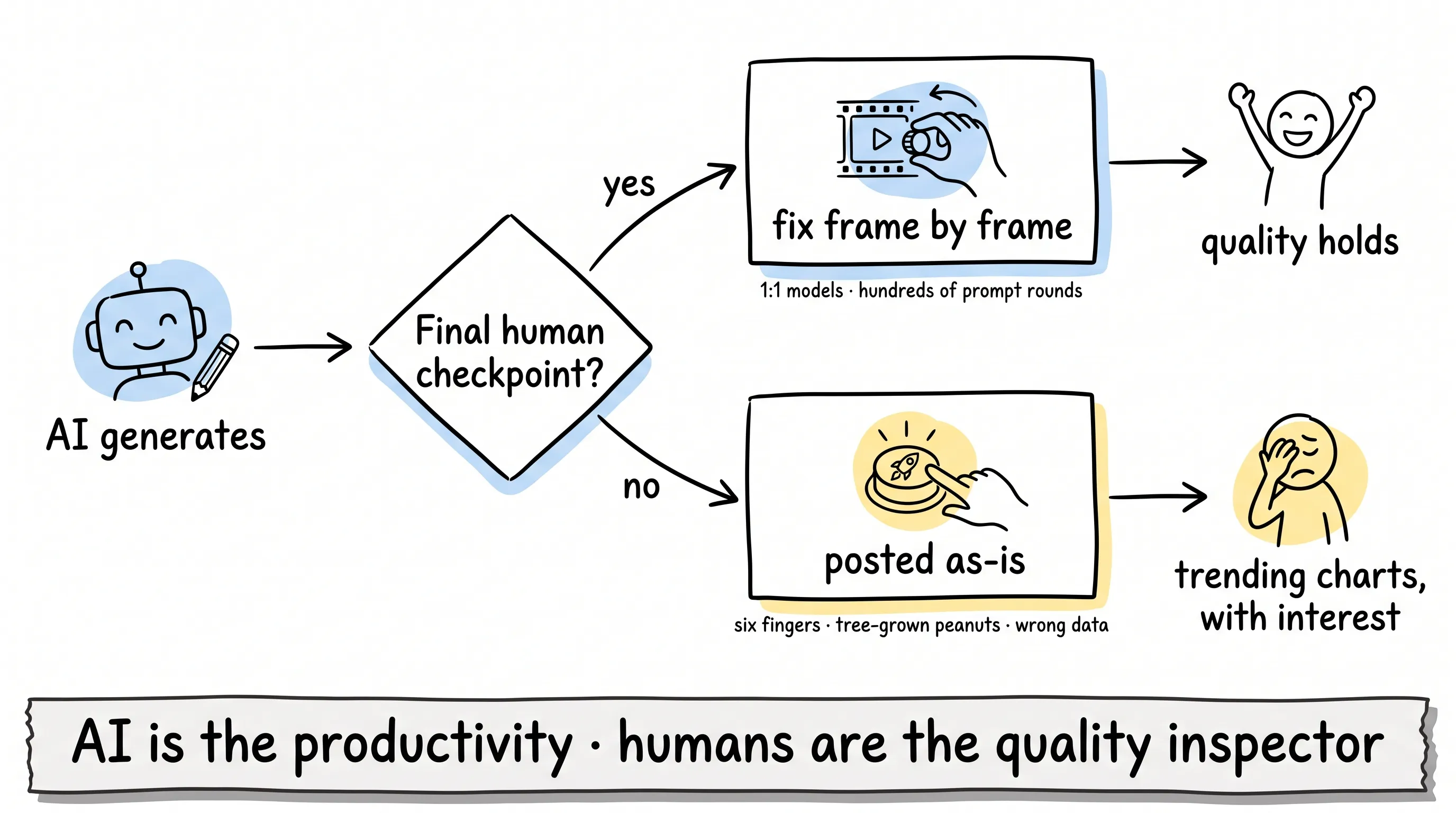
Every minute you save on that step will be paid back to you on the trending charts — with interest.
Finally, the Road Ahead
From here, AI will only burrow deeper into the marketing chain: from generating images and videos to weighing in on strategy and decisions; from a labor-saving tool for one step to a full operating system running the whole pipeline.
The stronger the technology, the less you can afford to cut that final gate — the last human look.
Back to the Antarctic brand film from the start. My guess: within a couple of years, the phrase "100% AI-made" will no longer appear in any news story — the way no movie trailer today bothers to announce "shot on digital cameras."
By then, the only contest left will be one thing: whether the thing itself is actually good.
May you take AI and do the things you never could before — the things you could never afford to do.
And more than that, may you always remember that final human checkpoint.
Continue reading
Related articles

Cross-Border Business: Time to Upgrade Your AI Toolbox
A learn article explaining how AI tools help cross-border e-commerce sellers clear five hurdles: language, regulation, logistics, payments, and fraud. It outlines a five-compartment toolbox, a five-step adoption path, and metrics such as conversion rate and CLV, while cautioning against over-reliance on AI.

AI Is Taking Over the Dirty Work of Social Media Marketing, One Task at a Time
This learn article outlines four social media marketing tasks AI can handle — audience analytics, content drafting and design, ad targeting and creative testing, and spam moderation — and cautions that taste, judgment, and data security remain human responsibilities.

AI Is Already This Good — Why Is Your Social Media Marketing Still Pure Manpower?
An overview of 18 AI tools for social media marketing, organized into six categories covering audience research, content creation, scheduling, comment and DM handling, ad management, and visual production, plus notes on personalization, prediction, and emerging trends.