
A $7.38 Billion Cross-Border E-commerce Market — and AI Is Helping People Pry It Open
A learn article on applying Google Ads AI tools in cross-border e-commerce, covering Pandora's year-round creative testing, Klook's multilingual AI-generated ad creatives, data consolidation, remarketing, and keyword localization tips.
A few days ago, a friend of mine who runs a cross-border e-commerce business took me out to dinner and spent the whole meal unloading his frustrations.
He pours his ad money into Google Ads, running a dedicated campaign team for each of his US, European, and Southeast Asian storefronts. The spend never stopped, yet orders just sat there, going neither up nor down — and his ROI was one big muddle.
He said: "Tell me, how am I supposed to fight this battle?"
I told him the battle can absolutely be fought. But before you rush to raise your budget, take a look at how the companies that have already broken out are fighting theirs.
The market is huge, but the gates open only for those who know how to fight.
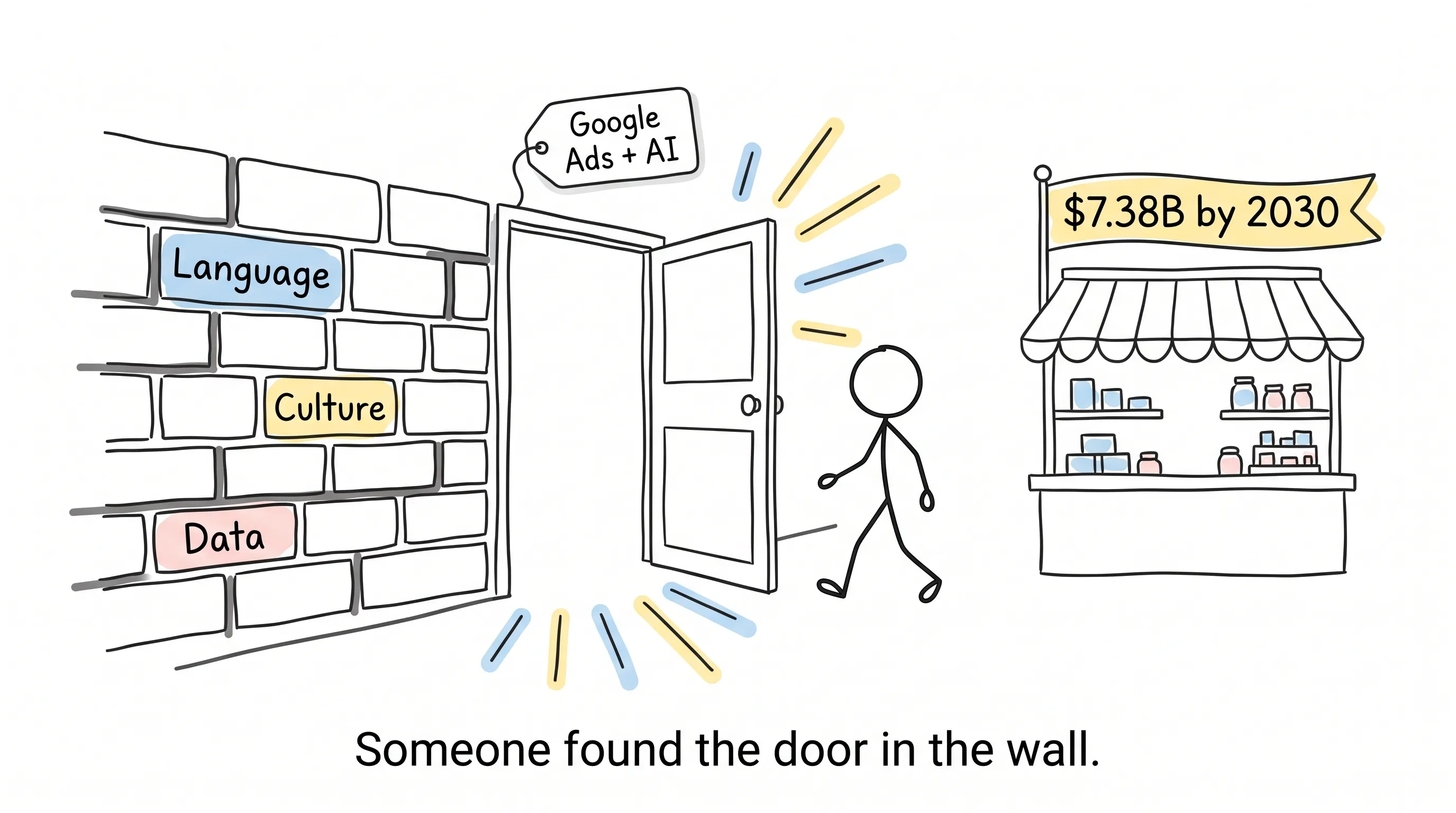
Forecasts say the global cross-border e-commerce market will reach $7.38 billion by 2030. It sounds as if the streets are paved with gold. But the barriers are every bit as real: language stands in the way, culture stands in the way, and the data lies scattered across the floor. Write your ads with an English-speaking mindset, and French readers feel nothing. Run one set of creatives worldwide, and it's like wearing a down jacket from the North Pole all the way to the equator.
What does "separated" mean? Separated means you think you're talking to your customers — but by the time your words reach the other shore, they no longer sound like you.
So what do you do? Let me tell you the stories of two companies. One sells jewelry. One sells travel.
Pandora: While Everyone Else Waits for Christmas, They Start in May
Pandora sells jewelry all over the world. Its holiday marketing playbook is called the "year-round testing framework."
What does year-round testing mean?
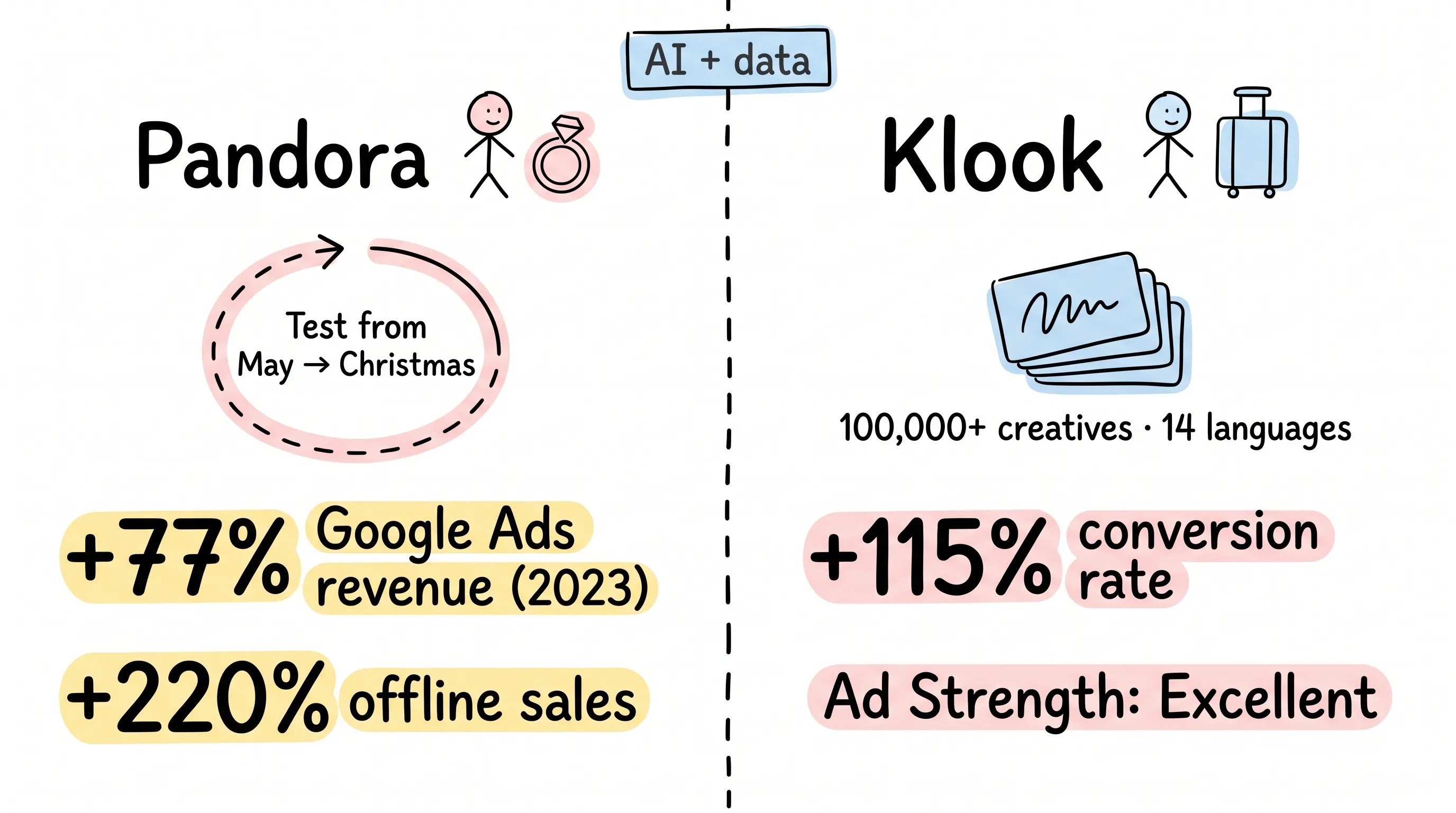
First look at how most companies do holiday marketing: Christmas draws near, they scramble into position, rush the creatives, and throw the whole budget at it in one go. Pandora doesn't do it that way. It starts preparing for Christmas in May. Six months of lead time, set aside for testing and optimization. Which headlines pull the most clicks, which set of images converts best — round after round of trials. By the time the real battle arrives in December, the ammunition has long been calibrated. Diwali is run the same way.
But testing alone isn't enough. Pandora wired its first-party data into Google Ads' AI tools, using Store Sales Measurement (Google Ads' tool for tying ad spend to real-world, offline sales) to track sales shifts online and offline, tuning its ad strategy dynamically as the data came in.
The result?
In 2023, Pandora's Google Ads revenue rose 77%. Offline sales rose 220%.
Staggering. Offline sales more than tripled — in the jewelry business, that's a scary number.
The battle of holiday marketing is never won during the holiday. It's won before the holiday begins.
Klook: 14 Languages, 100,000 Sets of Creatives
The second company, Klook, runs a travel platform.
One of the worst headaches in cross-border e-commerce is multilingual content production. Ten markets means ten sets of copy, and human translation is expensive, slow, and never quite native.
Klook used Google Ads' AI copy-generation tools to automatically produce more than 100,000 ad creatives covering 14 languages. More than 100,000. No human team can stack up that volume. Then it layered on Responsive Search Ads, which dynamically match the best-fitting headlines and descriptions to each user's search intent.
The result? Conversion rates rose 115%. Half of its creatives earned an Ad Strength (Google's own rating of ad quality) of "Excellent" or above.
Think about it: it used to be one set of creatives for the whole world; now it's one set of creatives per user. What separates those two isn't money. It's tools.
Two tool ideas worth jotting down along the way. Responsive Search Ads automatically put together the optimal combination of headlines and descriptions, and ad relevance climbs fast. And AI visual tools like Canva Magic Design turn out localized image assets quickly and cheaply.
When the Data Stays Whole, the Money Stops Going Blind
But creatives alone aren't enough. Cross-border has a subtler trap: the data is fragmented.
One account for the US, one for Europe; one set of numbers in Google, another in Facebook. Every drawer holds something, but no two keys match.
So the companies that make it work all start with one move: pull the data into a single dashboard. Hook up the major ad platforms, and conversion events sync automatically. A user abandons a cart, and the system knows immediately — and can follow up immediately.
The next step is remarketing. What is remarketing? Taking the people who "came but didn't buy" and splitting them by depth of engagement. How long someone watched a video, how many product pages they browsed — each group sees different creatives. If you've opened a product page three times, you're tempted; the ad served to you should not be the same one in the hands of someone who lingered five seconds.
One more detail: landing-page tracking has to be fine-grained. Traditional UTM tags are rather rigid; the current approach is to customize tracking rules by ad source and region, generating dedicated landing-page links for different audience segments — not a single step can go wrong.
A Hong Kong beauty brand is the textbook case. Its tracking revealed that most Middle East users entered the site through Display ads, but the ones who actually placed orders were pushed over the line by Search ads. So the budget followed. Water the tree that bears fruit.
If attribution is unclear, budget splits are guesswork done blindfolded.
A Few Things You Can Do Right Now
If you want to get moving today, here are a few things I've pulled out of these cases that you can put to work right away.
First, keywords. Keywords need localization, not just translation. For an electronics brand selling into Southeast Asia, fixating on wireless headphones alone is useless — Indonesian users search earphone bluetooth murah, which translates literally as "cheap Bluetooth earphones." Bury your keywords exactly the way locals search. Pair that with Smart Bidding and broad match: coverage spreads wide, and accuracy doesn't get lost.
Next, creatives. AI handles efficiency; humans handle culture. AI generates multilingual copy and images, and it's fast — but the final pass must go through the local team. Ads aimed at the Japanese market should speak of refinement and after-sales care; ads for Western markets should speak of value for money and user reviews. AI plus humans: one handles speed, the other handles tact.
And the cheapest move of all: treat testing as a daily routine. Don't wait for the next big sale to think about optimization. Pandora's May is your now.
Finally, Back to That Friend
After dinner, I sent him the two stories — Pandora's and Klook's.
A while later, he replied with one line: "Turns out it's not that I spent too little money. It's that I spent it crudely."
Exactly. In advertising, AI tools stopped being a "nice-to-have" and became a "must-have" a long time ago. The walls of language, culture, and data are still standing — but someone has already found the door in the wall.
If your team doesn't have this craft in-house yet, don't try to muscle through alone. Plenty of agencies specialize in running Google Ads campaigns, and they can set the whole thing up for you, from keyword research to attribution analysis.
Here's wishing you — and that friend of yours in the same trade — an early day when every last dollar of ad spend lands where you can see it.
Continue reading
Related articles

Cross-Border Business: Time to Upgrade Your AI Toolbox
A learn article explaining how AI tools help cross-border e-commerce sellers clear five hurdles: language, regulation, logistics, payments, and fraud. It outlines a five-compartment toolbox, a five-step adoption path, and metrics such as conversion rate and CLV, while cautioning against over-reliance on AI.

AI Is Taking Over the Dirty Work of Social Media Marketing, One Task at a Time
This learn article outlines four social media marketing tasks AI can handle — audience analytics, content drafting and design, ad targeting and creative testing, and spam moderation — and cautions that taste, judgment, and data security remain human responsibilities.

AI Is Already This Good — Why Is Your Social Media Marketing Still Pure Manpower?
An overview of 18 AI tools for social media marketing, organized into six categories covering audience research, content creation, scheduling, comment and DM handling, ad management, and visual production, plus notes on personalization, prediction, and emerging trends.