
A 450% Click-Through Rate Proves Nothing About Brand
An opinion piece arguing that popular AI marketing metrics such as output volume, cost savings, and click-through lifts measure production efficiency, not brand outcomes. Using cases from Unilever, JPMorgan, and Airbnb, it offers five questions for judging whether a case study shows real business impact.
A few days ago, an old friend who works in branding asked me for help.
His boss had handed him an assignment: find a few case studies of "AI used for brand strategy, with measurable business impact" — the kind you could put in front of finance.
I said that would be easy. One search, and the case studies came pouring in.
Content output doubled. Costs halved. Click-through rates up by triple digits. Hundreds of assets generated overnight while the team was still asleep.
Wow. Gorgeous.
But as I read them one by one, something felt more and more off.
Not one of those numbers is about the brand.
They're about the factory.
What are factory numbers? How many assets produced, how many hours spent, cost per unit, days from brief to launch. Open your dashboard on a Monday morning and they're all right there, crystal clear.
And what are brand numbers? Unaided brand awareness (how many people can name your brand without being prompted), branded search volume, share of direct traffic, preference, pricing power. These build slowly, surface by roundabout routes, and are nearly impossible to attribute cleanly.
So only one kind of case study gets published: the kind with clean numbers. And the clean numbers are, without exception, the ones describing the machine.
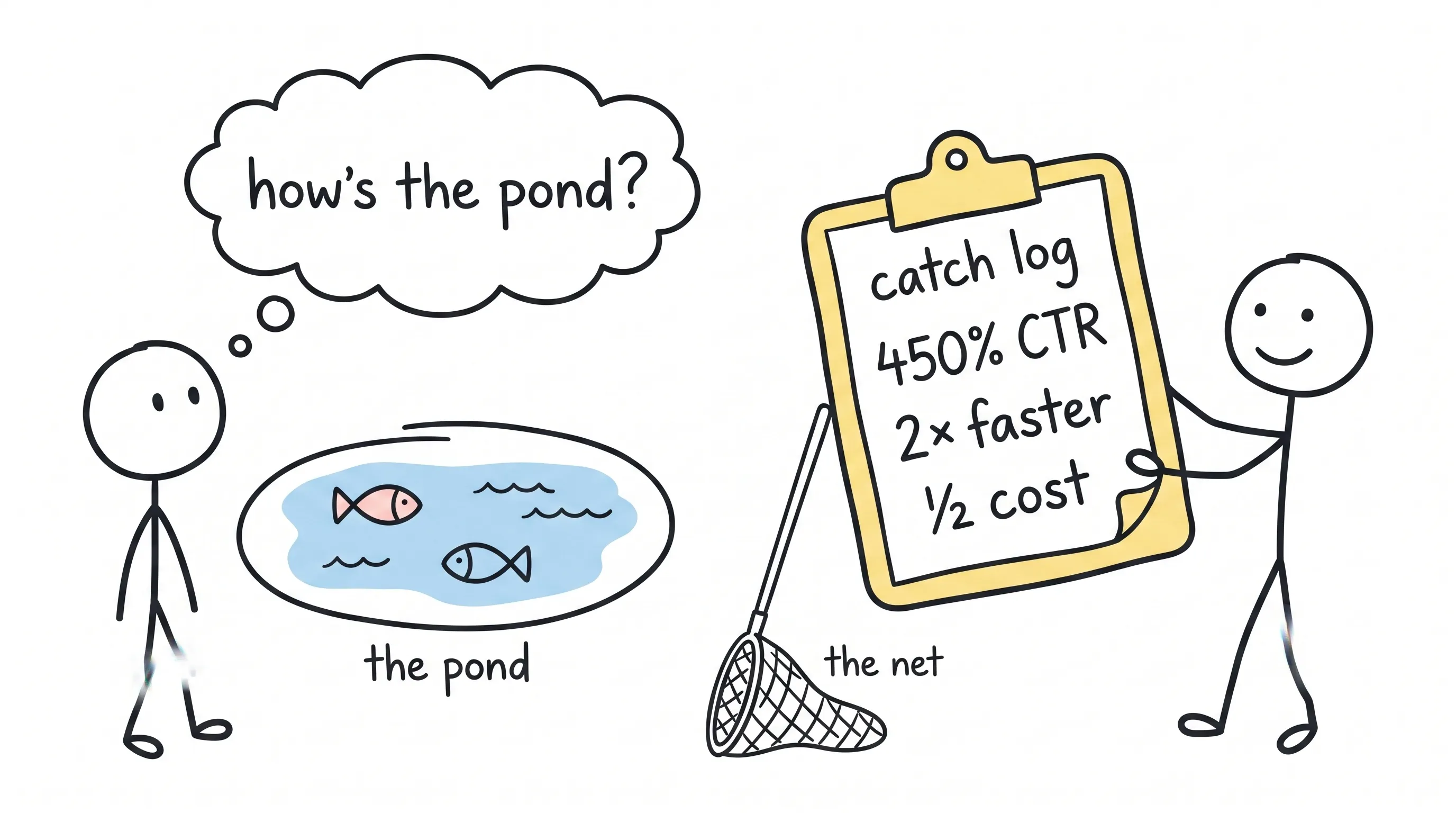
Put bluntly: hauling in the net got sold as the same thing as raising the fish. You asked how the pond was doing; you were handed a catch log. The catch is real. But that's not what you asked.
Let me start with three stories
First story: Unilever.
Unilever is the most-cited company in this genre, and deservedly so: the work was done seriously, and the reporting is specific.
Its Beauty & Wellbeing business — home to Dove, Vaseline, and CLEAR — was among the first to pilot digital twins: building 3D replicas of products on NVIDIA's Omniverse platform so that assets no longer need physical shoots. A March 2025 report said savings in that business had grown 55%, with content turnaround 65% faster. Unilever's own press release put it more bluntly: some content now ships twice as fast, at half the cost.
Every number is true. But flip each one over — what's written on the back?
Savings. Turnaround. Cost per unit. Speed.
All operating metrics.
The only result in the whole story that genuinely touches brand is a lift in purchase intent. It comes with no number attached, and it covers only "some brands."
The interesting part is that Unilever itself is remarkably honest. Chief Growth and Marketing Officer Esi Eggleston Bracey said it straight: "This isn't about putting out more content."
In plain terms: efficiency paves the road; it isn't the destination.
Yet once those numbers get passed around and stuffed into decks, they become "brand results." Nobody mentions the quiet swap in the middle.
Second story: JPMorgan.
The most-cited number in all of AI marketing comes from here: 450%.
JPMorgan partnered with Persado to run machine-written ad copy against human-written copy. In the pilot, machine-written ads lifted click-through rates by as much as 450%, with most results landing between 50% and 200%. A five-year enterprise deal followed.
Impressive!
But look up close: which variant won?
A word swap.
"Yes — you can unlock cash from your home equity" beat "Get cash from your home equity."
One sentence, two phrasings, scored by a click. That's copy optimization. Perfect the art, and it's still copy optimization.
As for "did anyone's perception of JPMorgan change because of it?" — it can't answer that. Not because it answered wrong, but because it was never asked.
One more detail. The project launched in 2016 and scaled up in 2019 — several years older than what we now routinely call "generative AI." Yet in 2026, people still hold it up in decks as evidence of "AI brand strategy."
The numbers were right. The job was misassigned.
Third story: the most counterintuitive one.
Say you're looking for a case of "brand strategy delivering measurable business impact" — hard enough that finance will nod. The hardest one of the past decade never once mentions AI.
In 2021, Airbnb cut its performance advertising budget and turned the money toward brand. Not a trim — a cut of roughly $541 million, most of it from performance channels like paid search auctions.
What happened next? Roughly 90% of its traffic came from direct visits or unpaid sources; total traffic recovered to about 95% of its pre-pandemic level.
The financials are public: 2022 revenue up 40%, to $8.4 billion; and that year, its first full-year profit, with $1.9 billion in net income.
Savor what this case is made of: a decision about brand, a quantified budget shift, a traceable change in where demand comes from, and a number that landed on the bottom line.
No asset counts in it. No production speed. No cost per unit.
Next time you read a case study, put these five questions to it
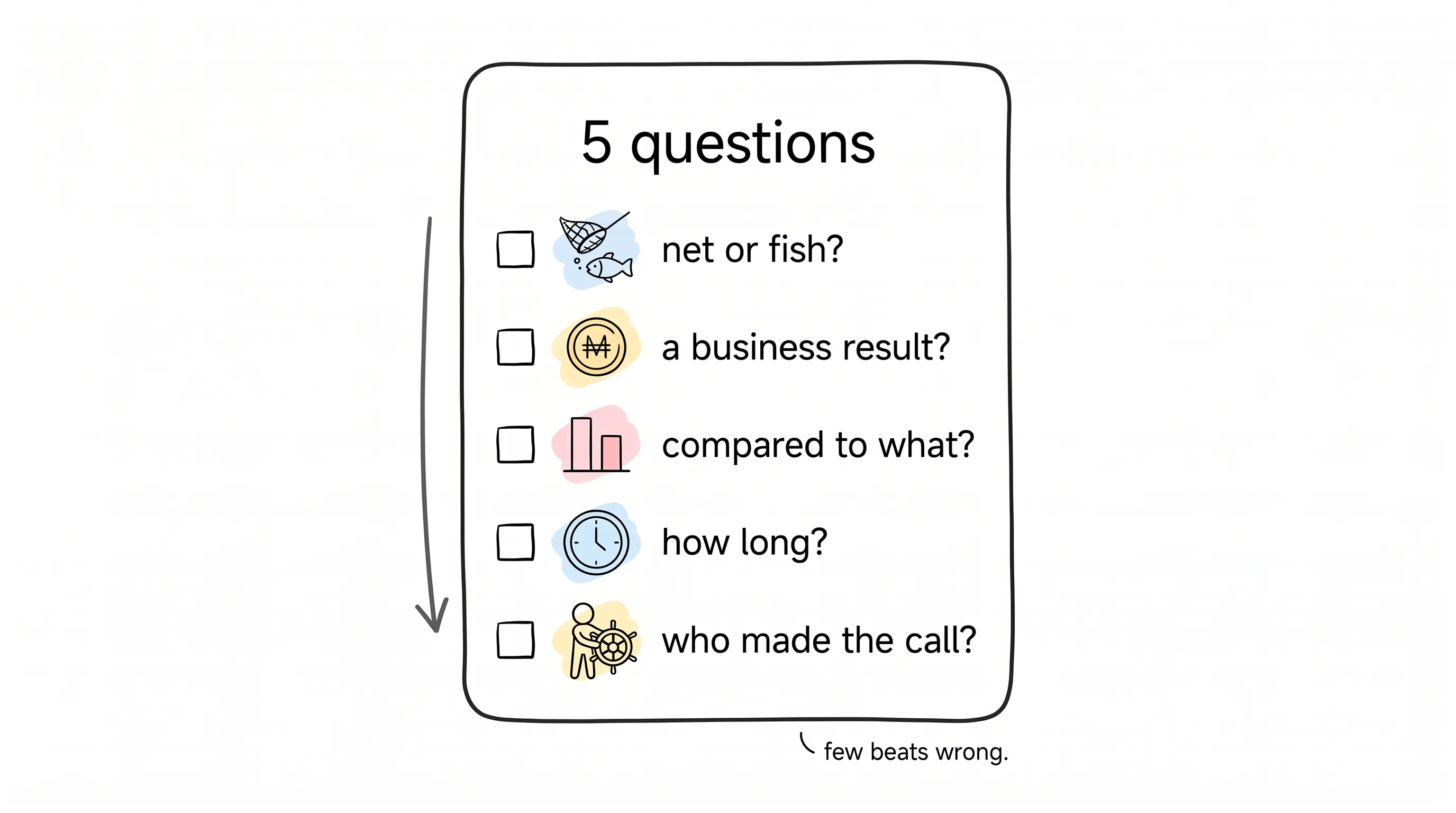
Question one: does it measure hauling in the net, or raising the fish?
Clicks, conversions, customer acquisition cost — these measure the net: catching people who already wanted to buy. Unaided awareness, branded search volume, share of direct traffic, preference, pricing power — these measure the fish: getting people who weren't thinking of you to start thinking of you.
When the net-hauling is efficient, your funnel isn't leaking. Only a well-tended pond shows that the brand is working.
Question two: is there a business result?
Revenue, margin, retention, share, valuation. A case that stops at engagement is still one step short of what finance actually wants to know.
Question three: compared to what?
Without a baseline, a control group, or a prior-period number, you have a claim, not a result. The JPMorgan pilot is credible precisely because machine-written copy was put head-to-head against human-written copy, for real.
Question four: how long did they watch?
Brand effects lag, and they compound. Anything measured within a single quarter is almost certainly the net. A brand case study has to make clear how long the results were watched before any conclusion was drawn.
The last question is also the one that stings most: AI did the work — so who made the call?
A model can generate a thousand variants. But what the brand should mean, which of the thousand is right, and what is strictly off-limits — those are decisions the model can't make, and shouldn't.
If a case study can't answer this one, what it describes is just a useful tool. Don't call it strategy.
Two reports, read side by side
None of this is an accident. It's structural.
Start with the marketers themselves. In McKinsey's survey of 500 senior marketing leaders across Europe, brand ranked first among 2026 marketing priorities. Generative and agentic AI (AI that plans and takes actions on its own, not just generates content)? Seventeenth out of twenty topics.
Now look at the finance side. NIQ's 2026 CMO Outlook found that the share of CMOs who think their CEO and CFO believe in brand's long-term value fell from 80% to 69% within a single year — while 84% of CMOs made ROI the number-one metric for allocating budget.
Read the two together, and the picture is deeply awkward:
Marketers rank brand first. Finance trusts brand less than it did a year ago. And the ruler being used to settle the argument was built, from day one, to score net-hauling, not fish-raising.
So the industry works furiously to produce the only evidence its dashboards can count — output and performance — and then uses that evidence to argue a brand proposition those numbers can't support at all.
There's a trap buried in here, too. Once you agree to defend brand only with the performance ruler, before long you'll be managing brand by that same ruler — cutting, one by one, the long-horizon moves that are invisible in the short term yet are what make the brand worth anything.
Cut all the way down, and the nameplate is still there — but the brand is gone.
Now, about ourselves
By these five questions, Starfish has to step on the scale too.
Starfish is a brand and creative agency specializing in brand experience, at it since 2002, with clients that include Samsung, PwC, Avis, and Gallup. Our way of working is called BCI™ (Brand & Creative Intelligence): AI can enter the production process, but the steering wheel must stay in human hands — what the brand should mean, and what to refuse, is a judgment we do not outsource to a model.
Full disclosure: we don't currently publish a set of quantified business outcomes attached to every project. Part of the data is client-sensitive; part of it has never been organized into a form we'd be willing to publicly vouch for.
We would rather say so plainly than reach for a few numbers that can't carry the weight.
What I can point you to is validation from outside judges: 12 Transform Awards in 2025, and 6 more entries shortlisted in 2026. All of it decided vote by vote, by judges scoring entries against named competitors.
That first thing? We're working on it. Those five questions are the standard we've set for our own case studies.
And I hope you'll hold every agency you're evaluating to the same standard — including us.
Finally
Back to my friend's request.
"Give me a few AI brand cases with measurable business impact" — there's nothing wrong with the request itself. But the market's answers will almost certainly mislead you, because the shelves are stacked with capacity metrics, while brand metrics are few and far between.
There is a better question, in fact, and it's very hard to bluff your way past:
What kind of decision did you make for this brand? And after that decision, what changed in the business?
Most case studies can't field that question.
The few that can are the ones worth reading all the way through.
As I was leaving, I told my friend: ask this way, and the cases you find may be pitifully few.
But few beats wrong.
Continue reading
Related articles

Cross-Border Business: Time to Upgrade Your AI Toolbox
A learn article explaining how AI tools help cross-border e-commerce sellers clear five hurdles: language, regulation, logistics, payments, and fraud. It outlines a five-compartment toolbox, a five-step adoption path, and metrics such as conversion rate and CLV, while cautioning against over-reliance on AI.

AI Is Taking Over the Dirty Work of Social Media Marketing, One Task at a Time
This learn article outlines four social media marketing tasks AI can handle — audience analytics, content drafting and design, ad targeting and creative testing, and spam moderation — and cautions that taste, judgment, and data security remain human responsibilities.

AI Is Already This Good — Why Is Your Social Media Marketing Still Pure Manpower?
An overview of 18 AI tools for social media marketing, organized into six categories covering audience research, content creation, scheduling, comment and DM handling, ad management, and visual production, plus notes on personalization, prediction, and emerging trends.