
A $40 Billion Business Is Changing Its Playbook
A learn article on how influencer marketing is shifting from buying posts to performance-based creator channels, covering pay models, small-creator economics, platform roles, UGC reuse, AI in operations, and what creators look for in brand deals.
A few days ago, a friend who runs a coffee-extract business took me out to dinner. Halfway through the meal, he pulled out his phone to show me his dashboard: this quarter, more than half of their new customers came from a few dozen small creators with a few thousand to a few tens of thousands of followers each.
Then he said something that stuck with me: "We used to call this buying placements. Now we call it a channel."
One word of difference — and it moves the entire line item on the budget sheet.
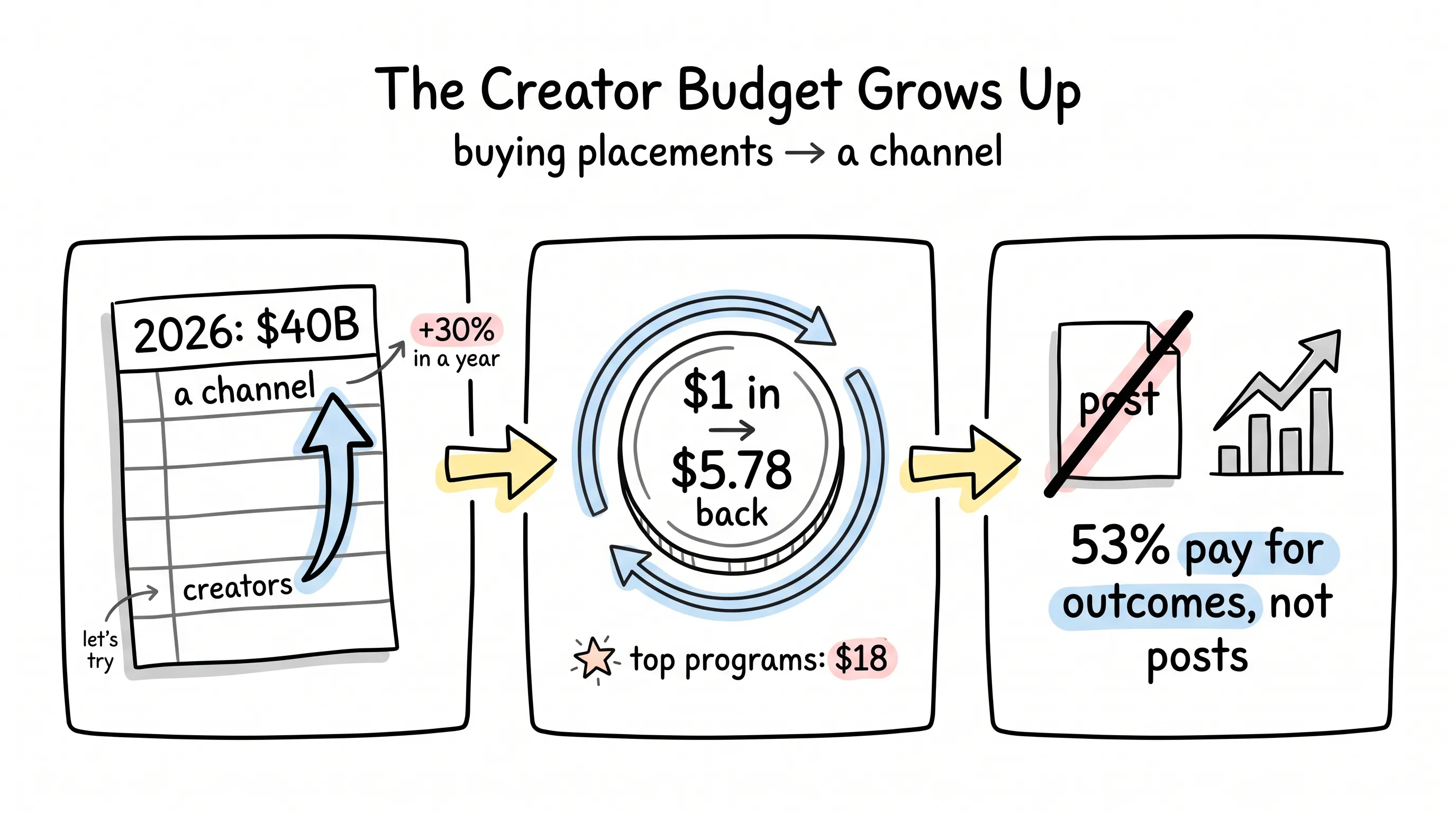
He is not the only one who feels it. This year, global influencer marketing will surpass $40 billion — that is exactly the number in Mordor Intelligence's forecast. Last year it was $32.55 billion; that's more than 30% growth in a single year. Go back five years and the market has tripled. The creator economy as a whole is a $2.34 trillion machine, growing 22% a year.
But what deserves more thought than the size of the pie is that its position has changed.
86% of US marketers are already using this channel, and 74% plan to spend more on it this year. On average, every dollar spent brings back $5.78. The best-run programs return $18.
Wow. Good luck finding another channel that survives that kind of math.
In budget meetings of the past, creators were the "let's give it a try" line, sitting at the bottom. Now, in many companies, they're the line every other channel comes mooching from.
How Is the Money Spent?
So has the way the money is spent changed?
It has. Completely.
It used to be: buy posts. Now: buy outcomes.
This year, in Aspire's research, performance-based pay became the number-one model, used by 53% of brands. Product gifting sits at 47%, flat fees per post at 46%, commission splits at 38%. Brands that pay nothing at all are down to 6%.
What is performance-based pay? It means what a creator earns is tied to what they actually sell. Brands no longer pay for "posted" — only for "sold."
The unit of measurement in the creator business is shifting from "the post" to "the outcome."
You might feel for the creators here: isn't this just risk-shifting?
That's what I thought at first. Then I realized it's the opposite. Creators who are genuinely good actually welcome the deal. Get paid per post and your income has a ceiling; get paid on results and the ceiling is one you set yourself. The ones who can't stomach it are the content shops that only know how to turn in assignments.
Here's another number I love: average CPM (cost per mille, the cost to reach a thousand viewers) has fallen to $2.68, 42% lower than a year ago. That's Aspire's 2025 data.
The channel hasn't shrunk — efficiency has exploded. Why?
Because one budget is now doing three jobs. The old division of labor: hire creators for awareness, run paid feeds for conversion, hire a production company for assets. Three budgets, three teams, three sets of books. Now a single creator video doubles as content, gets licensed to platforms for paid amplification, and carries a product page link. One deal, three jobs' worth of work. Spread the cost and it's naturally cheap.
To put it plainly: the walls between influencer marketing, affiliate selling, paid media, and content production are collapsing — and when they're gone, it's all the same thing.
Who Do You Partner With?
Second question: the money is spent — who do you partner with?
The answer is that the weight is falling downmarket.
On Instagram, 75.9% of creators are nano-tier — 1,000 to 10,000 followers — with an engagement rate of 2.71%, roughly half again higher than micro-tier and several times higher than mega-tier. For conversion-focused campaigns, brands choose micro creators ten times more often than mega ones.
Let's do the math.
A nano post costs $50 to $200 and buys you 5,000 followers who genuinely believe in that creator. A mega post costs tens of thousands and buys passersby who scroll past and forget.
Which one is the better deal? I don't need to finish that sentence.
But there's a hidden threshold. Someone will say: fine, then I'll stack a thousand small creators and win.
No. The trouble with small creators was never finding them — it's managing them. Contracts, content review, payouts, attribution: every one is real work. Look: 48% of marketers still say "finding creators" is their biggest pain point. Finding people stopped being the problem long ago; managing them is.
The bottleneck isn't discovery, it's throughput.
Whoever turns this into an assembly line first, wins.
And the mega creators? They're not dead, just reassigned. From the engine to the highlight reel. Product launches, big sale events, new-product endorsement — bring in the big names; day-to-day volume goes to small and mid-tier creators.
The most awkward spot is the middle: the 100,000-to-500,000-follower band. Their prices aren't low enough, their reach isn't big enough. But there's one exception: mid-tier creators with proven sales records are starting to command a premium. Brands increasingly pay for "proven ability to sell," not for volume.
Where Do You Play?
Third question: how do you pick platforms?
This year's platform data is a bit counterintuitive: brands are spreading out across creator tiers, but concentrating their bets on platforms. Most teams pick one primary platform and go deep.
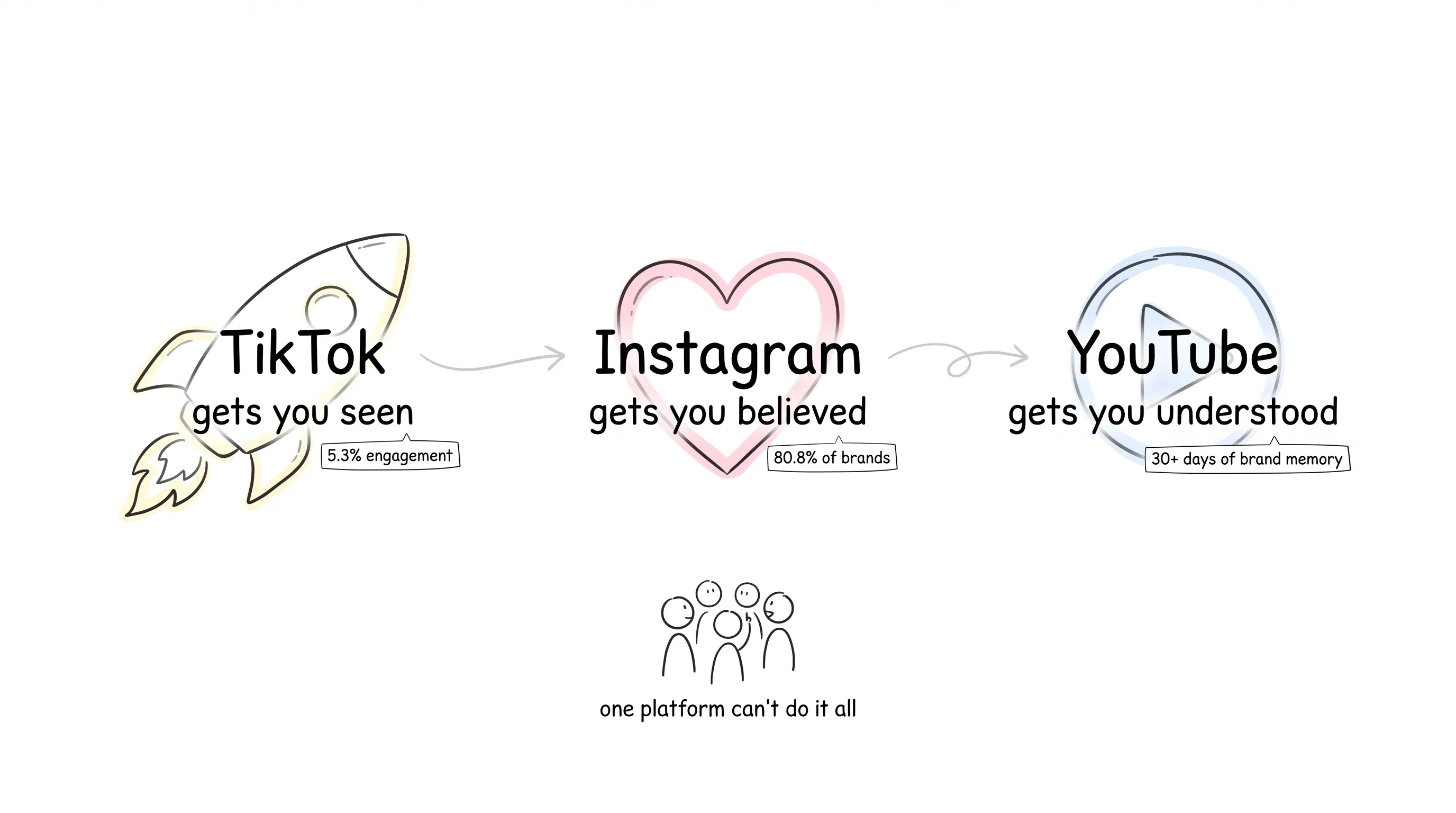
On Instagram, 80.8% of brands are active — still the base layer. TikTok is the discovery-and-conversion engine: a 5.3% engagement rate, three times Instagram's; 75% of advertisers say it delivers the best ROI; 40% of Gen Z search TikTok before Google when looking up products. YouTube is the consideration layer, holding brand memory for 30-plus days — anything that needs explaining or demonstrating still belongs there. For B2B, look at LinkedIn: content from industry creators earns 2.3 times the engagement of brand accounts, with an average ROI of 520%.
TikTok gets you seen. Instagram gets you believed. YouTube gets you understood.
Three platforms, three jobs. Don't expect one platform to do it all.
How Is the Content Produced?
Fourth question: where does the content come from?
Over the past few years, UGC (user-generated content) has been upgraded: from a "content type" to a "means of production."
93% of brands say UGC outperforms polished brand ads. 61% of Gen Z prefer it. Put shoppable UGC on a product page and conversion rates rise by as much as 17%, revenue by up to 28.5%.
The real change is structural. Creators' content used to live only on the creators' own accounts. Now a single 30-second video can simultaneously be a TikTok in-feed ad, a paid asset on Meta, a product-page display slot, the hero image in a CRM email, even content for in-store retail screens. One brief, many placements — and the cost per asset is far below hiring a production company.
So the brief has been rewritten, in reverse: loosen the creative, tighten the metrics.
Give hook frameworks, not verbatim scripts. Spell out the usage rights and the term. Then give a target number the creator can understand and chase on their own.
Treat creators as part of the creative team, not as a distribution channel.
Where Does AI Fit?
Fifth question — the one you can't dodge these past two years: what about AI?
In 2025, AI in influencer marketing was still a talking point. This year, it's a daily tool for six in ten teams.
59% of marketing teams use AI to find creators, run workflows, read data, and do attribution. 91% of creators use it for production. And 66.4% of users say the results have genuinely gotten better.
But what's interesting is what AI is eating. It isn't taking creators' jobs — it's eating the operations layer beneath them: searching for talent, verifying followers, drafting briefs, flagging fake followers, running dashboards. In large-scale programs, that's the exhausting, boring 80% of the work.
What can't it eat?
Trust and taste. Only 23% of US adults trust generative AI's use on social media. And 39% say the more a creator relies on AI, the less they trust that person.
Audiences can smell it. That part, AI cannot do for you.
One more detail worth chewing on: the share of teams that want to automate everything fell from 77% to 73.4% in a single year. Everyone has found the line.
AI runs the pipeline. Humans own the judgment.
The companies that truly lose will be the ones that put AI in the wrong seats.
One Budget, Two Names
The clearest signal that this industry is growing up: the influencer budget and the affiliate budget are merging into a single line.
Creators on the Aspire platform drove $52 million in attributable commission sales in 2025, up 45% year over year.
The structure usually looks like this: the brand pays a base fee, $100 to $500 per post, then layers on an ongoing 20% to 30% commission. Because the creator earns on every sale, they have a reason to keep recommending in good faith; and the brand only pays more when real sales come in. One partnership grows into a channel.
In the ideal case, this structure pays for itself in 60 days, then runs as a profit center.
But the pothole-riddled part is attribution. Only 20% of brands track customer acquisition cost (CAC) in their affiliate programs, and 18% look at average order value (AOV). Without those two numbers, you can't tell which creators are moving the business and which are just manufacturing clicks.
Install the dashboard before you step on the gas.
The Highest-Certainty Opportunity Has the Fewest Players
One more contrast I want to pull out on its own.
Social commerce is already about as de-risked as it gets: TikTok Shop alone accounts for 66% of social commerce activity, while Instagram Checkout has just 13%. The number of brands on TikTok Shop nearly doubled within a year — 32% are already selling there, and another 25% are on the way. Livestream shopping is growing fastest, and the mix of entertainment, scarcity, and instant checkout makes it one of the highest-converting creator formats there is.
And yet? 53.3% of brands haven't touched social commerce at all.
The highest-certainty opportunity, the least-prepared players. Whenever that gap sits on the table, history has never lacked people to pick it up. What it lacks is whoever reaches out first.
What Do Creators Want?
Finally, let's turn the camera around. Brands are choosing creators — and creators are choosing brands. In 2026, what does the creator side want?
The data is remarkably consistent.
84% of creators say whether a product fits their followers is the first criterion for taking a deal. 79% say being respected as a professional is a hard requirement, not a bonus. 86% are willing to collaborate for free on high-value products that genuinely fit.
And the deals they turn down fastest? Verbatim-script briefs with no room to create. Usage terms left vague on purpose. One-off buyouts of all their future content.
The brands that get a yes fastest do four things: they've actually watched this creator's content; they pay decent money; they leave real freedom inside clear metrics; they sign long-term, not one-off deals.
To the brand side, I'll say one thing: treat creators as a creative team, not as vendors. This "respect tax" is real — and the ones who pay it sign the best people.
To the creators, one thing as well: making beautiful content is no longer worth much. Making content that converts — that's what's worth something.
Looking Ahead: My Calls
Last, a few directions as I see them.
-
The term "influencer marketing" will gradually give way to "creator marketing." Not fashion — the boundaries have already collapsed, and the vocabulary has to follow.
-
DTC brands that reach a certain scale will start pulling creator teams in-house. The work is too core to fully outsource.
-
TikTok Shop will hold steady through midyear and explode in Q4. Looking back from 2027, it will be the default channel, no longer an experiment.
-
B2B will retreat toward long-form content. Thirty-minute clips can't carry major decisions; a one-hour deep conversation can.
-
The first big brand-to-creator equity deal will show up in the news. The structure is already being designed.
-
AI verification — fake-follower detection, AI content disclosure — will go from paid feature to entry ticket.
-
Creators introducing brands to other creators, for a cut, will grow into a sales network of its own. Whoever plugs in first benefits first.
Back to the friend at dinner. As we parted, I asked how he planned to run things next year.
He said he wasn't going to "buy placements" anymore. He was going to build a production line.
I think he spoke for a lot of companies' shared next step.
In the first half of the creator business, you competed on finding the right people. In the second half, you compete on being able to absorb them.
Here's to becoming the one who can absorb them.
Continue reading
Related articles

Cross-Border Business: Time to Upgrade Your AI Toolbox
A learn article explaining how AI tools help cross-border e-commerce sellers clear five hurdles: language, regulation, logistics, payments, and fraud. It outlines a five-compartment toolbox, a five-step adoption path, and metrics such as conversion rate and CLV, while cautioning against over-reliance on AI.

AI Is Taking Over the Dirty Work of Social Media Marketing, One Task at a Time
This learn article outlines four social media marketing tasks AI can handle — audience analytics, content drafting and design, ad targeting and creative testing, and spam moderation — and cautions that taste, judgment, and data security remain human responsibilities.

AI Is Already This Good — Why Is Your Social Media Marketing Still Pure Manpower?
An overview of 18 AI tools for social media marketing, organized into six categories covering audience research, content creation, scheduling, comment and DM handling, ad management, and visual production, plus notes on personalization, prediction, and emerging trends.