
A €4.4 Million Fine, and a Privacy Lesson for Social Media Marketing
A learn article explaining how GDPR applies to social media marketing, covering consent, data minimization, deletion rights, and UGC permissions, with examples from Facebook, Airbnb, and Microsoft.
Start with two numbers.
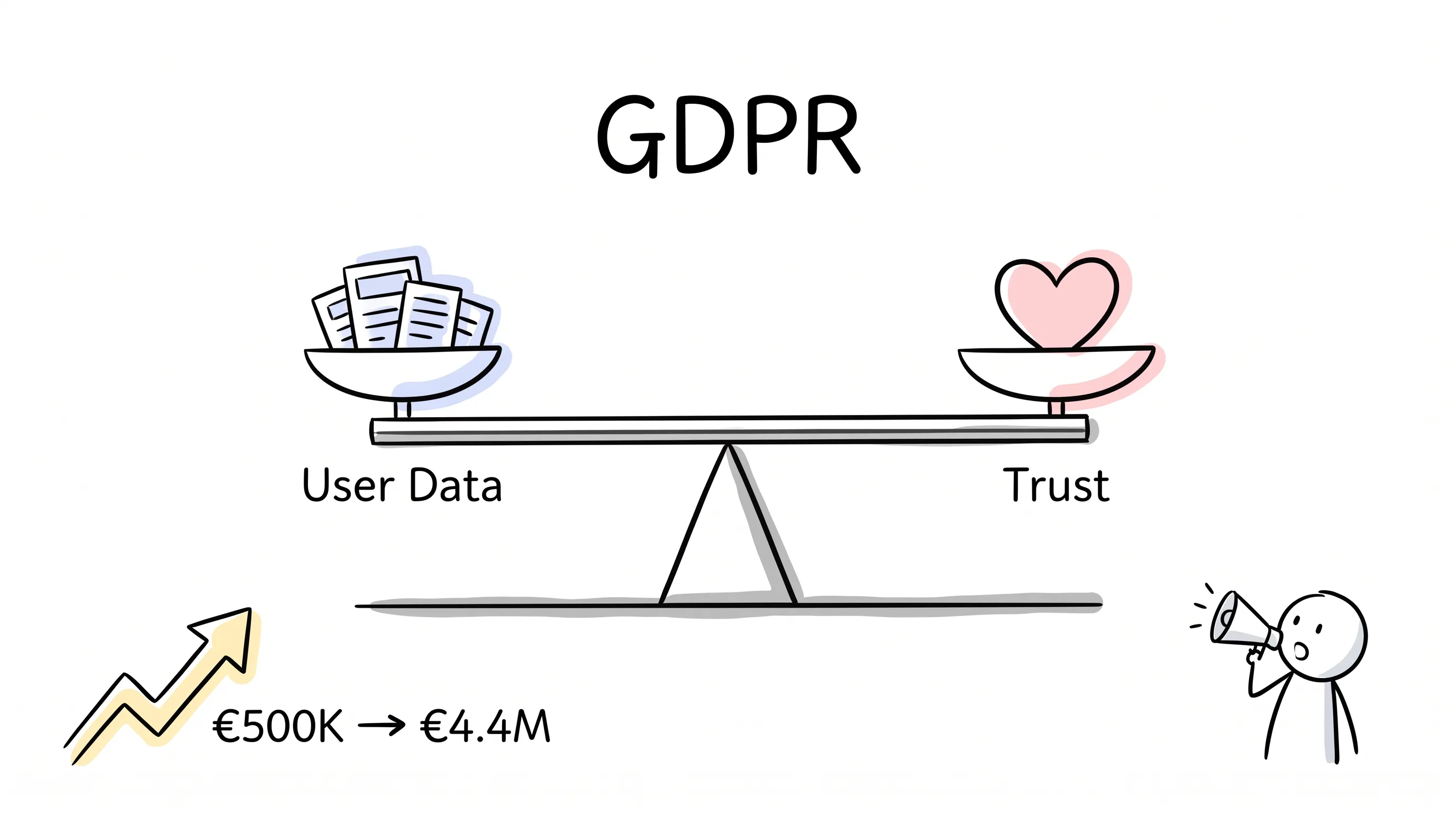
In 2019, the average fine for a company caught violating GDPR was €500,000.
By 2023, that number had become €4.4 million.
Four years. Up more than eightfold. And that's just the average. Under the regulation, a single fine can reach 4% of global annual revenue. For big companies, that means billions.
What does that mean in practice? That user email you casually collected on social media, that slice of browsing history — handled the wrong way, either one can turn into a line item on an invoice.
Data, handled well, is an asset. Handled poorly, it's a liability.
So what exactly is GDPR? And what gives it the power to reach every marketing move you make on social media? Today, let's get this fully straight.
What Is GDPR?
What is GDPR?
GDPR stands for the General Data Protection Regulation, a European Union law that took effect in May 2018. In plain language: if you're a user in the EU, any company that wants to touch your personal data has to ask you first.
What counts as personal data? You might say, name and email — that I know.
But the scope is far bigger than you think.
Your date of birth — counts. Your IP address, the cookies and tracking pixels in your browser — count. Your race, religion, education, occupation — count. Your genetic data, biometric data, health records — count too.
Seriously — even cookies count?
Yes, even cookies. There's only one test: can this data, pieced together, identify you as a person? If yes, GDPR applies.
Once these rules landed, your experience of the web changed. Before, you searched for something on Website A, and Website B started showing you related ads. Back then, your digital footprint was shared across companies, pieced into "user journeys" and retargeting campaigns. Now, without your explicit nod, that road is closed.
Here's an example. LinkedIn pops up a consent box asking whether you agree to ad retargeting. That's what the GDPR era looks like: ask first, then take.
Can It Really Reach What I Do on Social Media?
Some will say: I do social media marketing, my company isn't in the EU — how can this possibly reach me?
It can.
GDPR governs data and people, not where your company sits. As long as you collect or process the data of EU users — even from the other side of the planet — you must follow the rules. It applies across the entire EU, and to European Economic Area countries like Iceland and Norway. The UK left the EU, but these rules were in place before Brexit and stayed after it; Switzerland has its own close cousin, called the FADP.
And there's a new variable: generative AI. Brands use AI tools to create content and run campaigns, platforms train models on user behavior data, and users' prompts often carry personal information inside them. How is this data collected, and where does it go? The regulatory searchlight has found its way here too.
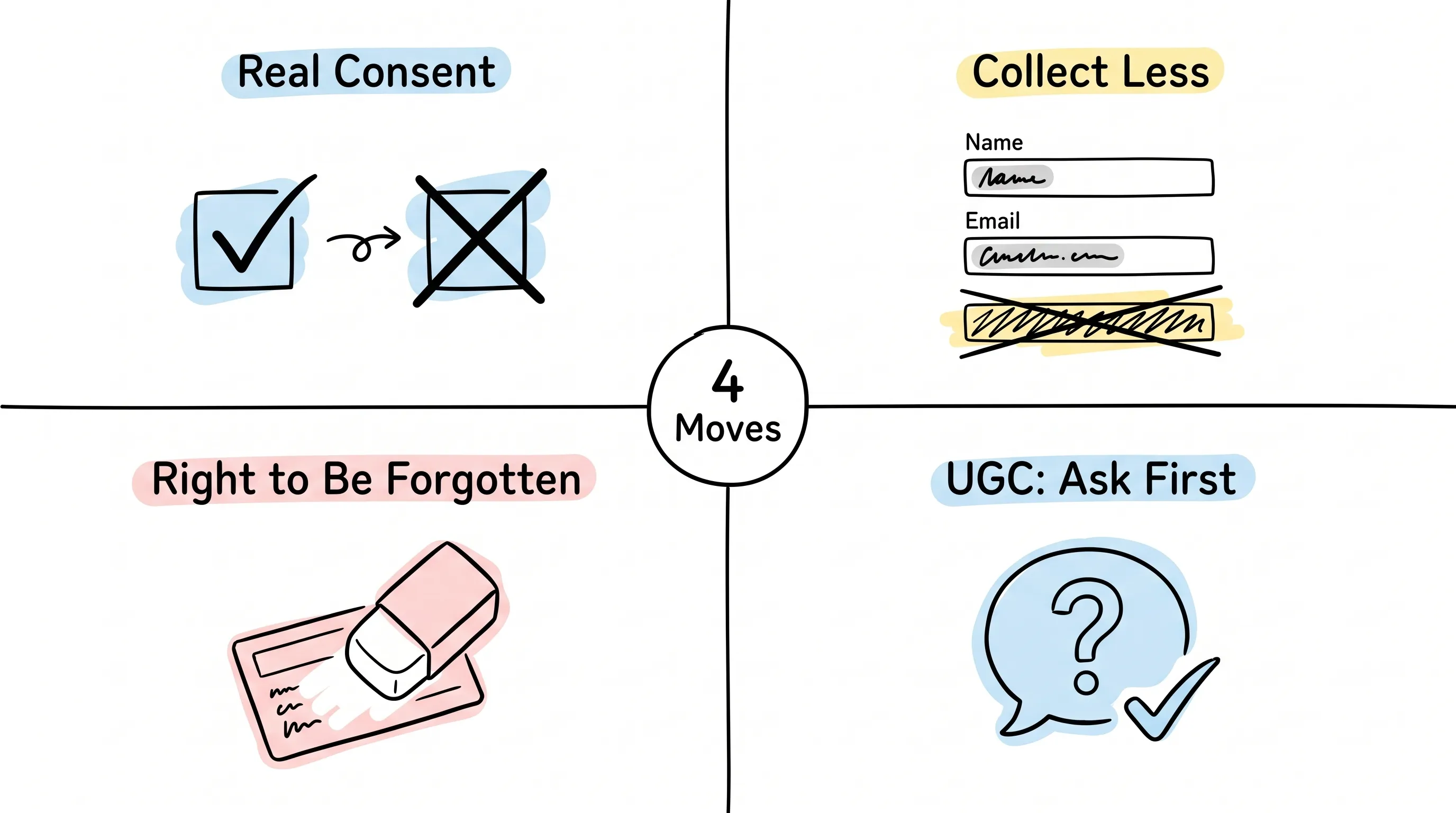
So where does it actually touch marketing? Let me break it into four things.
First: consent has to be real consent.
Pre-checked consent boxes — no. Privacy policies written in fog — no. A user's personal data can only be touched after you've explained things in plain terms and the user actively nods. Meta's disclosure on sharing user activity across partner ad networks is a fairly honest example of how this is done.
It's like a first date: intentions have to be on the table, so both sides know what they're getting into.
Second: if you can collect less, collect less.
Think of a typical lead-gen form: name, email, date of birth, LinkedIn profile link.
You're not running an age-restricted service, and you're not sending birthday wishes — so why collect date of birth? A LinkedIn link is even more sensitive; it exposes the user one more layer.
The GDPR-friendly way: keep just the name and email. If you genuinely need to verify age, a simple "Are you 18 or over?" checkbox is enough.
Before adding any field, ask yourself one question: do I truly need this information, or do I just want it? If the answer isn't a resounding yes, delete it.
Third: users have the right to make you forget them.
Users can ask you to delete their data at any time. For marketers who rely on historical data for targeting and analytics, that stings.
But look at it from another angle: it's actually a win-win. Users take back control of their own data; marketers are pushed to give up "precision bombing" and get back to the honest work of sharpening their value proposition, telling stories, and building brands.
The right to be forgotten ends up producing, of all things, more creative marketing.
Fourth: public content doesn't mean free to use.
Someone followed your brand account and posted something praising you. Can you reshare it?
Not by default.
"They praised us publicly" and "they authorized us to use that content" are two different things. Especially now that UGC (user-generated content) is the universally acknowledged growth lever, too many marketers have stepped over the line here on pure assumption. If you want to use it, ask for permission first.
The convenient route is to use the platform's built-in collaboration mechanism, like Instagram's collab post: only once the other party confirms does the content officially link to your account — a crystal-clear chain of authorization. No such mechanism? Then do the unglamorous thing and ask in a direct message.
How Are the Big Players Responding?
Enough theory. Let's look at how the fast-moving big players are handling it. I'll walk you through three.
First: Facebook.
After GDPR took effect, Facebook was the one under the closest watch. After several rounds of scrutiny of its data practices, it had to rebuild its privacy machinery: clearer privacy settings, control handed back to users, plus a "Clear History" feature that lets you sever your off-site activity records with a single click.
Second: Airbnb.
Plenty of companies like to use little design tricks, burying privacy settings deep where users can't find them — and treating "can't find it" as default consent. The industry has a name for this: dark patterns.
Airbnb went the other way. It built a user-friendly privacy preferences center: data-sharing settings and the off switch for personalized ads, all clear at a glance. It was one of the first brands to put privacy settings openly on the table.
Third: Microsoft.
Microsoft's play is to hand users tools. View your data, export it, delete it — users can do it all themselves. And its rule is explicit: any data collected through social media channels must come with the user's explicit consent.
Notice how the three moves differ — yet the underlying logic is the same: don't fight user privacy; treat it as a chance to win trust.
So What Should You Do?
On the execution side, here's what needs doing, gathered into a short list.
Run regular data audits. Go through everything — what data you collect, why you collect it, where it's stored, how it's used — from lead-gen forms to targeting tools. Leave no corner unchecked.
Never assume consent. Every collection and use of data must be stated openly and backed by an explicit nod. Content users post publicly is no exception.
Don't bet everything on precision targeting. That road keeps narrowing. Instead of scheming to de-anonymize people, invest in contextual advertising, social selling, and brand building. When users want to buy, they'll raise their own hands.
Manage your own people. Tier data access: whoever publishes your social content doesn't necessarily need to see user email addresses. Pair that with training — how to handle data, how to read the regulation — so the team genuinely understands, rather than just signing a form.
Respond to users fast. Catch access, deletion, and correction requests with automated workflows — don't let user requests gather dust in an inbox.
Two more items hide in the details: don't stuff your privacy policy into fine print; and don't hoard data past its shelf life — contacts who no longer engage should be periodically cleaned out of your CRM and marketing automation tools.
Companies that treat user privacy as a burden will pay tuition sooner or later. Companies that treat it as an asset are quietly banking trust.
Apple has already turned privacy into its headline selling point. That's worth every marketer's careful thought.
A Few Last Words
In social media marketing, the surface game is content and cadence. One layer deeper, the game is whether users dare to hand you their data.
GDPR is less a wall than a scale.
Back to that €4.4 million at the start. What it fines has never been "people who used data." It fines "people who treated users as traffic."
May you never have to pay that tuition.
Continue reading
Related articles

Cross-Border Business: Time to Upgrade Your AI Toolbox
A learn article explaining how AI tools help cross-border e-commerce sellers clear five hurdles: language, regulation, logistics, payments, and fraud. It outlines a five-compartment toolbox, a five-step adoption path, and metrics such as conversion rate and CLV, while cautioning against over-reliance on AI.

AI Is Taking Over the Dirty Work of Social Media Marketing, One Task at a Time
This learn article outlines four social media marketing tasks AI can handle — audience analytics, content drafting and design, ad targeting and creative testing, and spam moderation — and cautions that taste, judgment, and data security remain human responsibilities.

AI Is Already This Good — Why Is Your Social Media Marketing Still Pure Manpower?
An overview of 18 AI tools for social media marketing, organized into six categories covering audience research, content creation, scheduling, comment and DM handling, ad management, and visual production, plus notes on personalization, prediction, and emerging trends.