
A 243% ROI, Carved Out of 30 Weeks of Waiting
An analysis of a Forrester-commissioned study on the Zappi consumer insights platform, covering its reported ROI breakdown, time savings in research workflows, and the shift from validating to shaping ideas with consumer feedback.
A few days ago, I came across a research report published in 2025, and one number in it stopped me cold.
243%.
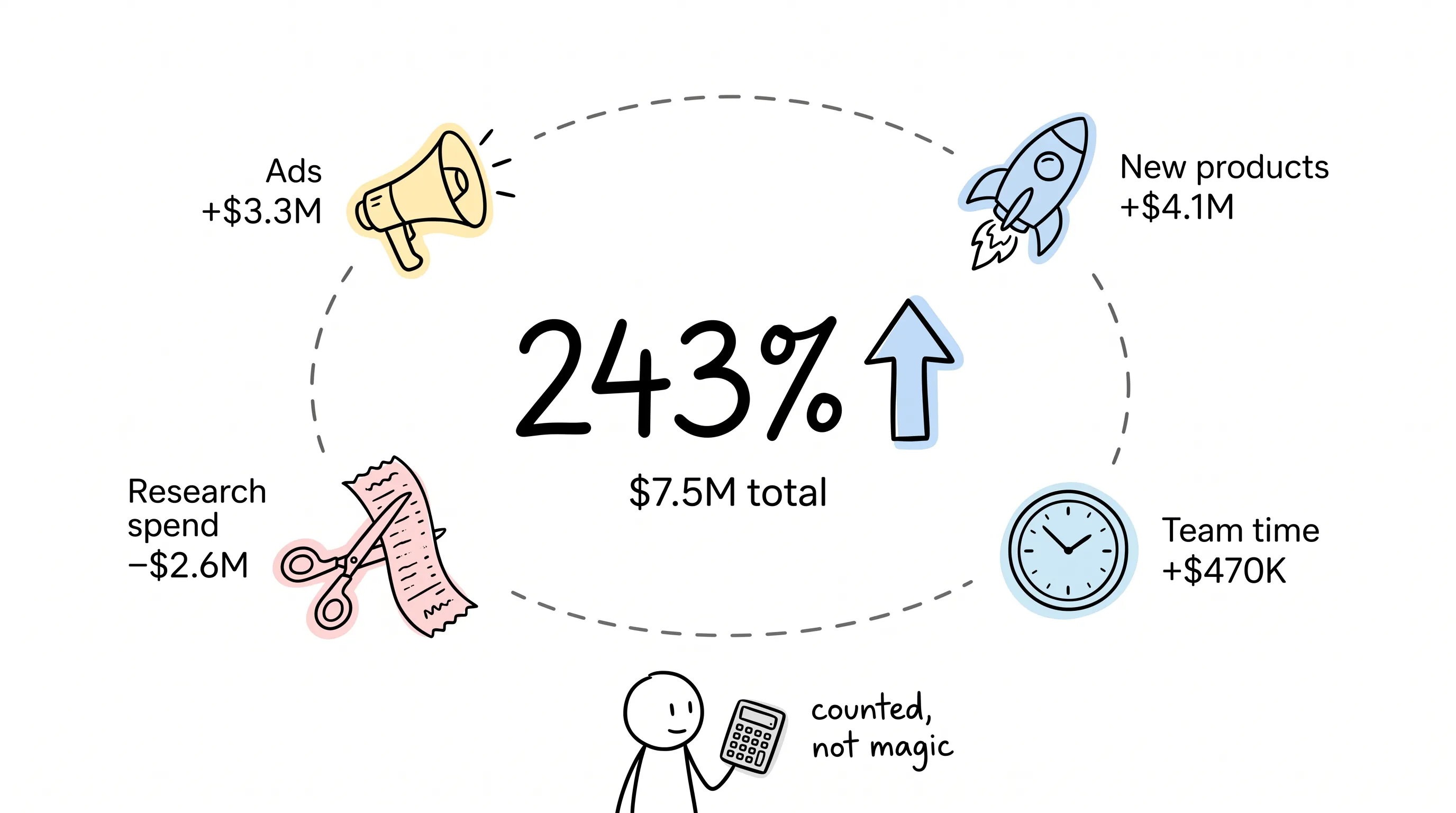
A global consumer goods company spent three years and worked out a 243% return on investment from its annual research budget. In money terms, that's $7.5 million in net present value. And it broke even in six months.
The study was an independent assessment commissioned from the consulting firm Forrester. The subject of the study: a consumer insights platform called Zappi.
My first reaction: can market research really deliver a return that high?
Hold on — let's break the math down.
First, Run the Numbers
The study's method is quite interesting: it modeled a hypothetical "standard company." 7,000 employees, $5 billion in annual revenue, with a 15-person insights team on staff. A typical large consumer goods company. Then it calculated what this company would save — and gain — from three years of using Zappi.
One calculation, four line items:
Item one: advertising. Ads get tested repeatedly on the platform and revised before launch; return on ad spend (ROAS) rises 5% to 6.5% — worth $3.3 million.
Item two: new products. Faster testing shortens time to market and lets more good products make it out; new-product revenue rises 4% to 7%, generating $4.1 million in incremental profit.
Item three: the research spend itself. 40% of traditional research spending is eliminated — $2.6 million. And the savings don't sit idle; they go straight back into more testing.
Item four: people. Freed from manual processes and vendor coordination, the insights team saves 10% to 15% of their time — equivalent to $470,000 in labor costs.
Add it up: $7.5 million. That's where the 243% comes from.
The math is easy. But what really caught my attention was a question behind the math:
Where was all this money going before?
30 Weeks of Dead Time
One comment from an interviewee in the report hit me hard. He's a brand insights director at a food and beverage company. Working with a traditional research agency, he said, even the "fielding" stage alone — getting the survey into the field and collecting responses — means waiting two weeks.
Then he added: by running all of their research on Zappi, they've saved a total of 30 weeks of dead time.
30 weeks. What does that mean?
More than half a year.
Think about it: a new product project, from idea to decision, with 30 weeks in the middle spent on "waiting for data." In that half a year, the market shifts, competitors sprint ahead, consumers change their minds. Your decision gets made based on a world that's six months old.
That's not caution. That's navigating new roads with an old map.
Plainly put, traditional research is slow not in the analysis but in the process. Surveys need people to execute; data coming back needs people to organize; projects queue up one after another. The whole industry has taken for granted that research runs on a monthly clock.
What Zappi does, at its core, is dismantle that process: consumer feedback lives on a platform — send any time, come back fast — so you can watch consumers the way you watch your own dashboard.
The Time You Save Is the Real Money
But here's the interesting part: saving money and saving time are still not the most valuable part.
Another interviewee in the report is an executive at a B2C fintech company. The company spends hundreds of millions of dollars a year on marketing. He said: Zappi makes sure that what we put into the market is the most effective version we know of, so every dollar lands where it counts.
Notice his wording. Not "spend less money" — "make every dollar more effective."
Behind this is a shift in thinking. Zappi's CEO put it in a way I find spot-on: the companies winning today use real consumer feedback to shape their ideas, not just validate them.
What is validation? I make an ad, take it to consumers, and if it passes, I run it. That's validation. Insight is the referee, who only shows up after the game is over.
What is shaping? Before the ad is finalized, you run several versions in front of consumers; whichever direction is right, the data tells you immediately, and you change immediately. Insight is the sparring partner, in the ring the whole time.
Insight is there to guide decisions, not to rubber-stamp them.
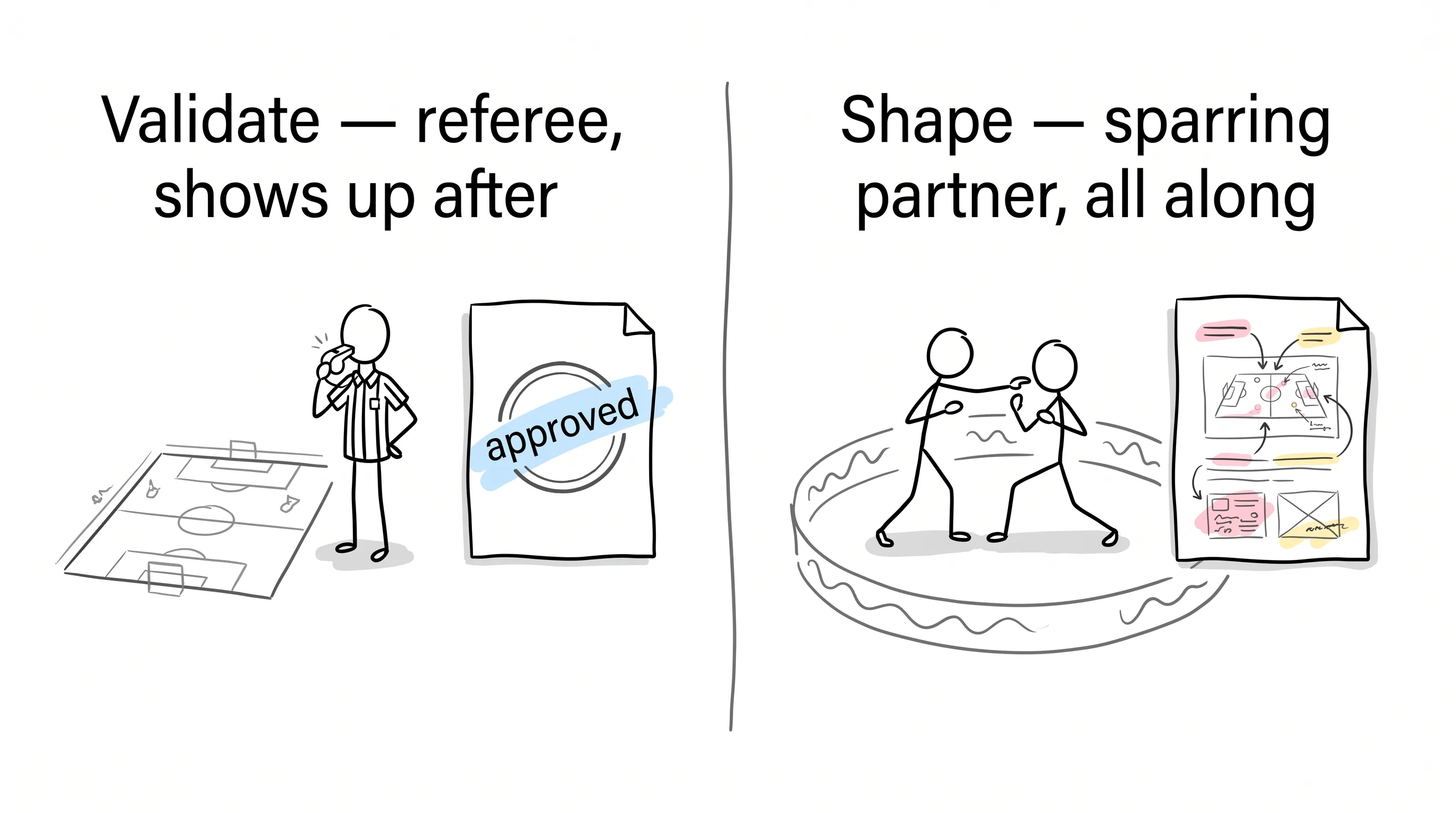
The same piece of consumer feedback: placed in the referee's hands, it can only tell you whether something works; placed in the sparring partner's hands, it can tell you how to make it work. That gap is exactly the distance between 243% and "research budget wasted."
Insight Compounds Too
There's one more layer I think many companies haven't realized.
The report introduces a concept called "connected insights." What are connected insights? Every consumer test you've ever run gets recorded, filed into the same benchmark, and made retrievable across teams. Over three years, what you've accumulated isn't just a few dozen reports — it's a data asset that keeps appreciating.
New tests can be compared against history; one team's conclusions can be picked up and used by another. Stack AI on top of that, and the gap in decision speed and accuracy keeps widening. Incidentally, the report notes that consumer goods giant PepsiCo runs its creative testing on Zappi — creative performance up 30%.
It's like a snowball. Every additional test makes it one size bigger. Companies that don't test are still guessing from scratch three years later.
The study also cites a bigger number: consumer-centric companies grow revenue 41% faster than their peers, and profit 49% faster.
The direction, actually, has always been clear. The hard part is that most companies treat insight as an expense to "cut," while a few treat it as an investment that "generates."
Cutting can only save you 40%. Generating can yield 243%.
A Final Word
Writing this, I think back to the math from the opening.
Break the $7.5 million down item by item and nothing about it is mysterious: ads a bit more effective, new products to market a bit faster, research spend a bit leaner, team time a bit freer.
In the business world, the truly big returns often come from picking out, bit by bit, the waste inside one old, tired process.
Does your company have a "wait 30 weeks" step somewhere?
Maybe it does. Maybe it's become so familiar you can no longer see it.
Worth looking for.
Continue reading
Related articles

Cross-Border Business: Time to Upgrade Your AI Toolbox
A learn article explaining how AI tools help cross-border e-commerce sellers clear five hurdles: language, regulation, logistics, payments, and fraud. It outlines a five-compartment toolbox, a five-step adoption path, and metrics such as conversion rate and CLV, while cautioning against over-reliance on AI.

AI Is Taking Over the Dirty Work of Social Media Marketing, One Task at a Time
This learn article outlines four social media marketing tasks AI can handle — audience analytics, content drafting and design, ad targeting and creative testing, and spam moderation — and cautions that taste, judgment, and data security remain human responsibilities.

AI Is Already This Good — Why Is Your Social Media Marketing Still Pure Manpower?
An overview of 18 AI tools for social media marketing, organized into six categories covering audience research, content creation, scheduling, comment and DM handling, ad management, and visual production, plus notes on personalization, prediction, and emerging trends.