
96% of Content Never Earns a Single Click
A learn article on why most published content earns no organic traffic and how AI search is changing content marketing, covering topic selection, content clusters, AI-assisted workflows, measurement by content type, and GEO practices for brand visibility in AI answers.
A couple of days ago, a friend who works in B2B marketing asked me out for coffee.
He looked worn out. "Man," he said, "we doubled our content output this year — went from weekly updates to publishing every day. But our website traffic hasn't budged, and leads are actually down. How messed up is that?"
I told him: not messed up at all.
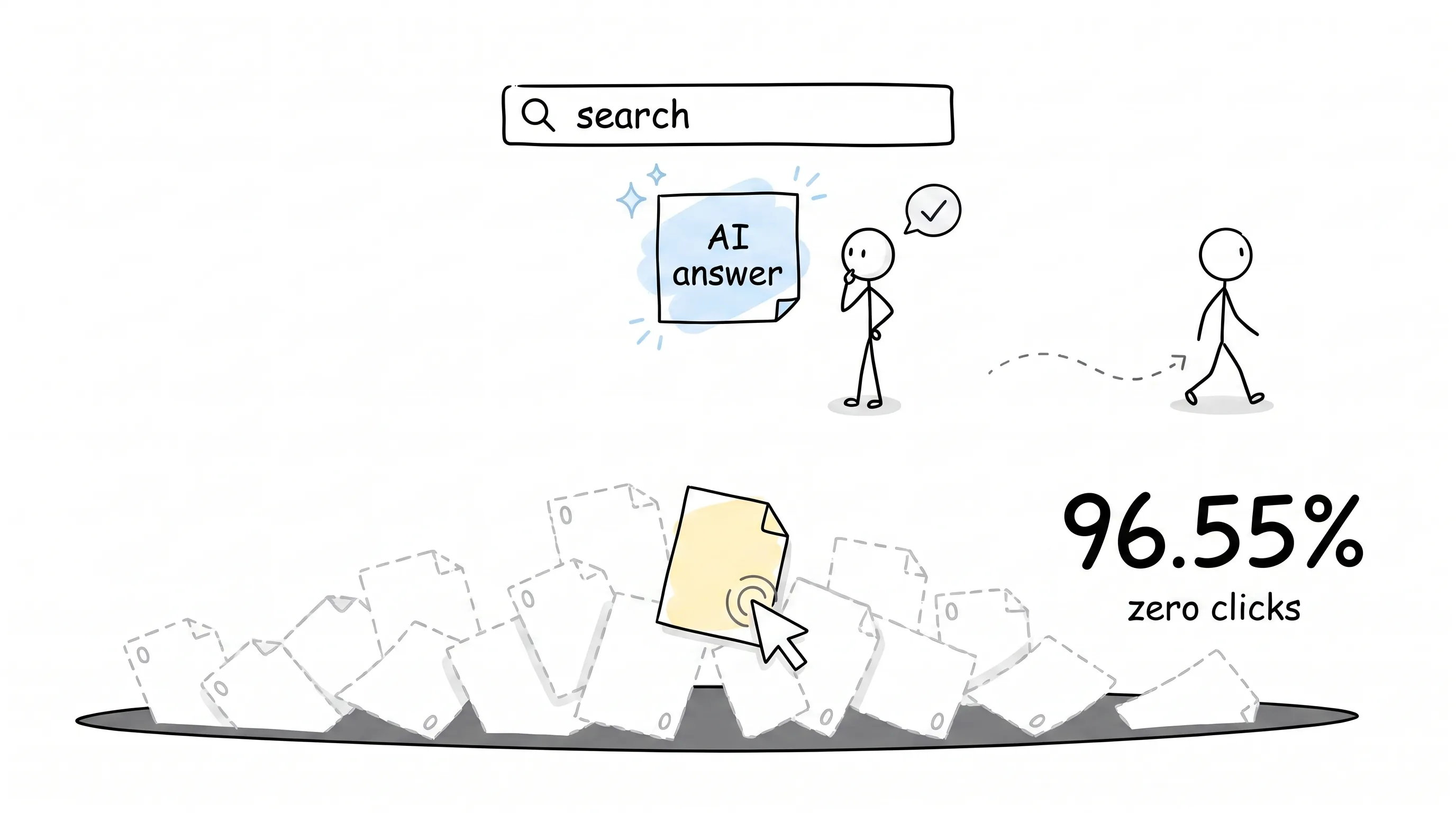
I showed him a number: 96.55%. That's the share of all pages on the web that get zero organic traffic from Google. In other words, the moment most content is published, it sinks straight to the bottom. Nobody sees it. Nobody clicks it.
He paused for a beat. "Then what are we even grinding for?"
Good question. That's what this article is about.
First, Let's Be Clear About What Content Marketing Is
What is content marketing, exactly?
Put simply: it's the craft of pulling people in by answering real questions, instead of paying for attention. Ads are rented traffic — stop spending and it drops to zero. Content is an asset you build up — a good article keeps bringing you customers three years after you publish it.
That principle hasn't changed. What has changed is the examiner.
There used to be only one examiner: Google. Rank near the top, and there was food on the table. Now the same article has to be findable in search, quotable by AI, usable in your sales team's talk tracks, and genuinely valuable to existing customers. One piece of content, four jobs.
The workload quadrupled; the headcount didn't. That's why in the Content Marketing Institute's (CMI) 2025 B2B research, 58% of marketers rated their own content strategy as merely "moderately effective," and 54% of teams said they lacked the people and budget.
But my takeaway from reading that data was: what's missing isn't resources. It's direction.
Content marketing rarely fails because there aren't enough channels. It almost always fails because no one was clear on what each piece was actually for.
How the Game Changed
To understand how content works today, I first need to make three things clear.
The first thing: search, as an entry point, is breaking down.
You think ranking a keyword means traffic? Since AI Overviews became widespread, the average click-through rate for pages ranking #1 has dropped by 58%. Users read the answer right there on the results page and never click through. This doesn't mean SEO is dead — it means the content that was scraped together and says nothing at all has completely run out of room to survive.
The second thing: AI has smashed the cost of content production down to the floor.
81% of marketers are already using AI for content work, and 87% use AI to generate or assist with generation. Sounds great? Now look at another number: only 19% of teams have woven it into their daily workflow.
Put those numbers together and one conclusion falls right out: when everyone can use AI to produce fifty pieces a day, AI-written content itself is no longer a competitive advantage.
Everyone's weapons are identical now. What you compete on is everything beyond the weapons: your judgment, your first-hand cases, your understanding of the customer. Those, AI cannot give you.
The third thing: tightening privacy has made "rented land" unstable.
One rule change on a platform, and the followers you worked years to accumulate can vanish overnight. That's why you see smart teams placing bigger bets on the things they hold in their own hands: their own blog, email subscriptions, customer communities, knowledge bases. In those places, you set the cadence and you write the rules.
String the three together and the conclusion is a single sentence: "Publish more, rank more" is officially void as of 2026. The win-by-volume road died the day AI started summarizing the whole web.
So How Should You Actually Do Content
The direction is set. What about execution? I break it into five steps.
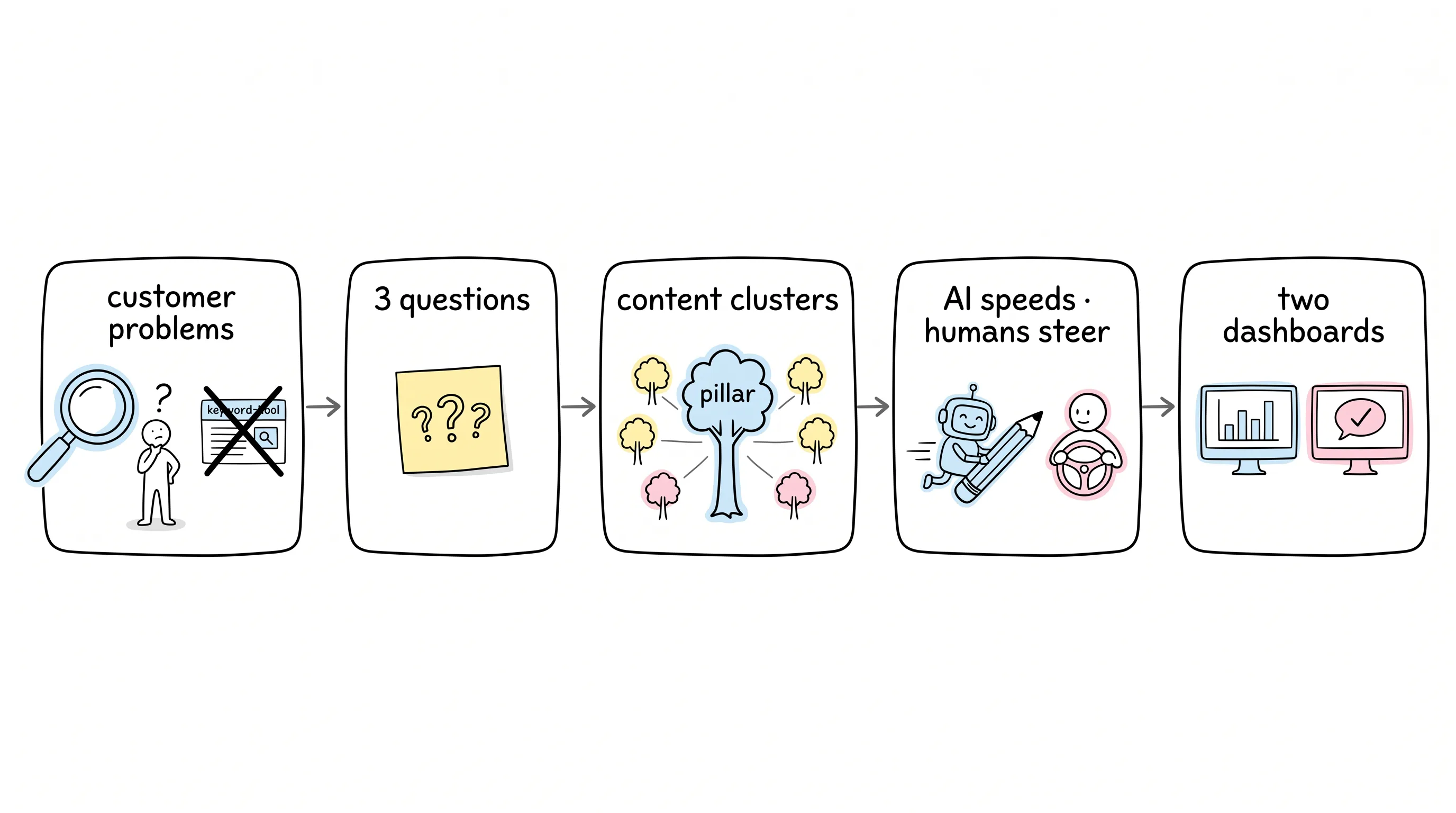
Step 1: Start from the customer's problems, not from keywords
Many teams' topic-selection process: open a keyword tool, pick the terms with the biggest search volume, assign them out for writing.
This is backwards.
Someone searching "content marketing platform" doesn't necessarily want a product comparison. They may just have a vague feeling that their current process is off, and want to figure out where the problem lies. You have to catch their confusion first, then talk solutions.
Before you start writing, ask three questions: Who is this person? What are they trying to solve? What do they need to understand first before they can move forward?
Step 2: Before any piece is commissioned, make it pass three questions
Who is it for? Where are they in the journey? After reading it, what should they do next?
If you can't answer all three, hold off on writing that piece. It would just be filler — and you already know how filler ends, from earlier in this article.
Step 3: Build a forest of content around what you know best
Stop writing isolated, one-off pieces. When you write, write in clusters around a topic you genuinely understand: one long-form pillar piece, a ring of supporting articles, a few customer stories, original research, plus a batch of Q&As that give readers the answer outright.
Why write in clusters? Because search engines use them to judge whether you're an authority on the topic, AI uses them to decide whether to cite you, and readers use them to judge whether you're credible. Three different exam papers, but the answer is the same: you have to make everyone see at a glance that on this topic, you call the shots.
Step 4: AI accelerates, humans steer
What does AI do? Research, building outlines, breaking long articles into social posts. Hand over that repetitive labor without a second thought.
What do humans do? Set the opinions, supply the cases, verify the facts, guard the brand's tone. In one sentence: AI makes the writing fast; humans make it right — and make it worth something.
Step 5: Install two dashboards
The old one: rankings, clicks, conversions. The new one: in the answers given by AI like ChatGPT, Gemini, and Perplexity, is your brand mentioned at all? Is the framing consistent? Are the key questions covered?
Many people still stare only at the first dashboard. This is why 56% of B2B marketers can't work out content ROI. When the ledger only records half the transactions, of course the books don't balance.
Different Content Can't Be Measured by the Same Yardstick
Back to the books. This is the part I most want you to take away.
Content isn't one thing; it's four things. Acquisition content: look at reach, branded search volume, and citation share inside AI answers. Consideration content: look at time on page, return visits, and how many sales-qualified leads it brings in. Bottom-of-funnel content: look at pricing-page visits and demo requests that come from content. Retention content: look at help-doc usage, community activity, and renewals.
You wouldn't grade a marathon runner on their sprint times, and you likewise can't grade four entirely different stretches of the race with the single metric of "pageviews."
Let Me Tell You 3 Stories
The methodology is done, but it may still feel abstract. So here are 3 true stories.
Story one: Rare Beauty sells perfume.
Perfume is something a screen can't convey — however beautiful the copy, nobody can smell it. Rather than shoot an even more expensive ad, Rare Beauty put up three scratch-and-sniff billboards in New York's SoHo and Chelsea. Passersby scratched off the coating, smelled the scent, scanned the QR code, and applied for a sample through Shopify's Shop app. The system even used geofencing to confirm that you really were standing next to the billboard.
From smelling it to requesting a sample is one short step. The essence of good content is compressing the distance between interest and action to the bare minimum.
Story two: Vaseline took the internet's home remedies seriously.
Thousands of folk uses for Vaseline circulate online. Some genuinely work, some are nonsense, and some hide risks. Vaseline's approach was clever: instead of inventing its own topics, it sifted through more than 6,000 uses that people had posted of their own accord, took the ones they really believed, and carried them into the lab to be verified, properly and methodically. The ones that worked got stamped with the "Vaseline Verified" seal of approval; the dangerous ones got officially debunked.
The campaign took the Grand Prix in the Social & Creator category at the 2025 Cannes Lions International Festival of Creativity, and carried home a Gold Lion in the Media category as well. 63.3 million social interactions, 87% positive sentiment, 71 million organic reach.
Where did it win? It won because it never shouted into empty air; it caught what users were already saying, then added the weight of authority to those words. Listening, by itself, can grow into content.
Story three: a survey that answered an industry-wide anxiety.
Plenty of companies take brand-building seriously, yet the account of "how much business the brand actually brings in" is one most marketing leaders can't settle. A survey of 613 enterprise marketers, conducted jointly by Sprinklr and LinkedIn, took this question head-on: 81% predict brand-building will become more and more important, yet 46% say that measuring brand campaign effectiveness is one of their biggest difficulties right now.
The survey offered several solid numbers: companies that genuinely weave LinkedIn into their marketing and sales playbook are 2.7 times more likely to grow ROAS (return on ad spend); 91% of enterprise marketers recognize LinkedIn's value for brand and customer acquisition, yet only 18% use it across the full funnel.
That's where the power of original research lies. Opinion pieces are a dime a dozen; data is the scarce commodity. A good survey gets cited by analysts, cited by articles, cited by AI — speaking for you for many years.
Three stories told. Do you see the common thread? Not a single one won by "publishing one more piece." Every one of them first understood how people think, then engineered that one step.
While we're here, let me answer a question I'm often asked: are case studies still useful?
Useful. But only the case studies that tell "what problem the customer was being plagued by, how they made the decision, and what changed afterward" are useful. Case studies stuffed with "a big-name brand chose us" — those are award acceptance speeches, not content.
Where Enterprise Teams Struggle
Small teams compete on topic selection. Large teams' difficulty is an entirely different one: it's not that they can't write; it's that they can't hold steady.
Several brands, a dozen-plus markets, dozens of channels — friction multiplies severalfold. Two teams quietly write the same article, with messaging that contradicts each other; a draft sits in legal's hands for nine days, and by the time it publishes, the trending topic has long gone cold.
What you're competing on at that point is operational capability. Five things, none of them optional.
One content calendar shared by everyone. Who's writing, writing for whom, publishing when, aimed at which goal — all visible on one page, so two teams won't collide.
One decent brief. Before pen touches paper, lock down audience, core message, internal links, call to action, and success criteria. If the brief is mushy, the draft is guaranteed to be mushy too.
One approval flow you can actually see. Who needs to review, where the review stands, which version it's stuck on — one click in the system and it's there, no need to dig through chat logs from three months ago.
One unbroken distribution chain. Ideation in one tool, publishing in another, retrospective in a third — the message distorts a little more with every hand it passes through.
One report that can be counted through to revenue. Don't stop at impressions and clicks; ask one more question: which pieces of content actually brought in demo requests, actually influenced renewals?
What does done-right look like? A benchmark circulates in enterprise content circles: production costs drop thirty to fifty percent, while speed to market actually improves. Cobble together ten small tools and you'll never touch that number; only when planning, production, distribution, and data turn inside one system can you reach it. Products on the market like Sprinklr Marketing, which pack the whole chain into one platform, exist precisely to solve this "can't hold steady."
Finally, a Word on the New Exam Called AI Search
Back to the upheaval at the start. The class content teams most need to catch up on right now is called GEO (Generative Engine Optimization) — getting AI to be willing to cite you when it generates answers.
A few practices that genuinely work.
The most important habit: put the answer at the very front. Don't spend three paragraphs warming up before you get to the point. Readers have no patience; AI has even less — it grabs exactly those first few sentences.
Next, use more structured formats: tables, lists, Q&As. Humans scan them fast; machines read them accurately too.
Also, be willing to invest in first-hand data. While everyone else is retelling the same report, the numbers you ran yourself are a web-wide rarity, and AI and analysts will both come to cite you.
Finally, you have to watch the results. In AI's answers, is your brand recommended, brushed past, or simply nonexistent? If you don't even know which question users came in from, there's nothing to optimize. There are already dedicated tools working at this layer — for example, the Sprinklr LLM Insights mentioned earlier, currently still in Beta, which watches exactly your brand's visibility, sentiment, and competitive position inside answers from ChatGPT, Gemini, Perplexity, and the like.
Some people may worry: will AI simply bypass content and answer everything directly?
My judgment: the more advanced AI gets, the more valuable "content worth citing" becomes. Every answer AI gives needs a source it can trust underneath.
Machines are responsible for distributing answers; humans are responsible for becoming the source.
Back to That Cup of Coffee
When we finished the coffee that day, my advice to my friend was one sentence: stop asking me how many pieces to publish next month.
Go back through everything you've published, and ask three questions: Who was this piece written for? What did it solve for the reader? Is it worth being cited by AI? The ones you can't answer — don't be precious about them; they were bottom-dwellers to begin with. The ones you can answer — polish them until they're as good as they can get, then write around them in whole clusters.
Write less, and write each piece through, so that every one knows exactly who it belongs to and exactly where it's meant to take the reader.
That's how you solve the mystery of doubled output and falling leads.
May your next piece of content not be another item on the daily-publishing treadmill, but an asset that people are still citing three years from now.
Continue reading
Related articles

Cross-Border Business: Time to Upgrade Your AI Toolbox
A learn article explaining how AI tools help cross-border e-commerce sellers clear five hurdles: language, regulation, logistics, payments, and fraud. It outlines a five-compartment toolbox, a five-step adoption path, and metrics such as conversion rate and CLV, while cautioning against over-reliance on AI.

AI Is Taking Over the Dirty Work of Social Media Marketing, One Task at a Time
This learn article outlines four social media marketing tasks AI can handle — audience analytics, content drafting and design, ad targeting and creative testing, and spam moderation — and cautions that taste, judgment, and data security remain human responsibilities.

AI Is Already This Good — Why Is Your Social Media Marketing Still Pure Manpower?
An overview of 18 AI tools for social media marketing, organized into six categories covering audience research, content creation, scheduling, comment and DM handling, ad management, and visual production, plus notes on personalization, prediction, and emerging trends.