
96% of CMOs Say AI Has Reshaped Marketing. Really? Only a Third.
A commentary on a BCG survey of 300 CMOs finding that while 96% say AI is reshaping marketing end to end, only about a third have deployed agents across rebuilt processes. Covers agent tiers, AEO, talent building, and the four-layer agent system architecture.
A while back, I came across an annual survey that stung a little. This year, BCG surveyed 300 chief marketing officers worldwide — B2C and B2B alike — and sat down for in-depth conversations with 50 of them.
The question was blunt: Is AI reshaping your marketing function end to end?
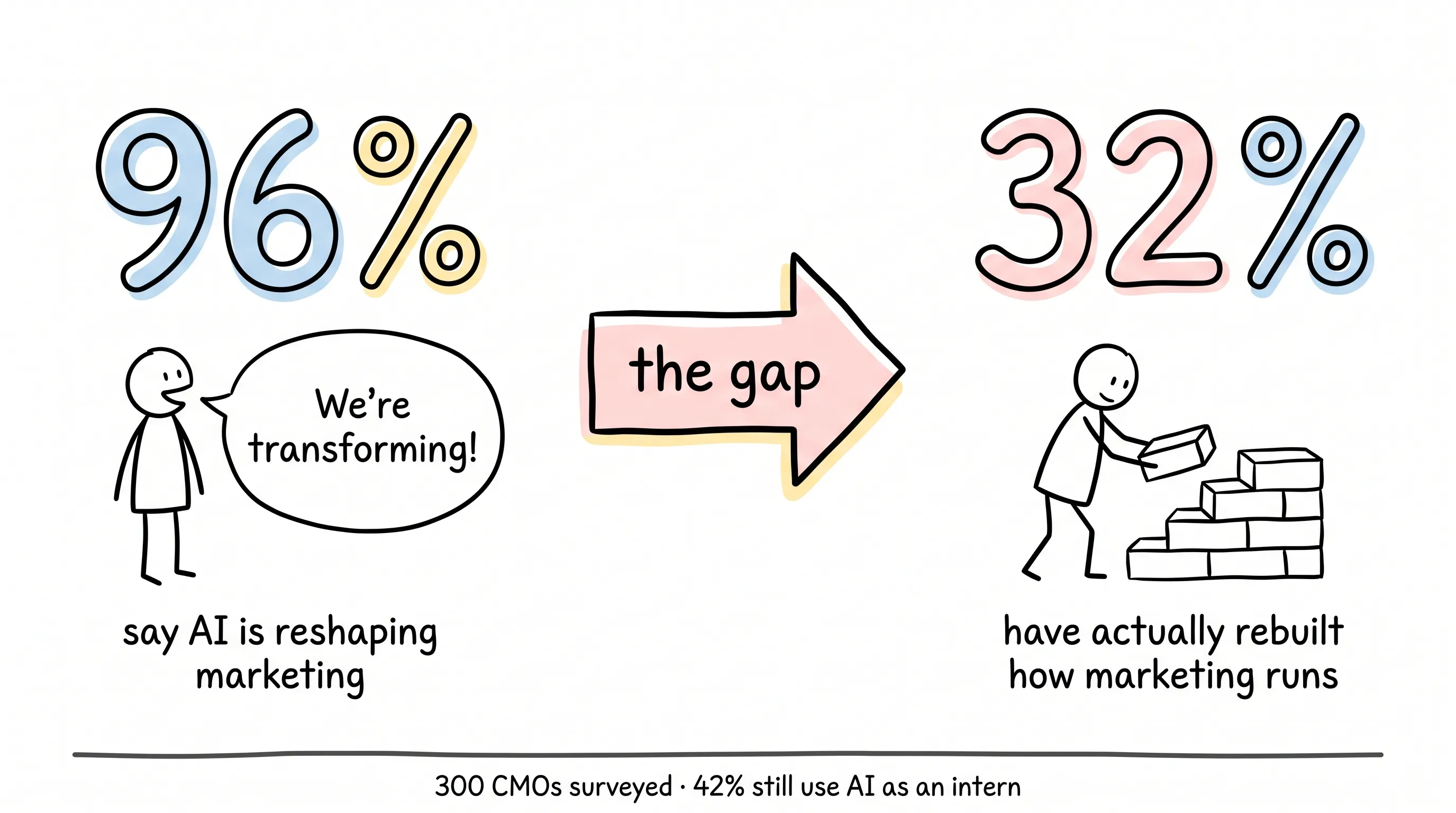
96% said yes.
Then the researchers flipped the question: So how exactly are you using generative AI today?
42% admitted: mostly, they still use it as a helper to humans — writing first drafts, floating ideas, pitching in on a few workflows.
96% say they're transforming. 42% are using AI as an intern.
Both numbers come from the same survey — and both are true.
A transformation you talk about and a transformation you actually build are two different things.
This Time, the Money and the Mandate Really Showed Up
First, a change many people have missed: this round, marketing wasn't pushed along — it walked to the front of the line on its own.
In the past, corporate AI initiatives were pushed top-down from the CEO's office or the strategy department, and marketing was usually the passive recipient: the memo arrived, the tools were handed out, now go learn them. Not this time. Nearly half of CMOs say that when it comes to AI investment in marketing, marketing makes the final call itself. Only 14% are driven directly by the CEO or the board; 15% by strategy departments.
No other function gets that treatment. Another BCG report, the AI Radar, shows that at the overall enterprise level, 72% of CEOs still consider themselves the top AI decision-maker. Which means: everywhere else in the company, AI is the boss's business; in marketing, AI is marketing's own business.
Why? Because the pressure has all landed on them. 94% of CMOs say that over the past two years, CEOs' expectations of marketing have clearly risen. The CMO of an insurance company said the board and CEO keep pushing him to speed up — he has positioned marketing as one of the two departments leading the company's transformation, partnering with the CTO. A beauty-industry CMO sounded even more urgent: tech and media companies are already running fully autonomous campaigns, and if marketing doesn't accelerate, share will be snatched away by the new brands born knowing how to use agents.
Pressure alone isn't enough — the money has genuinely arrived too. 43% of CMOs say their AI spend in marketing exceeded $15 million this year. Last year, that share was 28%. Some are already blazing the trail: the CEO of a restaurant company built an agent command tower that watches trends and opportunities across the business in real time, so marketing and operations can act on them at a moment's notice.
Mandate, pressure, budget — all three are in place.
But once all three are in place, the countdown begins. CFO patience is finite. Before that patience runs out, turning optimism into results you can account for clearly and defend on the books is the question every CMO must answer this year.
What Is an Illusion of Transformation?
Let me give you an analogy.
Say you buy a top-of-the-line set of kitchen knives for an old restaurant. The knives are genuinely sharp — the julienned potatoes come out thin and even, and everyone in the kitchen sings their praises.
But the kitchen's flow hasn't changed, the chefs' craft hasn't changed, the menu hasn't changed, and neither has the speed at which dishes come out.
So, has this restaurant transformed?
Plenty of AI transformations in marketing departments are exactly this set of knives. The symptoms: a dozen-plus pilots run, copywriting is faster, insights come faster, media bidding is faster — every single point saves a bit of time. But the processes haven't been redesigned, the org hasn't moved, the tech stack hasn't been swapped, and the same people are doing the same work.
BCG segmented the 300 CMOs by how they actually deploy agents. The criteria are refreshingly concrete: how many processes agents actually touch, how many of those processes get rebuilt, how agents collaborate with one another, and whether efficiency and return on investment genuinely change.
First, let's explain the term. What is an agent? It's AI that can pick up tasks on its own, break them into steps, call the tools it needs, and report back when the job is done. Not the kind that answers one question at a time — the kind that can run the whole race by itself.
That sorting yields three tiers.
The front-runners: 32%. Less than a third. They've spread agents across strategy, insights, briefing, content, media buying, and optimization, and redesigned how humans and agents collaborate. The most aggressive among them, roughly 8%, have already started letting multiple agents coordinate with one another to run complete marketing campaigns, with humans monitoring from the sidelines.
The chasers: 26%. They've broken out one or two pilot zones, mostly in content production or media optimization. But when they try to scale up, talent and technology both fall behind.
The at-risk: 42%. Nearly half. Agents only assist humans. Plenty of pilots, some point-level gains — but nothing scales out. The org hasn't moved, the stack hasn't been swapped, and the talent gap is a mile wide.
Nearly half of these transformations are on the road to becoming an illusion.
The Front-Runners Are Already Asking a Different Question
The way marketing spends money on AI has cycled through three generations in the past few years.
Wave one: buying tools. One for content writing, one for personalization, plus a chatbot on the side. Every tool worked fine — they just didn't know each other.
Wave two: buying connections. Everyone realized the tools had to be wired together, and the money shifted to the foundations: data, measurement, technology, experience — and talent.
Wave three, happening right now: building an operating system.
The front-running CMOs no longer ask "which tool should we buy." They ask a different question: What kind of operating system do I need so that my tools, my agents, and my processes can work together?
Change the question, and where the money goes changes completely: the data foundation, the brand intelligence layer, multi-agent orchestration — plus one thing that matters most of all: talent that simply cannot be bought on the market.
And the report card holds up. The numbers BCG sees in client projects run roughly: 20% to 30% improvement in cost efficiency; marketing ROI up to 3x; and campaign cycles compressed, at best, to one-tenth of what they were.
What does one-tenth mean in practice? A process that used to take a month now finishes in three days.
What matters even more is revenue. 40% of CMOs say their companies measure them mainly on cost efficiency. The other 60% — especially the ones running furthest ahead — are already using the growth and speed AI brings to generate their own fuel: funding investment with what efficiency saves, while keeping their eyes on revenue. Among B2C CMOs, 31% say agent-based marketing has already delivered a significant, measurable revenue impact. For B2B, it's 20%.
Efficiency is only the passing grade. Growth is the extra credit on this exam.
Your Consumers Have Already Changed How They Ask
While this side is still in meetings discussing transformation, the consumers over there have already made their move.
Before, when he wanted to buy a camera, he'd go to a search engine and type "mirrorless camera recommendations for beginners," then flip through ten pages of results. Now he asks AI directly: budget of 8,000 yuan, mainly shooting kids and cats, recommend one for me — and tell me why while you're at it.
AI hands him the answer right away: three models, the pros and cons of each, and a plain-language summary. He may never even open a shopping site.
90% of CMOs already agree: generative AI is reshaping how consumers discover and evaluate brands. What does that mean? It means brands no longer fully own their visibility. If the AI doesn't mention you, then for that round you simply don't exist. However strong the brand, however big the budget — it all goes to waste.
And so a new discipline has emerged: AEO, Agent Engine Optimization. Search optimization gets search engines to rank you first; AEO gets AI to mention you, speak well of you, and put you forward when it summarizes, compares, and recommends on consumers' behalf. Most CMOs have already stood up dedicated teams to do this. Its weight is rising to match what SEO was back then and what media optimization is today.
One step further, and AI takes over the purchase itself. 91% of B2C CMOs say AI-mediated "zero-click" discovery is already reshaping their funnel — a funnel that was already looking less and less like a funnel. So you see CMOs working through a multiple-choice question: when to go serve customers inside someone else's AI, and when to install an agent of your own at home and keep a tight grip on the customer relationship.
Who feels this wave most urgently? Asia-Pacific. 28% of APAC CMOs have ranked agentic commerce in their top three priorities; North America is 23%; Europe is only 13%. A travel-industry CMO in APAC put it bluntly: this disruption is every bit as big as search and e-commerce were, and we don't want to repeat the mistakes of that era all over again.
Those who've been burned learn fastest.
Talent You Can't Buy, You Have to Build
If you've read this far, you might think this race is about technology.
Quite the opposite. The front-running CMOs are nearly unanimous: this is a "people plus technology" transformation. Technology is actually the easy part; the choke point is people.
Why do they say that? One B2B CMO just finished AI training for her 3,000-person global marketing team: in-person courses, hackathons, a self-built AI academy — nothing left out. Why go to such lengths? Her answer was plain honesty: there is no ready-made talent on the market. If you can't hire it, you can only build it.
Three CMOs — from pharma, media, and fashion — said almost the same thing.
So you see 80% of CMOs running all-hands AI training, and nearly as many also adding responsible-AI and ethics courses, up 10 percentage points from the year before. You see organizations being carved smaller: smaller teams, broader mandates, organized around business goals and customer groups rather than channels. And you see them cultivating "superusers": in every team, the people who play best with the tools get first access to the new ones, then go on to pull the whole team along.
One tech-company CMO has a practice I especially like. Every Monday morning she emails her team a five-minute video introducing one new tool they can try out that week.
Fifteen minutes a week. No big meetings, no memos. Over a year, learning grows into a habit.
A consumer-goods CMO described it with precision: at first, training these agents is quite a grind — you have to feed them data and teach them the rules. But once the team's best hands marinate everyone's experience, the brand's voice, and the campaign playbook into the tools bit by bit, the results turn out surprisingly good.
Early on, you teach the AI; later, the AI brings the newcomers along. That trade pays off no matter how you do the math.
Of course, the road is still long. 75% of CMOs are still pushing agile pods to crack the human-powered bottlenecks that agents can't yet take over. The AI-native marketing function of the future will have a smaller core team, more fluid boundaries, a redrawn division of labor with agencies — plus a governance layer that didn't even exist three years ago. Everyone has the blueprint; few have actually arrived.
The Risks Haven't Disappeared — They've Changed the Question
This time last year, CMOs were still agonizing over one thing: whether mass-producing content with AI would flatten creativity into mediocrity and dilute the brand's voice.
Ask again this year, and the answers converge: it's manageable. Pick the right tools, train the team well, put good guardrails on the brand, and you can keep it in check.
The real headaches have given way to a few tougher nuts to crack: data security, privacy, legal, implementation. One tech-industry CMO said: "I'm far more confident than a year ago — I know what to amplify. The hard part is getting the whole company aligned, leveling up systems, security, and protocols across the board."
The risk hasn't disappeared; it has moved from "whether to do it" to "how to do it well."
That, in itself, is progress.
House Rules for Agents
One more signal from the survey: this year's top investment priority has become marketing technology and data, up 11 to 12 percentage points from the year before.
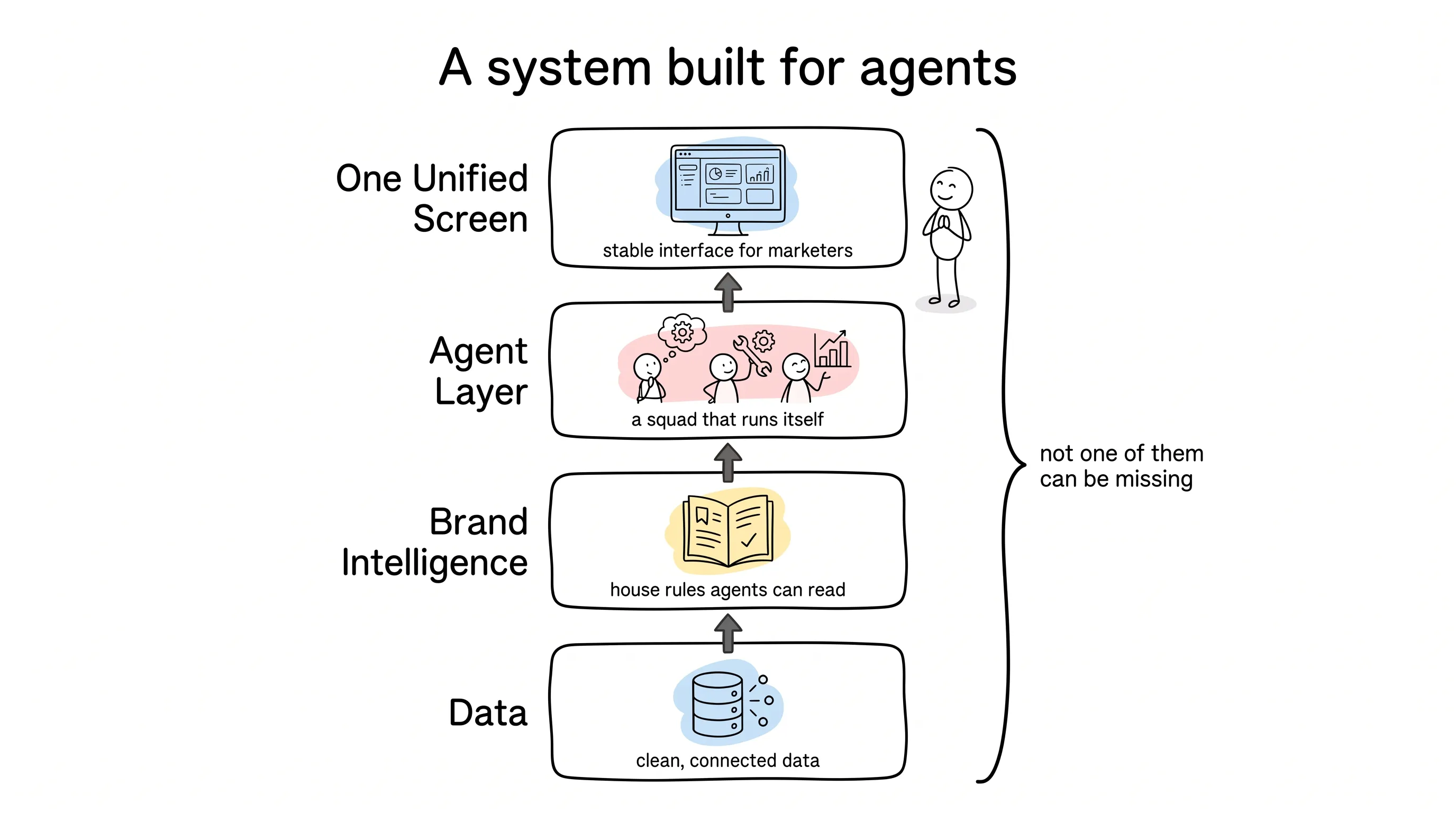
Where is the money going? Just look at what the front-running players are building. A system built for agents has roughly four layers.
Layer one is data. The foundation. Without clean, connected data that carries experiment records, whatever you build on top is structurally unsound. The good news: pulling together data scattered across systems no longer requires a wrenching rip-and-replace migration.
Layer two is the brand intelligence layer. The layer easiest to skip — and the most valuable. Simply put, it's the house rules written for agents to read: what our house's messaging is, what can and cannot be said, how metrics are set, which sources are trustworthy. A general-purpose large model, however clever, is still an outsider who doesn't know your business; write the house rules in, and it becomes "your family's" agent. This layer is what turns a generic copilot into one of your own.
Layer three is the agent layer. An upgrade from single tools to a group of agents collaborating: one plans, one executes, one measures, one re-plans after the review — a small squad that runs itself, carrying a marketing campaign across channels from start to finish.
Layer four is one unified screen for marketers. The tools underneath will be swapped, the agents will iterate — but as long as the interface the marketing team sees stays stable, the transformation can keep moving.
Four floors. Not one of them can be missing.
One Last Thing
What I appreciate most about this survey is its honesty: 96% say AI is reshaping marketing end to end, and yet only about a third have actually built it. No one pretends that those dozen-odd pilots equal transformation.
Over the next 12 months, the work CMOs will do is mostly the kind that never gets a launch event: re-arranging the organization, re-training the team, shoring up the data, writing the house rules, building the orchestration. None of it makes for a social-media post, and none of it makes for a launch event.
But the ones who finish will push marketing's ceiling higher once again. The ones who don't will probably find, a budget cycle or two later, that the mandate they held quietly changed hands without them noticing.
Remember the two numbers from the beginning?
96% is talk. 32% is built.
Everyone has a transformation on their lips. On the books, only the third that actually built it counts.
And more than that — may you be one of the third who truly built it.
Continue reading
Related articles

Cross-Border Business: Time to Upgrade Your AI Toolbox
A learn article explaining how AI tools help cross-border e-commerce sellers clear five hurdles: language, regulation, logistics, payments, and fraud. It outlines a five-compartment toolbox, a five-step adoption path, and metrics such as conversion rate and CLV, while cautioning against over-reliance on AI.

AI Is Taking Over the Dirty Work of Social Media Marketing, One Task at a Time
This learn article outlines four social media marketing tasks AI can handle — audience analytics, content drafting and design, ad targeting and creative testing, and spam moderation — and cautions that taste, judgment, and data security remain human responsibilities.

AI Is Already This Good — Why Is Your Social Media Marketing Still Pure Manpower?
An overview of 18 AI tools for social media marketing, organized into six categories covering audience research, content creation, scheduling, comment and DM handling, ad management, and visual production, plus notes on personalization, prediction, and emerging trends.