
93% of CMOs Say AI Pays Off. So Where Is the Payoff Hiding?
An analysis of survey data on generative AI in marketing, contrasting widespread reported returns with the smaller share of leaders who can point to measurable results, and discussing strategy, process redesign, trust risks, and adoption gaps.
A few days ago, I had dinner with a friend who works in consumer goods. He runs the marketing department at his company, with a few dozen people reporting to him.
When the conversation turned to AI, his eyes lit up. AI drafts the copy. AI sketches the image concepts. AI pulls the data tables. He said nobody in his department could get through the day without it anymore.
I asked one question: so how much money has AI made you?
He froze. He thought about it for a long moment, then said: never counted the money. But time — time it has saved, plenty of it.
Back home, I dug through survey after survey published since 2025, and the more I read, the more convinced I became: my friend is no outlier. He is standing on a massive fault line.
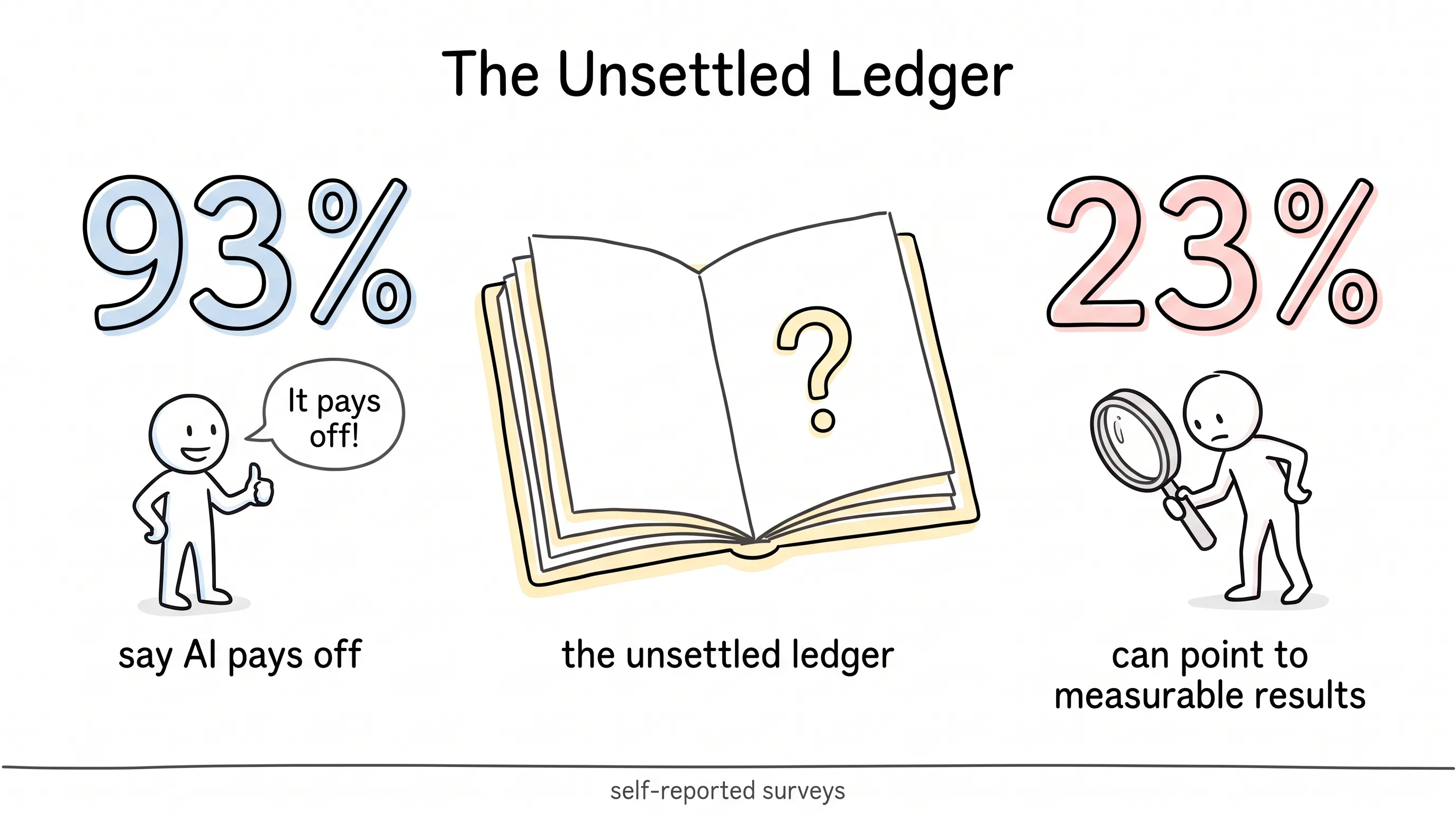
On one side of the fault, nearly everyone says AI works. In SAS's survey, 93% of CMOs say generative AI has brought their companies returns they can actually see.
On the other side, the people who can spell out "exactly where it works" are startlingly few. In Gartner's research, only 23% of marketing leaders can point at their own campaigns and say: AI made this, measurably, better.
93% versus 23%.
Oh — one caveat before we start. Nearly all the numbers below are "self-reported" survey answers, not figures pried out of audited financial statements. Treat them as directional, not as an audit report.
Even so, between these two numbers sits the biggest unsettled ledger in marketing right now. Today, let's try to do the math.
1. The Return You Can Feel Is Probably Just "Time Saved"
What counts as a return?
Most people blur the terms. It's really two different things: one is saving time; the other is making more money.
On saving time, AI has genuinely delivered.
What are marketers doing with AI? Gartner asked. Among marketers using AI, 77% put it to creative work. Writing copy, editing drafts, producing images, brainstorming concepts — every one a notorious time hog. Now AI handles them, and people's hands are free.
Microsoft ran a Copilot study and found an intriguing "threshold": 11 minutes a day. Only when daily savings reach 11 minutes do users start to clearly feel that this thing is useful.
Think about what 11 minutes means: you haven't even finished a cup of coffee. Yet those 11 minutes decide whether a tool gets to stay on your computer.
Microsoft also ran the numbers: 11 minutes a day, banked over 11 weeks, adds up to about 10 hours. Nearly two full workdays.
OpenAI's enterprise users report an even wilder number: 40 to 60 minutes a day.
Impressive.
In Gartner's data, 53% of marketing leaders also admit that output speed has genuinely picked up.
But here comes the question. What did the saved time actually become?
If your answer is "made a few more poster versions, wrote a few more lines of copy," let me remind you: that isn't business. That's running the same show, just cheaper.
Saving time is doing the same old work faster. Making money is taking the effort you saved and spending it on what you could never do before.
Between those two things lies an entire Pacific Ocean.
2. The Money Has Already Voted
Before you rush to doubt AI, consider this: real money is already voting with its feet.
The research firm Menlo Ventures put a figure on it: enterprise spending on the generative AI application layer was just $11.5 billion in 2024, and by 2025 it had surged to $37 billion. One year. More than triple.
In Gartner's survey, 92% of marketing leaders say they are putting money into generative AI right now. In another SAS study, 93% of marketing teams already have their 2026 AI budgets lined up.
93% again. That number certainly gets around.
Plenty of people are using it, too. MiQ's report says 66% of marketers now use AI on most, or even all, of their projects. The CMO Survey tracked three years: the share using AI to optimize and automate marketing climbed from 17.2% all the way to 44.22%.
Three years — up about two and a half times.
But I'd like you to notice another number.
In that same CMO Survey — the Spring 2025 edition — the share of marketing-activity time where generative AI is genuinely involved averages just 15.12%.
What does that mean?
It means AI has already walked through every company's front door, but it's still standing in the foyer. The shoes have changed; the living room, not yet.
Over at Gartner, another 27% of CMOs admit generative AI is barely used in their campaigns at all. The front-runners sprinting and the tail-enders still watching — happening at the same time.
3. Why Can't 74% of Companies Earn This Money?
McKinsey once tallied the grand total: generative AI could unlock $800 billion to $1.2 trillion of value every year, in sales and marketing alone.
800 billion dollars. You can't save your way to that money. You have to earn it in a whole new way.
Yet BCG's survey says 74% of companies fail to capture AI's value and scale it up.
The money is sitting right there. Why can't they take it?
Gartner found a particularly painful contrast: marketing teams that treat generative AI as a tool are more likely to get poor results; those that treat it as a strategy are the ones more likely to get good results.
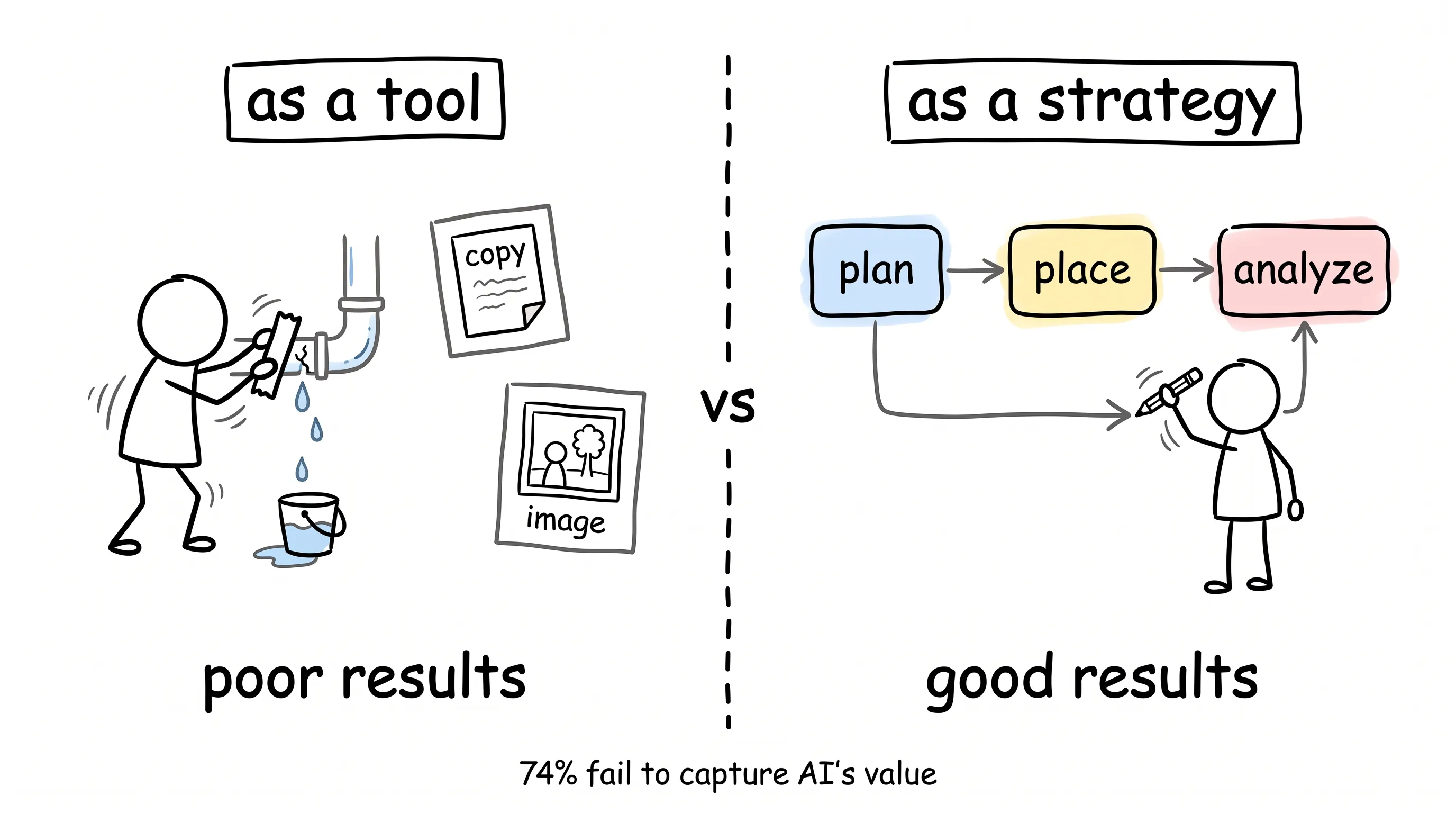
What does "as a tool" look like? Plug the hole wherever it leaks. Copy is backed up, so AI writes the copy. Images run short, so AI draws them. Each team fights its own fire; nobody compares notes.
And "as a strategy"? Tear the whole workflow apart and lay it out again: which steps AI takes over, how the data gets re-fed, where the people move to. McKinsey puts it bluntly: capturing AI's value depends on process redesign, data, and organizational change. The tool itself is the least important piece.
McKinsey's own estimate: generative AI can lift marketing productivity by 5% to 15%. Note the word — productivity, not revenue. It hardens the foundation first; the tower hasn't grown taller yet.
So you see, the bottleneck was never AI. It's people.
In Gartner's survey, 91% of marketing leaders complain that AI adoption is too slow, and 75% say optimizing AI is too slow. Only about a quarter dare claim AI is fully woven into daily work. Another 45% say AI has made things messier inside their teams.
IAB's State of Data 2025 cuts even deeper: only 30% of organizations have AI running the full "plan – place – analyze" chain end to end. Half of the organizations don't even have an AI transformation roadmap on paper yet.
Everyone bought the same shovel. Some used it to dig a well. Others just polished the shovel until it gleamed.
What AI renders obsolete are the processes that were never redesigned.
4. The Gift's Price Is Marked on Trust
Of course, everything has another side.
First, one number: more than 70% of marketers have collided with an AI-caused mess at work. Hallucinations, bias, output that strays off brand tone — IAB calls these "AI incidents."
On Gartner's side, 73% of marketing leaders worry AI will make things up, and 70% worry about customer data privacy.
With this many incidents, surely the money should be pouring into governance by now?
IAB's survey says fewer than 35% of organizations plan to increase AI governance and brand safety spending over the next 12 months.
On one side, seven in ten have burned their hands. On the other, fewer than three and a half in ten are willing to install a fire extinguisher.
Every gift of fate has its price marked in the fine print, long before it arrives. For AI in marketing, that price is marked on one word: trust. Advertising is, at bottom, a business built on trust. Suppose AI helps you turn out 100 assets in a day — if just one of them spouts nonsense in public, every minute you saved could be lost back in a single day.
5. The Next Wave Already Has a Shape
So where does this all go?
Toward the places you can already see.
IAB asked buyers of digital video advertising: are you using AI for creative? 86% are using it, or preparing to. They expect that by 2026, video ads made with AI's involvement will make up 40% of the total.
Forty percent. In the creative industries, this is the restructuring that sits closest to the money.
And there's a quieter change still.
Gartner asked marketing leaders: will AI change what customers expect? 86% said yes.
Think about what that means. When more than eight in ten buyers are making video with AI, and customers have grown spoiled by AI-generated experiences all around them, your rival is no longer the company across the street — it's the "AI-boosted industry average."
AI has raised the passing grade.
In Adobe's digital trends research, 65% of executives say AI and predictive analytics are the number-one driver of their growth. And 59% of marketers already feel AI redefining what their job is.
In Microsoft's 2025 Work Trend Index, one number is worth savoring: 79% of leaders believe AI will accelerate their own career growth. Among employees, only 67% think so.
Leaders are always a little more optimistic than their people. That one holds true in every era.
Finally, Back to That Dinner
At the end of that dinner, I asked my friend one more question: now that time is saved — have you thought about spending that saved effort on something you couldn't do before?
Like actually stringing together the customer feedback scattered across inboxes, spreadsheets, and meeting notes — and rebuilding the whole campaign workflow from end to end?
He said he had thought about it. But nobody had taken the lead.
I said: well, there it is.
Gartner's judgment: the hype phase of AI is winding down, and marketers are shifting from "let's try it" to "show me the numbers." The tool money, anyone can save. The process money belongs only to the few companies brave enough to perform surgery.
Here's to your 11 minutes — may they add up not just to 10 hours, but to a whole new business.
Continue reading
Related articles

Cross-Border Business: Time to Upgrade Your AI Toolbox
A learn article explaining how AI tools help cross-border e-commerce sellers clear five hurdles: language, regulation, logistics, payments, and fraud. It outlines a five-compartment toolbox, a five-step adoption path, and metrics such as conversion rate and CLV, while cautioning against over-reliance on AI.

AI Is Taking Over the Dirty Work of Social Media Marketing, One Task at a Time
This learn article outlines four social media marketing tasks AI can handle — audience analytics, content drafting and design, ad targeting and creative testing, and spam moderation — and cautions that taste, judgment, and data security remain human responsibilities.

AI Is Already This Good — Why Is Your Social Media Marketing Still Pure Manpower?
An overview of 18 AI tools for social media marketing, organized into six categories covering audience research, content creation, scheduling, comment and DM handling, ad management, and visual production, plus notes on personalization, prediction, and emerging trends.