
92% of Brands Are Doing AI Personalization. Only 24% Do It Well
A while back, I stopped by the pharmacy near my home to pick up a routine prescription.
A while back, I stopped by the pharmacy near my home to pick up a routine prescription. The prescription was written by my doctor, and the medication was one I'd been taking for years. That was all. And yet I stood at the counter for nearly twenty minutes.
The pharmacist was perfectly polite, but every single step required a fresh lookup and a fresh question: verifying my identity, digging through records, calling the doctor to confirm. I don't blame him. He faces hundreds of faces a day — how could he possibly remember every one?
But one thought kept surfacing: this didn't have to be so hard.
Later, when I saw what the US pharmacy chain Walgreens is doing, that afternoon came straight back to me. Walgreens built an AI-powered automatic triage at the pharmacy counter: the moment a customer arrives, the system gets to work. By the time it's your turn to check out, the pharmacist already has everything he needs to know at his fingertips.
You never have to say a word.
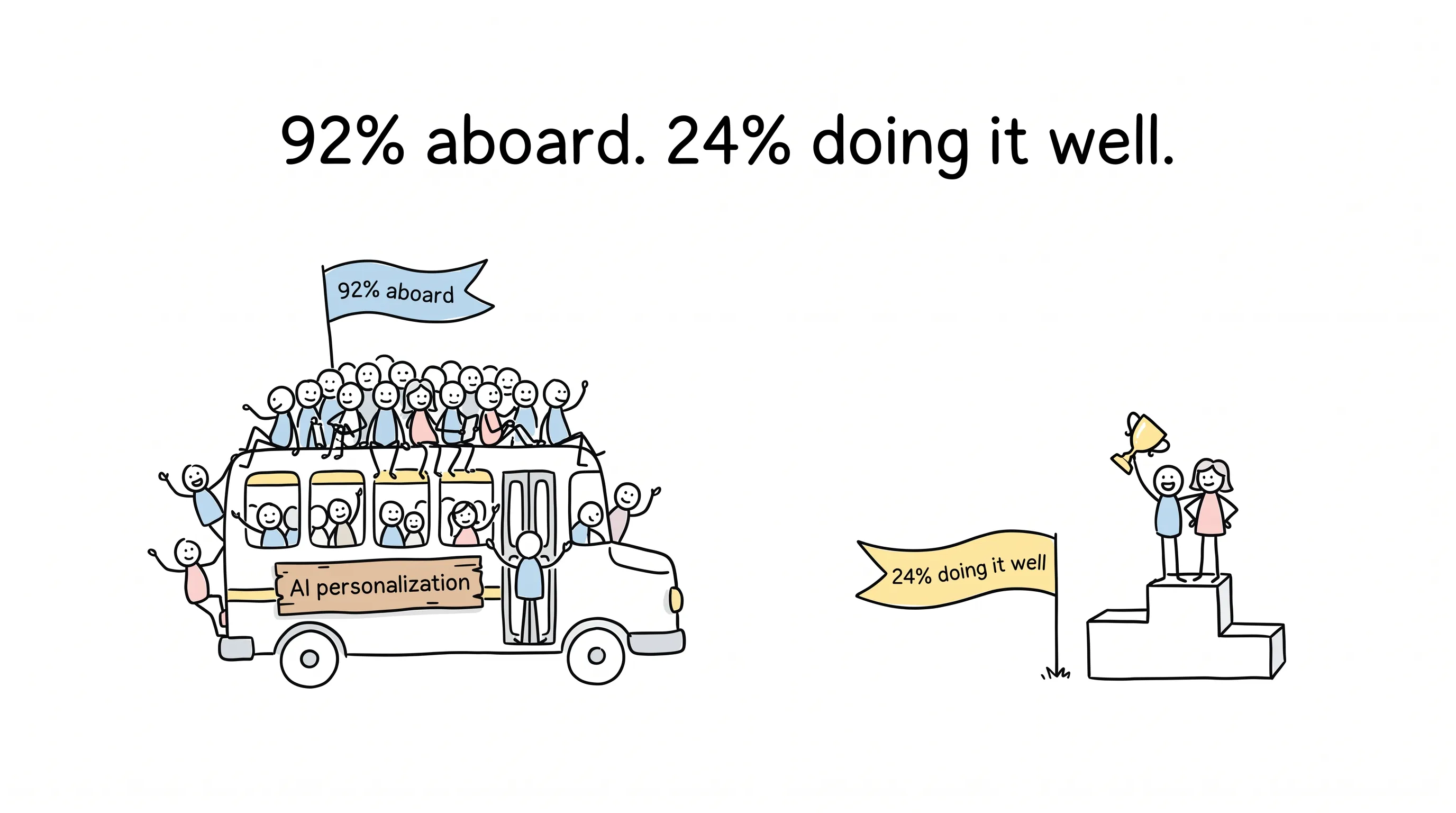
That's what I want to talk about today: AI personalization. In Medallia's 2024 report, 92% of brands say they're using AI for personalization; yet in that same report, only 24% believe their own experience qualifies as "highly personalized."
A business almost everyone has climbed aboard — and almost no one has mastered.
What Is AI Personalization?
So what is AI personalization?
Plainly put: it's letting machines "get to know" each of your customers for you — then turning that knowledge into exactly the products, content, services, and offers each one happens to need.
You've long since seen the handmade version of this. The woman who runs the corner store downstairs sees you walk in and says: that soda you like came in yesterday — I set two aside for you. Why do you always buy from her? Because she knows you.
But a hundred customers is about the limit for a shop owner. Your brand has to face a hundred thousand, a million. Now what?
The answer is AI personalization: using algorithms and data analysis to turn "knowing every customer" from a craft into an industry. What customers bought, what they browsed, what they complained about — all of it becomes input for the system's next move. What to recommend, which emails to send, which perks to give — everything can be tailored per person, at a speed no human team could ever match.
Corner-store relationships at industrial scale. That is AI personalization.
Run the Numbers: This Isn't Magic
What is personalization actually worth? Forget the concepts. Look at the numbers.
There's a company called Medallia that specializes in customer experience management and has been studying personalization for years. In a 2023 consumer survey, 82% of consumers said that in at least half of their shopping situations, whether the experience is personalized directly decides which brand they choose.
Roughly eight out of ten customers will take their business elsewhere over one question: do you get me?
Now the supply side. Medallia's 2024 State of CX Personalization report found that making experiences more personalized is priority number one for customer experience practitioners. Everyone is doing it.
So how are they doing?
Only 24% of practitioners believe their own experience qualifies as "highly personalized." The consumer side stings more: earlier research cited in the report shows only 26% of people felt their most recent interaction with a brand was highly personalized.
24% versus 26% — the two sides line up almost perfectly.
Brands feel they're falling short, and customers genuinely don't feel it either. And the bigger the gap, the bigger the opportunity: the track is packed with runners, but hardly anyone is actually running.
One more number, for those still hesitating. In the same report, the brands that rated their own personalization capabilities highest were twice as likely as weaker performers to post revenue growth of more than 10%.
The better your personalization, the closer your growth. This isn't a feeling. It's statistics.
What's Actually in the Toolbox?
Where do you start? Strip down the most common approaches on the market and you find three classes of tools, each layer a step further along.
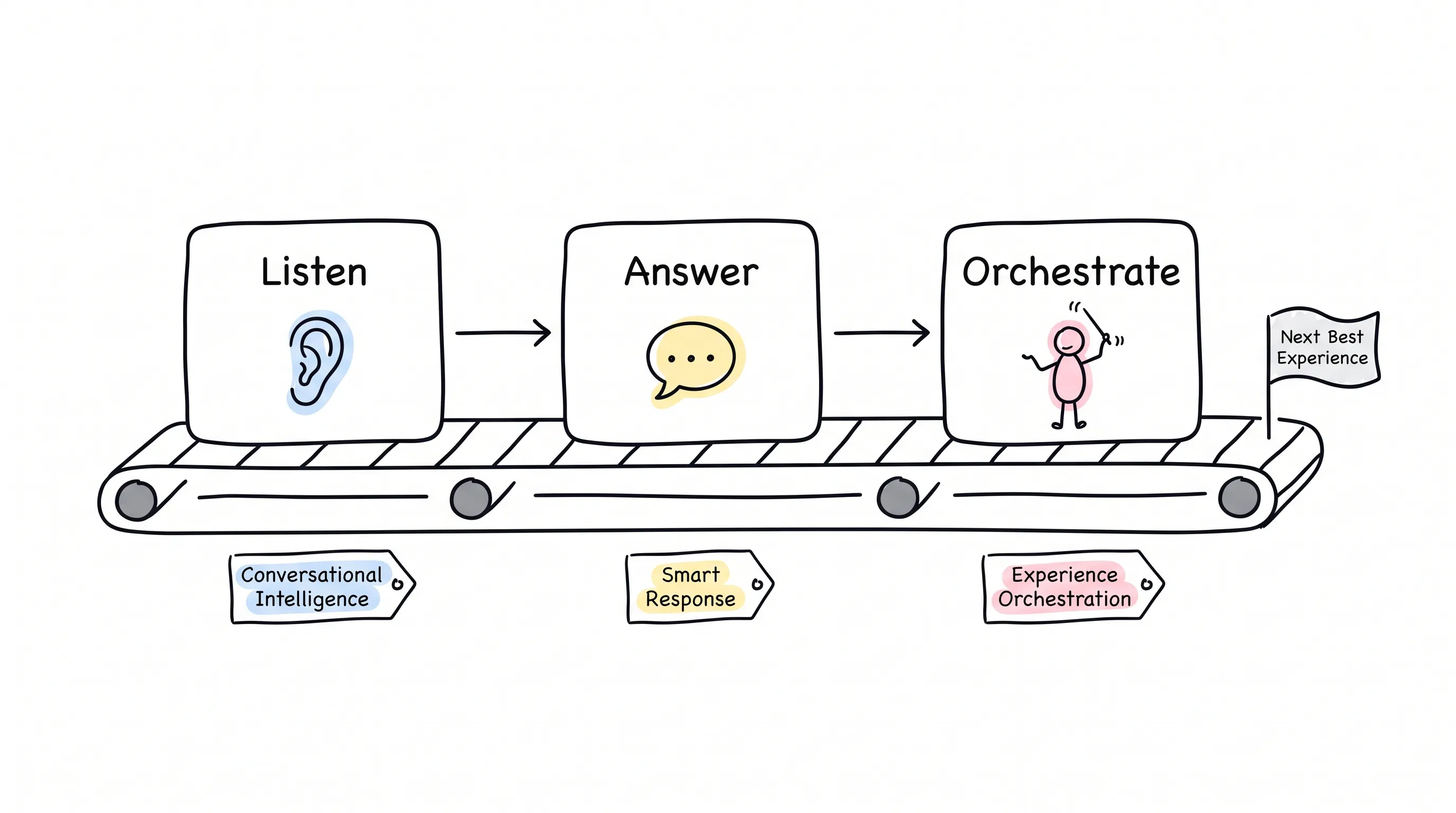
Layer one: listen first. The flagship is Conversational Intelligence, which combines two disciplines: text analytics and speech analytics. It digests massive volumes of service conversations, calls, and messages, and turns them into insight. It doesn't just tell you what customers said; it can predict what they'll want next. A 2025 Medallia survey found that this kind of AI-powered Conversational Intelligence measurably lifts a whole chain of metrics, from NPS (Net Promoter Score — whether customers would recommend you) to average order value. Small wonder most practitioners in that survey said they plan to invest even more.
Layer two: answer. The flagship is Smart Response, powered by generative AI: it reads what the conversation is about, then generates a reply that belongs to this one customer, in this context. The customer switches topics; it switches with them. For service scenarios, this is the most practical application there is.
Layer three: orchestrate. The flagship is Experience Orchestration, turning the understanding accumulated by the first two layers into action: based on each customer's current intent, interests, and behavior, it decides in real time what experience to give next — and brings service costs down along the way. Medallia's Experience Orchestration is exactly this kind of solution.
Listen first, then answer, then orchestrate. The industrial assembly line of personalization has exactly three stations.
It Serves You Every Day — You Just Don't Notice
What does this assembly line look like in daily life? You're already living it.
You open a shopping app and the homepage is full of the things you lingered on last time — that's the recommendation engine going through your browsing and purchase history. An after-sales email picks up right where your last question left off, no need to start over — that's email and service replies tailored per person. Your feed gets more and more to your taste the longer you scroll — that's dynamic content tracking your interests. A birthday-month coupon arrives, and it happens to be for the store you buy from most — that's perks distributed per person: if you regularly buy baby products, no one should be pitching you an esports keyboard.
It goes further: prediction. Based on accumulated data, AI anticipates shifts in your interests — and even anticipates whether you're about to leave. When the system spots a customer whose churn risk is climbing, it moves before they walk, offering something they genuinely care about. The industry calls this Next Best Experience: the next step is the one experience that fits best.
Before you even speak, it's already on its way.
That's what makes this technology so powerful — and also where the most restraint is required.
The Case Where Conversion Rose 106%
Let me give you a real case.
BSH Group, one of the most recognizable names in global home appliances. Using Medallia's AI personalization and experience orchestration capabilities, it connected 40 multichannel touchpoints: website, marketing channels, email, physical stores, CRM — all of it, plugged in.
The system does several things. First, it pulls in the voice of the customer across all 40 touchpoints to work out who each customer actually is. Then it watches for churn: at which step do customers turn away, where is the breaking point, what's the root cause. Flip it around, and it isolates the actions that genuinely drive conversion. Then it computes a real-time engagement score for every customer. Finally, it arranges experiences according to that score, walking each person all the way to the sale.
The result?
Conversion rate up 106%. Add-to-cart conversion up 22%.
You read that right. 106% — as good as doubling your sales out of thin air.
Imagine that. That is the return on turning "knowing your customers" into a system.
Back to That Pharmacy
Now think about that pharmacy again. My prescription was right. The medication was right. What was wrong was that in the entire process, not one person — and not one system — "knew me."
The technology has been sitting there all along. The 2023 survey said customers want personalization. In 2024, practitioners ranked it priority number one. In 2025, investment in Conversational Intelligence is being scaled up. The signals keep coming, one after another, without pause.
Only one difference remains: 92% of brands have already climbed aboard, but those who truly treat a million customers as a million "individual customers" are still the few.
With personalization, the hard part was never the algorithm. It's treating "knowing every customer" as a craft to be practiced.
May you be more than one of the 92%.
May you be one of the 24%.
Continue reading
Related articles

Cross-Border Business: Time to Upgrade Your AI Toolbox
A learn article explaining how AI tools help cross-border e-commerce sellers clear five hurdles: language, regulation, logistics, payments, and fraud. It outlines a five-compartment toolbox, a five-step adoption path, and metrics such as conversion rate and CLV, while cautioning against over-reliance on AI.

AI Is Taking Over the Dirty Work of Social Media Marketing, One Task at a Time
This learn article outlines four social media marketing tasks AI can handle — audience analytics, content drafting and design, ad targeting and creative testing, and spam moderation — and cautions that taste, judgment, and data security remain human responsibilities.

AI Is Already This Good — Why Is Your Social Media Marketing Still Pure Manpower?
An overview of 18 AI tools for social media marketing, organized into six categories covering audience research, content creation, scheduling, comment and DM handling, ad management, and visual production, plus notes on personalization, prediction, and emerging trends.