
91% of Teams Are Using AI. Only 41% Can Do the ROI Math
A learn article on the gap between widespread AI adoption in marketing teams and the ability to prove ROI, citing industry reports on adoption rates, governance, maturity, and practical steps for tying AI to business results.
A while back, I had dinner with an old friend who runs B2B (business-to-business) marketing.
Over one meal, he sighed three times.
I asked what was wrong. He said, "Man, we've practically bought the full set of AI tools at my company. AI writes the copy, AI makes the visuals, AI takes the meeting notes. You can see the productivity gains with your own eyes."
But at last month's board meeting, the CFO asked him one question: how much revenue has AI actually brought the company?
He froze.
He said, "I can rattle off a pile of numbers — hours saved, extra content produced. But the moment those numbers come face to face with money, they all go soft."
I told him: your predicament is not yours alone. Today, nearly every B2B company is stuck in the exact same spot.
1. Everyone's on the Bus, but Nobody Knows Where It's Heading
Start with two sets of numbers.
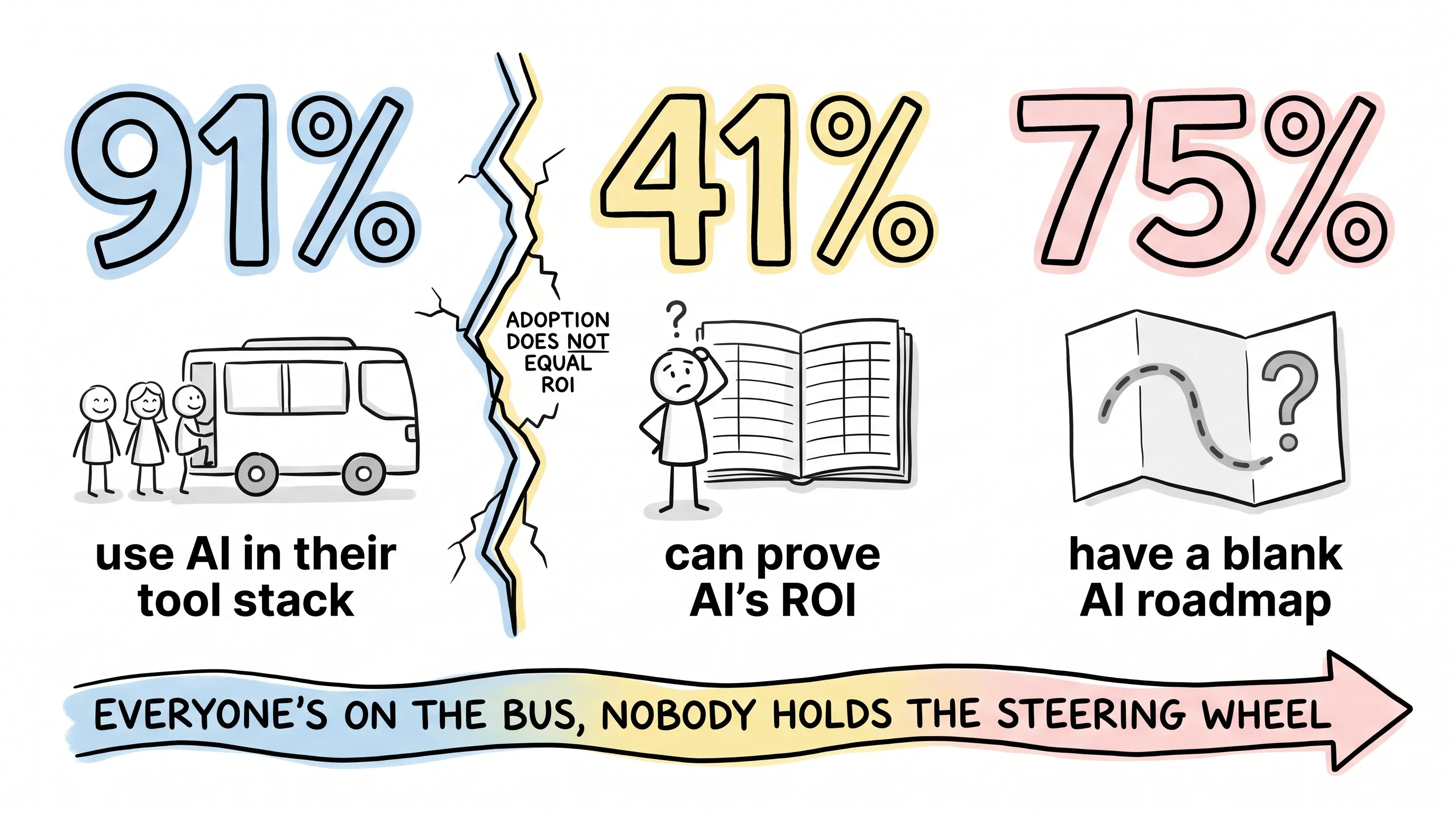
Jasper published a State of AI in Marketing report. It says 91% of marketing teams already have AI in their tool stack.
91%. What does that mean? Basically, everyone is on the bus.
But the other set of numbers stings. From the same report: only 41% of marketers dare claim they can prove AI is delivering ROI (return on investment).
And that number had dropped from the year before — a year when it was still nearly half.
Picture the scene: everyone has boarded the bus, yet most people have no idea where it's going.
So where's the problem?
Many people's first reaction: the technology isn't mature yet.
Wrong.
SmarterX and Marketing AI Institute published a State of Marketing AI report in 2025. One number in it stopped me cold the first time I saw it: a full 75% of companies have a completely blank AI roadmap for the next year or two.
It's not that the technology is running too slow. It's that nobody's holding the steering wheel.
Everyone is charging ahead, yet many haven't even thought through what the finish line looks like.
So if you're a CMO, or the person in charge of marketing technology, the question you should really be asking today is no longer "are we using AI?"
It's: is AI genuinely moving pipeline, deal velocity, and revenue?
2. The Tactical Trap: AI Is Smoothest Exactly Where It's Worth the Least
So why can't most people do this math?
Because everyone has deployed AI in the "safest" places.
What does safest mean? Writing social posts, brainstorming email subject lines, summarizing meeting notes. AI does these jobs fast, well, and without surprises. A human eyeballs the output, then it ships. Very safe.
Move Forward Strategies published a 2026 State of AI and B2B Marketing report. 71% of B2B companies use AI to produce content, and 56% believe AI's main value lies in exactly these basic execution tasks.
See? That's the comfort zone.
No betting the brand voice, no fighting over product positioning, and output keeps climbing. Who wouldn't say: now there's a team embracing AI.
But there's a trap hidden in there. I call it random acts of AI.
What do I mean by random? Swinging here, hammering there. Output goes way up, but there is not a single thread connecting that output to business results.
AI has genuinely made you faster. But if your original direction was already wrong, you're just running toward the wrong place faster.
3. Why Do We Let AI Draft but Never Set Strategy?
You might say: then go deeper — let AI do strategy.
Do you dare?
Nearly every leader I know will let AI draft a blog outline. But hand it market positioning, customer segmentation? Very few dare.
The numbers are honest, too. Only 6% of leaders are willing to hand high-stakes decisions like positioning to AI. 57% believe strategic thinking is AI's biggest weakness. And 88% say AI output must be reworked before it's actually usable.
Growth Syndicate's research confirms it: AI is humming along in content creation and campaign execution, but the moment you reach market planning and positioning — the calls that actually decide things — usage falls off a cliff.
Why?
Think about what AI is good at. Organizing data, restructuring language, distilling themes. It's strong at all of that.
But it can't touch context.
Why did that deal fall apart? What is the client actually losing sleep over at midnight? None of this is written in any database. It lives only in the hard knocks of frontline work.
Context is precisely where the value is — and where the risk is. And today, that thing is still in human hands.
So my advice: don't let AI make your go-to-market strategy for you. Treat it as a thinking partner. Throw your ideas at it, let it game out scenarios and surface your blind spots.
The steering wheel stays in your hands. It draws the maps and sounds your ideas back to you.
4. The Maturity Divide: Same AI, Some Win and Some Just Ride Along
So what kind of team actually breaks out?
Jasper's report gives a very clear answer: maturity is the variable that separates the field. High-maturity organizations are twice as likely to deliver real, tangible ROI.
And the 2025 State of Marketing AI report shows most teams as they actually are: only one company in four has a written AI roadmap. Fewer still have even basic usage policies.
A lot of teams look like this: each department experiments with AI on its own, no shared alignment, let alone shared governance. Strategy lives in one place, tools in another, and measurement can't reach either. Sound familiar?
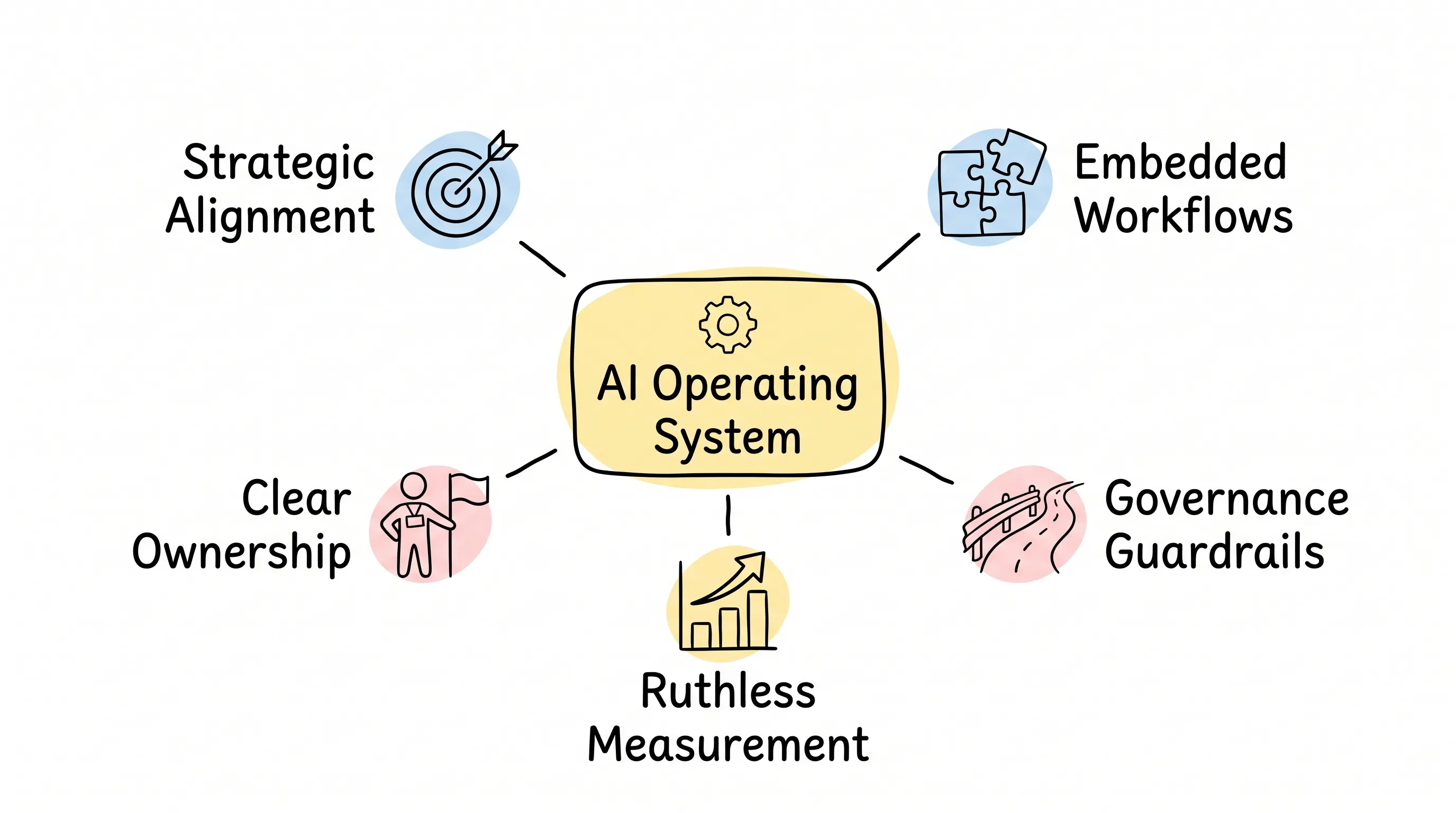
So what does maturity actually look like? From what I've seen, it's five things.
Strategic alignment. If AI isn't aimed at revenue bottlenecks, it's just doing chores.
Embedded in workflows. Top teams bolt AI straight into their CRM (customer relationship management), MAP (marketing automation platform), and attribution systems. Insights turn straight into action instead of lying in another browser tab, gathering dust.
Clear ownership. Who signs off on output quality, who owns compliance, who keeps improving the system — written down, in plain words.
Governance guardrails. Brand, legal, privacy, data. Draw the boundaries first.
Ruthless measurement. KPIs (key performance indicators) that don't stop at "how much content did we produce" and go straight at business impact.
Put simply: great teams don't run random experiments. They turn AI into an operating system.
5. Where AI Actually Makes Money: Three Places
Theory alone is too thin. Let's get concrete — where is the math actually working out today?
First place: personalization at scale.
Roughly 63% of enterprises are seeing clear wins here.
And note — this is not stuffing "Dear Mr. Zhang" into an email. It's dynamically re-tailoring content by role, by industry, by customer. ON24's research on AI in B2B marketing shows AI-driven personalization genuinely lifting engagement metrics across every kind of digital touchpoint, from live-event attendance to content interaction.
Once first-party behavioral data is activated by AI, the conversion lift can actually be computed. Today's B2B buyers have been spoiled rotten: blast them with generic messaging and they won't even glance. So where is AI's real value? In making "relevance" scalable. The time savings are just a side effect.
Second place: the content recycling engine.
Your whitepapers, research reports, webinar replays — do they retire to a shelf and gather dust the moment they're done?
AI can take one asset, pull it apart, and spin it into blog posts, LinkedIn carousels, industry-targeted emails. One spend, ten meals' worth of value.
Third place: data enrichment and ABM (account-based marketing).
AI cleans your CRM records, tiers your target accounts, catches the intent signals sales tends to miss. Leads that used to get "let's revisit next quarter" get turned into real opportunities.
ON24's research also notes that engagement analysis based on real-time digital behavior helps marketing and sales lock onto high-intent buyers together.
Low-maturity teams use AI to produce more stuff. High-maturity teams use AI to unlock things they could never do before.
That sentence is worth reading twice.
6. Governance: One Hurdle Between Scattered Use and an Enterprise Capability
There's one more shift a lot of people haven't caught up to yet.
A number from Jasper's report: over the past year, governance-related concerns multiplied 3.4x.
3.4x. Why the sudden anxiety?
Because AI is no longer a little toy on the table. It's becoming something like a foundation. And foundation-level risks are a completely different order of magnitude from the last generation of marketing tools.
AI fabricates data (hallucination) and drifts off-tone. Worse is privacy: the moment prompts in your workflows start touching sensitive customer information, the risk moves up a notch.
But here's the interesting part: governance isn't a leash. It's a starting block.
Set your review process, privacy rules, and brand boundaries first, and the team actually runs faster. Why? Because once the boundaries are clear, nobody has to guess "can this go out." All the time saved from dithering goes straight back into the work.
The organizations with the clearest rules tend to run the fastest.
7. Next Stop: From Tools to Agents
Let's look one step further ahead.
Today's AI mostly sits beside you and nudges: "Here's a title variant — want it?"
The next generation of agentic workflows gets to work for you.
It will kick off nurture flows on its own when real-time signals fire. It will adjust the messaging mid-campaign based on engagement data. It will propose — and even execute — budget reallocations. It will watch the performance curve and auto-optimize the moment it dips.
Of course, all of this rests on tighter workflow integration, stronger governance, and clearer accountability.
Whoever redesigns "how decisions get made" first captures the next wave of gains.
8. If You're the CMO: Four Steps You Can Start Tomorrow
Alright, the reasoning is done. From "interesting experiment" to "ROI engine," the road is open — the only question is whether you'll build the structure.
Four things, in order.
1. Bolt AI to revenue. Find one or two real bottlenecks — pipeline progression, deal acceleration, post-sale expansion — and throw your AI budget at them. Don't adopt AI for AI's sake.
2. Build the operating model. Who signs off on AI's output? Who trains the models? Who's on the hook when something breaks? Write it down in black and white, and turn review into muscle memory — not a cleanup after the accident.
3. Integrate; stop collecting tools. Stop stacking isolated little AI gadgets. Embed AI into the CRM, MAP, and analytics platforms your team already lives in, and let the data actually flow.
4. Upskill everyone. To use AI well, writing prompts is just the entry ticket. The team has to spot hallucinations, verify output, guard the data. More importantly, understand why every step is used the way it is.
Writing this, I think of the friend from the opening.
At the end of that dinner, I gave him one line. Here it is for you too:
AI is a lever, not the answer. The lever only amplifies the strength you already have. The more solid your processes, data, and governance, the more your lever is worth.
Turn experiments into systems. Turn systems into muscle.
The leaders who have truly thought this through won't linger in the thrill of "we tried a few small tools." They'll take their organizations and weld AI into every pipe of daily operations.
If you're still in the "trying things here and there" stage, don't panic. Audit first, then lay the foundation, then get the team aligned.
AI was never the destination. The real dividing line has always been the person who knows how to use the lever.
Here's to tallying your own ledger, sooner rather than later.
Continue reading
Related articles

Cross-Border Business: Time to Upgrade Your AI Toolbox
A learn article explaining how AI tools help cross-border e-commerce sellers clear five hurdles: language, regulation, logistics, payments, and fraud. It outlines a five-compartment toolbox, a five-step adoption path, and metrics such as conversion rate and CLV, while cautioning against over-reliance on AI.

AI Is Taking Over the Dirty Work of Social Media Marketing, One Task at a Time
This learn article outlines four social media marketing tasks AI can handle — audience analytics, content drafting and design, ad targeting and creative testing, and spam moderation — and cautions that taste, judgment, and data security remain human responsibilities.

AI Is Already This Good — Why Is Your Social Media Marketing Still Pure Manpower?
An overview of 18 AI tools for social media marketing, organized into six categories covering audience research, content creation, scheduling, comment and DM handling, ad management, and visual production, plus notes on personalization, prediction, and emerging trends.