
90% of Marketing Teams Use AI. So Why Do Only 10% Get Results?
A while back, I came across a set of numbers that genuinely surprised me.
A while back, I came across a set of numbers that genuinely surprised me.
HubSpot just released its 2026 report on the state of AI in marketing, surveying more than 1,700 marketers. Hidden in the data is a glaring dividing line: only 10% of marketing teams are truly using AI to change their business. The other 90% use it too — every day, in fact — but the results? Mediocre.
Same tools, bought and paid for. Same daily usage. So why is the gap so wide?
I read the report cover to cover, then thought it through against a few teams I know firsthand. The gap isn't about whether you use AI. It comes down to one term: AI maturity.
The winning 10% have stopped treating AI as a "tool." They run AI as a system.
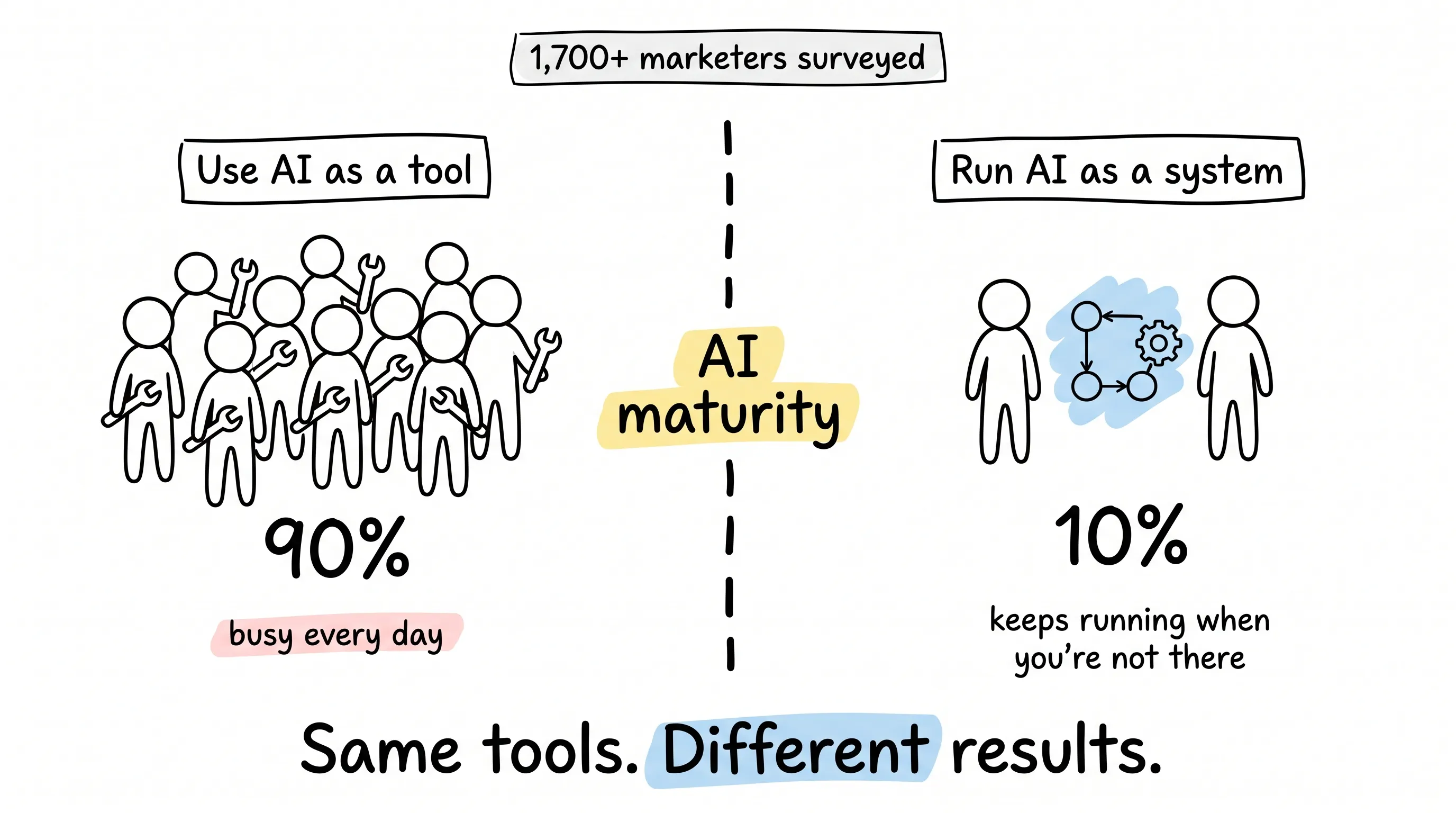
What's the difference between a tool and a system?
A tool is something you reach for when you remember to. A system is something that keeps running when you're not there.
Between the 90% and the 10% sits a single chain. I've broken it into six steps. Let's take them one at a time.
Step 1: Be Honest — Which Stage Are You In?
The report breaks AI maturity into four stages.
What does Early mean? You're still "experimenting." Every now and then you have AI write a headline or punch up some copy. It's hit or miss, and you can't really articulate the results.
One level up is Growth. AI is now inside real workflows and starting to deliver, but you're still figuring it out — good days and bad days.
Above that sits Mature. AI produces reliably across a few core functions. The team knows it can count on AI, and knows what to expect from it.
At the very top is Transformation. AI has become the foundation the whole team runs on, and it's starting to reshape how the entire company works.
Don't these four stages look a lot like the gym?
A membership you signed up for and visit once in a while? That's Early. Training to a set schedule? Growth. Steady, consistent results? Mature. When the workouts have reshaped your whole routine and state of mind — that's transformation.
The problem with most teams: they overestimate where they stand. You think you're Mature. You might still be in Growth.
Here's a dead-simple test: if you can't clearly say which stage you're in, chances are you're not in the fourth one.
Once you've located yourself, the way forward depends on the stage.
If you're in Early: pick one small, repetitive task and automate it completely. Social captions, email subject lines — anything. Don't be greedy. Finish one thing before starting the next.
If you're in Growth, the problem usually isn't the tool — it's the process. One exercise that works immediately: have AI review your last three campaigns. Where did the numbers drop? What data had you already seen but never acted on?
If you're already Mature and want to jump higher, one thing matters: look at what you're feeding your AI. It points straight at the next step.
Step 2: From "You Ask, It Answers" to "It Runs on Its Own"
Last year, most teams used AI like a lightning-fast assistant: you ask a question, it gives an answer.
The teams out front now let AI run entire workflows on its own.
Behind this shift are two different words: the AI tool and the AI agent.
Here's the plain-English version. An AI tool answers when you ask. An AI agent takes a goal and gets the job done on its own — no step-by-step nudging required.
What does the data say? 86% of marketing departments are already using agents, and 76% say usage has kept climbing over the past six months.
Adoption is that high — yet pull any of those people aside, ask what an agent actually is, and most can't tell you.
Here's the sting: most teams are dabbling with two or three agents, each working in isolation. Top teams run four to six, wired into one system. Humans are still watching — but only for the final sign-off. No more shuttling work by hand.
How do you start? Pick a task that currently takes several back-and-forth rounds with AI to finish. The easiest on-ramp is content repurposing.
Take one long article, and have an agent pull out the key points, write the social captions, draft a three-line email summary, and produce a 60-second spoken script. One input, four outputs, zero human effort in between.
Once two of these run smoothly, chain them together: the breakdown agent produces the assets, the distribution agent delivers them where they need to go. All you do is click "approve" at the end.
Step 3: Great Chefs Are Everywhere. Ingredients Are Scarce.
Which raises a new question: even with the strongest agent lineup in the industry, what's the point if your output looks like everyone else's?
That's why step three — the most commonly skipped step — is this: what you feed your AI matters more than which AI you use.
What's the most-used AI tool right now? Still ChatGPT. Everyone uses it. So where's your moat?
It's in the "intelligence layer" behind you: customer data, campaign history, brand voice. Nobody can copy those. Only when AI can see them does your output stop being generic.
Reality is brutal, though: only 25% of teams believe their own data qualifies as excellent.
In other words, most people are serving a genius chef last night's takeout — then complaining the dish tastes bad.
How do you fix it? Start with a health check: what can your AI actually "see"? Customer data in your CRM? Brand guidelines? Past campaign records? Whatever it can't see — that's your action list.
Then connect one data source this week. Most teams start with the CRM. Plenty of CRMs now plug directly into mainstream AI tools — HubSpot and Claude, for example.
One last piece of straight talk: clean your data before you connect anything. It's the most boring, most painful step in the entire chain. But conclusions built on dirty data? You wouldn't trust them yourself.
Step 4: An Exam Nobody Handed You a Syllabus For
We've covered tools and data. Step four is about people. It's the easiest step to skip — and the most sobering.
53% of marketers worry, to some degree, that AI threatens their jobs. Last year everyone kept telling each other: learn AI now, save your job. Looking back... I hope you actually listened.
Here's the number that really stings: only 15% of companies have put their AI skill requirements down in writing — yet 35% are already quietly factoring AI skills into hiring, performance reviews, and pay.
What does that mean?
A lot of people are being graded on an exam nobody handed them a syllabus for.
There are two sides to this.
If you're the one being graded: make yourself "seen." Write down, line by line, what you've done with AI and what results it produced, and bring that list into your next performance review. Remember, "writing one piece of copy with AI" and "running an AI-powered content pipeline" are two entirely different skills.
If you're the one grading: your team is waiting for you to define "what good looks like." Say it out loud — ideally before the performance reviews begin, not after.
One signal worth noting: the two hottest roles right now, tied for first, are AEO specialists (AEO = Answer Engine Optimization) and AI coaches. Don't rush to hire externally. Someone on your team is probably already doing that job without the title. A raise for that person costs far less than a new hire.
Step 5: Speed Is What Shortening Buys You
One more word separates the 10% from everyone else: fast.
27% of marketers say speed is where AI delivers the clearest gains. And AI is fast. But the real gain comes from shortening the distance between "something's off" and "it's fixed."
Think about it: most companies still run on a monthly reporting rhythm. By the time your fix has cleared layer after layer of approvals, the moment has long gone cold.
What do Transformation-stage teams do? They review data weekly, sometimes daily, and adjust live campaigns within hours.
The method is plain. Pick one live campaign and ask yourself: when did I last really look at it? If it's been more than a week, start there. Set a fixed time to review the data, find the problem, fix one thing.
No heroics required. A/B test two email subject lines on Friday, check open rates, put the winning one to work on Monday.
Small tweaks rolling across live campaigns compound far faster than starting over from scratch, again and again.
Step 6: Point the System Beyond Your Walls
The first five steps are all in-house groundwork. To see real compounding, you have to turn the system outward. Beyond your walls, two things matter.
First: get AI to "mention you."
Remember the AEO specialist from step four — the hottest hire? Here's why they're hot: people click fewer links than ever. When a question comes up, they ask AI directly, and the answer lands right in front of them. Not a single click required.
What does that mean? If your content isn't organized in a form that can show up inside those answers, you're invisible before the user ever sees your brand.
What is AEO? Answer Engine Optimization. In plain terms: organize your data and expertise so answer engines can find it, understand it, and want to cite it. It's the outward-facing version of step three's "feed your AI good data."
A drill you can run this week: take one article, find the answer buried in the middle, and move it to the top. Write it short. Write it direct. Answer engines only cite what they can pull out without extra context. And by the way — a person scrolling their phone at 11 p.m. runs on the exact same logic.
Second: keep the people who find you.
Companies using AI for personalization were 3x more likely to grow revenue over the past year.
The logic is simple: generic content keeps getting cheaper, which means fewer people read it. Pick one segment you already have — existing customers, trial users, people who downloaded a particular resource — and look at what you're sending them now. Is it the same thing you send everyone?
If it is, that's your opening. Use AI to write three versions for that segment: same message, different angles.
Answer engines get you found. Personalization keeps people around. Stack both on top of that in-house system, and the gap opens up.
Finally: Connect the Chain
Look back and you'll see the six steps lock together, link by link.
First, figure out which stage you're in — only then do you know where to push. Then build agents and let AI run workflows on its own. Then feed it clean data so the output stops being generic. Then come people and skills, so someone can actually keep the pipeline under control. Once the system runs, shorten the feedback loop and fix problems within the week. Finally, turn outward: get AI to cite you, and keep the right people around.
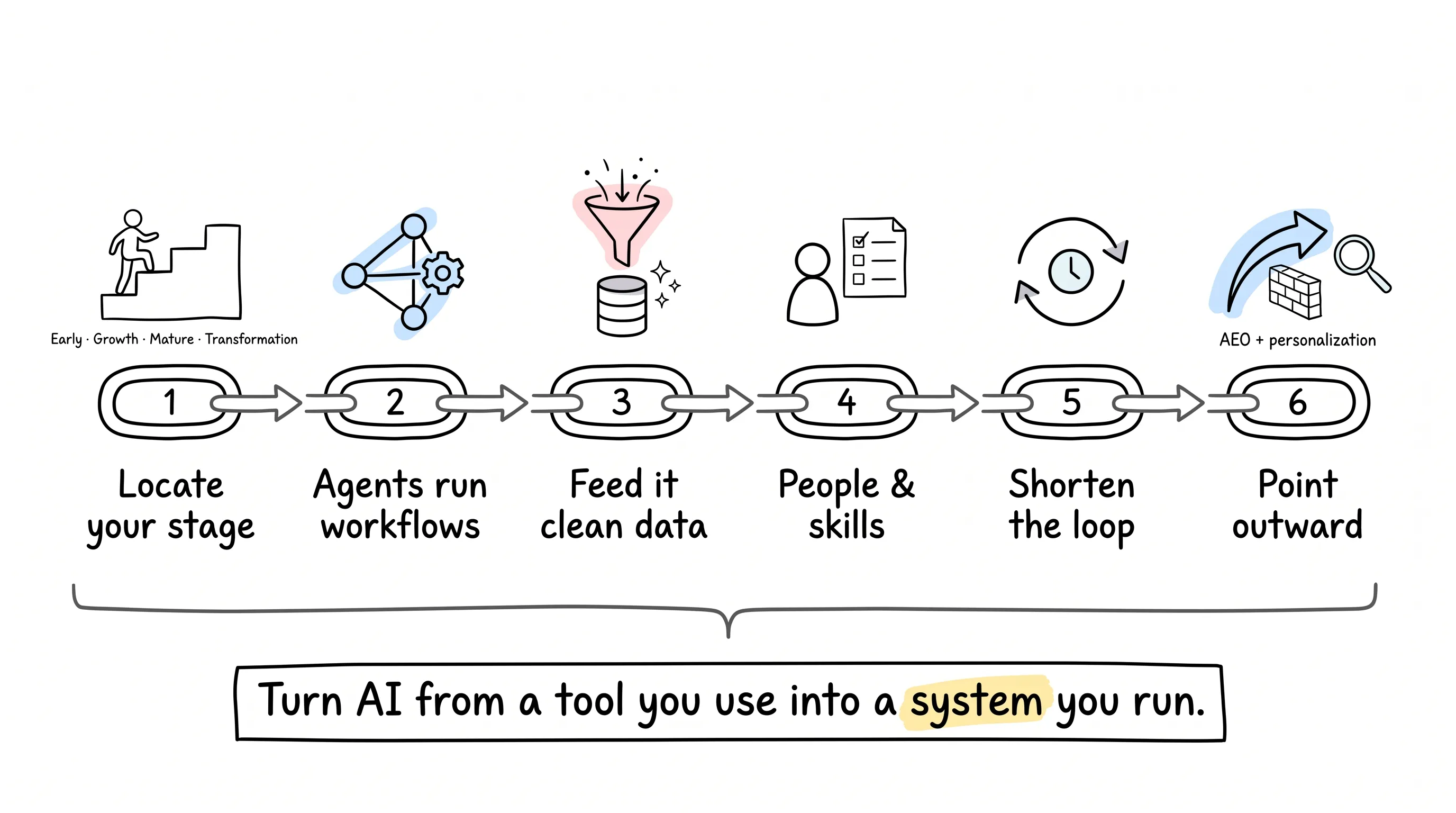
Moving from the 90% to the 10% boils down to one sentence:
Turn AI from a tool you use into a system you run.
If you recognized yourself in more than four of those six steps, don't panic. Go back to step one and start with an honest answer to "which stage am I in?" That's all it takes.
Here's to landing in that 10% — soon.
Continue reading
Related articles

Cross-Border Business: Time to Upgrade Your AI Toolbox
A learn article explaining how AI tools help cross-border e-commerce sellers clear five hurdles: language, regulation, logistics, payments, and fraud. It outlines a five-compartment toolbox, a five-step adoption path, and metrics such as conversion rate and CLV, while cautioning against over-reliance on AI.

AI Is Taking Over the Dirty Work of Social Media Marketing, One Task at a Time
This learn article outlines four social media marketing tasks AI can handle — audience analytics, content drafting and design, ad targeting and creative testing, and spam moderation — and cautions that taste, judgment, and data security remain human responsibilities.

AI Is Already This Good — Why Is Your Social Media Marketing Still Pure Manpower?
An overview of 18 AI tools for social media marketing, organized into six categories covering audience research, content creation, scheduling, comment and DM handling, ad management, and visual production, plus notes on personalization, prediction, and emerging trends.