
88% of Marketers Use AI Every Single Day. But the Data Says the Best Posts Are Co-Written by Humans and AI
A data-rich learn article arguing AI-assisted content outperforms fully AI-generated posts, citing marketer AI-adoption surveys, per-platform engagement figures, video cost cuts, AI-driven influencer marketing, and sparse AI governance, with the takeaway that human judgment is the scarce skill.
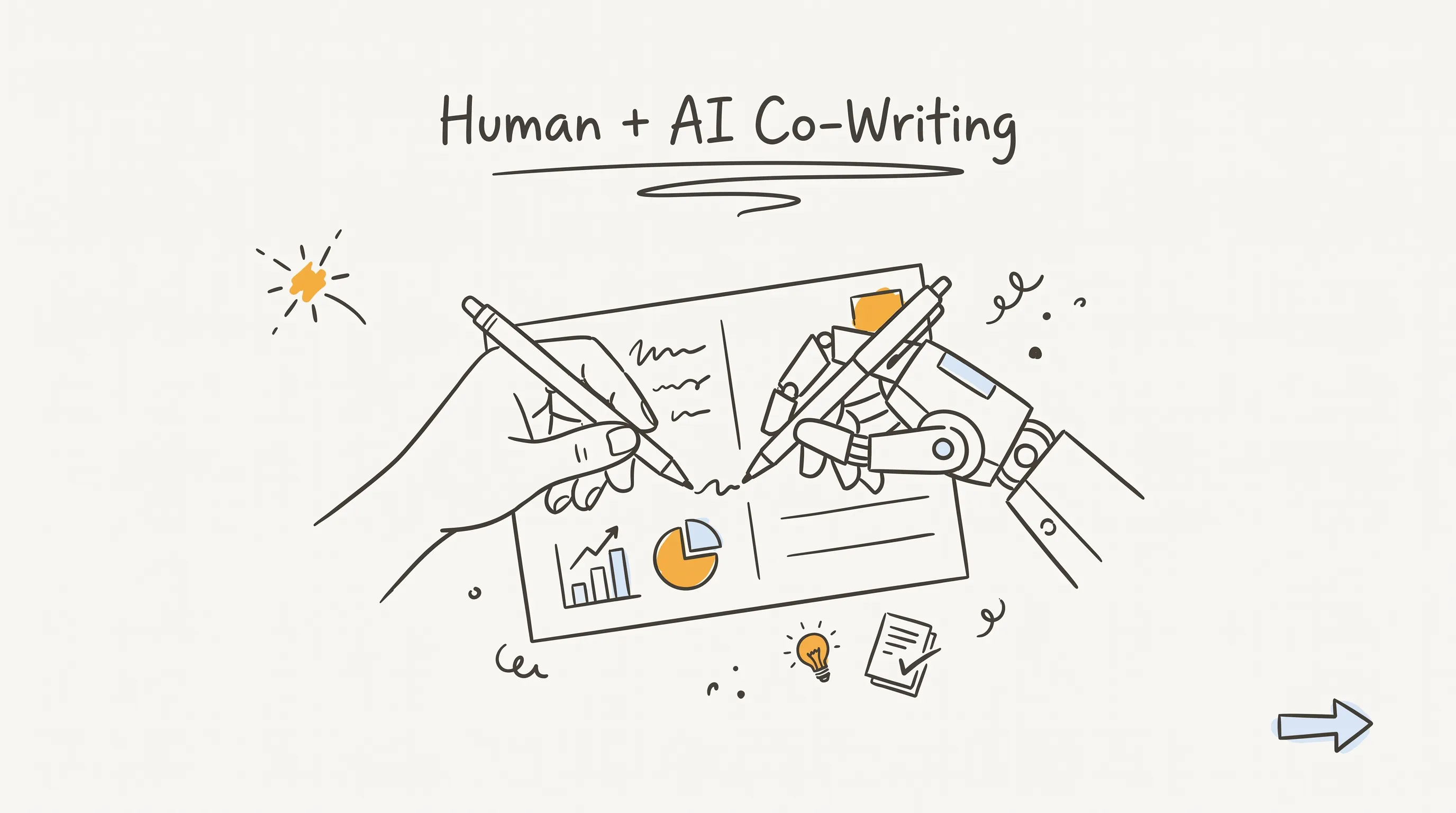
A few days ago, I had dinner with a friend who runs branded social media accounts.
He was pretty pleased with himself. His accounts, he said, were now basically handed over to AI — a dozen-plus posts a day, and he's all but vanished from the work.
I said: congratulations. You may be paying money to run your own accounts into the ground.
He froze. Why?
Everyone Is Using AI — But for What?
Start with the numbers. In 2026, SQ Magazine published a report: 88% of marketers use AI every single day. 93% use it to speed up content creation, 90% to speed up decision-making, and 81% to distill insights.
The Sociality.io survey twists the knife: 89.7% of social media marketers touch AI at least once a week, and 64% of them use it every day.
Good grief. AI is no longer a tool — it's the air we breathe.
And how big has this business gotten? Market.us estimates that in 2025, the global AI-plus-social-media market stood at roughly $3 billion; in 2026, it climbs to about $3.9 billion; and by 2033, it is projected to hit $22.4 billion, a compound annual growth rate of 28.37%. Another firm, Precedence Research, is even more aggressive: $60.5 billion by 2035.
What does that mean? More than a sevenfold jump in seven years.
And what is everyone using AI for? 59.5% use it for data analysis and reporting, 59.5% for topic selection and trend research, and 45.9% for writing copy.
Here's the interesting part: 54% of content marketers use it to find inspiration, but only 6% dare let it write an entire article.
You see, the smart ones figured this out long ago: AI clears the path; humans make the call.
How hard are people leaning on it? Hard. 86% of marketers say AI saves them more than an hour a day. For 61% of agencies, the top reason for adopting AI is taking the load off their people. And what do they do with the time saved? They think. That's math that adds up.
Does It Actually Work?
71% of social media marketers say AI-assisted content performs better than purely human-made content.
In 2025, Data-Buffer ran a platform-by-platform study that breaks this down in finer detail — worth a look.
On LinkedIn, AI-assisted posts saw 5% higher engagement than purely human ones. Facebook: 3% higher. X: 2%. Instagram: 1%.
All positive, right?
Hold on. Now look at purely AI-generated content: LinkedIn, down 2%. X, down 3%. Instagram, down 6%. Facebook, barely flat.
AI-assisted adds points everywhere; fully AI-generated subtracts them everywhere.
What does "AI-assisted" mean? Humans supply the direction, the taste, the judgment; AI supplies the muscle, the first draft, the variations. On any given post, human and machine each do what they're best at.
Fully AI-generated means handing the entire steering wheel to the machine. And readers can smell the difference.
Graphite estimates that in 2025, more than half of the articles published online were already written by AI. Yet AI-written content earns, on average, less than half the backlinks of human-written content — a 2.3x gap.
That helps explain another set of numbers: 78.4% of marketers still make moderate-to-heavy edits to AI output before publishing. Only 21.6% dare to publish with light edits.
The tools are getting mixed, too. In Sociality.io's survey, 69.2% of social media teams use conversational AI, 59% use visual AI, and 41% use text generation. More than half of teams stack two or more tool types.
Nobody expects one hammer to drive every nail.
The Money Story
Now let's talk about cost — the part of this business that's changing most brutally.
AutoFaceless ran the numbers: with AI, video production costs can be cut by 91%, from $4,500 per minute down to $400. Colossyan is even more optimistic, claiming 90% to 97% savings in time and cost, plus the ability to generate 10 to 50 variations in one go.
Hootsuite's Social Trends 2026 research says AI can push publishing volume to 72 posts a week. In July 2025, 9 of the 100 fastest-growing YouTube channels were running entirely AI-generated content.
The influencer economy is being recalculated too. In 2025, the global influencer marketing market reached roughly $32.55 billion, up 35% from the year before. The top-tier play: every $1 invested returns $20. Virtual influencer Aitana López has more than 250,000 followers; another AI persona, Mia Zelu, more than 165,000. And 92% of brands are using — or plan to use — AI to run their influencer campaigns.
What's interesting is what sits underneath: 73% of brands are betting their budget on mid-tier and micro influencers. Why? AI can lift influencer-selection accuracy by 27%. Run the numbers, and the value-for-money of small and mid-tier creators comes out razor-sharp — while the halo around top-tier celebrities is the first thing to get punctured.
Even the industry itself is swelling. The number of companies offering influencer marketing services worldwide grew from 1,120 in 2019 to 6,939 in 2025. Six years, a sixfold increase.
Production costs are in free fall, and content is flooding the world. In an era like this, what's scarce?
Judgment is scarce.
Where Are the Brakes?
But here's the problem: the money is moving too fast, and the brakes haven't caught up.
Back to Sociality.io's survey: 61.5% of teams expect their AI budgets to grow again in 2026. Yet only 17% of companies have established AI governance policies. 22% are running employee training. And nearly half — 48% — have done none of the above.
Half of the teams say data accuracy and AI hallucination are the biggest pitfalls in implementation. 61.1% worry about originality and plagiarism.
Flooding the accelerator while refusing to install brakes isn't courage. That's running naked.
What Did the Ones Who Cracked It Get Right?
Unilever, in July 2025, used an AI-driven influencer strategy to land 3.5 billion social impressions — and 52% of its new customers came from it.
Meta poured roughly $68 billion into AI in 2025. By 2026, most stages of its advertising business — from creative generation to audience targeting — are expected to be automated by AI.
Pinterest, in June 2025, saw AI-powered advertising drive revenue up 17% year over year to $998 million, with 578 million monthly active users — and Gen Z is especially buying in.
Notice what these three have in common: AI didn't replace people. It pulled them out of the grunt work, so they could do what machines can't.
Back to That Dinner
I told my friend: your direction is right; your effort is misplaced.
You use AI to write for you. Others use AI to think with them. That one layer is the whole difference.
88% of people are already using AI. Tools have never been scarce. What's scarce is the judgment to wield them.
AI is in charge of fast; humans are in charge of right. Only when fast and right come together does value appear.
Here's hoping you find that good copilot too.
Continue reading
Related articles

Cross-Border Business: Time to Upgrade Your AI Toolbox
A learn article explaining how AI tools help cross-border e-commerce sellers clear five hurdles: language, regulation, logistics, payments, and fraud. It outlines a five-compartment toolbox, a five-step adoption path, and metrics such as conversion rate and CLV, while cautioning against over-reliance on AI.

AI Is Taking Over the Dirty Work of Social Media Marketing, One Task at a Time
This learn article outlines four social media marketing tasks AI can handle — audience analytics, content drafting and design, ad targeting and creative testing, and spam moderation — and cautions that taste, judgment, and data security remain human responsibilities.

AI Is Already This Good — Why Is Your Social Media Marketing Still Pure Manpower?
An overview of 18 AI tools for social media marketing, organized into six categories covering audience research, content creation, scheduling, comment and DM handling, ad management, and visual production, plus notes on personalization, prediction, and emerging trends.