
88% of Companies Use AI. So Why Do Only 6% Make Money?
An analysis of the gap between widespread AI adoption and the small share of companies profiting from it, covering shifting search behavior, GEO and AI citations, AI-assisted content, agents, and emerging rules such as the EU AI Act.
A while back, a friend of mine who runs a B2B software company invited me out for tea.
The first thing he said when we sat down: "We've bought a pile of AI tools. We've spent a fortune on subscriptions. And I've been staring at the reports for the longest time — I still can't find where the money is."
I laughed. I told him: you're not alone.
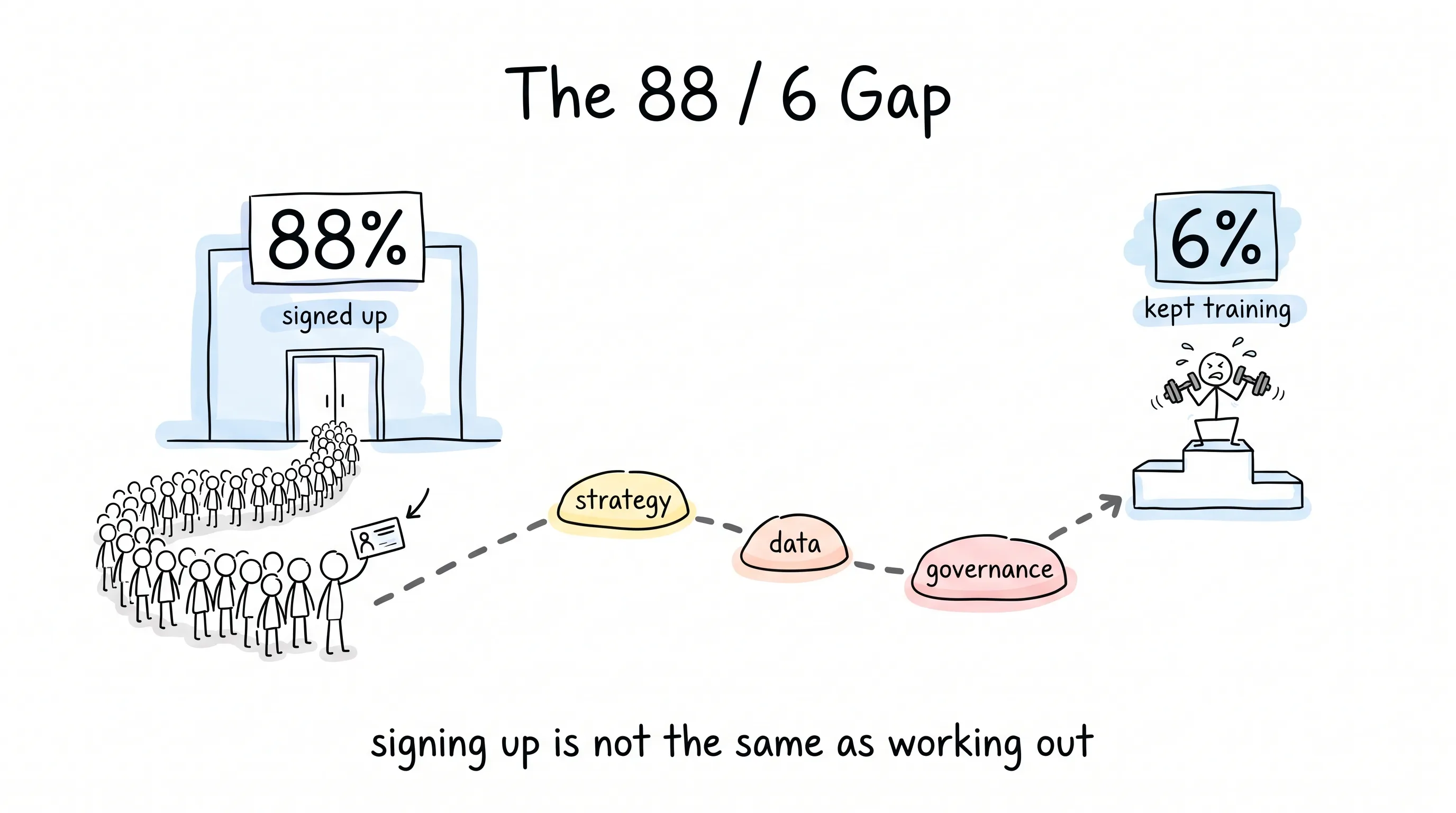
In 2025, McKinsey ran a global survey: 88% of companies now use AI in at least one business function, and marketing and sales are among the top use cases. Generative AI adoption has climbed from 33% in 2023 to 79%.
What does that mean? Adoption is nearly saturated.
But. The companies that are genuinely good at this — the ones pulling real, tangible profit out of AI — number just 6%.
88%. And 6%.
The gap between these two numbers is what I want to talk about today.
1. First, Do the Math: Where Did the Money Go?
The CMO Survey by Duke University and Deloitte this spring shows that AI and machine learning now drive 24.2% of marketing activities. A year ago, that number was 13.1%.
Doubled in a single year. The marketing executives surveyed expect it to hit 55.9% within three years.
Now look at intent. In Gartner's 2025 CMO Spend Survey, only 1% of CMOs said generative AI is not a priority. Marketing technology and AI now take 19% of marketing budgets, projected to rise to 31.7% within five years.
Practically everyone is getting in, and everyone is adding spend.
But what about the overall pie? Marketing budgets sit at 7.7% of company revenue — flat versus 2024, and still below the 9.5% of three years ago. 59% of CMOs say it outright: the budget isn't enough to execute the strategy.
On one side, usage is skyrocketing. On the other, budgets aren't moving. And only 6% are actually making money.
What does this remind you of? A gym.
88% of people signed up for a membership. 6% got abs.
Signing up is not the same as working out.
So what did the 6% get right? McKinsey's conclusion: the gap isn't the tool — it's strategy, data readiness, and governance. In plain language: everyone holds the same card. The difference is whether you have a training plan, whether a coach is watching, and whether you keep training.
Two more details, and they sting.
One is scale. Among big companies with revenue above $5 billion, nearly half have pushed AI to the scaling stage. Among small and mid-sized companies under $100 million, the figure is 29%.
The big ones are pulling further ahead; the small ones are still spinning their wheels.
The other is geography. A January survey by the UK government's DSIT: only 16% of UK businesses use AI — far lower than all those marketing surveys would have you believe. But among the ones that have adopted it, 72% use AI in marketing, tied with administrative work for first place. Penetration is low, yet the UK AI market is projected to sustain 27.6% annual growth through 2030 — the high ground of AI investment in Europe.
Low penetration, high growth. What does that tell you? Most of the players haven't entered the game yet.
And marketing is precisely the business function where AI has penetrated deepest. You're standing on the most crowded, most cutthroat track there is. There is no dodging it.
2. The Rules of Search Have Changed
Done with the math. Now, search.
Have you noticed that when you search on Google, you can hardly be bothered to click anymore? Right at the top sits an answer the AI has already prepared for you. You read it, and the task is done. The third link? Whether you open it hardly matters.
This is not an illusion. It's data. ChatGPT has 900 million weekly active users. Perplexity handles 780 million queries a month, up eightfold in one year. Seer Interactive measured it: for informational searches with an AI summary, organic click-through rates fell from 1.76% to 0.61% — a drop of up to 61%. In Semrush and Similarweb's numbers, zero-click searches account for 58% to 69% of all searches.
What is a zero-click search? You searched, but you didn't click a single link.
The user gets the job done without ever leaving the search page.
Hearing this, you might feel a flicker of despair: so what's the point of SEO anymore?
Hold on. There's something deeply counterintuitive here.
That little bit of traffic AI brings converts 23 times better than traditional search traffic — and carries 4.4 times the economic value.
Twenty-three times.
Why? Think about it. When someone clicks through to your page in traditional search, they're browsing. When someone finds you through an AI answer, it's because they asked a question, the AI gave an answer, and they accepted you in that answer. That's why they came.
They arrive carrying a conclusion.
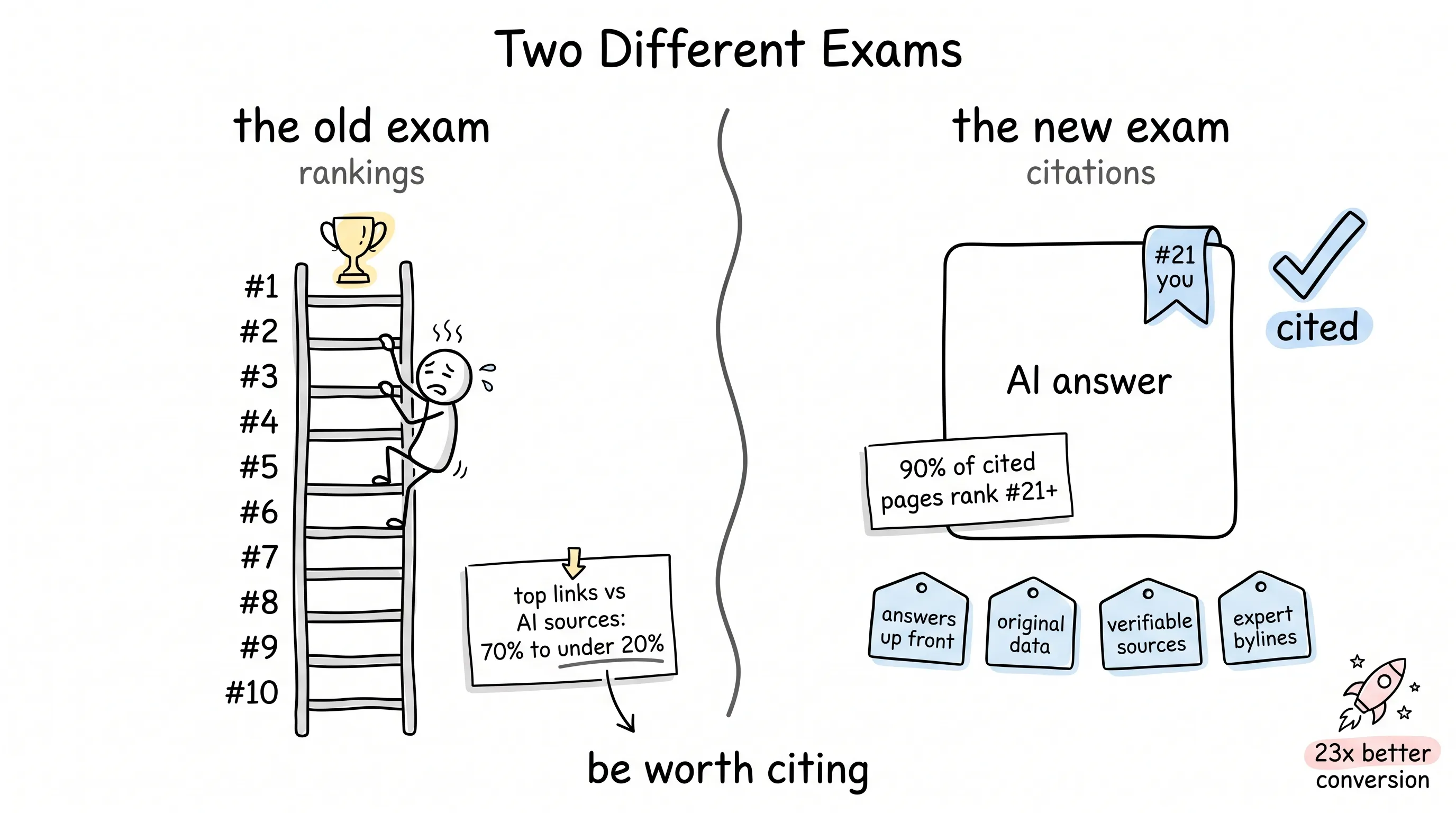
More critical still: Brandlight's research shows the overlap between Google's top links and the sources AI cites has fallen from 70% to under 20%. Semrush also found that roughly 90% of the pages cited by ChatGPT search rank 21st or below in traditional rankings.
In other words, even if you can't crack the top 20 in traditional rankings, you still have every chance of being cited heavily by AI.
These are two completely different exams. The old exam tested rankings. What does the new one test? Whether you're worth citing: answers up front, original data, verifiable sources, expert bylines. This new subject has a name in the industry: GEO — Generative Engine Optimization. Also AEO — Answer Engine Optimization.
And Semrush's other number: 47% of brands don't even have a GEO strategy yet.
The window is still open. It won't stay open long.
3. Does Google Punish AI-Written Content?
On content, the question I get asked most is: will Google penalize articles written by AI?
No.
Google itself has said it plainly: it looks at quality, originality, and usefulness to the user — not at how you produced it. Ahrefs scanned 600,000 web pages; among top-ranking pages, 82% used AI-generated content to some degree.
So can you just let loose and have AI generate 500 articles a day?
Quite the opposite.
Fully automated output performs 4.1 times worse than human-AI collaboration. Research from eMarketer this April: once consumers discover content is AI-generated, 31% trust the brand less. Only 7% trust it more.
A gap of more than four to one.
Think about it — it makes perfect sense. That AI-slush content in your feed, the kind you can spot at a glance: how do you feel after seeing too much of it?
So the direction was never to have AI write for you. It's AI as the production line, humans as the editor-in-chief. 85% to 88% of marketers already use AI for content, and 93% say it is indeed faster. But speed only gets you in the door. Trust is what brings customers back.
AI owns the capacity. Humans own the signature.
Two more things, by the way, that have already reached mass production.
One is personalization. 92% of companies use AI for it; McKinsey says it lifts efficiency 10% to 30%, and high-growth companies draw 40% more revenue from personalized experiences.
The other is video. BCG's numbers: 68% of CMOs have deployed, or are planning to deploy, AI video generation. IAB projects that this year, AI-generated video will account for 40% of all advertising video.
B2B product demos, executive thought-leadership videos, multilingual content — all of it is suddenly affordable.
4. What Exactly Is an Agent?
Now for the real variable of the past two years.
What is an agent?
You're driving, and in the passenger seat sits a copilot. He points out the route, hands you water — but the steering wheel is in your hands. That was the AI of the past two years: Copilot, the copilot.
An agent is the driver.
You get in the car, say "to the airport," and settle into the back seat to answer email in peace. It plans the route by itself, handles the traffic jam by itself, finds the parking garage by itself. It has four key capabilities: it can reason, it has memory, it can use tools. And the one that matters most: you hand part of the decision-making over to it.
If the copilot gets it wrong, you correct him. If the driver gets it wrong, you've already arrived somewhere else.
BCG has studied this: well-used AI agents can speed up business processes by 30% to 50% and cut the time spent on low-value work by 25% to 40%. As of the end of 2025, 62% of companies had begun piloting, and 23% were scaling.
On the platform side, it's all guns blazing.
HubSpot's Breeze is a family of agents that grew out of CRM: the customer agent can take over more than half of support tickets, and the content agent learns to write in your brand's voice. Salesforce's Agentforce saw its agent count grow 119% in the first half of 2025 — campaign co-creation, audience segmentation, journey orchestration, end to end. Adobe is betting on creative production: give it a marketing brief, and it directly produces assets for every channel. Jasper laid out more than 100 vertical agents in one go; Writer launched its agent-building tool before OpenAI; 6sense and Demandbase stacked agents on top of their intent-data and ABM platforms.
The agent market as a whole is worth roughly $12 billion this year, projected to reach $52.6 billion by 2030 — a compound annual growth rate of 46.3%.
Staggering.
But now I'm going to pour some cold water on this.
When agents run, what burns is not passion. It's data.
Is your CRM clean? Are customer profiles unified? Can the platforms actually connect with one another? This dirty work nobody loves decides whether your agent is an employee, or a liability.
An agent built on bad data will manufacture chaos you can't imagine, at an efficiency you can't imagine.
Get the data ready before you hire the driver.
5. The Rules Have Already Landed
One more thing many people aren't taking seriously: the rules have arrived.
On August 2 of this year, the EU's AI Act came into full force for most operators. AI-generated synthetic content must be labeled; chatbots must disclose their AI identity. If you produce marketing content or run conversational bots in Europe, this is a live constraint, not a headline.
The UK keeps a different rhythm. As of April this year, the UK still has no dedicated AI act. But the regulators haven't been idle: the ICO has listed agents as a key focus area for 2026. Its fines totaled £19.6 million in 2025, and in February of this year it hit Reddit with a £14.47 million fine — the largest children's-data fine in its history. Over at the ASA, an AI-driven ad monitoring system is expected to review 40 million ads this year — moving from waiting for complaints to actively patrolling.
So how do consumers feel?
Gartner's research: 78% of consumers say clear labeling of AI content is very important for maintaining trust.
More troublesome is the perception gap. 77% of advertisers hold a positive attitude toward AI. And consumers? 38%.
Lopsided optimism crashing head-on into lopsided skepticism. The seam between them is exactly where brand trust leaks away.
Oh, and one overlooked weak spot: people.
51.7% of B2B marketers admit their teams have an AI skills gap. 68% have never received any formal generative AI training. People who know AI command a salary premium of 20% to 30%, and related job postings have grown 71%. Meanwhile, organizations that ran targeted AI training see project success rates 43% higher.
Do the math: training may be the most cost-effective AI investment there is.
6. The Next Two Years Decide Who Wins
Finally, the judgment of the big institutions.
Gartner is aggressive: by the end of this year, 40% of enterprise applications will have task-specific agents embedded — eight times the 2025 figure. By 2028, 60% of brands will use agents for one-to-one communication, 90% of B2B purchases will be intermediated by AI agents, and $15 trillion will flow through agent exchanges.
Fifteen trillion dollars.
Forrester, meanwhile, brings the cold water: in 2026, the AI hype cycle ends. Companies that put no governance around generative AI will lose more than $10 billion combined through falling share prices, legal settlements, and fines. As consumers flood toward AI summaries, advertisers will cut 30% of display ad budgets.
McKinsey does the grand tally: AI can bring marketing $463 billion in productivity gains, more than 60% of it driven by agents. Yet it also found: on European CMOs' priority lists, generative AI ranks only 17th. Out of 20 total.
The opportunity is enormous. The attention is not.
For all their back-and-forth, these three agree on one thing: the hype is over — what comes next is a contest of who actually gets it done. Global AI spending is projected at $2.52 trillion this year, up 44% year over year.
The money keeps pouring in. And wherever it pours in, the churn is just as fast.
So, What Do You Do?
Back to that tea-drinking friend from the beginning. After hearing all of it, he asked me one question: "I understand all the logic. What should I do tomorrow?"
I said: four things.
First, run two tracks on search. Don't throw away the old SEO, but start answering the new exam: front-load the answer in your content, publish original data, get the structured markup right, and track AI citations separately. Remember: AI traffic converts 23 times better than traditional traffic. The clicks you lost, you earn back with quality.
Second, fix the data before you bring in agents. A clean CRM, unified customer profiles, connected platforms. If those three aren't ready, the agent you invite home will just be a decoration.
Third, treat governance as a weapon, not a burden. Label what should be labeled, build the processes that should be built. The EU act took effect in August — the question stopped being "whether to do it" long ago; it is "how much you've done." Wait for the fines and the trust crisis to arrive before you do the homework, and the tuition is ten times higher.
Fourth, watch revenue, not rankings. Every AI project must be able to connect to the sales pipeline, customer acquisition cost, and customer lifetime value. Track AI-driven conversions separately. When you ask the board for budget, make your case with a 1-to-5 return: put in a dollar, get five back. Below that number, put a question mark on it in your own head first.
My friend listened, and said: "So this is lay the foundation first, then put up the building?"
I said: exactly.
88% of people have walked into the gym. But the vast majority only ever signed up for the membership.
Before the tool, everyone is equal. After the tool, worlds apart.
May you be that 6%.
Continue reading
Related articles

Cross-Border Business: Time to Upgrade Your AI Toolbox
A learn article explaining how AI tools help cross-border e-commerce sellers clear five hurdles: language, regulation, logistics, payments, and fraud. It outlines a five-compartment toolbox, a five-step adoption path, and metrics such as conversion rate and CLV, while cautioning against over-reliance on AI.

AI Is Taking Over the Dirty Work of Social Media Marketing, One Task at a Time
This learn article outlines four social media marketing tasks AI can handle — audience analytics, content drafting and design, ad targeting and creative testing, and spam moderation — and cautions that taste, judgment, and data security remain human responsibilities.

AI Is Already This Good — Why Is Your Social Media Marketing Still Pure Manpower?
An overview of 18 AI tools for social media marketing, organized into six categories covering audience research, content creation, scheduling, comment and DM handling, ad management, and visual production, plus notes on personalization, prediction, and emerging trends.