
87% of Marketing Teams Now Use AI. So Why Have Most Seen So Little Reward?
A data-driven look at why most marketing teams using AI have seen limited returns, drawing on industry surveys to compare adoption rates, ROI by application, consumer trust trends, job market shifts, and visibility in AI answers, with suggestions on where to focus AI budgets.
A few days ago, I had dinner with a friend who works in marketing.
He told me: "Our company has gone all-in on AI. We bought seven or eight tools, and everyone uses them."
I asked: "So what's the output?"
He paused. "We're producing twice as much as before. But complaints from clients have doubled too. They say the things we publish feel less and less human."
I said, this isn't an AI problem. You're treating AI like a typewriter.
After that dinner, I went back through the pile of surveys I keep on hand — Salesforce's State of Marketing, HubSpot's AI Trends, McKinsey's global AI survey, Gartner's CMO spend survey… Pieced together, they tell one story.
What story?
A deeply counterintuitive one: when it comes to AI marketing, "using it" is no longer the problem. The problem is that the overwhelming majority are still stuck at "using it," and haven't moved on from there to "getting value out of it."
Let's start from the beginning.
1. The Entry Ticket
First, a number: 87%.
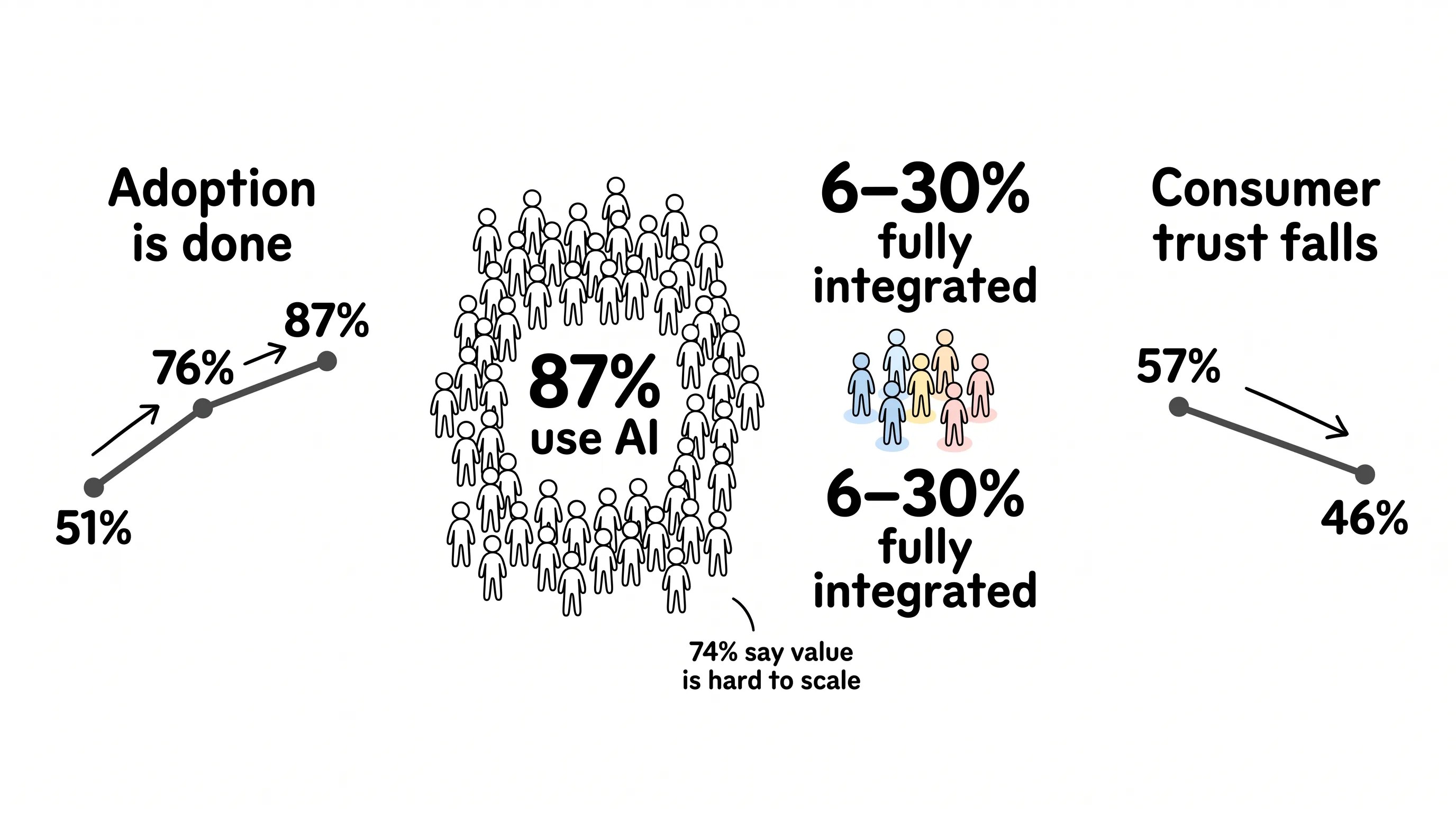
Salesforce's survey says that in the first quarter of this year, 87% of marketers were using generative AI in at least one regular workflow.
What does that mean?
Two years ago, the figure was 51%. A year ago, 76%. Up 36 points in two years — nearly 1.5 points a month on average, with almost no pullbacks.
In other words, adoption is essentially done. Among marketing teams at companies with 250 people or more, 94% are using it. Even the smallest solo operators and tiny teams have reached 73%. And the small teams are closing fast — the gap with large enterprises has narrowed from 28 points to 21. Why? Because AI tools are consumer-grade. Anyone can sign up in minutes; the tools don't care how big your company is.
It gets even more interesting when you break it down by role. Content marketing has the highest adoption rate, 96%. Event marketing is the lowest, 68%.
Why? Because content is the part of the work AI can take over most easily.
You've seen this curve many times in business history. Around 2015, everyone rushed to open a WeChat official account; around 2016, everyone went live; after that, everyone started shooting short videos.
At the start, "being able to do this" was itself the opportunity. Later on, "being able to do this" is merely the entry ticket.
When 87% of people are doing something, it's no longer a windfall. It's the price of admission.
One detail stings: for the teams that boarded back in 2024, the productivity gains they've racked up by this year are 2.1 times those of the teams that only boarded this year.
The ones who miss the windfall are usually not the ones who never boarded. They're the ones who boarded late.
2. Signing Up for the Gym Isn't the Same as Building Abs
OK — 87% are using it. But are they using it well?
Let's run the numbers again.
McKinsey's data says that among all AI marketing applications, the hardest return is content drafting, with an average ROI of 3.2x. Next come personalization engines, at 2.7x. Payback period? On average you now break even in 4.2 months — in 2024, that figure was still 7.8 months.
Sounds like all good news, right?
But.
Another set of numbers says that although 87% are using AI, only 6% to 30% of marketing organizations have truly integrated it across their entire workflow. BCG's survey is blunter: 74% of companies say AI's value is hard to scale.
87% are using it; 6 to 30% are benefiting.
Where's the gap?
Here's an analogy. Gym annual memberships — the sign-up rate is probably eighty or ninety percent too. The share who actually build abs? Very few.
Signing up means "buying the tool." Building abs means "growing the tool into your life."
AI works the same way. Buying a few tools and having the team create accounts is not "using AI." Embedding AI into the content process, the data process, the review process — someone reviewing before publication, data flowing back after review, prompts revised when the data comes in — that is using AI.
Where is it most worth using? The structure of returns makes it obvious. Wherever AI replaces an expensive human bottleneck — writers, analysts — returns are excellent. Wherever AI has to fight professional creative tools for the work, or produces output that reads as assembly-line product at a glance — exactly what the platforms are pressing down on — returns collapse. Meta, TikTok, Google: their 2026 ranking mechanisms all suppress pure AI content. AI really did let teams publish 42% more content per month, and early adopters' per-person output is 4.1 times what it was. But the more volume you lay down, the more assembly-line you look. What's scarce today is no longer output. It's quality and original insight.
Now for the noisiest corner, AI video. Over the past year, marketers' usage of tools like Sora, Runway, and HeyGen grew 340% — that's exactly what Wistia's numbers show. Yet its ROI is the lowest of all AI marketing applications, just 1.1x to 1.6x.
All that heat, almost none of the return.
There's also a new development: 34% of enterprise marketing teams are already running autonomous AI agents in production. Six months ago, that figure was only 14%. The average company runs 8 agents. At the same time, though, 29% of agent deployments get abandoned within 90 days.
The number-one cause of failure: no clear definition of success, 41%. Second: tool and data permissions that don't connect, 33%. Third: brand voice drifting off course in customer-facing output like support and copywriting, 19%.
So agents come with one cold, hard rule:
They reward discipline and punish vagueness.
3. You're Accelerating, but Your Customer Is Stepping Back
Speaking of brand voice, we come to the third layer — the one most easily overlooked: how customers see all this.
On the marketing team's side, AI is in full swing. And on the consumer side?
Qualtrics' research shows that consumers' acceptance of "brands using AI" was still 57% in Q3 2023; a year later, it had fallen to 46%. Down 11 points. And only 26% of consumers believe brands will use AI responsibly.
In other words, 74% of people don't trust your use of AI.
What are they worried about? Ranked first, cited by 59%: "losing the human touch." Counting downward — fear of job losses, and wanting a real person to talk to and not finding one. 51% dislike AI virtual brand spokespersons. Only 43% can accept AI writing brand introductions.
Behind this sits a hidden asymmetry. Appfigures' data shows that 89% of AI-tool app users are male, and 18-to-24-year-olds are the largest group in every AI app category.
What does that mean?
It means: the people using AI to do marketing and the people being marketed to are almost two different populations. You think the copy AI writes is pretty good — smooth, efficient. Your customers, especially those outside that age bracket, read it and feel only cold.
One company replaced its phone support with AI. Money saved. But longtime customers said privately: before, you could call and chat for a bit; now you press buttons forever, the bot is perfectly polite — but there's no one there.
The money was saved. The trust is leaking.
What's saved is efficiency; what leaks is loyalty. Those two accounts usually don't appear on the same statement, so nobody reconciles them.
Technology isn't the bottleneck. Trust is.
4. What AI Takes Isn't the Job — It's Half of What's Inside the Job
When people hear "no human touch," the first reaction is often: it's over, AI is going to replace marketers.
That judgment is half right.
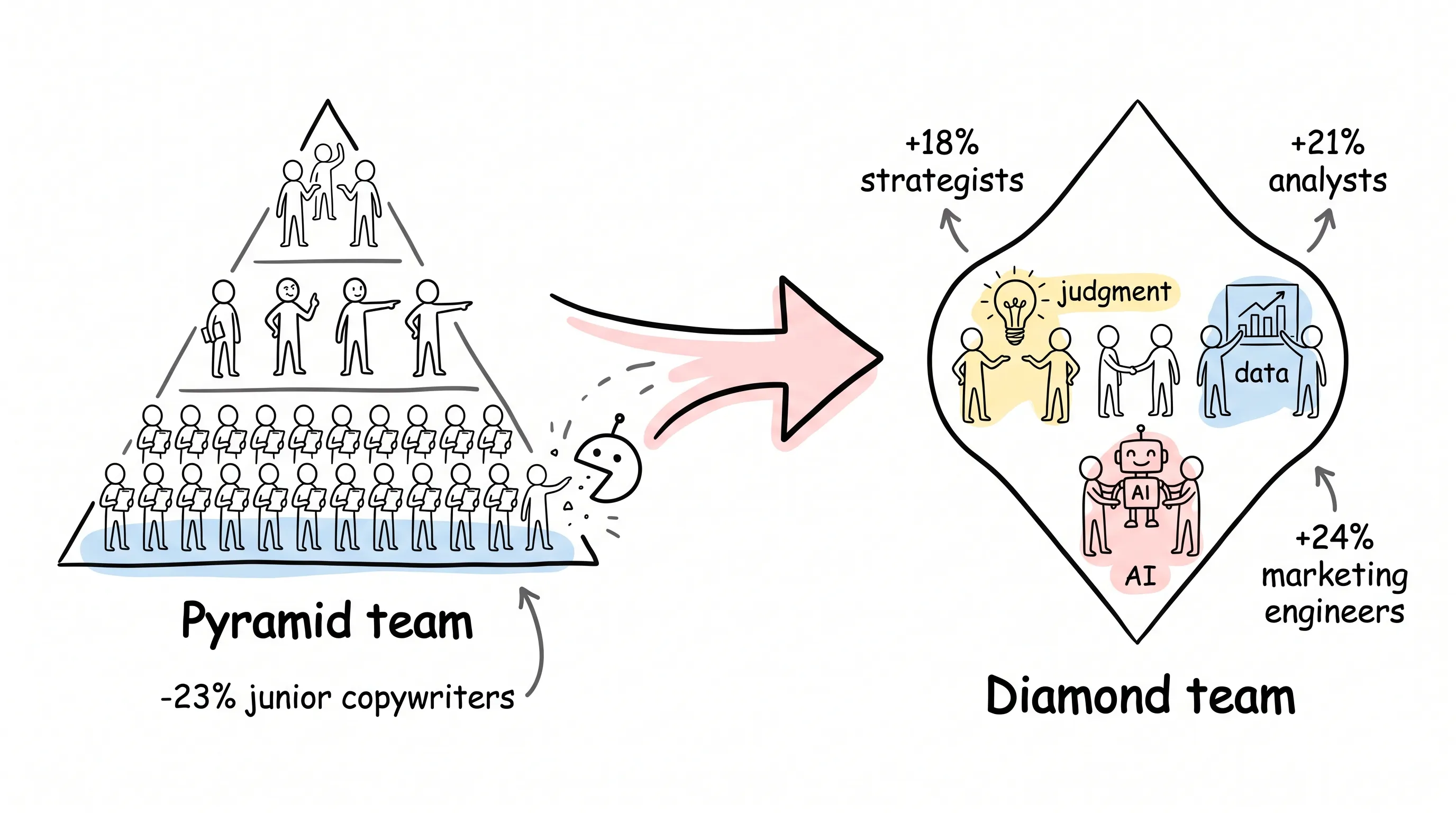
Gartner's CMO spend survey provides very detailed job-level data. In 2025, 23% of agencies cut junior copywriters, and another 31% plan to keep cutting. Junior design and production roles are much the same.
At the same time, senior content strategist roles grew 18% year over year. Marketing data analysts, 21%. Marketing engineers who understand AI, 24%.
And total headcount? The total number of marketing jobs in the US is basically flat.
Cutting on one side, hiring on the other, totals unchanged. What does that tell us?
That AI isn't eliminating jobs — it's reconfiguring them. A team used to be a pyramid: a crowd of executors at the bottom, a few direction-setters on top. AI ate the bottom layer of "just follow instructions" work, and the team became diamond-shaped: the people in the middle who understand judgment, data, and AI are becoming more and more valuable.
And what do AI users themselves say? 70% of marketers say AI made their work easier, and 83% say their output efficiency went up.
So don't panic — and don't count yourself lucky either.
AI won't take your job. What it takes is the half of your job that "doesn't use the brain."
5. Your Store Is Still Open — but the Map Can't Find You Anymore
Jobs are the supply side. On the consumption side, something bigger is quietly happening.
According to Cloudflare Radar, in Q2 2026, among all crawler requests across the web, Googlebot is still first, at 27.49%. Who's second?
Not Bing, not any traditional search engine. It's ClaudeBot — the AI crawler sent out by Anthropic — at 13.87%. Further down, Meta's crawler at 12.70%, and OpenAI's GPTBot at 10.23%.
AI crawlers now stand toe-to-toe with traditional search crawlers.
What does that mean?
HubSpot's research says half of consumers now start with AI search when they look for information. 42% of people buying CRM software use AI to evaluate vendors — AI search has even become the strongest predictor of purchase intent. Within marketing teams, the share treating "Answer Engine Optimization" (AEO — optimizing your content so AI answer engines cite it) as a standalone KPI rose from 9% at the start of 2025 to 37%.
For example: customers used to find software by opening a search engine and typing keywords. Now? They ask ChatGPT, ask Claude, ask Perplexity: "Compare these CRM options for me."
Whether the AI's answer includes you decides whether the deal still includes you.
And whether AI cites you follows rules of its own. Piece several studies together: among Google's top-three organic results, 72% of the pages were produced with AI assistance. But pages that are purely AI-generated with no human review are 3.1 times less likely to make the top three than human-reviewed ones. AI content enriched with first-party data, original research, and real expert interviews ranks 2.4 times better than purely generated content. And after Google's core algorithm update in March this year, 18% of sites publishing pure AI content at scale lost more than 40% of their traffic.
The one that really bites is the last: if your robots.txt accidentally blocks AI crawlers like ClaudeBot and GPTBot, you've effectively erased yourself from AI's answers.
What's that equivalent to? Your store is still open, the lights still on — but navigation and maps have both marked your building as nonexistent.
Today, "whether AI can cite you" is the new "whether you can be searched."
6. Where the Money Should Go
By now you might ask: I get the logic — so what do I actually do?
First, look at the money's attitude. Gartner's survey says 63% of CMOs plan to increase AI budgets by 2027, and only 8% plan to cut. The money will keep coming in. The question is where it should go.
Three things, in order.
First: dig through the toolbox you already have before talking procurement.
HubSpot, Salesforce, MailChimp — the platforms you're already paying for all have AI features built in. Don't rush to buy new tools. The biggest windfall is often a switch inside your existing platform.
Second: start where the return is hardest.
Content drafting, 3.2x ROI, is the most certain of all applications. Email personalization too — over 80% of marketers are using AI to write emails, and 77% say content relevance has improved. Don't chase the flashiest thing first. AI video looks lively, but its ROI sits at the bottom of the table; until your production process is untangled, don't put big money in.
Third: put the "human" back into the process.
73% of enterprise teams already require every piece of customer-facing AI output to pass human review. And the amount of editing matters: AI content where human editing accounts for more than 20% gets organic traffic 2.7 times that of lightly edited content. Publishing the moment AI finishes writing doesn't save time — it spends trust.
Once the process runs smoothly, one step further: 52% of enterprise marketing organizations have already built brand-voice prompt libraries, writing brand guidelines directly into the prompts, teaching AI to talk like a human.
Then there's the biggest prize of all — one almost nobody has gone to claim.
McKinsey's data says AI-driven personalization can cut customer acquisition cost (CAC) by up to half, lift revenue 5% to 15%, and raise marketing ROI 10% to 30%.
Sounds tempting. But the reality is: 53% of marketers are still stuck at the most basic personalization — "put the recipient's name in the email." Only 13% are doing personalization truly based on behavioral data and real-time signals. The remaining space, more than 80% of it, is sitting on the table.
And there's one precondition you can't route around: 84% of consumers treat data privacy as a basic right. So the next stage of personalization isn't about who holds more data — it's about who makes customers willingly hand it over. Give them a benefit they can see, and they'll give you genuine consent.
Don't push hardest where it's cheapest. Push where it's most valuable.
Epilogue
Near the end of that dinner, I asked him again: "So what does AI mean for marketing, in your view?"
He thought for a moment, then said: "Our work used to be 'making things.' Now it's become 'deciding what to make — and letting the machine make it.'"
I said, right.
In HubSpot's survey, 61% of marketers believe AI is the biggest disruption the marketing industry has seen in twenty years.
I believe it.
Because the data has already said it plainly: output is rising, adoption is rising. But consumer trust is falling, junior roles are shrinking, and pure AI content is being down-ranked.
Fit those curves together and they point to the same sentence:
AI has turned execution into a commodity — and judgment into a scarcity.
That friend of mine no longer lets his team compete over who uses AI the most. Every week, his meeting discusses one question only: what do we know that AI doesn't?
I wish him success.
And I wish you the same: be the one who sets the direction — not the one racing a machine at typing speed.
Continue reading
Related articles

Cross-Border Business: Time to Upgrade Your AI Toolbox
A learn article explaining how AI tools help cross-border e-commerce sellers clear five hurdles: language, regulation, logistics, payments, and fraud. It outlines a five-compartment toolbox, a five-step adoption path, and metrics such as conversion rate and CLV, while cautioning against over-reliance on AI.

AI Is Taking Over the Dirty Work of Social Media Marketing, One Task at a Time
This learn article outlines four social media marketing tasks AI can handle — audience analytics, content drafting and design, ad targeting and creative testing, and spam moderation — and cautions that taste, judgment, and data security remain human responsibilities.

AI Is Already This Good — Why Is Your Social Media Marketing Still Pure Manpower?
An overview of 18 AI tools for social media marketing, organized into six categories covering audience research, content creation, scheduling, comment and DM handling, ad management, and visual production, plus notes on personalization, prediction, and emerging trends.