
82% of Companies Draw a Customer Journey Map. Only 47% Actually Use It
A learn article on AI-driven customer journey mapping: it cites a 2019 Gartner survey where 82% of firms drew maps but only 47% used the data, then covers real-time map updates, AI propensity scoring for budget targeting, and personalization cases from Starbucks, Netflix, Sephora, and IceCartel.
A few days ago, I had dinner with a friend who runs an e-commerce business.
He needed to vent: his company had spent months drawing a beautiful customer journey map. From the first time a user sees an ad, to placing an order, to receiving the goods, to after-sales support — every step marked out in crisp detail. They printed it and pinned it to the office wall like a battle plan.
I asked: so your recent calls on operations — have you been making them off this map?
He paused for a beat. "Honestly? No. Mostly it's gut calls."
I said, then that's not a map.
That's decoration.
So what is a customer journey map?
A customer journey map takes the whole road a customer travels — from first hearing about you, to buying from you, to using what they bought, to recommending you to others — and draws everything they experience into a single picture: where they cruise, where they get stuck, whether they're happy.
Strip it down and the purpose of this map is just two things: make customers happy, and make things effortless for them. In 2023, Statista published a breakdown: when brands build journey maps, these are the two things they're chasing.
Great idea.
But maps don't move. Customers do.
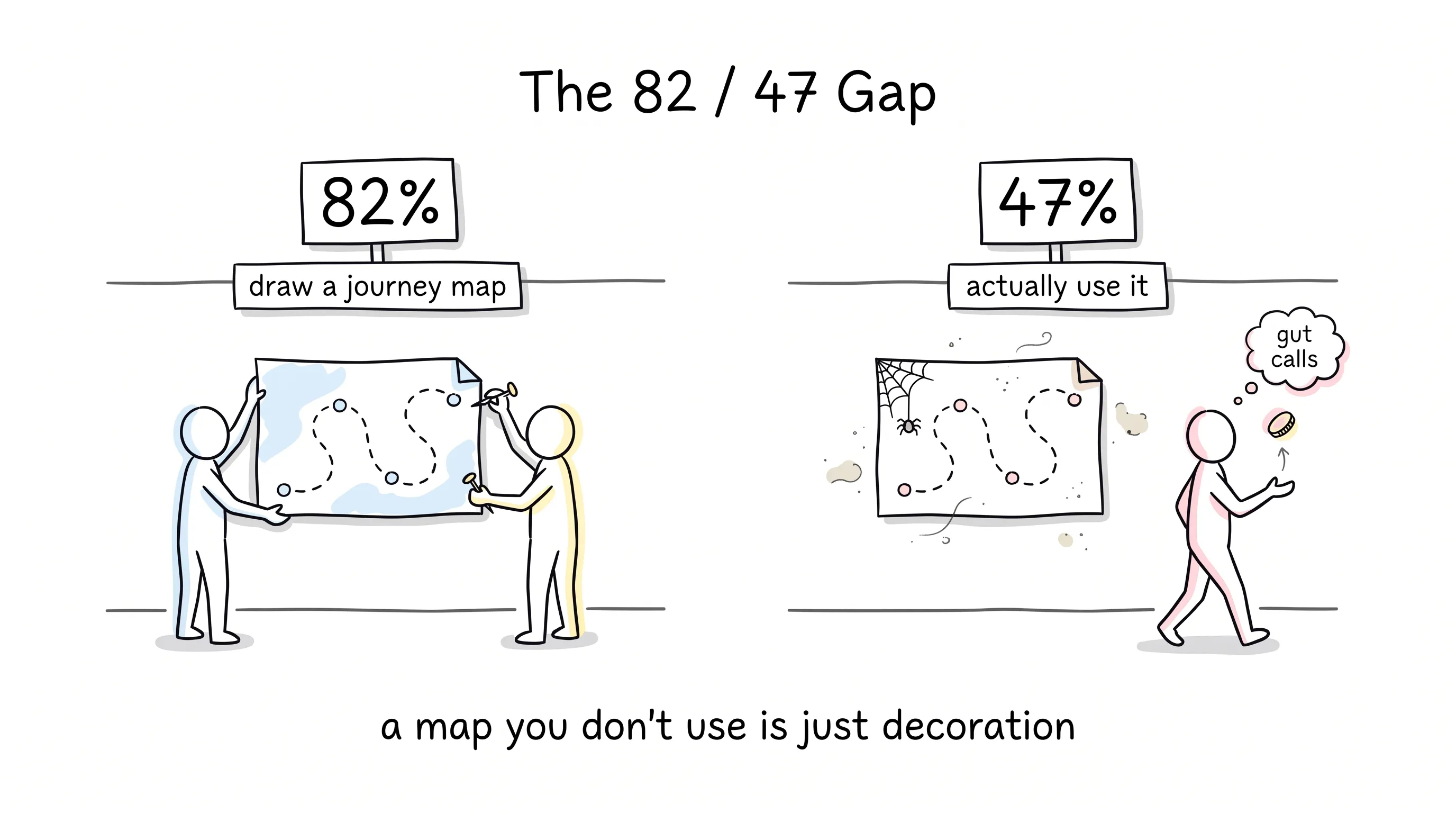
In 2019, Gartner ran a survey: 82% of enterprises had drawn a customer journey map. Yet only 47% actually put the data in it to work.
In other words, at more than half of companies, the map they worked so hard to draw ends up gathering dust on a wall.
Why?
Because the way we draw them is primitive. Interview a few customers, send out some surveys, hold a few rounds of meetings — then lean on human observation and experience to stitch scattered behaviors into one journey. The day the map is finished, it starts going stale.
Last month your customer loved scrolling shopping apps before bed. This month she switched to lunch-break scrolling. The map on your wall? Still the same.
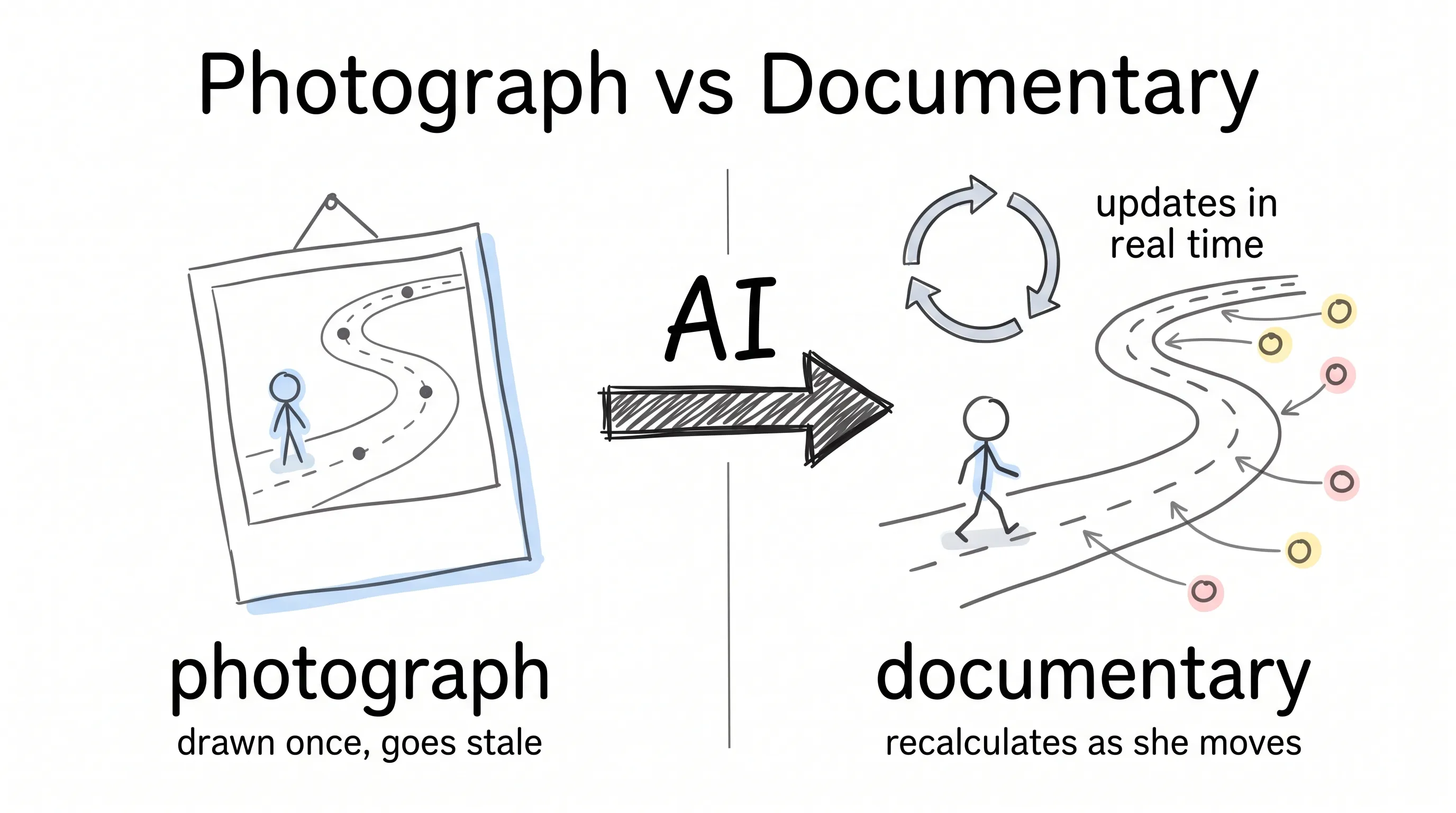
A traditional journey map is a photograph. Of customers as they used to be.
Today, something is turning that photograph into a documentary — one that updates in real time.
AI.
So what exactly changes when AI enters the customer journey map? Three things.
First, the map starts moving on its own.
An annual refresh used to count as diligent. Now machine learning models watch the full stream of data — every click on your website, every order, every review — refreshing the map around the clock. Wherever the customer goes, the map follows.
And along the way, the repetitive labor — collecting, cleaning, analyzing data — is fully handed off to machines. People are freed up for what only a person can do: make the judgment calls, set the strategy.
Second, the map learns to look ahead.
Which brings us to a concept: AI propensity scoring.
What is propensity scoring?
Plainly put: for each customer, calculate a probability. Their next move — buy, or not buy?
The head of product marketing at the software company Progress gave an example: feed each customer's behavior at every touchpoint, plus the key milestones of their journey, into a predictive model. The model tells you which customers are most likely to act right away, and which are most likely to churn. Then you aim your marketing budget hard at the ones most likely to buy.
Think about it. Budget used to be spread like sprinkling pepper — everyone got a dash, nobody tasted it. Now every single dollar goes where the odds of winning are highest.
Now that's doing the math.
Third, personalization goes from slogan to action.
One online jewelry and accessories retailer, IceCartel, does this at a level of detail that honestly surprised me.
You drop something in your cart, don't buy, and walk away. In the old days, that sale was basically dead. Now the machine remembers. Next time you open the product page, the unfinished purchase is sitting right there waiting for you — and beside it: people who bought this ring mostly paired it with this chain.
Cart abandonment — won back, little by little.
What's more, the hidden patterns machines dig out of the full data — which type of customer is most easily swayed at which moment — the human eye simply cannot spot. Even if you spotted one, you couldn't run the numbers in time.
An executive at Blackhawk Network, a gift card and payments company, once offered a particularly apt analogy: what AI does for the customer journey is what navigation apps do for driving. The moment road conditions change, the route recalculates.
Yes — that's exactly the feeling. The map is no longer a picture. It's a road that recalculates itself.
The big companies have been running this playbook for a while.
Starbucks has an internal system called Deep Brew. Every recommendation you receive in its app has predictive analytics working behind it. It even optimizes in-store inventory and staffing: stock up before the rush, put the right people on the right shifts.
Netflix is even more direct. It uses AI to guess what you want to watch. And the guessing isn't the end of it — everyone's viewing behavior feeds back into what shows it should make. Audiences vote with their remotes, and the votes go straight into the greenlight meeting.
And Sephora? It aimed AI at the "too nervous to buy" problem. What will this lipstick actually look like on my face? Open the virtual try-on, check the effect against your phone first, then order. One of the biggest hesitations in the beauty business — dismantled just like that.
See, same technology. Some use it to push products, some to decide what to produce, some to remove hesitation.
The tool is the same. The imagination isn't.
But everything has a flip side.
Before you bring this stuff in, there are three hurdles you need to think through first.
First hurdle: data.
For AI to call the odds right, it has to eat deep. Your clicks, orders, location, social traces — all of it is fuel. More data, sharper predictions. But more data also means heavier weight on your shoulders. One breach, and your customers' trust in you drops to zero overnight. Compliance isn't a cost. It's the price of admission.
Second hurdle: systems.
AI is not a rice cooker you just plug in. Between your old systems, old processes, old reports and the new tools lies a mountain of rework. It takes money, new hires, training. Plenty of companies want to use it — they just can't get connected.
Third hurdle: warmth.
This is the easiest one to forget. The machine knows what you've bought; it doesn't know whether you're having a good day. When a customer complains, the last thing they want to hear is a standard script. What they want is a real person who cares.
Automation owns efficiency; people own empathy. Lose either one, and the customer journey hits a sudden drop at some link in the chain.
When dinner ended that night, here's what I told my friend: don't rush to tear the map off the wall.
Bring the data to life. Let the machines redraw the map — as a documentary that updates every second. Then take the few people on your team who understand customers best, post them in front of the map, watching for the moment to step in.
Customer journey maps aren't drawn. They're grown.
Photographs go out of date.
Documentaries don't.
Here's to bringing yours to life.
Continue reading
Related articles

Cross-Border Business: Time to Upgrade Your AI Toolbox
A learn article explaining how AI tools help cross-border e-commerce sellers clear five hurdles: language, regulation, logistics, payments, and fraud. It outlines a five-compartment toolbox, a five-step adoption path, and metrics such as conversion rate and CLV, while cautioning against over-reliance on AI.

AI Is Taking Over the Dirty Work of Social Media Marketing, One Task at a Time
This learn article outlines four social media marketing tasks AI can handle — audience analytics, content drafting and design, ad targeting and creative testing, and spam moderation — and cautions that taste, judgment, and data security remain human responsibilities.

AI Is Already This Good — Why Is Your Social Media Marketing Still Pure Manpower?
An overview of 18 AI tools for social media marketing, organized into six categories covering audience research, content creation, scheduling, comment and DM handling, ad management, and visual production, plus notes on personalization, prediction, and emerging trends.