
81% of Marketers Use AI. So Why Can Only 41% Do the Math?
This article reviews nine AI marketing case studies, from a $300 monthly ad budget to Snowflake's ABM program, arguing that ROI depends on the human-machine division of labor rather than the tools. It covers ad creative testing, SEO content workflows, GEO citation tactics, and a fully autonomous outbound failure case.
A few days ago, a friend of mine who runs a SaaS company invited me out for tea.
He had barely sat down before he pulled out his phone to show me his company's list of AI tools. Copywriting, creative design, automated outbound calling, analytics dashboards—one screen couldn't even hold them all.
"We bought every tool there is," he said. "But last month my boss asked me exactly how much extra money AI has made the company. I opened my mouth, and nothing came out."
I smiled. This really wasn't his fault.
Because I had just gone through nine real AI marketing case studies, top to bottom—from a small team with a $300 monthly budget all the way up to a giant the size of Snowflake, from big wins to total crashes. And reading them, I found a pattern. Let me share it with you today.
Numbers That Don't Add Up
First, two sets of numbers.
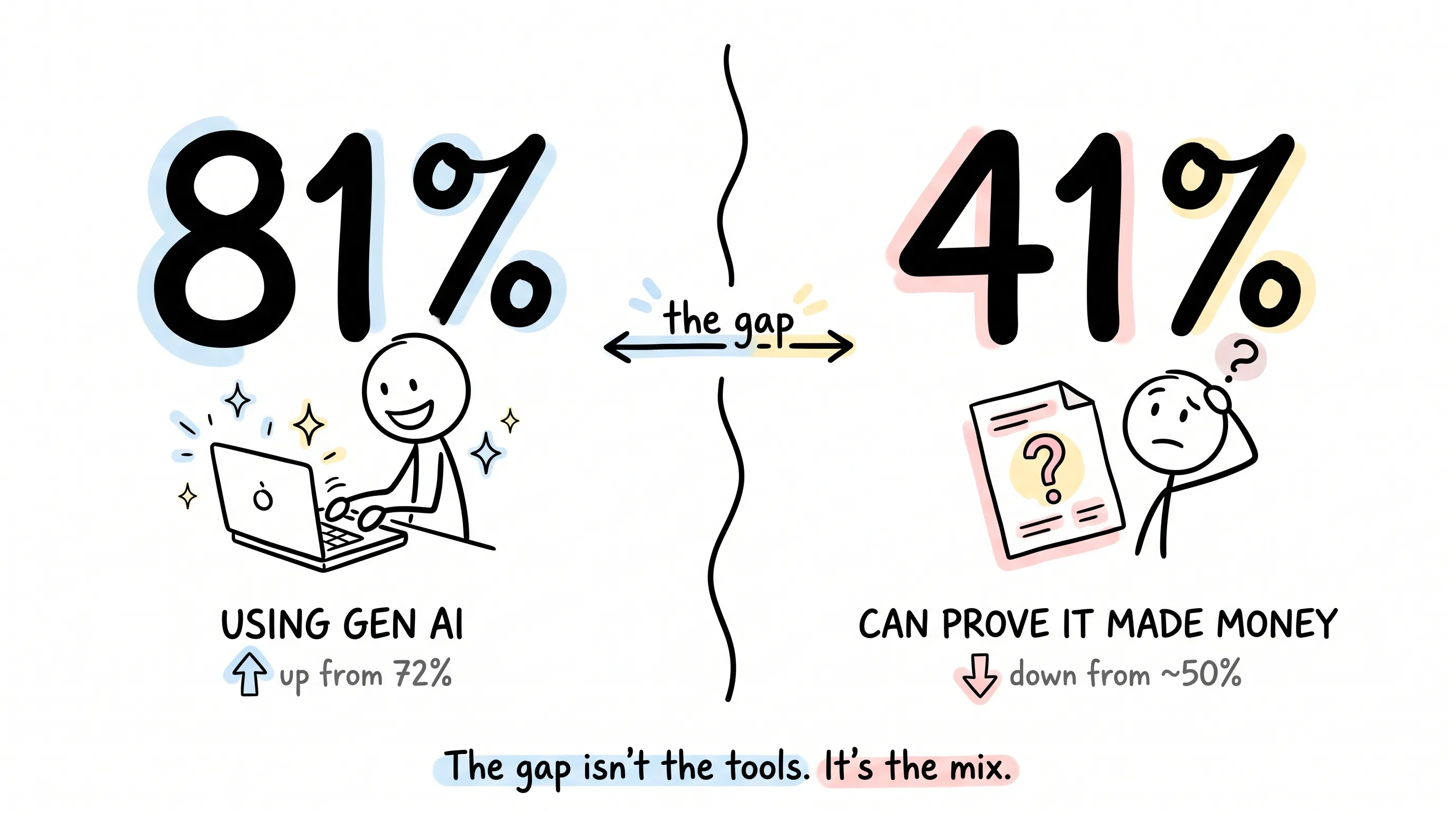
Set one: This spring, G2 reported that 81% of B2B marketers are already using generative AI—up from 72% a year ago. Spending on AI-powered ad buying grew 63% in a year. Gartner predicts that by the end of this year, 40% of enterprise applications will have task-specific AI agents built in. Last year, that number was under 5%.
On fire, right?
Now set two: The share of marketers who can produce a decent set of data proving that AI actually made money dropped from roughly 50% to 41%.
Strange, isn't it? More users than ever, yet fewer who can account for the results.
Why?
After going through all nine cases, my answer is: The gap isn't the tools. It's the mix.
What do I mean by the mix? Deciding, in any campaign, which tasks go to the machine and which decisions stay with the human. Get this straight, and the math works out. Don't, and you're either burning money or already crashing.
Let me walk you through three groups.
Group One: Two Fights on a Shoestring Budget
First, a company willing to place a big bet.
Nailed It, an AI company in consumer beauty. Founder Alex Jin wanted to test one thing: can AI-driven marketing agents actually beat a traditional agency?
His approach was hardcore. He refused to pick one. Both tracks ran at the same time, with real money, head-to-head. In two cities, Los Angeles and Seattle, the AI system tested creative on one side and shifted budgets in real time on the other.
Three months later, the results came in.
More than 4,000 leads, 328 add-to-carts, a click-through rate of 2.91%. What does that mean? Roughly 3.2 times the industry average. Cost per click: 24 cents.
One more data point jumped out: users in Los Angeles were 2.3 times more active than users in Seattle. When Jin saw that number, he shifted the whole company's resources toward Los Angeles—and even rewrote the company's regional strategy around it.
In this fight, AI won.
But take it apart, and where exactly did the win come from? Creative testing, budget shuffling—at the speed a machine does it, a human team couldn't even dream of it. Yet the decision to "settle it with a head-to-head test," and the decision to "go all-in on Los Angeles the moment the data showed up"—those were made by humans.
Humans design the experiment, machines run the volume, humans make the final call.
If Nailed It was willing to bet, then the second company took "bootstrapped" to an art form.
Cora, a digital health platform, co-founded by Jay Agarwal. Their entire monthly ad budget: $300.
What can $300 buy? At many companies, a single team dinner costs more than that.
On just $300, they used AI to generate UGC-style creative, pulled 1,000 high-intent leads from Apollo for re-engagement, and placed carefully managed ads on Meta.
Peak click-through rate: 13.19%. In a single month, 435 valid clicks.
The most brilliant move was one small change. Their landing page originally asked visitors to "book a demo"—too high a bar, so visitors turned around and walked. They swapped in a lighter entry point, and conversion smoothed out immediately.
Who made that call? A human. The founder's industry instinct said healthcare buyers don't like being cornered into a demo. What did the AI do? Lay the evidence on the table, piece by piece, so the call could be made with confidence.
A lot of people tell me the budget is too small to play the AI marketing game.
It's exactly backwards. The less money you have, the less room for waste. And "no waste" is precisely what machines are best at.
Group Two: The Big Companies' Two Blades
Small companies use AI to survive. Big companies use AI to be precise.
Snowflake—you know it, the cloud data platform. Their account-based marketing (ABM) operation was already substantial, with thousands of enterprise accounts in play. But one problem never got solved: money goes out, meetings don't come in.
Why? Traditional account filtering asks, "Does this company look like our customers?" Looking like a customer is not the same as being about to book a meeting.
Snowflake used its own Cortex AI to build a model that does exactly one thing: predict which accounts will actually schedule meetings soon. On top of that, they layered intent signals from 6sense and Bombora.
The result: meeting bookings from high-potential accounts went up 2.3 times, and total spend for the same level of activity dropped 38%.
They also ran a side experiment along the way: AI-written ad copy against human-written copy. AI won—with a click-through rate 54% higher.
Wait—was copywriting about to get out-competed by machines too?
Hold on. What did Snowflake's ABM team actually do? Which signals feed the model, which accounts deserve one-on-one attention, which go into programmatic—all decided by humans. The machine is the blade. The human is the hand that holds it.
That 38% savings came from hitting more precisely, not spending less blindly. AI is the ranker, not the strategist.
The second blade was hiding in their own drawer.
Jedox, a B2B company that makes financial planning software, had been using HubSpot for years. But the AI segmentation and personalization features inside HubSpot? Never once switched on.
After switching them on: marketing-qualified leads up 54%, sales cycles shortened by 12% to 20%.
They bought nothing new. They just turned on the features they already owned.
This is what I keep telling friends: Before you buy new tools, take inventory of what you already have. In your CRM, there is most likely a pile of AI features nobody has ever clicked on. They're free. They're just waiting for you to come back.
Group Three: Two-Person Armies
Now, two teams that took "lean" to the extreme.
Enrich Labs documented one client: a B2B analytics platform with $2.1 million in annual revenue and a marketing department of exactly two people. The founder, plus one marketing manager.
What did these two people's days look like? 80% of their time went to execution: writing articles, sending emails, scheduling posts. Only 20% left for strategy.
That ratio is upside down.
Think about it. Once an article is published, execution ends and the output just sits there. Strategy is different. Strategy compounds: when the direction is right, every piece of execution that follows gets amplified.
After bringing in AI agents, writing content, building email sequences, scheduling social media—the machine took over all of it. In 90 days, SEO articles went from zero to 18, and the first 3 cracked the top 10 of search results. The onboarding flow the AI built pushed trial-to-paid conversion to 6.2%.
Every single piece of content still went through the marketing manager—reviewed, edited, approved, one by one. Machines own the volume. Humans own the quality.
And the two people's time split flipped exactly upside down: 20% execution, 80% strategy.
So the most valuable lesson in this case is the reallocation of time. The biggest return on AI marketing is ransoming human time back from execution—and betting it on strategy.
Another lean team took the cold outbound route.
A B2B platform in revenue intelligence wanted to scale up cold outbound. But human SDRs (sales development reps) are expensive to hire and take 3 to 4 months to ramp up.
Their answer was a hybrid setup. The AI SDR handles the list, the first touch, and booking meetings—a single agent can reach up to 8,000 prospects a month. The moment a high-intent reply or a runaround objection appears, a human steps in.
Customer acquisition cost dropped 35% to 40%.
Note where the savings came from: the division of labor. Machines open the door. Humans do the talking that matters.
One Exception: Some Jobs Really Can Go Fully to AI
At this point you might ask: does every single step need a human watching?
There is one exception.
Phrasee specializes in email copy optimization: subject lines, preview text, the words on the call-to-action button. The machine generates massive numbers of variants, sends them for real, measures real results, then learns and iterates from millions of emails. Click-through rate up 38%.
Why does this barely need humans?
Because the problem has been put in a cage. The task is narrow—optimize a few lines of text. The feedback is fast—you know within hours of sending whether it worked. The metric is clear—click-through rate, plain as day. Humans draw the brand's bottom line; inside the cage, the machine can jump freely.
Zoom out, and the pattern appears: The narrower the task and the faster the feedback, the less AI needs a human. The wider the task and the heavier the judgment, the less a human can walk away.
One side note: in email, AI optimization pays off most on triggered and behavior-based emails. Don't start by practicing on your big batch-and-blast campaigns.
A New Battlefield: Getting AI to Call Your Name
There's another shift many companies haven't caught up with.
Enterprise buyers used to find vendors by opening a search engine first. Now, 84% of enterprise buyers ask AI first. A year ago, that number was 24%.
And platforms like ChatGPT, Perplexity, and Google AI Overviews don't hand out rankings. They hand out answers, with citations. If your brand never gets name-dropped, you might as well not exist.
This has a name: GEO (Generative Engine Optimization). What is GEO? It's doing everything you can to make AI cite you when it answers a buyer's question.
Grow & Convert ran a GEO project for a B2B SaaS client. The playbook: use Traqer.ai to track how often their brand gets cited in AI answers across platforms, then focus hard on the keywords with the strongest purchase intent.
The result: top 5 placements on all three major AI platforms for their target topics, with citation counts beating every other source. Purchase-intent keywords converted at 10 to 25 times the rate of ordinary low-intent keywords.
The key here is counterintuitive: What AI cites is always the single most authoritative piece on that specific question. Churning out volume is useless. Deciding which piece is most authoritative, and what to write—that judgment is entirely human. Pick topics by purchase intent, not by search traffic.
A Cautionary Tale: A $70 Million Lesson
That's the good stuff. Now a crash—worth even more.
11x, an AI outbound company, raised over $70 million, from top-tier investors like Andreessen Horowitz and Benchmark.
The pitch was seductive: fully autonomous. Do away with human sales development entirely. The machine finds its own customers, sends its own messages, books its own meetings.
And then?
First came the exposé: the customer logo list they showed the world included companies they had never actually worked with. Then came the churn rate: 70% to 80%.
Practitioners who've been burned by this put it more bluntly: AI outbound with no adult supervision is, at its core, expensive spam at scale.
The most convincing evidence is a 90-day controlled experiment. Pure AI outbound booked 847 meetings with an 11% opportunity conversion rate. The human-AI hybrid booked 312 meetings with a 38% conversion rate.
Let's run the numbers. 847 times 11% is about 93 opportunities. 312 times 38% is about 119 opportunities. The hybrid side booked 63% fewer meetings—and generated 2.3 times the revenue of the pure-AI side.
535 more meetings booked. Less money earned.
Volume is not pipeline.
Next time someone tells you "AI can fully replace human judgment," throw this experiment at them.
Three Patterns from Nine Case Studies
Put the nine cases side by side, and three patterns keep showing up.
Pattern one: every winning team is a hybrid.
Snowflake had an ABM team deciding the model's inputs. Cora had a founder making the final call on the CTA. Enrich Labs' client had a marketing manager editing every piece. And 11x, the crash, crashed precisely because they stripped humans out of the team entirely.
Pattern two: the clearer the constraints, the stronger the AI.
A $300 budget produced a 13% click-through rate. A two-person headcount produced 18 articles in 90 days. Good results grow inside cages: budgets have ceilings, brands have guardrails, strategy has boundaries. The cage you draw for AI determines how steadily it performs.
Pattern three: three traps, biting year after year.
At the B2BMX conference earlier this year, someone on stage offered a prediction: 95% of B2B outbound messages will get no response at all. Behind it stand three traps.
- The volume trap: using AI to carpet-bomb without any filtering. 11x is the textbook case.
- The intent trap: paying for the same third-party intent data everyone else buys. The real winners—Snowflake, Cora, and the like—all build their own first-party signal loops.
- The strategy trap: AI pumps out content, ads, and emails at full speed, while nobody stops to ask whether the underlying strategy is even right.
So How Do You Actually Start?
Enough theory. Here's a path you can actually walk.
Step one: run a diagnosis before you buy anything. Audit your current marketing activities and outputs, and see where human time is actually going. Remember Jedox: switch on what you already own before you talk about spending money.
Step two: set the mix by function. Email copy: machine 80%, human 20%. ABM: fifty-fifty. GEO content: machine 30%, human 70%. Outbound development: machine 40%, human 60%. Your business won't match these exactly, but this order of magnitude is worth copying.
Step three: iterate weekly, don't hold quarterly meetings. Nailed It moved budgets between two cities in real time. Cora watched the data every week and adjusted the entry point. The winners' shared playbook comes down to one word: fast. Get moving first, correct as you go.
Step four: validate before you scale. Run controlled experiments the way Nailed It did, and measure in revenue—not in impressions to console yourself. Once a channel is validated, then the money follows.
Four small chores to go with it: check your CRM for AI features you never switched on; pipe your own product's first-party data into your ad platforms; put rate limits on AI outbound—bounce rate under 2%, complaint rate under 0.3%; and get a GEO tracking tool in place early.
None of this is hard. The hard part is deciding first: who does what.
Back to That Cup of Tea
Near the end of that tea, I told my friend:
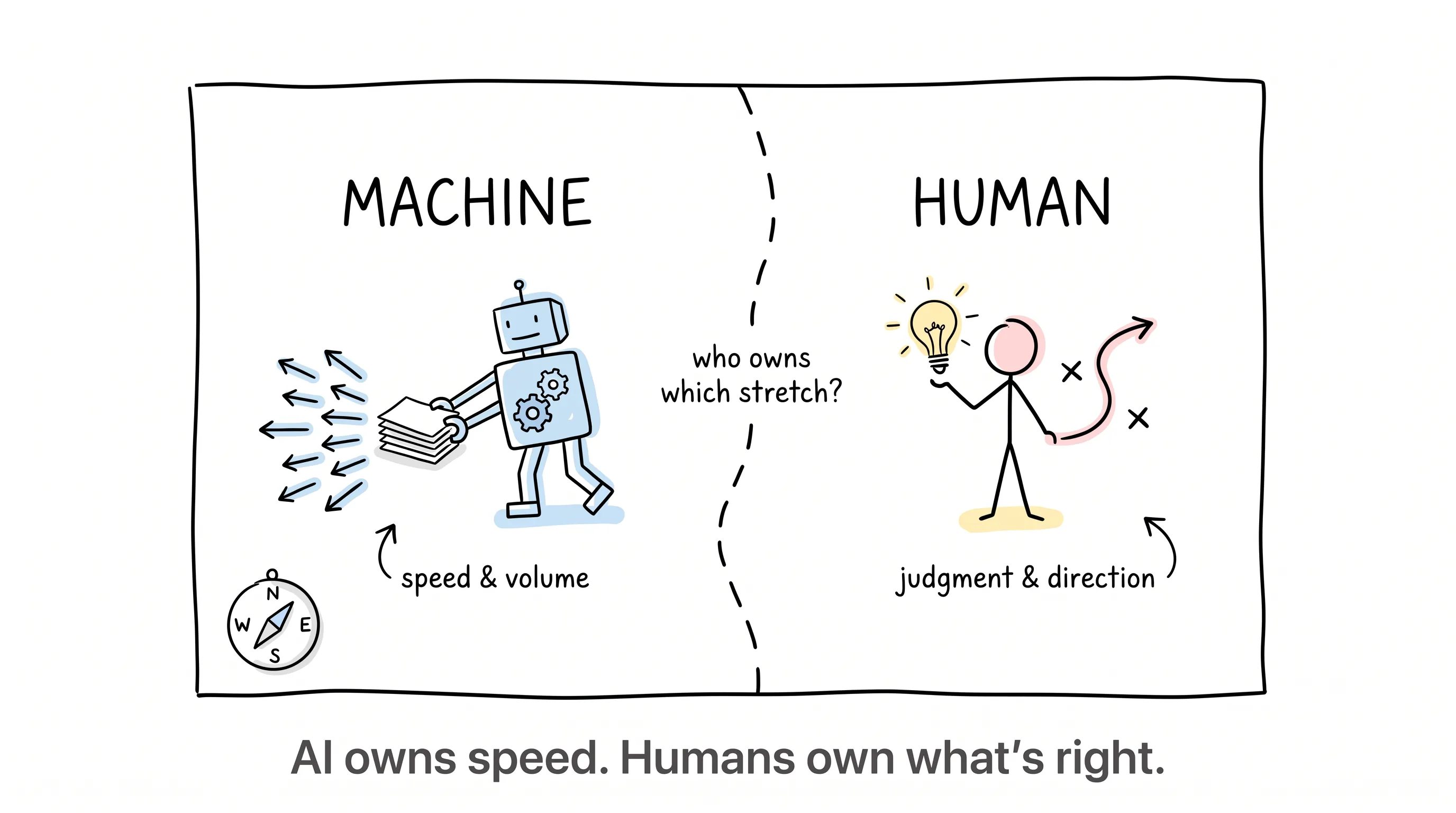
"You're not short of tools. What you're short of is a boundary map—who owns which stretch, human and machine, drawn clearly."
Tools are bought. Boundaries are drawn.
Oh, and this math pays for itself, too. McKinsey research says AI sales tools can lift leads by as much as 50% and cut costs by 60%. HBR's data says AI lead scoring raises the lead-to-close conversion rate by 51%. And the industry's going rate: a mid-market B2B SaaS spends $2 to earn every $1 of new annual revenue. Anything that improves that ratio is paying you back directly.
AI owns speed. Humans own what's right. Speed, a machine can give you. What's right, only you can grow.
Here's wishing you an early seat among the 41% who can do the math.
Continue reading
Related articles

Cross-Border Business: Time to Upgrade Your AI Toolbox
A learn article explaining how AI tools help cross-border e-commerce sellers clear five hurdles: language, regulation, logistics, payments, and fraud. It outlines a five-compartment toolbox, a five-step adoption path, and metrics such as conversion rate and CLV, while cautioning against over-reliance on AI.

AI Is Taking Over the Dirty Work of Social Media Marketing, One Task at a Time
This learn article outlines four social media marketing tasks AI can handle — audience analytics, content drafting and design, ad targeting and creative testing, and spam moderation — and cautions that taste, judgment, and data security remain human responsibilities.

AI Is Already This Good — Why Is Your Social Media Marketing Still Pure Manpower?
An overview of 18 AI tools for social media marketing, organized into six categories covering audience research, content creation, scheduling, comment and DM handling, ad management, and visual production, plus notes on personalization, prediction, and emerging trends.