
8 Agencies, 8 Ways to Survive
A learn article profiling 8 marketing agencies and their distinct paths of adopting AI, from embedding AI-native agents into client teams and shifting to consulting, to on-demand expert rental and AI-native delivery that rewrites cost structures, with one path focused on making brands the cited answer in AI search.
A while back, I had dinner with a few friends who work in marketing services.
A few drinks in, one of them — a guy who's been running an agency for over a decade — said something that stuck with me.
He said the question he dreads most from clients these days is: "You've adopted AI. Why hasn't your price come down?"
Have you noticed what makes that question sting? It's not the price.
It's that it exposes the underlying logic of the agency business.
What is an agency, really?
Plainly put: it sells the billable hours of professionals. The strategist's brain, the designer's hands — packaged up and billed by the person-day. The pricier the people, the more of them, the higher the revenue.
And now, AI has moved the "people" variable.
So the real divergence begins. Some companies treat AI as a new tool, bolt it onto the old process, and carry on business as usual. Others have started asking a different question: now that the tools have changed, shouldn't the organization itself be rebuilt too?
Recently I went through the agencies that are moving fastest, and picked out 8. Honestly, these 8 are almost 8 different ways of staying alive. Looked at together, you can watch the whole process of a business being torn apart and rebuilt.
One at a time.
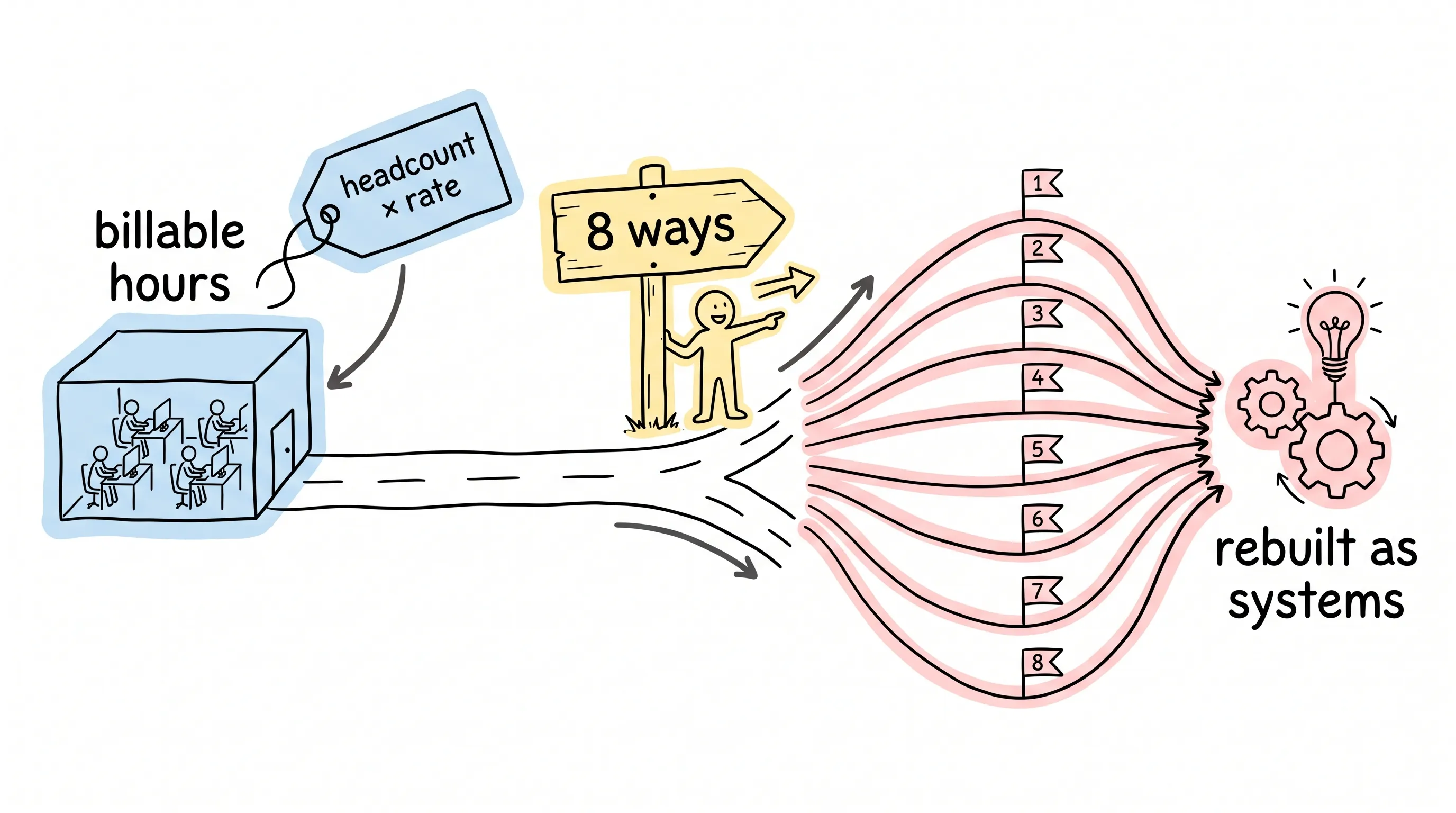
Way #1: Install the System Inside Your Team
First, Algomarketing.
This company's approach is interesting. They don't sell reports, and they don't deliver remotely. Instead, they embed their seasoned veterans directly into the client's team, and first hunker down to watch how the work actually gets done.
Once they understand it, what next?
Together with the client, they break that work apart and rebuild it as AI-native agents, letting the machines optimize and automate it.
What does AI-native mean? It means these agents are designed around AI's capabilities from day one. Welding an AI patch onto an old process afterward — that's not native.
Even better: once the tools are installed, they don't leave. They stay on as coaches, working alongside the client's team until the new machinery actually runs smoothly.
Diagnose first, then build together with the client, then stay to run alongside them. Think about it: this is no longer an agency in the traditional sense.
Way #2: From Doing the Work to Showing the Way
The second way is to move upstream, into consulting.
Demand Spring is a B2B revenue marketing consultancy. Their job is to line up three things — marketing strategy, technology, and execution — behind one plain goal: measurable growth.
ABM (account-based marketing), buyer journey optimization, SEO and AEO (answer engine optimization), marketing automation, MarTech implementation — they take on all of these specific campaigns.
But what they really want to solve is a very common awkwardness: plenty of companies have been at AI for a while now, yet they're still stuck at the "a few colleagues trying it out" stage.
How do you get from "trying" to "using"? Demand Spring's prescription is four things: set the strategy, automate the workflows, train the team, establish governance.
In one sentence: turn AI from one person's efficiency tool into the way the whole company works.
Seer Interactive is also on the consulting path, but with a different posture.
This company has been in digital marketing for over 20 years and has served a long roster of top brands. Their method is to operate on themselves first: they built their own AI lab, use their own business as the test field, and try and run every method there first.
Once the results are in, they package the validated lessons into custom AI consulting services and deliver them to clients.
First be the guinea pig, then be the teacher.
Looked at in reverse, the order holds too: if you don't dare use it or test it on yourself, what right do you have to sell it to clients?
Way #3: Stop Hiring Whole Functions — Rent On Demand
The third way is to redesign "outsourcing" itself.
EMMIE Collective provides on-demand marketing operations and revenue operations experts. In plain terms: instead of hiring a full-time operations executive, you rent one as needed. The person embeds directly into your team and works alongside your people.
Their range is wide, too: Marketo, HubSpot, Salesforce, Tableau — they can take on marketing automation work and data operations work alike. Whichever link is short-handed, they fill it.
Fjorge applies the same logic on the technical side.
This company is a digital development partner: building websites, custom web applications, mobile apps, e-commerce, plus long-term maintenance and support. Their way of surviving is distinctive: they live year-round behind the scenes of creative firms and marketing agencies, carrying the technical weight of complex digital ideas that would otherwise never get built.
Put these two side by side and you'll spot the common thread: the boundary of the company is getting thinner. Capability can be drawn on demand, like water and electricity — it doesn't all have to grow inside your own organization.
Way #4: AI-Native Delivery, Rewriting the Cost Structure
The fourth way is the most ruthless.
Rewrite the cost structure of delivery outright.
Intercept's service surface is broad: strategy, content creative, digital media, sales enablement, channel marketing — focused on enterprise technology clients, specializing in buying journeys with especially tangled decision chains.
Their differentiator is the delivery model: using their own set of AI tools and workflows to accelerate research, content production, personalization, campaign execution, and performance measurement across the board.
But — and notice this but — strategy and creative are still led by humans.
The machine's job is to make the work fast; the human's job is to decide what to do and why. They've even set up a dedicated lab where they experiment with new AI plays together with clients.
Level Agency's approach is a variation on the same theme. They serve brands with complex buying journeys and very high deal sizes. The traditional agency menu is all there: digital marketing strategy, media planning, SEO and AI search, content creation, CRM and automation, data science.
So where's the difference?
In how it's delivered.
What they've done is reorganize those scattered services into a reusable, AI-driven system, so that strategy, execution, and data connect into one piece across the entire customer journey.
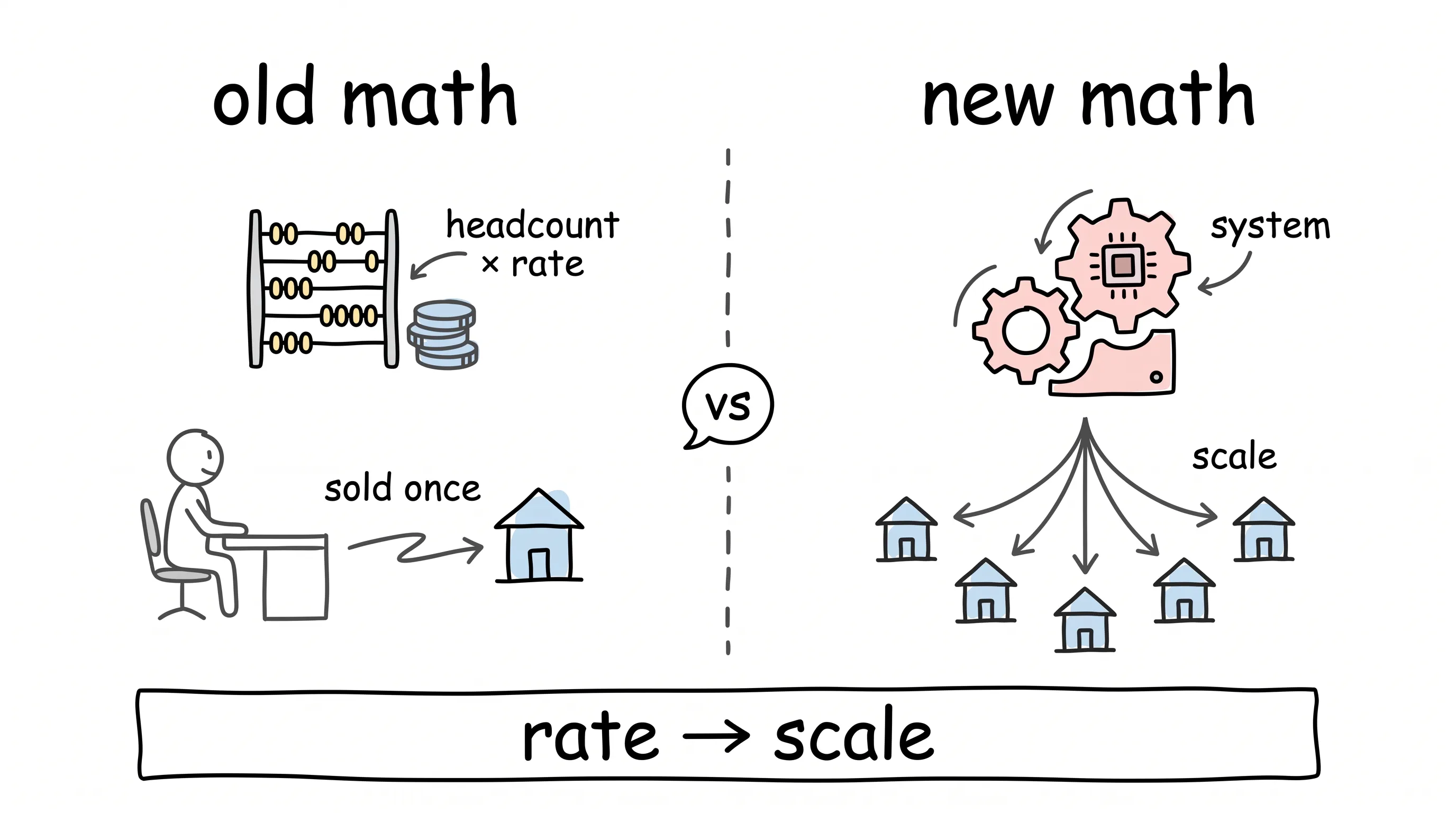
What does that mean? The same unit of expertise used to be sold once and billed once; now it's distilled into a system that can be invoked over and over.
A consultant's day used to be sellable to one client. Now, that day can be copied into many.
That is rewriting the cost structure.
Way #5: Snatch the Answer from AI's Mouth
The last way targets an entirely new battlefield: AI search.
Soarion Digital has placed its bet here. Their read is that the way people find information is changing. People used to ask the search box; now they're starting to ask AI directly.
So here's the question: when a user asks AI, does AI mention you?
Soarion's method combines AI technology with human expertise to optimize the client's website. First, re-lay the foundation for search; then build content around citability, so AI has something to cite; then go collect third-party endorsements to add credibility.
The cadence is equally practical: weekly updates, letting referral traffic from AI climb bit by bit.
Not sexy. But it works.
There's only one goal: when a user asks AI, your brand is the go-to answer.
Think about it: what every company used to fight for was ranking on the search results page. What's worth fighting for now is the sentence that comes out of AI's mouth.
This is a completely new front.
8 Companies, Doing the Same Thing
That's all 8. The approaches are wildly different — but zoom out a little, and they're all doing the same thing.
What thing?
Agencies used to price by "headcount × rate." People were the unit of measurement for the business.
And these 8 companies are all turning "people" into "systems." Some pack workflows into agents; some rewrite delivery as AI-native workflows; some distill experience into methodology and pair it with governance.
Once the unit of measurement changes, the entire arithmetic of the business changes.
Once expertise is distilled into a system, what compounds is no longer your rate — it's your scale.
Back to that dinner-table question: you've adopted AI, so why hasn't your price come down?
My sense is the question will soon be flipped around: you're still pricing by headcount — what makes you think you can?
This is just my read; it may well be wrong. But if you run an agency, or you're choosing one, this divergence deserves a close watch.
Here's to you being the first to finish the rebuild.
Continue reading
Related articles

Cross-Border Business: Time to Upgrade Your AI Toolbox
A learn article explaining how AI tools help cross-border e-commerce sellers clear five hurdles: language, regulation, logistics, payments, and fraud. It outlines a five-compartment toolbox, a five-step adoption path, and metrics such as conversion rate and CLV, while cautioning against over-reliance on AI.

AI Is Taking Over the Dirty Work of Social Media Marketing, One Task at a Time
This learn article outlines four social media marketing tasks AI can handle — audience analytics, content drafting and design, ad targeting and creative testing, and spam moderation — and cautions that taste, judgment, and data security remain human responsibilities.

AI Is Already This Good — Why Is Your Social Media Marketing Still Pure Manpower?
An overview of 18 AI tools for social media marketing, organized into six categories covering audience research, content creation, scheduling, comment and DM handling, ad management, and visual production, plus notes on personalization, prediction, and emerging trends.