
75% of Marketers Are Already Using AI — So Why Are 84% Still Running "Generic" Ads?
This learn article examines why high AI adoption in marketing has not translated into results, arguing that short feedback loops, governance, and recording performance baselines before deploying AI determine ROI. It cites industry reports and case examples such as JPMorgan Chase and Cosabella.
A while back, I had dinner with a friend who works in consumer goods.
He was excited. His company had gone all-in on AI: copywriting, image creation, ad buying — all of it. Everyone on the team had their own tool, and anyone who couldn't use one got teased.
I asked him: so how are the results?
He paused for a second, then said, well... it's fine, I guess? The ads nobody clicked still went unclicked, and conversions hadn't moved. Meanwhile the boss had started asking: all these subscription fees — are they actually worth it?
That dinner kept me thinking. Then, when I came across a few industry reports, I realized my friend is not an isolated case. He stands for a remarkably common pattern, one I'd describe as: adopted, but not used right.
A Set of Numbers That Don't Sit Well Together
First, some numbers.
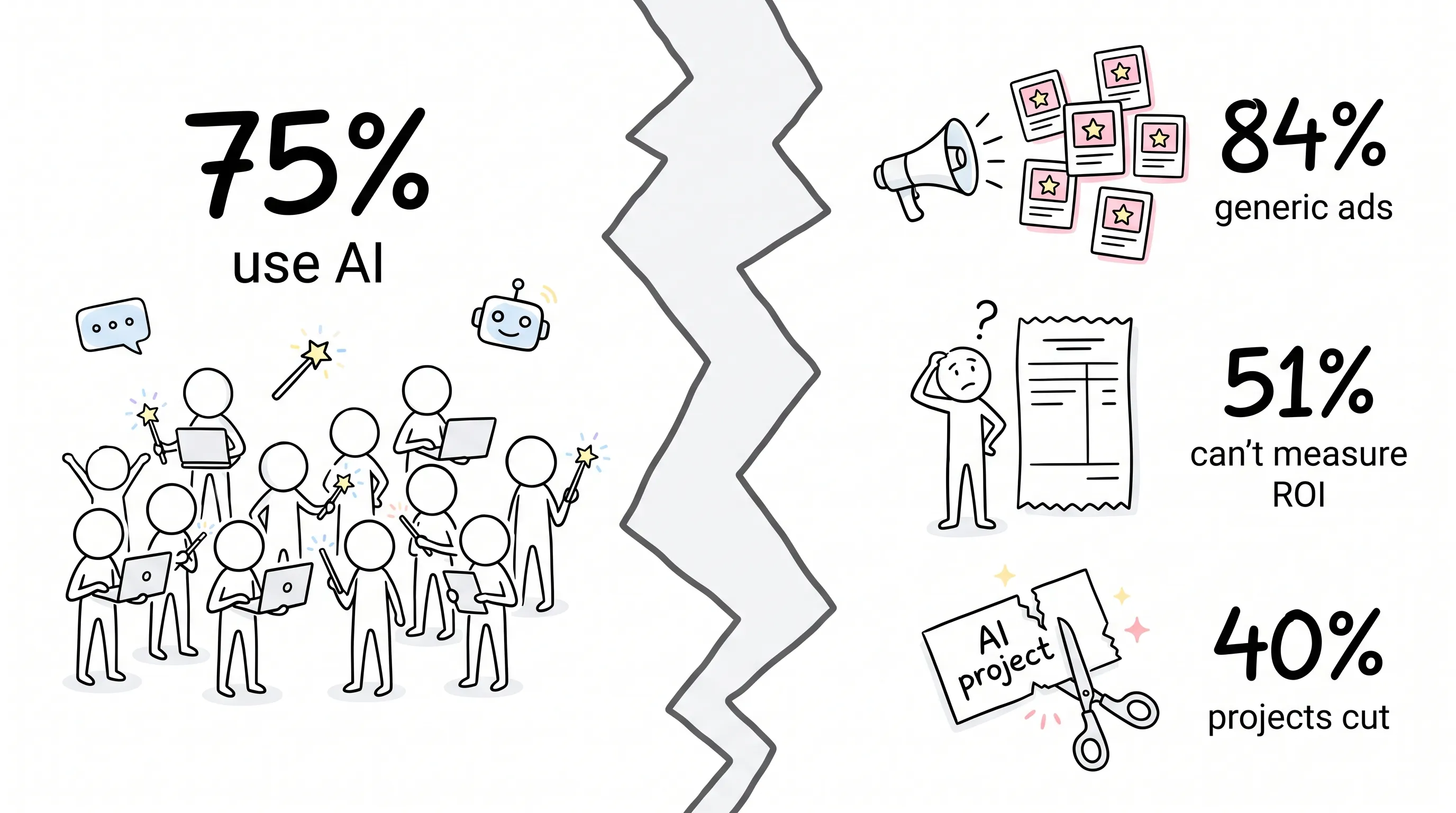
McKinsey's 2026 global AI survey says 75% of marketers already use AI in their workflows, and 91% say they use it every single day.
Looks like universal adoption, right?
But the same batch of reports holds several other numbers. Salesforce's State of Marketing, 2026 edition, found that 84% of marketing teams are still running cookie-cutter "generic" campaigns. Jasper's research cuts deeper: 51% of marketers simply cannot calculate whether the money they've poured into AI has paid for itself.
What does it mean that 51% can't calculate it?
It means half the industry is spending on faith. Tools switched on, processes unchanged, money gone, results untallied. The day the boss gets serious and demands an ROI report, the story stops holding up.
Gartner even predicts that by the end of 2027, more than 40% of agentic AI marketing projects will be cut. Not because the technology doesn't work — because the ROI can't be explained while the costs keep climbing.
Adoption and results are two different things. The gap between them is what's truly worth talking about today.
Two Stories About Actually Making Money
Where is the gap? Let me start with two positive examples.
The first story is about JPMorgan Chase.
The bank uses Persado's AI platform to optimize ad copy. Note this: it doesn't let the AI write freely — it generates variations inside a pre-approved messaging library, with humans keeping final watch. The result: click-through rate (CTR) up 450%.
450%. You read that right. One ad, same budget, same placements — the only change was that the copy had been optimized by AI, and nearly five times as many people clicked.
The second story is about a lingerie brand called Cosabella.
The brand handed its ad budget to an AI named Albert. The old way was media buyers deciding by gut feel: a bit more to Google? A bit more to Facebook? Now the AI watches all three platforms in real time and shifts the money wherever performance is strongest, on its own. The result: return on ad spend (ROAS) up 336%, paid-search revenue up 155%. And not one extra hire.
Pretty impressive. But put these two stories side by side and you'll notice something they have in common — and that something matters far more than AI itself.
Why Some Use Cases Make Money and Others Go Down the Drain
I went through the AI marketing use cases on record for 2026 and ranked them by real returns. Once the ranking was done, one pattern surfaced.
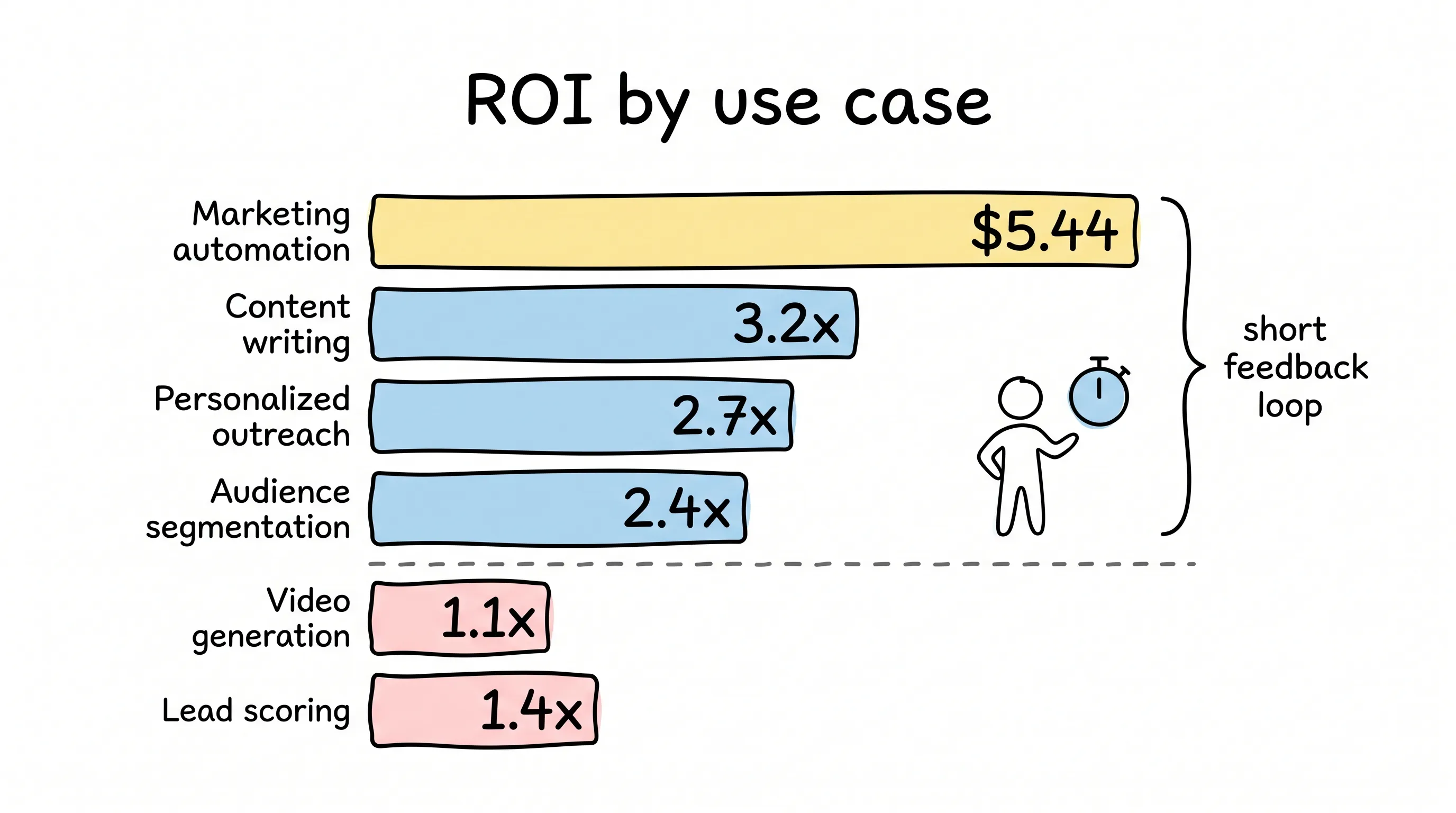
The highest-returning use cases: content writing, average ROI of 3.2x; personalized outreach, 2.7x (large enterprises reach 3.4x); audience segmentation, 2.4x. And then marketing automation, the most staggering of all: for every $1 invested, an average of $5.44 back over three years — and 76% of companies saw positive returns within a year.
And the ones at the bottom? Video generation, 1.1x; paid social creative, 1.2x; lead scoring, 1.4x.
Think about why.
Their models aren't all that different. The underlying technology is the same generation. The real difference is this: the use cases that make money have short, clear feedback loops.
What does a short feedback loop mean? It means what the marketer does today shows a result within days — good or bad, obvious at a glance. Finish the copy, and the CTR is sitting right there. Switch on automation, and the three-month return can actually be computed.
But video, lead scoring, and the like? The output itself is hard to judge, the data is dirty and slow, and by the time you can see clearly, the money is already spent. Leave a tool running with no one building the discipline to verify it, and it quietly burns cash.
Put plainly: what decides success or failure is rarely the model — it's whether you can find out fast whether the thing actually works.
And one more twist of the knife: even the biggest number, 5.44x, comes with a precondition — the process being automated has to be right in the first place. If the process is rotten, automation only helps you do the wrong thing faster.
Where the Other Half Loses
So you might ask: by that logic, can't you just set up the tools and watch the metrics?
Not that simple. There's another hurdle, called governance.
Deloitte's 2026 State of AI in the Enterprise says only one in five companies has built a mature governance framework for autonomous AI agents. Roughly half of the AI agents already deployed are scattered across silos, each fighting its own battle. And 86% of IT executives put it bluntly: unintegrated agents deliver more complexity than value.
Add the 51% of companies that can't even track ROI, and Gartner's "40% of projects cut" prediction makes sense. It's not that AI doesn't work — it's that most companies got on the bus first and went looking for the steering wheel afterward.
So if you ask me what order to adopt these use cases in, here's my take:
Teams just starting out, with shallow pockets, should begin with content writing and email optimization: high returns, mature tools, fast payoff. Those with a decent data foundation can move on to personalization and audience segmentation — bigger returns, but only if your customer data is actually connected, not a pile of fragments that don't match up. Marketing automation belongs in the same wave.
As for fully autonomous agent marketing — the Agentforce kind — in Salesforce's own service scenarios, 83% of customer conversations resolve without human involvement, so the ceiling really is high. But I'd put it last. Rushing into full autonomy before governance is built is how you turn a promising project, with your own hands, into a budget line that gets cut next year.
The Most Important Thing Isn't Picking Which Use Case
Finally, a habit that matters more than choosing a use case.
Look back at the cases that made money: JPMorgan's 450%, Cosabella's 336%, automation's 5.44x. Each one could be proven for a single reason: before AI touched the process, the team already knew what "normal" looked like.
With a baseline, you have comparison. With comparison, you can talk about returns.
And the 51% who can't work out their ROI almost all lost at the starting line: the tools were switched on first, and the baseline was never recorded. There's no ledger — how am I supposed to do the math?
Remember my friend from that dinner? Later I gave him one tip: don't rush into new tools. First, honestly record the CTR of every ad you run now and the conversion of every email you send, for one full month. Then — and only then — bring in the AI.
Three months later he told me he could finally explain the numbers to his boss.
Anyone can afford the tools. But measuring the baseline first, bringing in the tools second, and letting the numbers speak — that unglamorous grind is precisely what the 84%, buried inside the 75% adoption rate, have never done.
That's the whole difference.
Continue reading
Related articles

Cross-Border Business: Time to Upgrade Your AI Toolbox
A learn article explaining how AI tools help cross-border e-commerce sellers clear five hurdles: language, regulation, logistics, payments, and fraud. It outlines a five-compartment toolbox, a five-step adoption path, and metrics such as conversion rate and CLV, while cautioning against over-reliance on AI.

AI Is Taking Over the Dirty Work of Social Media Marketing, One Task at a Time
This learn article outlines four social media marketing tasks AI can handle — audience analytics, content drafting and design, ad targeting and creative testing, and spam moderation — and cautions that taste, judgment, and data security remain human responsibilities.

AI Is Already This Good — Why Is Your Social Media Marketing Still Pure Manpower?
An overview of 18 AI tools for social media marketing, organized into six categories covering audience research, content creation, scheduling, comment and DM handling, ad management, and visual production, plus notes on personalization, prediction, and emerging trends.